
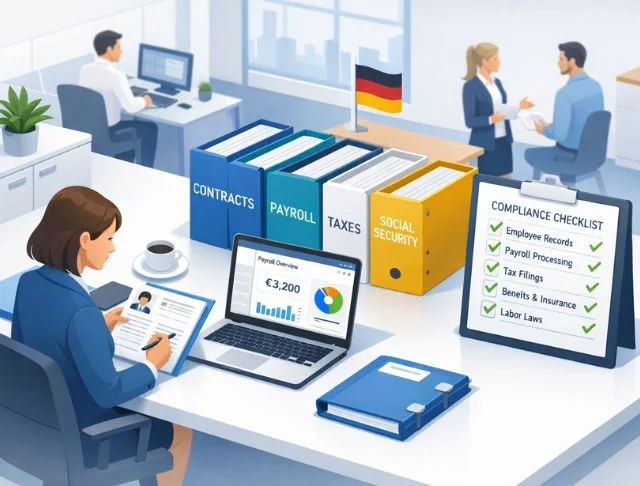
Today, you’re going to see 11 administrative burdens that an Employer of Record handles in Germany.
And these tasks not only consume employers’ time but can also lead to legal risks when employers handle them themselves.
In fact:
These tasks have helped us hire employees for our clients in 50 countries while fully complying with labor laws.
So, whether you want to hire in Germany or any other country, understanding from this post which administrative burdens an EOR takes over can help you scale your teams internationally hassle-free.

Author
Today, you’re going to see 11 administrative burdens that an Employer of Record handles in Germany.
And these tasks not only consume employers’ time but can also lead to legal risks when employers handle them themselves.
In fact:
These tasks have helped us hire employees for our clients in 50 countries while fully complying with labor laws.
So, whether you want to hire in Germany or any other country, understanding from this post which administrative burdens an EOR takes over can help you scale your teams internationally hassle-free.
Author
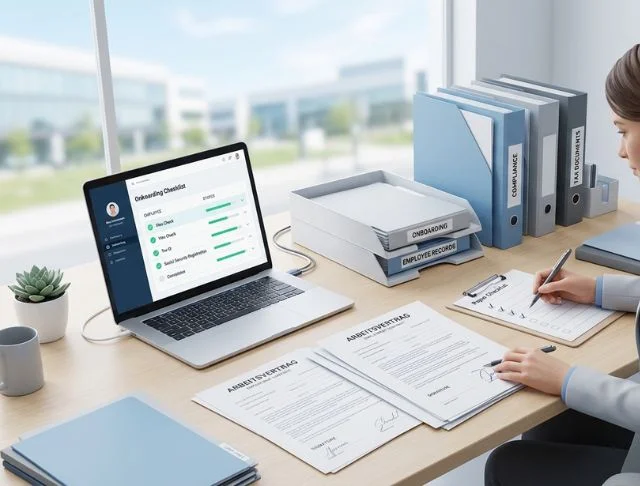
Employment paperwork is one of the most time-consuming administrative responsibilities when you want to hire in Germany. Employers have to prepare employment contracts according to German labor laws. They need to issue mandatory employment documents and keep records updated throughout the employment relationship.
Under Germany’s Nachweisgesetz (Act on the Proof of Employment Conditions), employers are legally required to provide employees with written documentation of key employment terms, including compensation, working hours, probation period, notice periods, and other statutory details.
Every contract must clearly define key terms such as salary, working hours, probation period, notice period, leave entitlement, and other conditions that German labor laws require. If an employee’s role, compensation, working hours, or other employment terms change, employers must also prepare and document contract amendments.
In addition, foreign companies have to collect, maintain, and store all required employment documents. These could include signed contracts, employee declarations, and other statutory records. An Employer of Record manages this entire documentation process by preparing employment documents, updating them, and maintaining the records in accordance with German legal requirements.

Employee onboarding in Germany involves more than welcoming a new hire. Employers must complete several administrative tasks before or right after the employee starts work. These tasks include collecting and verifying onboarding documents, verifying the employee’s identity and ensuring compliance with residence and work authorization requirements where applicable (e.g., for non-EU nationals), obtaining their tax identification number (Steuer-ID), and gathering information required for payroll and statutory registrations.
Employers also have to complete initial registration with the relevant authorities and social security institutions. This ensures that taxes and mandatory contributions can be processed correctly from the first payroll cycle.
An Employer of Record (EOR) streamlines the entire onboarding process. The professionals collect the required documents, verify employment eligibility, and complete mandatory registrations. They make sure all administrative requirements are fulfilled before the employee begins work.

Payroll administration is one of the most critical administrative responsibilities for employers in Germany. Every payroll cycle requires accurate calculations of gross and net salary, income tax, social security contributions, statutory deductions, and employer contributions in accordance with German regulations.
Employers must process payroll on time, issue salaries through the correct payment channels, and provide employees with detailed payslips. These payslips accurately reflect earnings, deductions, taxes, and benefits.
An Employer of Record (EOR) manages the entire payroll administration process. A typical payroll administration process includes calculating employee compensation, processing monthly payroll, issuing compliant payslips, and ensuring employees receive accurate and timely salary payments.

Tax administration is an ongoing responsibility for employers hiring in Germany. Businesses must correctly withhold income tax from employee salaries, calculate payroll-related tax obligations, and submit accurate tax reports to the appropriate authorities within the required deadlines.
In Germany, payroll tax data is processed via the ELStAM system (Elektronische LohnSteuerAbzugsMerkmale), which provides employers with employees’ tax class and withholding details electronically.
Foreign employers have to align these obligations with the employee’s tax class, tax identification number, and current tax regulations. They must also maintain accurate tax documentation to support reporting and regulatory inspections.
An Employer of Record (EOR) manages these tax administration tasks by calculating and withholding the correct amount of income tax, preparing payroll tax reports, and ensuring all tax obligations are fulfilled in accordance with German regulations.

Social security administration is a mandatory responsibility for every employer in Germany. Employers must complete social security registration at the start of employment in accordance with statutory reporting deadlines. You also need to confirm that employees are enrolled in the appropriate statutory insurance system.
Employers are responsible for calculating, withholding, and paying both employer and employee contributions for pension, health, unemployment, and long-term care insurance. Accident insurance contributions are fully employer-funded and administered separately via the relevant Berufsgenossenschaft.
In addition, you have to report the contribution data accurately and submit it to the relevant institutions within the statutory deadlines.
An Employer of Record (EOR) manages the entire social security administration process. The experts complete registrations, calculate contributions, make timely payments, and submit mandatory reports to the appropriate authorities.

Health insurance administration is an essential part of employing workers in Germany. Every employee must be covered by a statutory or eligible private health insurance plan. Employers need to collect the employee’s health insurance information, register the employee through the social security system with their chosen statutory health insurance provider, calculate and pay the employer’s share of contributions. They also have to withhold the employee’s share through payroll and ensure contribution payments are made on time.
You must also keep insurance records up to date and process administrative changes resulting from salary adjustments, changes in employment status, or an employee switching health insurance providers.
An Employer of Record (EOR) handles the entire health insurance administration process. It includes enrollment, contribution management, ongoing coordination with health insurance providers, and compliance with German statutory requirements.

Maintaining complete, accurate, and secure personnel files throughout the employment relationship is employee records management. These records consist of employment contracts, payroll information, tax and social security documents, leave records, performance-related documentation, and other mandatory employment records.
Employers must also process, store, and protect personal employee data in accordance with the General Data Protection Regulation (GDPR) and German data protection laws. It is the employer’s responsibility to ensure that access is restricted, data is used only for legitimate employment purposes, and privacy rights are respected.
In addition, you need to retain the employment documents for the legally required retention periods and make them available if authorities request them for audits, inspections, or legal proceedings.
An Employer of Record (EOR) manages personnel files, maintains GDPR-compliant employee records, and handles document retention requirements.

In Germany, employers are legally required to continue paying full salary for up to six weeks during an employee’s illness (Entgeltfortzahlung), after which statutory health insurance may take over sick pay.
Leave and absence administration is an ongoing responsibility for employers in Germany. Local labor laws require careful tracking to protect both parties. Employers must administer annual leave entitlements, monitor leave balances, approve and record vacation requests, and ensure employees receive the statutory minimum paid leave.
They also have to manage sick leave, including recording absences and processing medical certificates where required. They must ensure continued salary payments or statutory sick pay obligations are handled correctly.
In addition, employers must administer other legally protected types of leave, such as maternity leave, parental leave, caregiver leave, and other statutory absences. Incorrect leave administration results in payroll errors, employee disputes, and legal risks.
An Employer of Record takes over the entire leave administration. Their team tracks employee absences, maintains leave records, and ensures all statutory leave entitlements are monitored according to German labor laws.

Employers in Germany must complete various reporting obligations. These could include completing mandatory employment registrations before or at the start of employment, submitting payroll-related reports to the appropriate tax and social security authorities, and notifying government agencies when legally required.
Depending on the employment event, you may also need to report changes such as salary adjustments, employment status updates, or employee departures. Remember that these administrative requirements can become complex for foreign employers who are unfamiliar with Germany’s regulatory system.
An Employer of Record (EOR) manages employment reporting by completing mandatory registrations, submitting payroll reports, and handling required government notifications on behalf of the employer.

Offboarding is not a single task but a set of many administrative tasks that employers have to complete when an employee leaves the organization. Employers need to prepare termination-related documentation and make sure the employee’s departure complies with German employment laws. They must process the final payroll, including outstanding salary, accrued leave payments, bonuses, or other contractual entitlements where applicable.
Employers must also complete required deregistrations with social security and health insurance authorities and submit final payroll and tax data to the relevant tax authorities. Moreover, they must issue any legally required exit documents, such as employment certificates and final payroll records.
An Employer of Record (EOR) manages the entire offboarding process by preparing termination documentation, processing final payroll, handling mandatory deregistrations, and issuing required exit documents.

Government audits, labor inspections, or regulatory reviews demand accurate employment records in Germany. You need to keep organized records of employment contracts, payroll data, tax filings, social security contributions, working time records where applicable, leave records, and other legally required employment documents.
In simple terms, when authorities request information, employers must be able to produce complete and accurate documentation within the required timeframe.
An Employer of Record (EOR) supports employers by maintaining compliant employment records, organizing required documentation, and assisting with government audits and inspections. When

Managing administrative responsibilities in Germany isn’t easy for foreign employers. FMC Group simplifies the entire employment lifecycle by acting as your Employer of Record (EOR).
Our team handles employment contracts, employee onboarding, payroll administration, tax withholding, social security and health insurance administration, leave management, statutory reporting, employee recordkeeping, and compliant offboarding.
By outsourcing these administrative burdens to FMC Group, your business can reduce compliance risks, eliminate time-consuming HR administration, and focus on managing employee performance and business growth.
Without further hesitation, discuss your hiring needs with us by scheduling a free 30-minute consultation call.
You are currently viewing a placeholder content from Calendly. To access the actual content, click the button below. Please note that doing so will share data with third-party providers.
More InformationYou are currently viewing a placeholder content from Calendly. To access the actual content, click the button below. Please note that doing so will share data with third-party providers.
More InformationYou need to load content from reCAPTCHA to submit the form. Please note that doing so will share data with third-party providers.
More InformationYou are currently viewing a placeholder content from Turnstile. To access the actual content, click the button below. Please note that doing so will share data with third-party providers.
More InformationYou are currently viewing a placeholder content from Vimeo. To access the actual content, click the button below. Please note that doing so will share data with third-party providers.
More InformationYou need to load content from reCAPTCHA to submit the form. Please note that doing so will share data with third-party providers.
More InformationYou are currently viewing a placeholder content from reCAPTCHA. To access the actual content, click the button below. Please note that doing so will share data with third-party providers.
More Information

