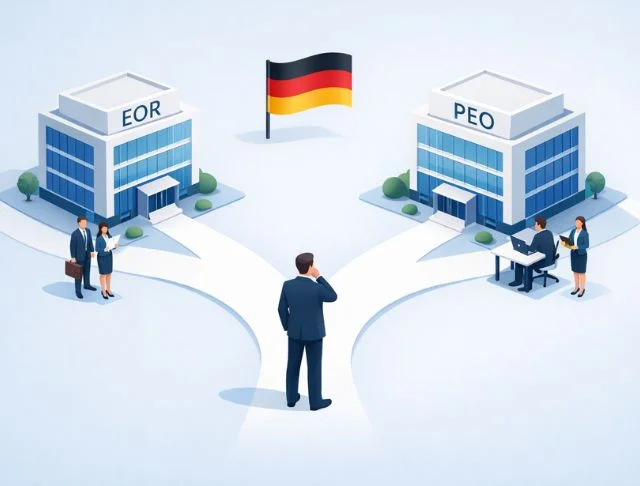
One of the first decisions that foreign employers face while hiring in Germany is selecting an Employer of Record (EOR) or Professional Employer Organization (PEO). Both models can make payroll, HR, and compliance hassle-free, but they are different.
One important fact that many guides miss is that Germany doesn’t have a traditional U.S.-style PEO market. In the United States, PEO companies work under a co-employment model. In Germany, the law places strict responsibilities on the legal employer.
This guide explains the TRUE differences between EOR and PEO models based on our experience as a German-owned business. Whether you’re hiring your first employee or building a long-term presence in Germany, you’ll have a clear framework for making an informed decision.

Author
One of the first decisions that foreign employers face while hiring in Germany is selecting an Employer of Record (EOR) or Professional Employer Organization (PEO). Both models can make payroll, HR, and compliance hassle-free, but they are different.
One important fact that many guides miss is that Germany doesn’t have a traditional U.S.-style PEO market. In the United States, PEO companies work under a co-employment model. In Germany, the law places strict responsibilities on the legal employer.
This guide explains the TRUE differences between EOR and PEO models based on our experience as a German-owned business. Whether you’re hiring your first employee or building a long-term presence in Germany, you’ll have a clear framework for making an informed decision.
Author
As you decide between an EOR or PEO, you should consider whether you have a legal entity and how quickly you need to hire. You can use the table below for a quick recommendation before diving into the detailed comparisons.
If you… | Best Option | Why |
Don’t have a German legal entity | Employer of Record (EOR) | An EOR becomes the legal employer, allowing you to hire without establishing a German company. |
Already own a German GmbH or branch | PEO / HR Outsourcing | You remain the legal employer while outsourcing payroll, HR administration, and compliance support. |
Need to hire one or a few employees quickly | Employer of Record (EOR) | Fast market entry without the time and cost of company incorporation. |
Plan to build a long-term operation in Germany | It depends | An EOR is ideal for initial hiring, while larger teams may justify establishing your own entity and using HR outsourcing services. |
Aren’t sure which model fits your business | Read the comparison below | The following sections compare legal responsibilities, costs, compliance, scalability, and ideal use cases to help you decide. |

Germany has one of the world’s most regulated employment systems. As a result, hiring in Germany is not just about signing contracts and paying salaries.
The core difference is that Germany places significant legal responsibilities on employers. That’s why the distinction between an EOR and a PEO matters more than in many other markets.
Germany Employment Requirement | Why It Matters |
Payroll tax | Employers must withhold wage tax, file payroll reports, and remit taxes |
Social insurance | Employers are responsible for calculating, collecting, and paying mandatory contributions. |
Employment contracts | Written contracts should comply with German labor law. |
Paid leave | Employees are entitled to statutory paid annual leave. |
Sick pay | Employers generally continue paying employees during qualifying periods of illness before statutory health insurance assumes responsibility where applicable. |
Collective agreements | Collective bargaining agreements may influence wages, working hours, benefits, and other employment conditions. |

Before comparing both options, it’s wise to understand the EOR and PEO hiring models and how they operate in Germany.
An Employer of Record (EOR) is a third-party organization that legally employs workers on behalf of another company. Your business directs the employee’s day-to-day work, while the EOR assumes the legal employer’s responsibilities.
Under German law, the EOR model is classified as Arbeitnehmerüberlassung (employee leasing) under the Arbeitnehmerüberlassungsgesetz (AÜG). This means a compliant EOR must hold a valid staff-leasing license issued by the Bundesagentur für Arbeit. Operating without this license is illegal and can result in fines of up to €500,000, and may cause German law to treat the client company as the direct employer regardless of intent. Since October 2025, updated federal guidance permits this model specifically when both the EOR and the employee are based outside Germany and the employee works remotely for a German-based hirer; if the employee performs physical work in Germany, the full licensing and time-limit rules of the AÜG apply.
Once you select a candidate, the EOR hires them under a compliant German employment contract. The EOR continues to handle employer obligations until the employment ends.
A Professional Employer Organization (PEO) provides HR, payroll, and employment administration services to companies that already have a legal presence in Germany.
The traditional U.S. PEO model relies on a co-employment relationship. This means both the client company and the PEO share employer responsibilities. Germany does not recognize this model in the same way. Instead, services marketed as “PEOs” in Germany are generally HR outsourcing or payroll administration services.

The biggest difference between the two is that an EOR becomes the legal employer, while a PEO supports companies that already employ staff through their own German entity.
Comparison Point | Employer of Record (EOR) | PEO / HR Outsourcing |
Need German entity | No. You can hire employees without establishing a German company. | Yes. Your business must already have a German GmbH, branch, or other legal entity. |
Legal employer | The EOR is the legal employer and assumes statutory employment responsibilities. | Your German entity remains the legal employer. |
Payroll | Fully managed by the EOR, including salary payments and payroll administration. | Payroll can be outsourced, but responsibility ultimately remains with your company. |
Tax filing | The EOR handles wage tax withholding, reporting, and remittance. | The PEO assists with payroll tax administration, while your entity remains legally responsible. |
Social security | The EOR registers employees and manages mandatory employer and employee contributions. | The PEO supports administration, but contributions are made under your company’s legal responsibility. |
Employment contracts | The EOR issues compliant German employment contracts as the legal employer. | Your company signs employment contracts with employees. |
Employee benefits | The EOR administers statutory benefits and any agreed contractual benefits. | The PEO helps administer benefits chosen by your company. |
Compliance liability | Most employment compliance obligations are handled by the EOR as the legal employer. | Your company retains primary liability for compliance with German employment laws. |
HR support | Includes onboarding, HR administration, employment documentation, and employee lifecycle support. | Focuses on payroll, HR administration, benefits management, and HR advisory services. |
Time to hire | Fast, often within days once a candidate is selected. | Slower if you first need to establish a German legal entity. |
Cost structure | Predictable monthly fee per employee with no entity setup costs. | Lower ongoing HR outsourcing costs, but you must fund entity formation, administration, and ongoing compliance. |
Best use case | Companies testing the German market, hiring remote employees, or expanding quickly without establishing a local entity. | Companies with an established German business that want to outsource HR and payroll while remaining the employer. |

Cost is often one of the biggest factors when choosing an expansion model. So, let’s see how it differs between the different hiring models:
Cost Item | Employer of Record (EOR) | PEO | Own German Entity |
German entity | ❌ Not required | ✅ Required | ✅ Required |
Company setup | €0–€1,000 onboarding | Small onboarding fee | €3,000–€8,000 setup costs, plus €25,000 minimum share capital* |
Payroll setup | ✅ Included | ✅ Included | Extra payroll setup required |
HR administration | ✅ Included | Shared responsibility | Managed in-house or outsourced |
Legal compliance | ✅ Included | Shared responsibility | Employer responsible |
Payroll & tax filing | ✅ Included | Supported | Managed internally |
Monthly service fee | €400–€800 per employee | €100–€250 per employee | No provider fee |
Best for | Fast market entry | Existing German entity | Long-term operations |
*Formation costs vary by entity type (UG vs. GmbH) and exclude share capital, which remains as company assets rather than a sunk cost. Minimum share capital is €25,000 (at least €12,500 paid in before registration)
Headline pricing rarely tells the full story. If you’re comparing an EOR, PEO, and your own German entity, don’t forget these additional costs.

The right hiring model depends on your expansion stage, hiring volume, and long-term plans. Use the table below to identify the best-suited option:
Your Situation | Best Option | Why |
Hiring your first employee | Employer of Record (EOR) | No German entity required; fastest way to hire. |
Hiring a remote sales representative | Employer of Record (EOR) | Hire compliantly without establishing a local company. |
Testing the German market | Employer of Record (EOR) | Minimize risk and upfront investment. |
Hiring around 5 employees | Employer of Record (EOR) | Simple, scalable, and lower administrative burden. |
Hiring 25+ employees | Own German entity | Better long-term cost efficiency and operational control. |
Opening a physical office | Own German entity | Supports permanent operations and business growth. |
Already own a German GmbH | PEO / HR Outsourcing | Keep legal employment while outsourcing HR and payroll. |

The key point to note is that most companies don’t need a German legal entity from day one. However, if they are using an EOR or PEO, they may eventually need to register a German entity and hire employees directly.
Business Stage | Recommended Model |
1 employee | Employer of Record (EOR) |
2–10 employees | Usually Employer of Record |
10–25 employees | Evaluate whether an entity makes financial and operational sense |
25+ employees | Consider establishing your own German entity |
Mature German business | Own German entity + HR outsourcing/PEO services |

There isn’t a single hiring model that’s best for every company. The right choice depends on several factors, including your expansion goals, hiring plans, and whether you already have a legal presence in Germany. Many companies start with an EOR for faster hiring and lower risk, then later establish their own German entity and hire employees directly without a third party.
Business Goal | Recommended Model |
Fast market entry | Employer of Record (EOR) |
Compliance-first hiring | Employer of Record (EOR) |
Established German subsidiary | PEO / HR Outsourcing |
Long-term operations | Own German entity |
FMC Group’s approach: Rather than recommending one model for every business, FMC Group offers a free 30-minute consultation. During the consultation, our experts take the time to understand your expansion goals and hiring plans, then recommend the hiring model that best suits your needs. This is because we are a people-first EOR service provider.
You are currently viewing a placeholder content from Calendly. To access the actual content, click the button below. Please note that doing so will share data with third-party providers.
More InformationYou are currently viewing a placeholder content from Calendly. To access the actual content, click the button below. Please note that doing so will share data with third-party providers.
More InformationYou need to load content from reCAPTCHA to submit the form. Please note that doing so will share data with third-party providers.
More InformationYou are currently viewing a placeholder content from Turnstile. To access the actual content, click the button below. Please note that doing so will share data with third-party providers.
More InformationYou are currently viewing a placeholder content from Vimeo. To access the actual content, click the button below. Please note that doing so will share data with third-party providers.
More InformationYou need to load content from reCAPTCHA to submit the form. Please note that doing so will share data with third-party providers.
More InformationYou are currently viewing a placeholder content from Elfsight. To access the actual content, click the button below. Please note that doing so will share data with third-party providers.
More InformationYou are currently viewing a placeholder content from reCAPTCHA. To access the actual content, click the button below. Please note that doing so will share data with third-party providers.
More Information