
In Germany, you can’t treat hiring as just an option to choose between an employee and an independent contractor. Hiring a contractor may seem like a faster and more affordable option, but the wrong choice can become an expensive mistake.
This is because German authorities closely examine the roles of workers. This is known under German law as Scheinselbstständigkeit (bogus self-employment), and it is assessed by the Deutsche Rentenversicherung (German Pension Insurance) or courts using a holistic evaluation of factors such as personal dependency and integration into the client’s work organization. If a contractor is later reclassified as an employee, your business could be liable for back payment of social security contributions (for up to four years, or 30 years if intent is found), wage tax, statutory benefits, and in serious cases, company directors may face criminal liability under German law.
In this guide, we’ll compare EOR vs. contractor hiring in Germany through real-world business scenarios. You’ll learn when hiring an independent contractor or using an EOR makes more sense. After reading this post, you’ll be able to choose the right model based on your hiring needs, budget, compliance obligations, and long-term business goals.

Author

In Germany, you can’t treat hiring as just an option to choose between an employee and an independent contractor. Hiring a contractor may seem like a faster and more affordable option, but the wrong choice can become an expensive mistake.
This is because German authorities closely examine the roles of workers. This is known under German law as Scheinselbstständigkeit (bogus self-employment), and it is assessed by the Deutsche Rentenversicherung (German Pension Insurance) or courts using a holistic evaluation of factors such as personal dependency and integration into the client’s work organization. If a contractor is later reclassified as an employee, your business could be liable for back payment of social security contributions (for up to four years, or 30 years if intent is found), wage tax, statutory benefits, and in serious cases, company directors may face criminal liability under German law.
In this guide, we’ll compare EOR vs. contractor hiring in Germany through real-world business scenarios. You’ll learn when hiring an independent contractor or using an EOR makes more sense. After reading this post, you’ll be able to choose the right model based on your hiring needs, budget, compliance obligations, and long-term business goals.
Author

Companies consider contractors first because of two main reasons. It usually involves less paperwork and lower upfront costs. Employers assume that they won’t need to manage payroll, withhold taxes, or pay social security contributions. This flexibility seems appealing for foreign companies, but it’s not.
However, simply calling someone a contractor doesn’t reduce the hiring burden. If the worker performs work like an employee, the government may reclassify the relationship regardless of the agreement you signed.
An EOR is the better option when you want your first hire to be a regular employee. For example, we recommend an EOR if the individual:
Hiring an independent contractor is an appropriate option when your business meets two conditions: the contractor operates an independent business and provides services on their own terms. This means this hiring model is suitable if the contractor:

Hiring an independent contractor is generally the better option when the work is project-based.
Common examples include hiring a freelance designer to create marketing materials, a consultant to improve business processes, or a software developer to build a specific feature with a defined delivery date.
Even for a short-term assignment, an Employer of Record may be the better choice. This is the case when the worker will perform duties similar to those of regular employees. For example, hiring someone full-time for a six-month project, requiring them to follow your working hours, attend internal meetings, and report to your managers may create an employment relationship rather than a genuine contractor engagement.
Before deciding between an EOR and a contractor for a short-term project, ask yourself the following questions:
Question | If Yes | Recommended Option |
Is the work project-based with a clearly defined scope? | Yes | Contractor |
Will the individual decide how and when to complete the work? | Yes | Contractor |
Will they work for multiple clients? | Yes | Contractor |
Will they follow your working hours and internal policies? | Yes | Employer of Record |
Will they report directly to your managers? | Yes | Employer of Record |
Will they become part of your day-to-day operations? | Yes | Employer of Record |

If you’re hiring a single remote professional for a freelance project, engaging an independent contractor is appropriate. Contractors manage their own taxes, social security, and business operations, so the hiring process becomes straightforward.
A time comes when you want to build a team of remote workers. In this situation, managing several independent contractors becomes more challenging. You need to be careful that no contractor is misclassified. In addition, coordinating contracts, invoicing, and compliance across multiple contractors can become increasingly complex.
Then, an Employer of Record offers a more scalable solution. You can have multiple employees under compliant employment contracts while outsourcing payroll, tax withholding, social security administration, statutory benefits, and HR operations. This way, you can focus on managing performance instead of administrative tasks.
Consideration | Employer of Record (EOR) | Independent Contractor |
Hiring one remote worker | Best for full-time, employee-like roles | Best for genuine freelance or project-based work |
Scaling your workforce | Easily supports hiring multiple employees | Administrative complexity increases as contractor numbers grow |
Payroll administration | Managed by the EOR | Contractors invoice your company directly |
Employment compliance | Managed by the EOR | Your company must ensure each contractor is genuinely independent |
Long-term team building | Well-suited for building a stable remote workforce | Better suited for temporary or specialized engagements |
As mentioned above, independent contractors can work well for project-based engagements or specialized services. However, if you want a contractor to be part of your core team, such as a manager, this choice becomes very difficult. Contractors may no longer be the right choice when you:
You can hire full-time employees even more quickly with an EOR. The EOR manages employment contracts, payroll, wage tax withholding, social security administration, statutory benefits, and ongoing employment compliance. An EOR is particularly valuable when you:
As your operations mature, establishing your own German entity becomes a more practical choice. This is the point when your company has validated the market and requires greater operational independence. Consider transitioning from an EOR to your own entity when you:
When you have a specific project with a defined scope and timeline, independent contractors are the right fit. Hiring a cybersecurity consultant to perform a security audit, a UX designer to redesign your website, or a legal consultant to provide regulatory advice are some examples.
If the specialist becomes an integral part of your business, hiring through an EOR is a safer option. This applies to roles such as software engineers, sales managers, marketing specialists, customer success professionals, or operations managers who contribute to your day-to-day business activities.
Hiring Scenario | Employer of Record (EOR) | Independent Contractor |
Hiring a full-time specialist | ✓ Fast onboarding with compliant employment | Not recommended if the role functions as regular employment |
Hiring a project-based expert | Suitable, but may be more than required | ✓ Typically the faster and more practical option |
Payroll and employment administration | Managed by the EOR | Not applicable; contractors invoice for their services |
Long-term workforce planning | ✓ Well suited | Limited suitability |
Compliance risk | Lower for employee-like roles | Higher if the contractor relationship resembles employment |
| Business Scenario | Recommended Hiring Model | Why? |
| You’re hiring your first employee in Germany | Employer of Record (EOR) | Provides compliant employment without requiring you to manage payroll, taxes, or employment administration. |
| You need someone for a short-term project | Independent Contractor (if the engagement is genuinely independent) | Offers flexibility and lower administrative overhead for project-based work with a defined scope. |
| You’re building a remote team in Germany | Employer of Record (EOR) | Makes it easier to hire, onboard, and manage multiple employees while ensuring ongoing compliance. |
| You want to avoid worker misclassification | Employer of Record (EOR) | Eliminates the risk of treating an employee as an independent contractor. |
| You’re planning long-term expansion in Germany | Employer of Record (EOR) (then transition to your own entity when appropriate) | Supports long-term hiring while allowing you to establish a German entity later if your operations grow. |
| You need specialized skills quickly | Depends on the role | Choose a contractor for genuine project-based expertise and an EOR for full-time specialists who will become part of your business. |
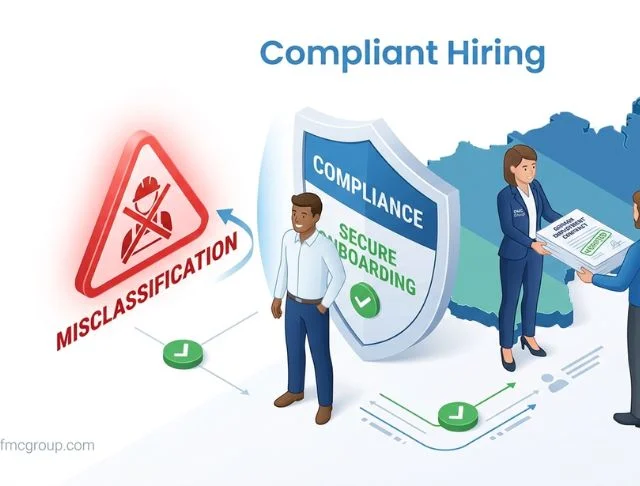
If a contractor performs the role of an employee, your business could face worker misclassification risks. FMC Group can eliminate these risks by hiring employees on your behalf in Germany. Instead of navigating complex German employment regulations yourself, you can onboard talent quickly and stay fully compliant.
When you partner with FMC Group, you can still manage your employees’ daily responsibilities, while we handle the legal employer obligations and the administrative workload. For more than 15 years, FMC Group has helped international businesses by managing:
Whether you’re hiring your first employee, building a remote team, or expanding your workforce in Germany, we can hire employees for you with confidence and without compliance risks. Book a free 30-minute consultation call to get your personalized hiring plan and strategy.
You are currently viewing a placeholder content from Calendly. To access the actual content, click the button below. Please note that doing so will share data with third-party providers.
More InformationYou are currently viewing a placeholder content from Calendly. To access the actual content, click the button below. Please note that doing so will share data with third-party providers.
More InformationYou need to load content from reCAPTCHA to submit the form. Please note that doing so will share data with third-party providers.
More InformationYou are currently viewing a placeholder content from Turnstile. To access the actual content, click the button below. Please note that doing so will share data with third-party providers.
More InformationYou are currently viewing a placeholder content from Vimeo. To access the actual content, click the button below. Please note that doing so will share data with third-party providers.
More InformationYou need to load content from reCAPTCHA to submit the form. Please note that doing so will share data with third-party providers.
More InformationYou are currently viewing a placeholder content from Elfsight. To access the actual content, click the button below. Please note that doing so will share data with third-party providers.
More InformationYou are currently viewing a placeholder content from reCAPTCHA. To access the actual content, click the button below. Please note that doing so will share data with third-party providers.
More Information

