Health insurance is one of the most important employer obligations due to its mandatory nature. Foreign employers not only need to understand its importance, but they also have to learn about contribution rates, payroll deductions, reporting, and more.
Germany regulates employee health insurance under the country’s social security framework. If employers make any mistakes in employee registration, contribution payments, or other compliance procedures, it can lead to serious legal issues.
This guide explains how health insurance in Germany works from an employer’s perspective. You are going to learn who must be insured, the difference between public and private health insurance, contribution requirements, employer responsibilities, and common mistakes employers make regarding health insurance. At the end of the post, you’ll also find alternative ways to save time, avoid errors, and hire people in Germany hassle-free.

Author
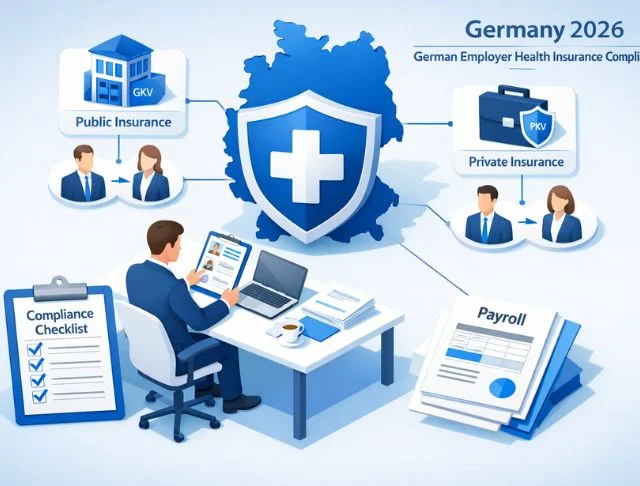
Health insurance is one of the most important employer obligations due to its mandatory nature. Foreign employers not only need to understand its importance, but they also have to learn about contribution rates, payroll deductions, reporting, and more.
Germany regulates employee health insurance under the country’s social security framework. If employers make any mistakes in employee registration, contribution payments, or other compliance procedures, it can lead to serious legal issues.
This guide explains how health insurance in Germany works from an employer’s perspective. You are going to learn who must be insured, the difference between public and private health insurance, contribution requirements, employer responsibilities, and common mistakes employers make regarding health insurance. At the end of the post, you’ll also find alternative ways to save time, avoid errors, and hire people in Germany hassle-free.
Author
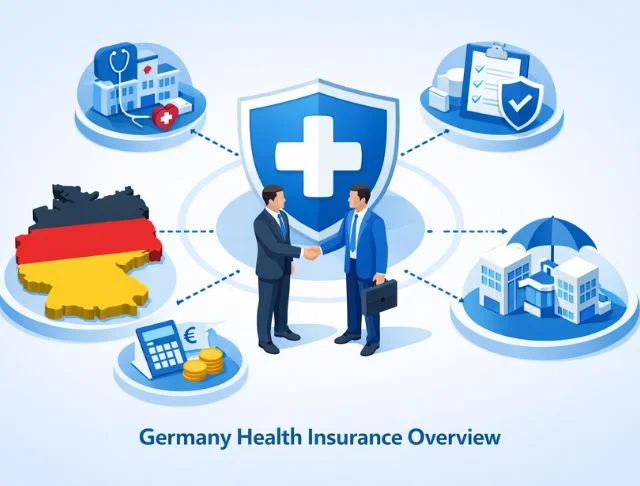
Yes, health insurance is 100% mandatory in Germany. Every employee must have health insurance coverage. Taking care of health insurance is one of your most important jobs as a foreign employer in Germany.
Almost everyone working in Germany needs health insurance. Here’s what you need to know about different types of employees:
In Germany, there are two main types of health insurance. Employees earning above the annual income threshold (Jahresarbeitsentgeltgrenze), €77,400 in 2026, may opt out of public insurance and choose private health insurance instead; those earning below it are generally required to stay in the statutory (public) system.

In 2026, let’s see how the German government has split the health insurance cost between foreign employers and employees:
Total Health Insurance Cost: 14.6% + Additional Contribution
What Is the “Additional Contribution”?
Each statutory health insurance fund sets its own additional contribution rate, which is reviewed regularly and may change over time. In 2026, individual fund rates range from about 2.18% to 4.4%, with the government-set average additional contribution at 2.9% (the actual member-weighted average is closer to 3.1%–3.4%).
There’s a maximum limit on how much salary you use to calculate health insurance. This is called the “contribution ceiling” or “Beitragsbemessungsgrenze.”
In 2026, the contribution ceiling is 69,750 euros per year, meaning 5,812.50 euros per month.. This is the maximum amount you can use for calculations. If your employee earns more than 5,812.50 euros per month, you still only pay health insurance calculated based on 5,812.50 euros.
The following calculations are for illustrative purposes only and assume hypothetical additional contribution rates. Actual contribution rates depend on the employee’s chosen statutory health insurance fund.
Let’s look at real examples to make this clear:
Employee earns 3,000 euros per month.
Additional contribution from the fund: 2.9% (so 1.45% each)
Your rate: 7.3% + 1.45% = 8.75%
Your monthly cost: 3,000 × 8.75% = 262.50 euros
Employee’s monthly cost: Also 262.50 euros;
Total: 525 euros per month
Employee earns 5,000 euros per month.
Additional contribution from the fund: 2.9% (so 1.45% each)
Your rate: 7.3% + 1.45% = 8.75%
Your monthly cost: 5,000 × 8.75% = 437.50 euros
Employee’s monthly cost: Also 437.50 euros
Total: 875 euros per month
Note that the 14.6% base rate is not the full cost. Each health insurance fund charges an extra amount.
Germany has many different public health insurance companies (called “Krankenkassen”). For example, AOK, TK (Techniker Krankenkasse), BARMER, HEK, and many more. There are more than 90 different funds in Germany. Your employee has the right to choose which fund they want to use.

As a foreign employer, you must register your employees immediately when they start working (from day one of work). Waiting until the end of the month is not allowed.
But how do you register employees?
Registrations are submitted electronically through the official German social security reporting system (DEÜV).
You need the following information from employees:
You must handle health insurance payments through your payroll. First, calculate the amounts, then deduct the contributions from employees’ salaries and pay the full amount each month (both shares and any additional contribution).
You must keep records and report information for legal inspections and compliance purposes.
Health insurance funds process contribution reports. Employer notifications to the German social security system must generally be submitted electronically using the prescribed reporting procedures.
Critical deadlines you (as a foreign employers) cannot miss:
Task | Deadline | What happens if you miss it |
Register new employee | Before or on first day of work | Fines up to 10,000 euros per employee |
Pay health insurance | The third-last banking day of the current month | Late payment fees (about 1% per month) |
Report employee leaving | Within 1 month after they stop | You might pay for coverage they don’t need |
Annual confirmation | By end of January each year | Missing annual report = fines |

An Employer of Record (EOR) acts as the legal employer of workers in Germany. At the same time, the foreign employer manages the employee’s daily responsibilities and performance. The EOR handles the following employee-related administration:
FMC Group provides Employer of Record services in Germany. As part of its EOR service, FMC Group manages:
With more than 15 years of international employment experience, FMC Group handles health insurance obligations accurately and on time.
Outsourcing payroll and social insurance administration through an EOR offers several advantages for foreign employers:
You are currently viewing a placeholder content from Calendly. To access the actual content, click the button below. Please note that doing so will share data with third-party providers.
More InformationYou are currently viewing a placeholder content from Calendly. To access the actual content, click the button below. Please note that doing so will share data with third-party providers.
More InformationYou need to load content from reCAPTCHA to submit the form. Please note that doing so will share data with third-party providers.
More InformationYou are currently viewing a placeholder content from Turnstile. To access the actual content, click the button below. Please note that doing so will share data with third-party providers.
More InformationYou are currently viewing a placeholder content from Vimeo. To access the actual content, click the button below. Please note that doing so will share data with third-party providers.
More InformationYou need to load content from reCAPTCHA to submit the form. Please note that doing so will share data with third-party providers.
More InformationYou are currently viewing a placeholder content from reCAPTCHA. To access the actual content, click the button below. Please note that doing so will share data with third-party providers.
More Information