In this post, I’m going to show you how you can get a work permit for your employees as a foreign employer in Germany.
In fact, this is the EXACT process we have been using at FMC Group for years to obtain work permits for our clients.
This post covers:
So, without further delay, let’s jump into this practical, no-fluff guide.

Author
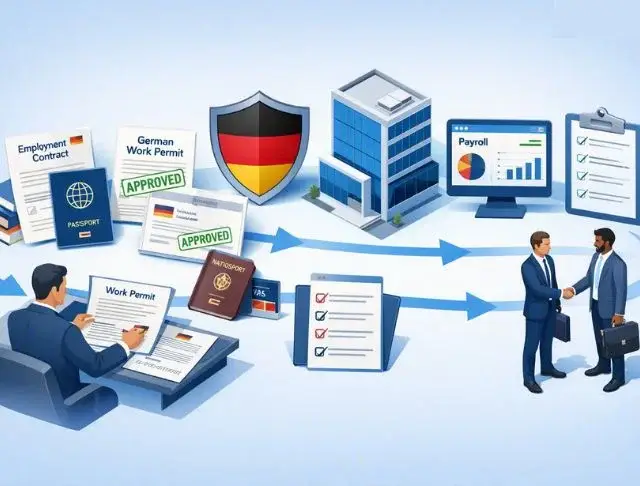
In this post, I’m going to show you how you can get a work permit for your employees as a foreign employer in Germany.
In fact, this is the EXACT process we have been using at FMC Group for years to obtain work permits for our clients.
This post covers:
So, without further delay, let’s jump into this practical, no-fluff guide.
Author

A German work permit is a legal authorization that allows non-EU nationals to live and work in Germany. Legal authorities issue it as part of a residence permit for employment. Foreign professionals can then work for a specific employer in accordance with German immigration and labor laws.
Employees have to obtain the appropriate work authorization before starting work. Work authorization depends on their qualifications, salary, occupation, and the type of job they will perform. Unlike other countries, such as the UK, Germany doesn’t require employers to have a sponsor licence before hiring foreign workers.

In Germany, EU, EEA, and Swiss citizens generally do not need a work permit. UK nationals may not need a work permit in some cases, but new UK arrivals fall under third-country rules and need a residence permit and work authorization. In general, non-EU nationals must have a work permit to work in Germany.
Permanent Residents: Permanent residence alone does not automatically exempt someone from Germany’s work authorization rules. Remember that many non-EU permanent residents still need the proper German residence permit to work.
Term | What it usually means | Where you apply | What it allows | When it is used |
Work Permit | Old/common shorthand for permission to work; in Germany, this is usually included in the residence title’s labor-market authorization. | Usually not a separate standalone application in the modern German system. | Employment rights are stated in the residence title or visa. | Used in everyday language, but not usually as a separate legal document. [ |
Work Visa | An entry visa for employment purposes, usually a national D visa. | German mission abroad before entry, in most cases. | Lets you enter Germany and work during its validity, and then convert to a residence permit if needed. | Best for getting into Germany for work from abroad. |
Residence Permit | The longer-term permit issued in Germany for staying and working beyond the initial visa period. | Local foreigners authority in Germany. | Authorizes longer-term residence and employment, depending on the title granted. | Used after arrival, or directly for some eligible nationalities. |

Yes, a foreign company can sponsor a German work permit. However, it is usually not “sponsorship” in the UK sense. For most employment cases, the company must have a German legal entity, a German branch, or a properly structured local employment arrangement.
For a standard German work permit, the authorities require a genuine employment relationship. A German company or German branch offers the job, signs the employment contract, and supports the immigration process. Simply put, a foreign company alone is not usually enough for standard hiring. Therefore, a foreign company can obtain work permits for its employees by registering an entity in Germany or using Employer of Record services.
German employers should understand that not every worker enters Germany through the same permit route. The table below explains which permit type is best for your situation:
Type | Best for | Main employer requirement | Key rule | Notes |
EU Blue Card | Highly qualified professionals, including eligible IT specialists. | Job offer or contract in Germany that matches the qualification. | Salary threshold applies; Germany’s 2026 thresholds are listed for Blue Card eligibility. | Often the fastest route for senior or well-paid talent. |
Skilled Worker Visa | Foreign workers with recognized vocational training or a recognized degree. | Job offer for qualified employment in Germany. | Qualification must fit the role. | Broad standard route for many hires. |
IT Specialist | IT professionals who may qualify under Blue Card rules even without a formal degree if they have the required experience. | Offer in IT/ICT field. | At least three years of relevant IT experience acquired in the last seven years. | Useful for experienced developers and tech talent. |
ICT Card | Intra-company transferees posted from a company or group outside Germany. | Foreign employers must transfer the employee to Germany. | Temporary assignment inside the same corporate group. | Not a standard local hire route. |
Opportunity Card | Job seekers who want to enter Germany to look for work. | No job offer needed at the start. | Used for job search, not immediate employment. | Employer involvement begins after the candidate finds a role. |
Research Visa | Researchers with a hosting agreement or research contract. | Hosting agreement or contract with a German research institution. | Designed for research and teaching activities. | Common for universities and R&D institutions. |
Employer-facing distinctions

Here’s a clean step-by-step employer process you can use for a work permit workflow.
Start by confirming whether your company can employ workers in Germany. To obtain a work permit, you must have a registered German legal entity. If you don’t have one, you can hire through an Employer of Record.
Select the most suitable immigration route based on the employee’s qualifications, job role, salary, and nationality. Choosing the correct permit early helps prevent unnecessary delays later in the process.
Check whether the employee’s academic or professional qualifications are recognized in Germany. Many occupations require recognized foreign qualifications, but some professions, such as healthcare, engineering, and law, require additional approval.
Gather all the documents required for the application. Both the employee and the employer have to prepare different documents.
Once eligibility, salary, and qualifications are confirmed, issue a compliant German employment contract. This is one of the key documents for the work permit application.
Depending on the employee’s nationality and route, the application is filed with the German mission abroad before entry or, for eligible nationalities, with the local foreigners authority after arrival.
Once approved, the employee receives the national visa or residence title needed to enter Germany and begin the employment setup.
Once the work permit and visa are approved, the employee can travel to Germany and begin completing the post-arrival formalities.
After arriving, the employee must register their residential address (Anmeldung), obtain their tax identification number, enroll in health insurance, receive a social security number, and apply for their electronic residence permit (eAT), where applicable.
The final step is registering the employee for payroll, tax withholding, and social security contributions. Once all legal registration is complete, you can pay the employee through a compliant German payroll system.
Document | Purpose |
Signed employment contract or binding job offer | Confirms the job terms, salary, and employment relationship. |
Detailed job description | Shows the role, duties, and whether the position meets permit requirements. |
Employer registration details | Identifies the hiring company and its legal entity in Germany. |
Company business registration extract | Proves the employer is legally established and active. |
Proof of salary and working conditions | Demonstrates that pay and conditions meet German requirements. |
Authorization letter, if applicable | Allows a representative to handle the application process. |
Workforce or position justification, if needed | Explains why the role must be filled by the foreign employee. |
Additional support letter for the employee | Helps support the visa or residence permit application. |
Document | Purpose |
Valid passport | Confirms identity and nationality. |
Completed visa or residence permit application form | Starts the application process with German authorities. |
Biometric passport photos | Required for the visa/residence permit file. |
Signed employment contract or binding job offer | Shows the job terms, salary, and duration of employment. |
Proof of qualifications | Demonstrates the employee is qualified for the role. |
Degree certificates and transcripts | Supports academic qualification claims. |
Qualification recognition or equivalence proof, if applicable | Confirms foreign qualifications are accepted in Germany. |
Curriculum vitae | Summarizes the employee’s education and work history. |
Motivation letter or cover letter, if requested | Explains the purpose of the move and role details. |
Proof of health insurance | Shows coverage for the period of stay, where required. |
Proof of language skills, if required | Supports eligibility for certain roles or permit types. |
Proof of financial means, if required | Shows the applicant can support themselves until employment starts. |
Pre-approval from the Federal Employment Agency, if applicable | Needed for some roles and permit routes. |
Stage | Typical Time |
Document preparation by employee and employer | 1–3 weeks |
Embassy or consulate appointment booking | Varies significantly by country and location |
Visa application processing after submission | About 1–3 months |
Additional review by the Foreigners’ Authority or labor office, if required | Can add extra time |
Travel to Germany and local registration | Usually a few days to 2 weeks after arrival |
Residence permit issuance in Germany, if separate from the entry visa | Often several weeks |
Cost item | Typical employer cost | Notes |
Visa fees | Usually €75 per adult applicant | The national visa fee is €75 for adults; children under 18 pay €37.50. |
Recognition | About €0–€400+ | Some qualification recognition checks are free, while a ZAB statement can cost about €208; regulated professions may need additional assessment fees. |
Translation | Roughly €20–€50 per page | Official translation costs vary by language, country, and translator. |
Payroll setup | About €300–€2,000 one-time, or bundled with a provider | Depends on whether payroll is handled in-house, by an accountant, or through software and external support. |
Employer social contributions | Often about 20%–24% of gross salary, plus accident insurance and levies | Core employer contributions include health, pension, unemployment, and long-term care; total cost varies by salary ceiling and insurance setup. |
Entity setup | Roughly €2,000–€10,000+ | Includes incorporation, notary, registration, tax setup, and legal/accounting support. |
EOR fees | Commonly a monthly per-employee fee | Pricing varies by provider and scope, but EOR is usually a recurring service fee on top of salary and statutory costs. |
Here are some common tasks that you, as a foreign employer, have to complete after work visa approval:
Reason | How to Avoid It |
Missing or incomplete documents | Submit a complete file with every required form, contract, and supporting document. |
Job offer does not match the permit type | Make sure the role, salary, and duties fit the exact visa or residence permit category. |
Salary below the required level | Check the current salary threshold before issuing the offer. |
Qualification not recognized in Germany | Start recognition early and confirm equivalence for regulated roles. |
Employment contract is unclear or inconsistent | Keep job title, salary, hours, and start date consistent across all documents. |
Employer has no valid local structure | Use a German entity, branch, or compliant EOR arrangement where required. |
Employer compliance issues | Ensure the company is up to date on taxes, social insurance, and labor-law obligations. [1] |
Illegal temporary placement or labor-leasing risk | Avoid structures that trigger unlawful agency work or restricted leasing rules. [1] |
Appointment or submission delays | Book embassy slots early and prepare the full application before the appointment. |
False or unverified information | Double-check all details and submit only accurate, traceable documents. |
Factor | Own German Entity | Employer of Record (EOR) | Independent Contractor |
Legal Employer | Your German entity | EOR provider | Self-employed individual |
Setup Time | 4–12 weeks (or longer) | 2–4 weeks | A few days |
Need a German Entity? | Yes | No | No |
Can Sponsor Work Permits? | Yes | Yes (through the EOR’s German entity) | No |
Payroll & Tax Compliance | Managed by your company | Managed by the EOR | Contractor handles their own taxes and social contributions |
Employment Law Compliance | Your responsibility | EOR’s responsibility | Limited, but misclassification rules apply |
Risk Level | Medium (requires ongoing compliance) | Low (provider manages compliance) | High if the contractor is later deemed an employee |
Best For | Long-term operations with multiple employees in Germany | Hiring quickly without establishing a German entity | Short-term, project-based, or genuinely independent work |
Typical Cost | High upfront investment plus ongoing administrative costs | Monthly service fee per employee | Contractor’s agreed fee (no employer payroll costs, but higher compliance risk) |
Scalability | Best for established and growing operations | Ideal for market entry and testing the German market | Not suitable for building a long-term workforce |

FMC Group provides Employer of Record services in 45 countries, including Germany. We handle the work permit process for your employees on your behalf and also manage payroll, social security, payroll taxes, and HR administration. The best part is that you don’t need a legal entity when working with us. To learn more about our services, book a free 30-minute consultation call and build a strong plan to scale your workforce in Germany.
You are currently viewing a placeholder content from Calendly. To access the actual content, click the button below. Please note that doing so will share data with third-party providers.
More InformationYou are currently viewing a placeholder content from Calendly. To access the actual content, click the button below. Please note that doing so will share data with third-party providers.
More InformationYou need to load content from reCAPTCHA to submit the form. Please note that doing so will share data with third-party providers.
More InformationYou are currently viewing a placeholder content from Turnstile. To access the actual content, click the button below. Please note that doing so will share data with third-party providers.
More InformationYou are currently viewing a placeholder content from Vimeo. To access the actual content, click the button below. Please note that doing so will share data with third-party providers.
More InformationYou need to load content from reCAPTCHA to submit the form. Please note that doing so will share data with third-party providers.
More InformationYou are currently viewing a placeholder content from reCAPTCHA. To access the actual content, click the button below. Please note that doing so will share data with third-party providers.
More Information