
Turkey hosts over one million expats today, but the real story sits behind the headline number. Migration into the country has risen fast since 2011, shaped by conflict, economics, and shifting visa rules.
Foreign residents grew from under 180,000 in 2005 to about 1.15 million by the end of 2025. Growth has not been smooth, with sharp drops during the pandemic and strong rebounds soon after.
This post breaks down who lives in Turkey, where they settle, and how policies shape expat life.

Author

Co-author

Turkey hosts over one million expats today, but the real story sits behind the headline number. Migration into the country has risen fast since 2011, shaped by conflict, economics, and shifting visa rules.
Foreign residents grew from under 180,000 in 2005 to about 1.15 million by the end of 2025. Growth has not been smooth, with sharp drops during the pandemic and strong rebounds soon after.
This post breaks down who lives in Turkey, where they settle, and how policies shape expat life.
Author
Co-author
Get in Touch with Us
Alp Atasoy
Sales and Business Development Consultant


Turkey hosted about 1.152 million foreign residents by the end of 2025. That figure marks a near sixfold jump since 2005, when the country counted fewer than 180,000 expats.
Year | Foreign Residents in Turkey |
2005 | 178,964 |
2011 | 234,268 |
2015 | 422,895 |
2018 | 856,470 |
2019 | 1,101,000 |
2020 | 886,653 |
2021 | 1,310,000 |
Numbers stayed flat through the 2000s. They then took off after 2011 as regional instability pushed migration into Turkey. The pandemic briefly reversed that trend before a sharp rebound.
Over the last ten years, Turkey’s expat population roughly doubled from about 430,000 to 1.15 million. That equals an average annual growth rate of around 7%, which is high for a non-EU destination.
This pace reflects Turkey’s role as both a regional safe haven and a flexible residence option.
Several clear moments reshaped Turkey’s foreign population. Each wave left a visible mark on the data.
Event | Impact |
Syrian war | Sharp inflow |
COVID-19 | Sudden drop |
Ukraine war | Short surge |
2023 outflow | Large exit |
The 2011 Syrian conflict drove the first major surge. Travel bans in 2020 caused the steepest decline. The Russia-Ukraine war pushed numbers higher in 2022, followed by heavy departures in 2023.
Sources: TurkishMinute, EduAid, Open4business

Recent years show how sensitive expat numbers are to global shocks. The swings since 2019 have been unusually large.
Between 2019 and 2025, Turkey saw both record losses and record rebounds.
Period | Change |
2019–20 | −19% |
2020–21 | +47% |
2021–22 | +2% |
2022–23 | −18% |
2023–24 | −4.5% |
2024–25 | +9% |
The sharp bounce in 2021 stands out. It shows how quickly foreign residents returned once borders reopened.
Each dip links directly to a global disruption. COVID-19 cut mobility almost overnight. The Ukraine conflict brought short-term inflows that later reversed as conditions changed.
Turkey’s residence-by-investment programs also played a role, especially during peak years like 2022.
Mid-2025 data showed around 1.084 million foreign residents. By year end, that number climbed to 1.152 million, signaling renewed momentum after two weaker years.

While totals change fast, the profile of expats in Turkey stays fairly stable.
Turkey’s foreign population remains mostly working age. OECD data points to strong youth and skilled migration, though Turkey does not publish detailed age splits over time.
Students and early-career workers make up a growing share.
Gender balance has barely moved year to year. In 2024, foreign residents were 51.7% female and 48.3% male, almost unchanged from 2023.
This balance suggests family and long-term settlement rather than short-term labor alone.
Now, let’s say you have decided to start a business in Turkey as a foreigner. Then let’s see how the real process looks, where to start, and what steps are involved.
Depending on your business needs, you will select the right type of legal business entity:
Liability varies depending on the chosen structure.
The company registration process includes notarizing the required documents. After that, you will obtain a tax ID. You then need to submit your business information to the Turkish Trade Registry, which is the official business record database in Turkey.
After registration, you must also register with the Chamber of Commerce. Depending on the nature of your business, you may also need to obtain specific licenses or permits.
When registering a business as a foreigner, you may need the following documents:
You only need a power of attorney if you want someone else to handle the entire process on your behalf.
To open a business bank account in Turkey, the following steps and requirements usually apply:
If you want to hire employees in Turkey, you need to register with the Social Security Institution (SGK). You must prepare employment contracts and agreements in compliance with local labor laws.
It is also essential to follow social security and employment regulations. In special cases, you may also need to obtain a work permit.
OR
You can partner with an Employer of Record (EOR). In this case, there is no need to register a company or manage the steps mentioned above, as the EOR handles employment, compliance, and payroll on your behalf.
Expats cluster heavily in a few provinces. Istanbul leads by a wide margin, followed by coastal hubs.
Istanbul remains Turkey’s main magnet for foreign residents.
Metric | Value |
Expats | 579,932 |
City share | ~3.5% |
By end-2025, Istanbul hosted nearly 580,000 expats. Growth stayed steady before 2020, dipped during the pandemic, then picked up again.
The capital attracts a smaller and more specialized expat base.
Metric | Value |
Expats | 73,263 |
City share | ~1.2% |
Most foreign residents here work in diplomacy, education, or corporate roles. Growth has been slow but consistent.
İzmir plays a minor role in Turkey’s expat landscape.
Metric | Value |
Expats | 25,576 |
City share | ~0.6% |
European retirees and long-stay visitors live here, but total numbers stay modest.
Coastal lifestyle draws many foreign residents, especially retirees.
Area | Expats |
Antalya | 117,052 |
Muğla | 20,453 |
Antalya once peaked near 160,000 expats around 2021. Numbers eased after 2023 as Russians and Europeans moved out.
Several secondary cities show steady foreign presence.
Province | Expats |
Bursa | 51,537 |
Mersin | 43,944 |
These hubs grow through industry, trade, and proximity to major cities. Smaller eastern provinces host only a few dozen foreigners at most.
Sources: CottGroup, DailySabah
Turkey’s expat story goes beyond totals. Nationalities, visa types, and work patterns reveal who actually moves in and why. These details help journalists frame Turkey’s role in global migration.
A small group of countries accounts for a large share of expats. Central Asia, the Middle East, and nearby regions dominate.
Country | Expats in Turkey (2023) |
Turkmenistan | 109,390 |
Russia | 100,847 |
Iraq | 91,117 |
Syria | 79,779 |
Iran | 79,505 |
Azerbaijan | 67,621 |
These six nationalities make up roughly half of all foreign residents. Other notable groups include Uzbeks, Kazakhs, Afghans, and Ukrainians, each in the tens of thousands.
Country | Total Expats | % of Population |
Turkey (2025) | 1,151,969 | 1.3% (of 85.66M) |
UAE (2024) | ≈10,050,000 | 88.5% (of 11.35M) |
Germany (2024) | 14,061,640 | 16.8% (of 83.58M) |
Spain (2024) | 6,502,282 | 13.4% (of 48.62M |
Recent growth came mainly from Central Asian nationals, driven by student and business visas. African communities also expanded, though they remain outside the top ten. EU nationals such as Germans and Britons stay smaller and skew toward long stays or retirement.
Not all expats come to Turkey for jobs. Permit data shows a mixed picture.
Residence Permit Type | 2023 (No.) | 2025 (No.) |
Short-Term (work etc) | 638,764 | 426,926 |
Student | 161,426 | 220,434 |
Family | 117,579 | 168,455 |
Other | 189,263 | 336,154 |
In 2023, around 58% of foreigners held short-term permits, which often link to work. Family permits accounted for about 11%, reflecting dependents and long-term households.
Turkey hosts a large student base. About 161,000 foreign students held permits in 2023. By 2025, that number rose to 220,000, signaling strong growth in education-driven migration.
Turkey does not publish a separate retiree category. Most retired expats hold short-term or family permits, especially in coastal regions.
Permit trends highlight how expat profiles shift year to year.
Short-term permits remain the largest group. In 2025, they totaled 426,926, down from earlier peaks as some workers exited after 2022.
Long-term residency exists but stays limited. Official sources do not release clear totals, which suggests a small share compared to short-term stays.
Citizenship by investment continues, though Turkey does not publish annual naturalization figures. The real estate threshold rose to $600,000 in 2024, which likely slowed uptake.
Short-term permits still dominate overall residency. Combined with students and family permits, they shape most of Turkey’s foreign population.
Permit Type | 2025 |
Short-term | 427k |
Student | 220k |
Family | 168k |
Other | 336k |
Sources: DuvarEnglish, Numbeo
Looking abroad puts Turkey’s numbers into context.
Turkey hosts many foreigners in absolute terms, yet its expat share stays low.
Metric | Turkey | UAE |
Expats | 1.15M | 10.05M |
Population share | 1.3% | 88.5% |
The UAE remains one of the most expat-heavy countries on earth. Turkey looks modest by comparison.
Metric | Turkey | Germany |
Expats | 1.15M | 14.06M |
Per 1,000 | 13 | 168 |
Germany hosts far more foreigners both in total and per capita. The makeup also differs, with Europe dominating Germany’s inflows.
Metric | Turkey | Spain |
Expats | 1.15M | 6.50M |
Population share | 1.3% | 13.4% |
Spain attracts climate-driven retirees and workers at a much higher scale, despite a smaller population.
Foreigners still form a small minority inside Turkey.
In 2005, expats made up just 0.26% of Turkey’s population. By 2024, that share rose to about 1.34%, a fivefold increase.
The jump signals growing internationalization. Even so, Turkey remains far below Western destination countries where expats often exceed 10%.
City-level data shows the same pattern.
City | Expat Share |
Istanbul | ~3.5% |
Dubai | ~88% |
Istanbul leads Turkey but trails global expat hubs by a wide margin.
City | Expat Share |
Ankara | ~1.2% |
Berlin | ~22.5% |
Berlin hosts nearly one in four residents as foreigners. Ankara stays far lower.
City | Expat Share |
Izmir | ~0.6% |
Barcelona | ~25.4% |
Turkey’s expat population skews young and economically active. Age, education, and lifestyle data help explain how foreigners fit into the wider economy and daily life.
Most expats arrive during prime working years. This pattern stays consistent across recent data.
In 2022, the largest share of new immigrants fell into the 25–29 age group. Ages 20–24 and 30–34 followed closely. The standing expat population also clusters in the 20s and 30s.
Age group | Share |
20–24 | 11.7% |
25–29 | 12.2% |
30–34 | 11.3% |
This age mix points to work and study as key drivers.
Gender balance remains fairly even. In 2022, 52.9% of immigrants were male and 47.1% female. Overall foreign residents show a similar split, close to Turkey’s national ratio.
Education profiles have shifted as migration sources changed.
The share of foreign workers with college degrees dropped sharply over time. In 2011, about 46% held degrees. By 2023, that figure fell to around 18%.
This shift reflects growth in labor-intensive migration rather than high-skill inflows.
Turkey does not publish detailed fields of study. Still, foreign student numbers keep rising. By 2025, roughly 188,000 international students studied at Turkish universities, pointing to stronger education ties.
Daily life factors shape how attractive Turkey feels to foreign residents.
Costs rose fast in recent years, especially in major cities.
Istanbul rent inflation surged in 2023. Mercer reported a 301% year-on-year rise, the highest globally. Ankara followed with 141% growth. Over half of expats rate housing affordability poorly.
Utilities and fuel costs climbed as well. Basic utilities average around 3,046 TL per month for a small apartment. Food and transport prices jumped sharply during 2023 and 2024.
Despite this, some indices still rank Istanbul cheaper than many Western capitals, excluding rent.
Quality of life results show sharp contrasts.
Safety stands out as a concern. In 2023, Istanbul ranked last among 49 cities for safety in an expat survey. Only 60% of expats said they felt satisfied with life in the city.
Political expression also worries many. About 37% of expats felt unable to express opinions freely.
Turkey offers broad healthcare access through public and private systems. Expats rate medical quality moderately well, placing Turkey around the mid-30s globally.
Cost remains a pain point. Only about 51% of expats find healthcare affordable. Public hospitals can also face long waits.
Major cities host many international schools. Istanbul and Ankara offer American, British, and French curricula. Annual tuition often ranges from $9,450 to $27,525.
Higher education also draws foreigners. As of early 2025, nearly 188,000 foreign students held active permits, reinforcing Turkey’s role as a regional education hub.
Legal access shapes how many expats stay in Turkey and for how long. Permit data shows sharp swings tied to policy shifts and economic pressure.
Turkey expanded permits quickly after 2020, then pulled back.
In 2023, Turkey issued 239,835 work permits. Syrians received the largest share, followed by Russians and Turkmens. In 2024, approvals rose to 300,852, with over one third again going to Syrians.
Year | Work permits |
2023 | 239,835 |
2024 | 300,852 |
Seasonal permits also played a role. In 2024, agriculture and livestock work accounted for 120,284 permits, mostly for Syrians.
The stock of foreign residents peaked in 2022 at about 1.354 million. In 2023, around 250,000 permit holders left, cutting totals to roughly 1.107 million. By April 2025, the count stood near 1.084 million.
Permit type | Apr 2025 |
Short-term | 481k |
Student | 188k |
Family | 151k |
Other | 264k |
In 2024 alone, Turkey issued over 1.05 million new residence permits, showing high turnover despite a stable total.
Turkey’s citizenship routes attract interest, though transparency remains limited.
Turkey does not publish yearly passport totals. Officials reported about 40,000 applications by 2024, linked to roughly $15 billion in investment. The real estate threshold rose to $400,000 in 2022.
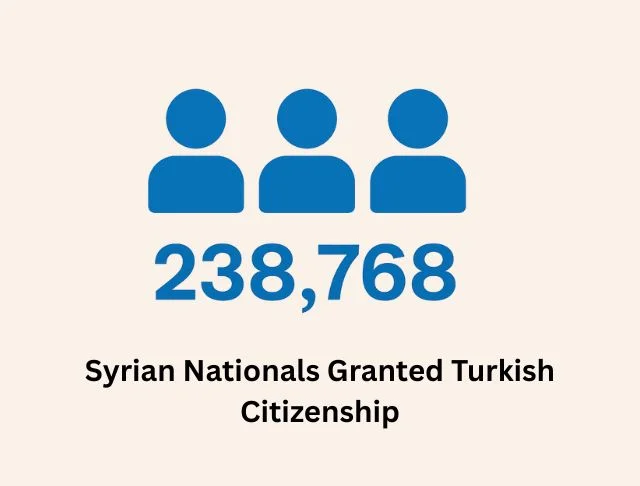
Separately, Turkey granted citizenship to about 238,768 Syrians by mid-2024 under humanitarian and special pathways.
Investment-based citizenship grew quickly before tightening rules. Long-term residence permits exist after eight years, but uptake stays modest compared to short-term stays.
No official forecasts target expats alone. Recent trends still point to likely scenarios.
Turkey’s foreign population stabilized near 1.0–1.2 million after peaking in 2022.
Scenario | Outlook |
Optimistic | Moderate rise |
Baseline | Flat levels |
Conservative | Gradual drop |
An economic rebound and eased restrictions could lift numbers. Ongoing inflation and tighter controls could push them lower.
Recent policies show a cautious stance. In July 2023, Turkey paused new residence permits in Istanbul except for compulsory cases. This move, paired with rising costs, drove large departures that year.
Labor needs still exist. Sectors such as technology, healthcare, and tourism face shortages. Demographic aging adds pressure, though policy direction will decide whether Turkey opens doors wider again.
Sources: EduAid, MuseumPass
Turkey hosts over one million expats, yet foreigners remain a small share of the population. Growth surged after 2011, peaked in 2022, then stabilized as policies tightened and costs climbed.
Turkey matters as a regional hub, not a global expat magnet. Future numbers will hinge less on geography and more on law, economics, and how open the country chooses to be.
You are currently viewing a placeholder content from Calendly. To access the actual content, click the button below. Please note that doing so will share data with third-party providers.
More InformationYou are currently viewing a placeholder content from Calendly. To access the actual content, click the button below. Please note that doing so will share data with third-party providers.
More InformationYou need to load content from reCAPTCHA to submit the form. Please note that doing so will share data with third-party providers.
More InformationYou are currently viewing a placeholder content from Turnstile. To access the actual content, click the button below. Please note that doing so will share data with third-party providers.
More InformationYou are currently viewing a placeholder content from Vimeo. To access the actual content, click the button below. Please note that doing so will share data with third-party providers.
More InformationYou need to load content from reCAPTCHA to submit the form. Please note that doing so will share data with third-party providers.
More Information