Understanding the legal requirements for hiring for foreign businesses is equally important as understanding labor laws in Germany.
One of the main purposes of international hiring is efficient budget usage, but due to non-compliance issues, it can lead to heavy fines. The core reason for such penalties is a lack of deep understanding of legal requirements.
If you want to hire employees in Germany, this post is a goldmine for you. It covers all the necessary requirements for hiring employees in Germany.
Author
Understanding the legal requirements for hiring for foreign businesses is equally important as understanding labor laws in Germany.
One of the main purposes of international hiring is efficient budget usage, but due to non-compliance issues, it can lead to heavy fines. The core reason for such penalties is a lack of deep understanding of legal requirements.
If you want to hire employees in Germany, this post is a goldmine for you. It covers all the necessary requirements for hiring employees in Germany.
Author
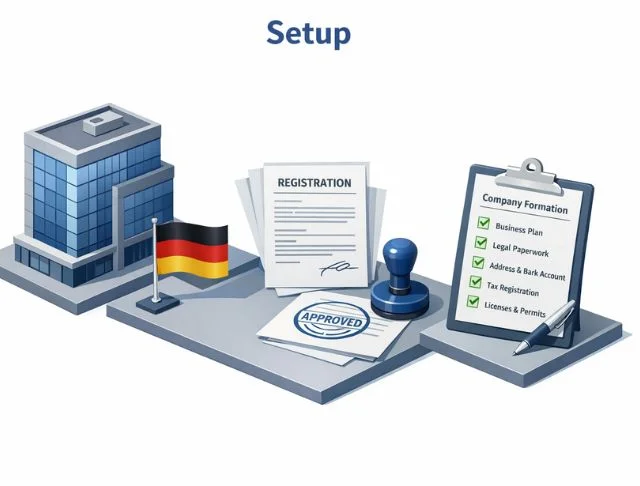
A legal entity is not strictly mandatory to hire employees in Germany. However, a GmbH (limited liability company) is the most common option to register the business. Branch offices and subsidiaries are alternatives when your expansion goals are larger.
Registration in the Commercial Register is mandatory for certain legal forms, such as a GmbH, UG, AG, and autonomous branch offices of foreign companies. Other business forms may only need trade office registration.
Companies must register their business activity with the local trade office before starting operations.
After registration, businesses receive a tax number. This number is essential for corporate tax, VAT, and payroll compliance.
Companies must formally register with the tax office to activate tax obligations. These obligations include VAT filings and employer-related taxes.
Employers must register with the tax office and social security authorities. Then, they can obtain an employer number and enable payroll processing.
Employment contracts can generally be concluded in text form, but employers must provide the essential terms of employment in writing or text form as required under the current rules. Fixed-term contracts still require written form.
Companies must correctly classify workers. Misclassification can lead to fines, back payments, and legal liabilities.
Employers must verify the employee’s right to work in Germany. They also need to maintain valid identification, tax ID, and Social Security details.
In many cases, as a foreign employer, you must follow industry-specific collective agreements that set minimum wages, working conditions, and benefits.
Employers must deduct income tax (wage tax) from employee salaries and remit it to the tax authorities.
For foreign employers with a permanent establishment in Germany, wage tax (Lohnsteuer) must be withheld from employee salaries and remitted to the tax authorities.
Foreign employers without a German permanent establishment are usually not required to withhold wage tax, employees instead declare their income via their annual tax return.
However, if an employee works in Germany for more than 183 days in a calendar year, withholding obligations may apply even without a permanent establishment.
Wage tax (Lohnsteuer) filings are submitted monthly, quarterly, or annually depending on the prior year’s tax volume. Corporate income tax returns are filed annually. Employers must ensure their filing schedule aligns with the thresholds set by the tax office.
You have to register employees with the German social security system. It covers health insurance, pensions, unemployment, and long-term care.
Employers need to contribute a significant portion of social security costs, typically shared with employees.
You need to process the payroll monthly. This should be done accurately with reports of taxes and contributions to the relevant authorities.
Employers must pay at least the statutory minimum wage set by German law. This wage limit is regularly updated by the government.
Employers must pay at least the statutory minimum wage set by German law. As of 1 January 2026, the gross minimum wage is €13.90 per hour, with a further increase to €14.60 planned for 1 January 2027. This wage is regularly reviewed and updated by the Mindestlohnkommission.
Under the Working Hours Act (Arbeitszeitgesetz), working hours are generally limited to 8 hours per day. This can be extended to up to 10 hours per day, provided the average over a 6-month or 24-week period does not exceed 8 hours/day. Employees must receive a minimum of 11 consecutive hours of rest between working days.
Employees are legally entitled to paid annual leave and paid time off for official public holidays in Germany.
Under the Continued Remuneration Act (Entgeltfortzahlungsgesetz), employees are entitled to full salary payments during illness for up to 6 weeks (42 calendar days) per illness. After this period, the statutory health insurance fund takes over with sickness benefits (Krankengeld). Employees must submit a medical certificate (Arbeitsunfähigkeitsbescheinigung) to the employer.
Employment contracts must follow legal notice periods. These vary based on tenure, and termination must comply with statutory requirements.
The Dismissal Protection Act (Kündigungsschutzgesetz, KSchG) protects employees against unfair termination in companies with more than 10 employees after a minimum of 6 months of employment. In such cases, dismissals must be socially justified, based on behavioral, personal, or operational grounds. Smaller establishments with 10 or fewer employees operate under less strict rules but must still avoid discriminatory dismissals.
When you hire employees in Germany, you must enroll them in a public or private health insurance scheme. In this insurance, employers and employees both contribute.
Employers must contribute to the state pension system to support employees’ retirement benefits.
Employers have to make mandatory contributions to unemployment insurance. This is to provide financial support if employees lose their jobs.
Under the Federal Vacation Act (Bundesurlaubsgesetz, BUrlG), employees are legally entitled to a minimum of 20 paid vacation days per year based on a 5-day workweek (24 days on a 6-day workweek). In practice, most employers offer 25–30 days through collective bargaining agreements or company policy.
Employers must comply with maternity protection laws and provide parental leave rights. They have to provide job protection during the leave period.
Employers must provide a safe working environment, conduct risk assessments, and ensure occupational health and safety standards.
Foreign businesses must ensure equal treatment regardless of gender, nationality, religion, age, or disability, in both hiring and employment practices.
You, as a foreign employer, must handle the data in compliance with GDPR. This includes secure storage, limited access, and lawful processing of personal information.
German authorities require employers to maintain accurate employee records such as contracts, payroll data, tax documents, and working hours for audit and compliance purposes.
Employers must submit regular tax filings. These filings include wage tax reports monthly and corporate tax returns annually.
You need to report all employee contributions monthly to the social security institutions with accurate data.
Companies must maintain proper bookkeeping records and prepare financial statements in accordance with German accounting standards.
Foreign businesses must keep all records organized and up to date. These should be ready for audits from tax authorities or labor inspections at any time.
Failure to correctly withhold or report taxes can result in fines, interest charges, and repayment of unpaid amounts.
Incorrectly classifying employees as contractors can lead to back payments for taxes, social security contributions, and additional penalties.
Violations of working time, minimum wage, or employee protection laws can result in fines and legal disputes.
Failure to register or contribute properly to social security systems can lead to retroactive payments and enforcement actions by authorities.
An Employer of Record is a third-party organization that legally employs workers on behalf of a foreign company in Germany.
The EOR becomes the official employer, and foreign business controls the employee’s daily tasks, performance, and business operations. With EOR, you can hire employees quickly without registering the GmbH, branch office, or subsidiary.
The EOR takes over all legal employment responsibilities. The most prominent responsibilities are employment contracts, payroll processing, tax withholding, social security contributions, and compliance with German labor laws. The core benefits of all these are the minimum risk of penalties that are imposed due to regulatory errors or unfamiliarity with local requirements.
When you use an EOR, you automatically avoid complex administrative tasks such as employer registration, wage tax filings, and ongoing reporting obligations. It also minimizes risks like worker misclassification, payroll mistakes, and social security non-compliance.
This model is particularly useful for those companies that want to test the German market, hire small teams, or scale operations quickly without committing to a full legal entity setup. EOR provides the flexibility while ensuring full legal compliance with German employment regulations.
A leading provider in this space is FMC Group, a German-owned company offering Employer of Record services in Germany and more than 50 countries.
When hiring employees based in Germany, companies using FMC Group remain fully compliant with the German Employee Leasing Act (AÜG), as FMC Group holds the required Arbeitnehmerüberlassungserlaubnis (employee leasing license).
With FMC Group acting as the legal employer, your business can gain fast market entry, reduced compliance risk, and full administrative support. At the same time, you’ll fully maintain day-to-day control of your employees.
You are currently viewing a placeholder content from Calendly. To access the actual content, click the button below. Please note that doing so will share data with third-party providers.
More InformationYou are currently viewing a placeholder content from Calendly. To access the actual content, click the button below. Please note that doing so will share data with third-party providers.
More InformationYou need to load content from reCAPTCHA to submit the form. Please note that doing so will share data with third-party providers.
More InformationYou are currently viewing a placeholder content from Turnstile. To access the actual content, click the button below. Please note that doing so will share data with third-party providers.
More InformationYou are currently viewing a placeholder content from Vimeo. To access the actual content, click the button below. Please note that doing so will share data with third-party providers.
More InformationYou need to load content from reCAPTCHA to submit the form. Please note that doing so will share data with third-party providers.
More Information