
For every foreign employer, understanding the rules related to the probation period in Germany is essential to avoid various legal and compliance issues after hiring.
In this post, we are covering all the rules you need to know specifically about this topic. This includes, but is not limited to, the legal framework, employer rules, employee compensation, termination rules during this period, and more.

Author
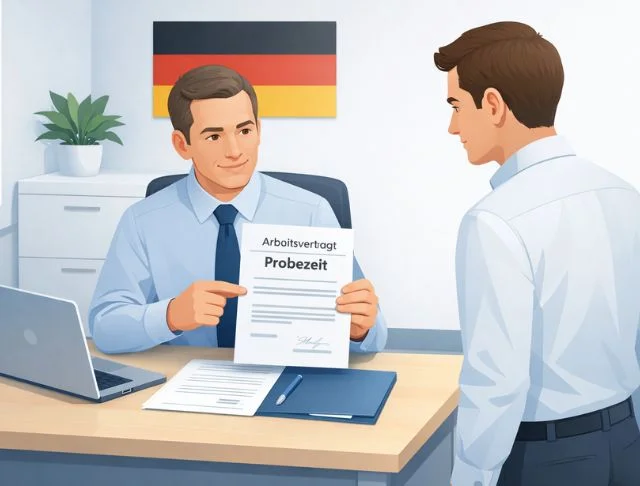
For every foreign employer, understanding the rules related to the probation period in Germany is essential to avoid various legal and compliance issues after hiring.
In this post, we are covering all the rules you need to know specifically about this topic. This includes, but is not limited to, the legal framework, employer rules, employee compensation, termination rules during this period, and more.
Author
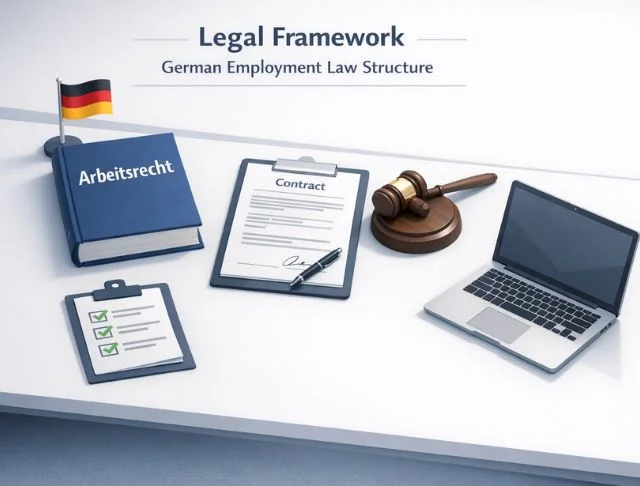
The probation period in Germany, known as “Probezeit,” is a phase at the beginning of an employment relationship. The main purpose of this phase is to evaluate whether the employer and employee are a good fit.
As a foreign employer, understanding this framework is essential because the rules around termination, notice periods, and protections are more flexible during this period.
Under German employment law, the probation period is a contractually agreed trial phase at the beginning of an employment relationship. Its meaning is that the probation period is not automatically applied by law. Employers must explicitly include it in the employment contract.
During this period, both employer and employee assess suitability for the role. The employment relationship is valid from day one, and standard labor protections also apply.
The maximum probation period is generally six months under German law. Important points:
Foreign employers should avoid extending the probation period beyond the legal limit, as this may make the clause unenforceable.
The probation period is completely optional in Germany. This means:
However, most employment contracts include a probation period because it allows easier termination rights, reduces hiring risk, and provides flexibility for workforce adjustment.

For foreign employers, this phase is a risk-management period. While complying with German labor laws, employers assess performance, and employees evaluate the workplace culture.
Employers in Germany have increased flexibility during the probation period. However, this does not mean they can cross legal boundaries. Key rights that employers have during this time frame include:
In addition to all of the above, employers must comply with anti-discrimination laws (AGG), special protection rules, and good faith employment principles at all times.
Employees in Germany also retain full employment rights during the probation period. Their key rights include:
Foreign employers often confuse probation periods with fixed-term contracts. In reality, they are different concepts in Germany.
Note: In fixed-term contracts, the probationary period must be proportionate to the contract’s duration and the nature of the work. There is no fixed formula, the Federal Labour Court confirmed in its ruling of 30 October 2025 (2 AZR 160/24) that proportionality is assessed case by case. In that specific case, a four-month probation period in a one-year contract was deemed acceptable.

The probation period gives more flexibility to employers, but they must still follow certain rules imposed by German labor law. These rules are stricter regarding notice periods, protection during pregnancy, and anti-discrimination requirements.
Yes, employers in Germany can terminate employees during the probation period with fewer legal barriers. Key points to keep in mind before terminating include:
During probation, the notice period is shorter than in standard employment.
Although employers do not need strong justification, termination typically falls into the following categories:
In most cases, no formal reason is legally required under German law during the probation period. However, If a works council (Betriebsrat) exists, the employer must consult it before any termination, including during probation. Failure to do so renders the termination legally void. However:

In most cases, no, you cannot legally terminate a pregnant employee, even during the probation period. Key rule:
However, timing and notification matter. If the employer had no knowledge of the pregnancy at the time of termination, legal outcomes may be less strict depending on when the pregnancy is formally confirmed and communicated.
The German Maternity Protection Act (Mutterschutzgesetz) provides strong legal safeguards for pregnant employees. It covers the following:
Mandatory work ban for 8 weeks after birth (12 weeks for premature or multiple births).
Note: This refers to the mandatory post-natal work ban (Beschäftigungsverbot). The dismissal protection period is at minimum four months after childbirth, and may be longer (see above).
German law places a general dismissal ban (Kündigungsverbot) on pregnant employees. This means termination during pregnancy is mostly invalid. Key points:
Although rare, there are limited exceptions where termination may be considered, but they require strict legal approval:

Once the probation period ends in Germany, the employment relationship transitions into a fully protected standard employment status. For foreign employers, this is the point where hiring risk increases.
After the probation ends, key changes that happen are:
Crucially, the KSchG only applies to companies with more than 10 employees in Germany (§ 23 KSchG); international headcount does not count toward this threshold. Part-time employees working up to 20 hours/week count as 0.5, and those working up to 30 hours/week count as 0.75.
Termination rights become significantly stricter after probation ends. Key differences:
After the probation period, employers in Germany face more structured employment obligations, including:
Long-term workforce management responsibility
Employers must justify structural changes, performance issues, or redundancies under German labor law standards.
Simplify hiring in Germany with FMC Group EOR. We manage contracts, payroll, and compliance so you can focus on growing your business.
You are currently viewing a placeholder content from Calendly. To access the actual content, click the button below. Please note that doing so will share data with third-party providers.
More InformationYou are currently viewing a placeholder content from Calendly. To access the actual content, click the button below. Please note that doing so will share data with third-party providers.
More InformationYou need to load content from reCAPTCHA to submit the form. Please note that doing so will share data with third-party providers.
More InformationYou are currently viewing a placeholder content from Turnstile. To access the actual content, click the button below. Please note that doing so will share data with third-party providers.
More InformationYou are currently viewing a placeholder content from Vimeo. To access the actual content, click the button below. Please note that doing so will share data with third-party providers.
More InformationYou need to load content from reCAPTCHA to submit the form. Please note that doing so will share data with third-party providers.
More InformationYou are currently viewing a placeholder content from Elfsight. To access the actual content, click the button below. Please note that doing so will share data with third-party providers.
More InformationYou are currently viewing a placeholder content from reCAPTCHA. To access the actual content, click the button below. Please note that doing so will share data with third-party providers.
More Information

