
Remote work has shifted from a niche flexibility perk to a defining feature of the modern workforce. Between 2020 and 2026, global labor markets experienced a structural transformation driven by necessity, technology, and evolving employee expectations.
What began as a temporary response to lockdowns has matured into a long-term reconfiguration of how and where work happens. The data shows a clear trajectory: a sharp surge in 2020, a gradual normalization, and a sustained hybrid future.

Author

Co-author

Remote work has shifted from a niche flexibility perk to a defining feature of the modern workforce. Between 2020 and 2026, global labor markets experienced a structural transformation driven by necessity, technology, and evolving employee expectations.
What began as a temporary response to lockdowns has matured into a long-term reconfiguration of how and where work happens. The data shows a clear trajectory: a sharp surge in 2020, a gradual normalization, and a sustained hybrid future.
Author
Co-author
Get in Touch with Us

Leah Maglalang
Business Coordinator UAE

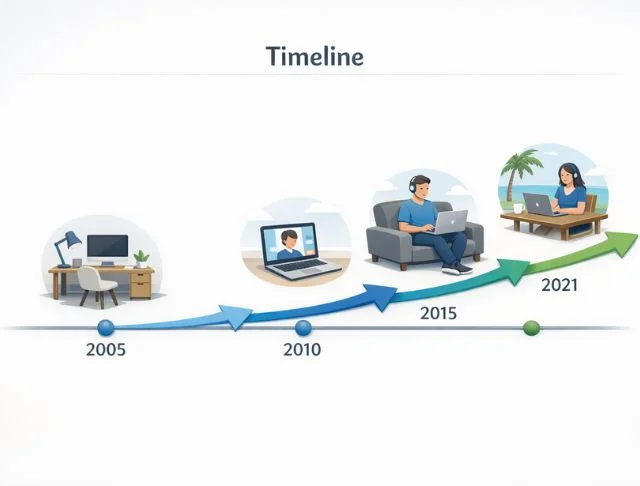
Before 2020, remote work existed but remained limited to specific roles and industries. Most economies were still structured around physical workplaces, with flexibility seen as a perk rather than a standard.
In 2019, only about 5.5% to 6% of workers in the European Union usually worked from home. The United States showed similar patterns, with roughly 6.5% of private-sector employees working primarily from home.
Across Africa and much of Asia, remote work penetration was even lower. This gap was driven by infrastructure limitations, lower digital adoption, and a higher share of jobs requiring physical presence.
The year 2020 marked a turning point. Government-imposed lockdowns triggered one of the fastest labor market transformations in modern history.
In the United States, the share of remote workdays surged from around 5% before 2020 to nearly 60% during the early months of the pandemic. This shift happened within weeks as companies moved operations online to maintain continuity.
European countries experienced similar spikes. Remote work in the EU more than doubled, rising from 5.5% in 2019 to approximately 12% to 13% in 2020. Globally, tens of millions of workers transitioned to remote setups almost simultaneously.
After the initial surge, the global workforce entered a phase of adjustment between 2021 and 2022, followed by stabilization from 2023 onward.
As restrictions eased, some workers returned to offices, but not at pre-pandemic levels. In the EU, remote work remained at around 13.5% in 2021. In the United States, 17.9% of workers were primarily remote in 2021, declining slightly to about 16% in 2022. Even with this decline, remote work levels stayed significantly higher than before 2020 across most industries.
By 2023 to 2025, a clear pattern emerged. Hybrid work became the dominant model. Global data shows a slight decline in average remote workdays, from about 1.33 days per week in 2023 to 1.27 in 2024, indicating stabilization rather than continued expansion.
Resources: Wfhresearch, Bls, Eurostat, Pmc, Cepr, Census, Gallup

North America remains one of the most advanced regions in remote work adoption, with strong infrastructure and a high share of knowledge-based jobs.
In the United States, roughly 1 in 4 workers aged 25 and above engaged in telework in 2023 to 2024. Among remote-capable roles, the distribution is heavily weighted toward flexibility, with about 26% fully remote and 52% working in hybrid arrangements. Historical data shows the shift clearly, rising from 5.7% of workers primarily working from home in 2019 to 17.9% in 2021, before stabilizing at 13.8% in 2023.
Canada follows a similar trajectory but with a slightly higher peak during the pandemic. Around 24.3% of Canadians worked primarily from home in 2021, declining to 20.1% in 2023 as offices reopened.
Mexico, by contrast, shows lower adoption levels. Global survey data suggests employees average around 1.2 remote workdays per week, reflecting differences in job structure and digital infrastructure compared to the United States and Canada.
Europe presents a diverse remote work landscape, with significant variation between countries.
Across the European Union, about 22% of workers reported working from home at least occasionally in 2023. This includes 9% who usually work remotely and 13% who do so part-time. However, national differences are substantial.
Northern European countries lead adoption rates. The Netherlands reports around 52% of workers engaging in remote work, followed by Sweden at approximately 45% and Finland and Norway at around 42%. In contrast, Germany sits closer to 23%, while many Southern and Eastern European countries remain below 15%.
The United Kingdom has settled into a hybrid-first model. By autumn 2024, approximately 28% of workers followed hybrid schedules, while fully remote work declined from its pandemic peak. Hybrid arrangements now represent the dominant format for about one-quarter of the workforce.
Asia-Pacific has the lowest levels of remote work adoption globally, driven by a combination of workplace culture, infrastructure gaps, and industry composition.
On average, employees in the region work remotely between 0.5 and 1 day per week. Country-level data highlights even lower figures in some major economies. South Korea averages around 0.4 remote days per week, while Japan is closer to 0.2 days.
Large economies such as China and India also report below-Western adoption levels. In India, for example, about 13% of workers were fully remote in 2024, indicating some growth but still limited compared to North America and Europe.
Australia and New Zealand are notable exceptions within the region. These countries align more closely with Western patterns, with employees averaging between 1.5 and 2 remote workdays per week, supported by stronger digital infrastructure and service-based economies.
Latin America occupies a middle position between high-adoption Western economies and lower-adoption regions in Asia.
In 2023, full-time employees in the region averaged between 1.0 and 1.6 remote workdays per week. Argentina leads with around 1.6 days, while Brazil and Mexico average closer to 1.2 days.
Country-specific data illustrates moderate but growing adoption. In Brazil, about 7.7% of workers engaged in telework using digital tools in 2022. When broader definitions of remote work are included, this figure rises to approximately 9.8% of the workforce.
Remote work adoption in Africa and other emerging markets remains limited but is steadily expanding.
Available data suggests that workers in these regions average about 1 remote workday per week. While this level is comparable to parts of Latin America, overall adoption is constrained by infrastructure challenges, including internet access and reliable electricity.

In the United States, data from late 2023 shows that 64.9% of workers in computer and mathematical occupations were teleworking.
Industry rankings for 2024 to 2025 consistently place technology and IT at the top of remote-friendly sectors. The combination of global talent demand and digital workflows continues to reinforce its leadership position.
Professional services and finance have also seen strong and sustained growth in remote work adoption.
Business and financial operations occupations recorded a 55.0% telework rate in late 2023. This includes roles in accounting, consulting, auditing, and financial analysis. Legal services also fall into this category, with many firms adopting hybrid models for research, documentation, and client communication.
Marketing, media, and creative industries have embraced remote work as a standard operating model.
Approximately 45.5% of workers in arts, design, entertainment, sports, and media occupations were teleworking in 2023. Roles such as content creation, digital marketing, graphic design, and video production are highly compatible with remote environments.
In contrast, healthcare, education, and government sectors show significantly lower levels of remote work adoption.
Healthcare practitioners reported only 10.1% telework rates, reflecting the need for direct patient interaction and on-site medical services. Similarly, education, training, and library occupations recorded a 13.2% telework rate, as teaching and institutional responsibilities often require physical presence.
The lowest levels of remote work are found in industries that rely on physical labor, on-site operations, or direct service delivery.
Service occupations show a telework rate of just 4.0%. Production and transportation roles are even lower at 2.5%, while construction and natural resource sectors stand at approximately 2.3%. These roles require physical presence, equipment handling, or location-specific tasks that cannot be digitized.

Remote job postings surged during the pandemic and have since stabilized at levels well above pre-2020 benchmarks.
In the United States, the share of job listings offering remote or hybrid options peaked at 10.3% in February 2022. By November 2023, this figure adjusted to around 8.3%, reflecting a post-pandemic normalization rather than a decline in relevance.
More recent data shows continued expansion in flexible roles. By late 2024, approximately 39% of new job postings were not fully in-office, including 24% hybrid roles and 15% fully remote positions. This marks an increase from about 34% the previous year.
Sector differences remain significant. Technology and professional services consistently show higher remote job availability. For example, around 36% of software development job postings were remote in late 2023, even after declining from earlier pandemic peaks.
Job seeker behavior strongly favors remote and hybrid opportunities, often outpacing employer supply.
By late 2023, about 8.6% of job searches included remote-related keywords, indicating sustained demand for flexible roles. Preference data reinforces this trend. Only 16% of professionals rank fully on-site roles as their top choice, while 55% prefer hybrid arrangements.
As early as 2020, 86% of organizations were using video interviews, a practice that continues to support distributed hiring.
Freelance and contract work has expanded rapidly alongside remote work, reshaping traditional employment models.
In 2023, approximately 64 million people in the United States engaged in freelance work, representing about 38% of the workforce. This marks an increase from around 60 million in 2022. Collectively, freelancers contributed $1.27 trillion to the economy, equivalent to roughly 6% of U.S. GDP.
Globally, the scale is even larger. Estimates suggest around 1.57 billion people, nearly 47% of the global workforce, participate in freelance or independent work.
Employer demand is also rising. Surveys indicate that 58% of managers are hiring independent professionals for remote work. This shift reflects a broader move toward flexible staffing models, where companies access global talent without long-term commitments.
The rise of digital nomads represents one of the most visible outcomes of remote work adoption.
As of 2022, the global digital nomad population was estimated at around 35 million. Growth has been especially rapid in the United States, where the number of digital nomads increased from 4.8 million in 2018 to 18.1 million in 2024, accounting for about 11% of the workforce.
These workers are concentrated in digital-first roles. Approximately 51% are employed in technology, marketing, or creative fields, all of which can be performed remotely with minimal location constraints.
Resources: McKinsey, Gartner, Upwork, FlexJobs, U.S. Bureau of Labor Statistics, Indeed Hiring Lab, PwC

Remote work is dissolving geographic hiring constraints, turning talent acquisition into a global competition.
By 2022, 58% of companies had already hired technology talent across borders, with another 27% actively exploring it. This shift reflects a broader move toward hiring based on skill availability rather than location. Organizations are increasingly sourcing talent from international markets, enabled by remote infrastructure and global job platforms..
Looking ahead, cross-border remote hiring is expected to expand significantly. By 2035, a substantial portion of IT and research roles may be filled through international remote contracts, reinforcing the globalization of the workforce.
Governments are increasingly adapting immigration policies to attract remote workers and digital professionals.
By mid-2024, more than 40 countries had introduced digital nomad or remote work visa programs. These initiatives are particularly common in Europe, the Caribbean, the Middle East, and parts of Asia-Pacific. Countries such as Portugal, Mexico, and Estonia are actively positioning themselves as remote work destinations by offering favorable visa terms and lifestyle incentives.
Future projections suggest rapid growth. The global digital nomad population could exceed 100 million by 2030, up from around 35 million in the early 2020s. This expansion will likely intensify competition between countries, with governments offering tax benefits, infrastructure, and quality-of-life incentives to attract remote workers.
Advances in artificial intelligence and immersive technologies are set to redefine how remote teams collaborate.
Virtual and augmented reality platforms are emerging as the next layer of remote interaction. Tools such as virtual meeting environments and digital workspaces aim to replicate in-person collaboration. The global AR and VR market is projected to exceed $300 billion by 2030, with potential to impact up to 23 million jobs.
These technologies are enabling early versions of virtual offices, where teams interact in shared digital environments. While still in development, such platforms could become mainstream by the mid-2030s, blending physical and digital workspaces.
The long-term outlook for remote work points to steady growth rather than complete transformation.
Forecasts indicate that remote-capable digital jobs will expand significantly, with millions of new roles emerging by 2030. Executive surveys suggest gradual increases in both fully remote and hybrid work. By 2028, projections estimate around 11.2% of employees will be fully remote and 16.3% will work in hybrid arrangements, both up from 2023 levels.
By 2035, conservative estimates suggest that 20% to 30% of knowledge-based jobs could be fully remote. More expansive scenarios, factoring in digital nomad growth and global hiring, suggest that up to one-third of roles may become location-independent.
Regional differences will remain. High-income economies such as the United States, Canada, Western Europe, Australia, and New Zealand are expected to maintain the highest levels of remote work adoption, typically ranging between 25% and 30% of the workforce.
Resources: World Economic Forum, McKinsey, Gartner, Deloitte, OECD, IMF, Statista, Brookings Institution
Remote work has shifted from a niche practice to a core element of the global workforce. The pandemic accelerated adoption, and while some workers returned to offices, hybrid and remote models have stabilized at levels far above pre-2020.
Looking to 2035, remote and hybrid work are expected to grow steadily. Borderless hiring, digital nomad migration, and AI-powered collaboration will further shape the workforce.
Hybrid models will likely remain the dominant structure. Work will increasingly be defined by access and flexibility rather than location, creating a more global and adaptable labor market.
You are currently viewing a placeholder content from Calendly. To access the actual content, click the button below. Please note that doing so will share data with third-party providers.
More InformationYou are currently viewing a placeholder content from Calendly. To access the actual content, click the button below. Please note that doing so will share data with third-party providers.
More InformationYou need to load content from reCAPTCHA to submit the form. Please note that doing so will share data with third-party providers.
More InformationYou are currently viewing a placeholder content from Turnstile. To access the actual content, click the button below. Please note that doing so will share data with third-party providers.
More InformationYou are currently viewing a placeholder content from Vimeo. To access the actual content, click the button below. Please note that doing so will share data with third-party providers.
More InformationYou need to load content from reCAPTCHA to submit the form. Please note that doing so will share data with third-party providers.
More InformationYou are currently viewing a placeholder content from Elfsight. To access the actual content, click the button below. Please note that doing so will share data with third-party providers.
More InformationYou are currently viewing a placeholder content from reCAPTCHA. To access the actual content, click the button below. Please note that doing so will share data with third-party providers.
More Information