When foreign employers hire employees in Germany, they must pay several social security contributions. Unemployment insurance is one of these mandatory contributions.
Understanding how unemployment insurance works is essential for employers who are expanding into Germany, hiring for the first time, or managing a growing team. Employers must know who is covered, how much they need to contribute, and what responsibilities they have throughout the employment lifecycle.
German unemployment insurance provides support to employees when they lose their jobs. Therefore, it is a key part of the country’s social security system. As a result, employers must make regular contributions, comply with reporting requirements, and maintain accurate employment records.
This guide explains everything foreign employers need to know about unemployment insurance in Germany. Specifically, it covers contribution rates, employer costs, employee benefits, compliance obligations, and how an Employer of Record (EOR) can simplify the hiring process in Germany.

Author
When foreign employers hire employees in Germany, they must pay several social security contributions. Unemployment insurance is one of these mandatory contributions.
Understanding how unemployment insurance works is essential for employers who are expanding into Germany, hiring for the first time, or managing a growing team. Employers must know who is covered, how much they need to contribute, and what responsibilities they have throughout the employment lifecycle.
German unemployment insurance provides support to employees when they lose their jobs. Therefore, it is a key part of the country’s social security system. As a result, employers must make regular contributions, comply with reporting requirements, and maintain accurate employment records.
This guide explains everything foreign employers need to know about unemployment insurance in Germany. Specifically, it covers contribution rates, employer costs, employee benefits, compliance obligations, and how an Employer of Record (EOR) can simplify the hiring process in Germany.
Author

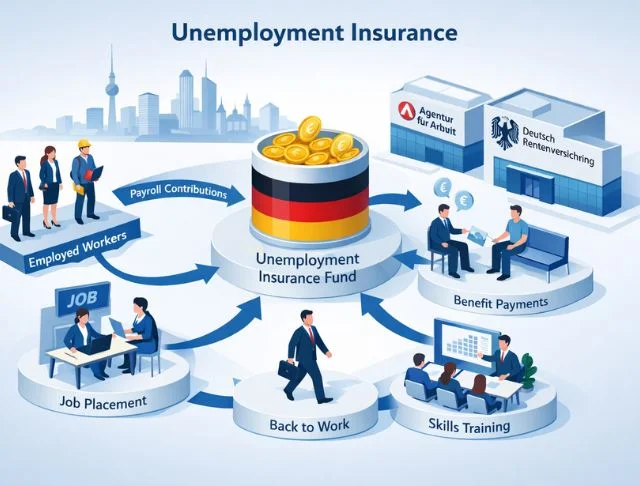
The primary purpose of unemployment insurance is to provide financial security to employees. It helps employees maintain financial stability while searching for a new job by replacing a portion of their previous earnings.
In addition to financial support, the system funds job placement services, career counseling, training programs, and workforce development initiatives. These services help unemployed individuals re-enter the labor market more quickly.
Germany’s unemployment insurance system is funded through mandatory social security contributions. This means that both employers and employees contribute an equal percentage of the employee’s gross salary. Employers withhold the employee’s share from payroll and remit both portions to the relevant social security authorities.
The Federal Employment Agency (Bundesagentur für Arbeit) administers Germany’s unemployment insurance system. It collects and manages unemployment insurance funds. The agency also determines benefit eligibility and oversees benefit payments.
In addition, the agency provides employment services, including job matching, career guidance, skills development programs, and labor market support. For employers, the Federal Employment Agency serves as an important institution for workforce recruitment.

The statutory unemployment insurance contribution rate for 2026 is 2.6% of gross wages subject to contributions. This rate remains unchanged from 2025.
Contribution rates may change as labor laws are updated. The rates above are current, but for the most accurate and up-to-date information, contact our specialist team.
Employers pay 1.3% of the employee’s gross wages toward unemployment insurance. The employer is responsible for paying this portion of the contribution and typically deducts it automatically through payroll.
As you know, employers calculate, withhold, and remit contributions, but these payments must be made monthly, not annually, to remain compliant with German employment regulations.
Employees pay 1.3% of their gross wages toward unemployment insurance, which is deducted from their salary. This equals the employer’s share and represents half of the total 2.6% contribution.
The key point for employers is that contributions are deducted from payroll automatically, and employees do not need to take any additional action to participate. However, employers must have the necessary payroll processes in place before employment begins.
For 2026, the contribution assessment ceiling for unemployment insurance is €101,400 annually (€8,450 monthly). This ceiling increased by 5% from the 2025 level of €96,600.
Income exceeding this threshold is not subject to additional unemployment insurance contributions. The ceiling applies uniformly to both pension and unemployment insurance.

Arbeitslosengeld I (ALG I) is Germany’s earnings-related unemployment benefit. The payment equals 60% of standardized net reference earnings, or 67% for individuals with at least one child. The duration of benefit payments depends on the employee’s contribution history and age, typically ranging from 6 to 24 months.
To qualify for ALG I, an employee must be unemployed and registered as a job seeker with the Agentur für Arbeit. They must also be available for placement and generally be able and willing to work at least 15 hours per week.
Another requirement is that unemployment insurance contributions must have been paid for at least 12 months within the previous 5 years (60 months) — the “Rahmenfrist” (§ 142 SGB III).
ALG I is calculated based on an employee’s average gross earnings during the 12 months preceding unemployment. The amount is then converted into a standardized monthly net reference wage (Bemessungsentgelt) by applying statutory tax and social security adjustments.
As mentioned above, the benefit rate is 60% of the net reference amount for claimants without children and 67% for claimants with at least one child.
The duration of ALG I depends on how long an employee has paid unemployment insurance contributions. For example, an employee with 12 months of insured employment within the previous 5 years is generally entitled to receive ALG I for 6 months.
With longer contribution histories, the entitlement period increases to up to 12 months for most claimants under the age of 50. Older claimants with longer insurance histories may qualify for benefits for up to 15 months and, in some cases, up to 24 months, depending on their age and contribution record.

German employers must withhold employee contributions from wages and transfer them, together with employer contributions, to the social security collection office. Employers must withhold:
Deadlines
Employers must register all employees for social security under Section 28a of the German Social Code, Book IV (SGB IV).
Key 2026 updates include:
Employers must maintain payroll records for each employee under Section 28f SGB IV. They must also create and transmit an Arbeitsbescheinigung (Certificate for the Federal Employment Agency) when requested by a former employee or the Federal Employment Agency (BA).
The certificate should be prepared immediately after the employment relationship ends. It must include the information required under Section 312 SGB III, including the employment period, earnings, and contribution data necessary for calculating ALG I benefits.
The employer’s unemployment insurance contribution rate for 2026 is 1.3% of gross salary, representing half of the total 2.6% contribution rate.
Monthly Employer Contribution = Gross Salary × 1.3%
Unemployment insurance contributions apply to gross salary up to the 2026 assessment ceiling of €8,450/month (€101,400/year).
Example monthly employer contribution:
2026 Updates
The compulsory insurance threshold for health and long-term care insurance increased from €66,150 to €69,750 annually (€5,812.50 per month) effective January 1, 2026, and applies uniformly across Germany. The pension and unemployment insurance assessment ceilings remain €101,400 annually for 2026.
Beyond unemployment insurance, employers should budget for total social security contributions of approximately 19%–22% of gross salary. These costs cover pension insurance, health insurance, long-term care insurance, unemployment insurance, and workplace accident insurance.
When employers manage unemployment insurance in Germany, they must calculate contributions, process payroll deductions, and comply with social security regulations. For foreign companies, these obligations can be time-consuming and complex.
An Employer of Record (EOR) handles unemployment insurance administration, payroll, and compliance on behalf of the employer.
With over 15 years of experience, FMC Group helps international businesses hire employees in Germany. FMC Group manages payroll, social security contributions, unemployment insurance, and employment compliance, allowing companies to focus on growing their operations.
You are currently viewing a placeholder content from Calendly. To access the actual content, click the button below. Please note that doing so will share data with third-party providers.
More InformationYou are currently viewing a placeholder content from Calendly. To access the actual content, click the button below. Please note that doing so will share data with third-party providers.
More InformationYou need to load content from reCAPTCHA to submit the form. Please note that doing so will share data with third-party providers.
More InformationYou are currently viewing a placeholder content from Turnstile. To access the actual content, click the button below. Please note that doing so will share data with third-party providers.
More InformationYou are currently viewing a placeholder content from Vimeo. To access the actual content, click the button below. Please note that doing so will share data with third-party providers.
More InformationYou need to load content from reCAPTCHA to submit the form. Please note that doing so will share data with third-party providers.
More InformationYou are currently viewing a placeholder content from Elfsight. To access the actual content, click the button below. Please note that doing so will share data with third-party providers.
More InformationYou are currently viewing a placeholder content from reCAPTCHA. To access the actual content, click the button below. Please note that doing so will share data with third-party providers.
More Information