
Remote work has evolved into a permanent feature of the global labor market. By 2026, it is no longer limited to a small segment of digital professionals. It now reflects broader shifts in how companies hire, manage teams, and structure operations.
This report presents a data-driven breakdown of who works remotely, focusing on global distribution, workforce share, and key demographic patterns across age, gender, and education.

Author

Co-author
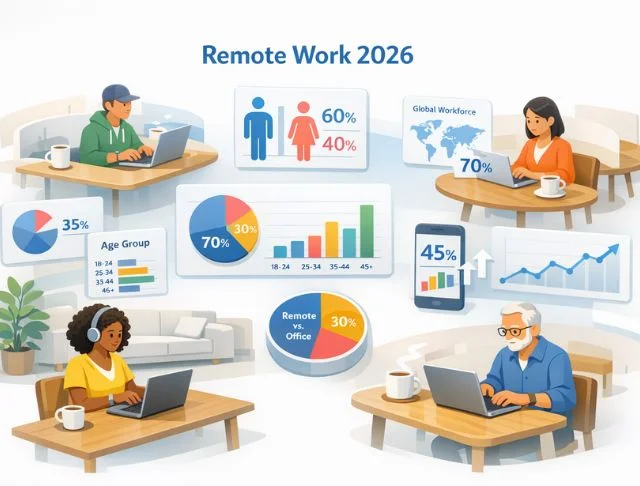
Remote work has evolved into a permanent feature of the global labor market. By 2026, it is no longer limited to a small segment of digital professionals. It now reflects broader shifts in how companies hire, manage teams, and structure operations.
This report presents a data-driven breakdown of who works remotely, focusing on global distribution, workforce share, and key demographic patterns across age, gender, and education.
Author
Co-author
Get in Touch with Us

Leah Maglalang
Business Coordinator UAE


Remote work participation varies significantly across age groups, with clear differences in access and adoption.
United States telework rates (Q1 2024):
Generational differences highlight how remote work aligns with career stage and job function.
Adoption rates show steady growth across all age groups, with notable differences in pace.
Growth trends (recent years):
Work preferences vary by life stage, but productivity differences are minimal.
One of the most notable trends is the rise of remote work among older employees.
Resources: Bls, Siepr, Weforum, Siepr, Census, Ons, Mckinsey

Remote work participation shows a consistent but moderate gap between men and women.
United States telework rates (Q1 2024):
While overall participation is similar, differences emerge when comparing full-time and hybrid work models.
United States (2024):
Additional Insight (Great Britain, 2024):
Remote work plays a significant role in shaping workforce participation among women.
Preferences for remote work are broadly similar across genders, with some differences driven by life circumstances.

Remote work participation increases significantly with higher education levels. In the United States (workers aged 25+), telework rates are as follows:
Telework adoption rises sharply with degree attainment:
Remote work aligns closely with skill and job type:
Remote work access is unevenly distributed by education:

Remote work is strongly associated with higher income levels. In the United States:
Income level is a key predictor of remote work eligibility.
Remote work is associated with higher pay even after adjusting for demographics:

Remote work adoption varies widely across the globe, reflecting differences in economy, industry composition, and infrastructure.
Remote-capable jobs are heavily concentrated in urban areas:
High-Remote Countries
Lower-Remote Regions

Parental status plays a major role in shaping remote work patterns.
Parents generally prefer more remote days, but practical challenges such as interruptions and limited managerial support often restrict their options.
Caregiving responsibilities strongly influence the demand for flexible work arrangements:
Remote work correlates with higher household income:
Remote work access is strongly shaped by household resources and the ability to work in skilled, remote-capable roles.

Remote work is concentrated in knowledge-intensive industries, where tasks can be completed digitally. In the United States (late 2023–2024):
Industry | Telework Rate |
Finance & Insurance | 61.5% |
Professional/Technical Services | 54.8% |
Information Technology / Communications | 46.7% |
Management, Admin & Waste Services | 9.8% |
Education Services | 5.0% |
Accommodation & Food Services | 3.8% |
Remote work opportunities increase with experience and seniority:
Additional Insights:
Independent work has expanded the remote workforce, complementing full-time employment in knowledge-based sectors.
Resources: PhiladelphiaFed, FMCGroup, MarcoPolo

The COVID-19 pandemic caused a dramatic surge in remote work adoption.
The pandemic accelerated long-term adoption of remote work, shifting it from a niche option to a mainstream work arrangement.
Remote work is expanding outside Western countries, but adoption remains uneven:
Emerging markets represent a significant growth opportunity for remote work, contingent on economic development and digital capability.
Remote work is no longer a temporary trend. Demographics, technology, and organizational preferences indicate that hybrid and fully remote work will remain a standard practice through 2030.
Resources: Census, FMCGroup, Stanford, BLS, WorldEconomicForum, TimeDoctor
Remote work has transformed the global workforce, reshaping who can work from home, where, and under what conditions. Across age, gender, education, income, geography, family status, and industry, clear patterns emerge.
Looking forward, remote and hybrid work will remain well above pre-pandemic levels, with global projections estimating 92 million fully remote-capable roles by 2030. These roles will continue to concentrate among higher-skilled, higher-paid workers, shaping both economic opportunity and workplace flexibility.
You are currently viewing a placeholder content from Calendly. To access the actual content, click the button below. Please note that doing so will share data with third-party providers.
More InformationYou are currently viewing a placeholder content from Calendly. To access the actual content, click the button below. Please note that doing so will share data with third-party providers.
More InformationYou need to load content from reCAPTCHA to submit the form. Please note that doing so will share data with third-party providers.
More InformationYou are currently viewing a placeholder content from Turnstile. To access the actual content, click the button below. Please note that doing so will share data with third-party providers.
More InformationYou are currently viewing a placeholder content from Vimeo. To access the actual content, click the button below. Please note that doing so will share data with third-party providers.
More InformationYou need to load content from reCAPTCHA to submit the form. Please note that doing so will share data with third-party providers.
More InformationYou are currently viewing a placeholder content from Elfsight. To access the actual content, click the button below. Please note that doing so will share data with third-party providers.
More InformationYou are currently viewing a placeholder content from reCAPTCHA. To access the actual content, click the button below. Please note that doing so will share data with third-party providers.
More Information