
Roughly 2.9 million people of Turkish origin live in Germany today. That makes the Turkish community the largest immigrant-background group in the country and the biggest Turkish diaspora in all of Europe.
But that single number only tells part of the story. Of those 2.9 million, 1.52 million still hold a Turkish passport. Around 1.6 million have German citizenship. And over 52% were not born in Turkey at all. They were born right here in Germany.
This post breaks down the full picture: historical growth, current population figures, regional distribution, citizenship trends, and how Germany’s Turkish community compares to other diaspora groups across Europe.

Author

Co-author
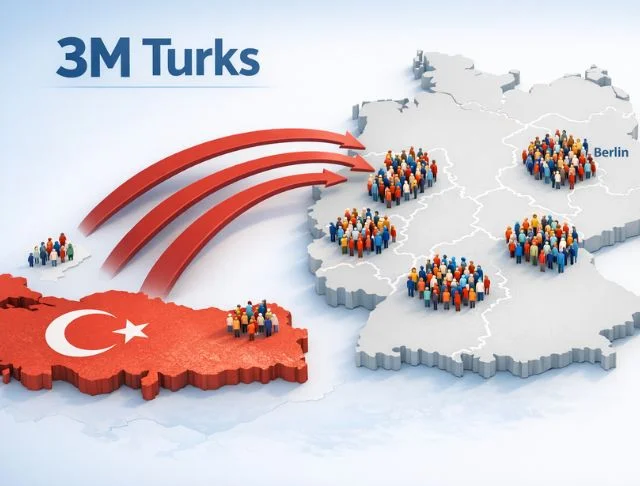
Roughly 2.9 million people of Turkish origin live in Germany today. That makes the Turkish community the largest immigrant-background group in the country and the biggest Turkish diaspora in all of Europe.
But that single number only tells part of the story. Of those 2.9 million, 1.52 million still hold a Turkish passport. Around 1.6 million have German citizenship. And over 52% were not born in Turkey at all. They were born right here in Germany.
This post breaks down the full picture: historical growth, current population figures, regional distribution, citizenship trends, and how Germany’s Turkish community compares to other diaspora groups across Europe.
Author
Co-author
Get in Touch with Us
Alp Atasoy
Sales and Business Development Consultant


The Turkish community in Germany did not appear overnight. It grew through decades of labor deals, family ties, and shifting immigration policies. Here is how it all unfolded.
It started with a single agreement. In 1961, West Germany signed a labor-recruitment deal with Turkey. That opened the door to one of the largest organized migration waves in modern European history.
Between 1961 and 1973, roughly 650,000 Turkish men arrived as contract workers. They were called “guest workers,” and the assumption was simple: work, then go home.
The 1973 oil crisis changed that plan. Germany halted new contracts. But many workers stayed put. Laws passed in 1969 and 1974 made family reunification easier. So instead of leaving, workers started bringing their families over.
By the 1980s, the “guest” part of the guest worker was fading fast. Turkish families were settling in, not packing up.
Family immigration and higher birth rates drove community growth through this period. Millions of relatives joined the original labor migrants. A voluntary return program ran from 1983 to 1984, but it did not take off. Only around 50% of Turkish migrants had returned to Turkey by the early 1990s.
By the late 1990s, Turks had become Germany’s largest immigrant group. Population estimates for that decade range from 1.8 million to 3 million depending on the source.
No massive new wave came in during this decade. Growth came from within. The large cohorts born in the 1960s and 1970s now had children of their own. Those German-born kids made up a growing second generation.
Total Turkish-origin population estimates by the mid-2000s sat around 2 to 2.5 million. That figure covered both Turkish citizens and German-born people of Turkish descent.
One notable exception was a late-1990s influx of Kurdish migrants from southeast Turkey. But overall, this was a decade of natural growth rather than fresh migration.
Growth slowed down in the 2010s but the community did not shrink. Germany’s Turkish-origin population reached about 2.9 million by 2019. The 2023 Federal microcensus confirmed that number again. Turkey ranked as the top country of origin among people with a migration background in Germany.
Net migration from Turkey dropped sharply. It went from +88,000 in 2022 down to +24,000 in 2025. But naturalizations surged. In 2024 alone, 22,525 Turks became German citizens. That was more than double the 2023 figure.
The 2024 citizenship law played a big role. It eased requirements and allowed dual nationality for the first time. Many long-term Turkish residents finally chose to take that step.
Sources: Yris, Swp-berlin, Bamf, Destatis, Hurriyetdailynews
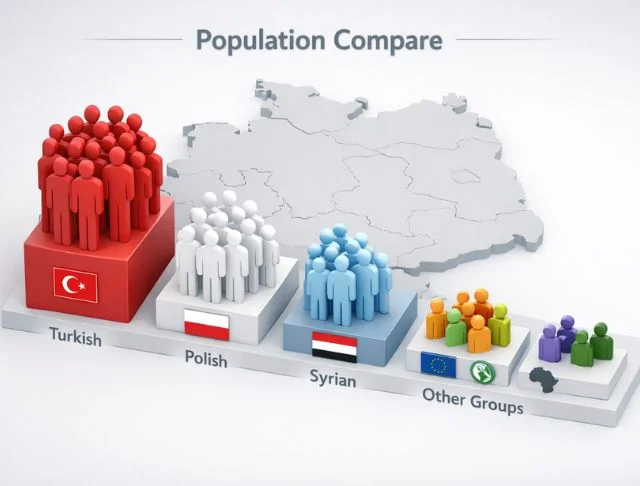
Two numbers tend to come up when people talk about Turks in Germany. They measure different things and both matter.
At the end of 2025, 1.52 million people in Germany held a Turkish passport. That figure only counts foreign residents and does not include people who naturalized or were born here.
The broader “Turkish-origin” figure tells a different story. It covers naturalized citizens and German-born descendants too. That number sits at roughly 2.9 million.
The 2023 Federal microcensus found that 24.9 million people in Germany carry a migration background. That is 29.7% of the total population. Turkish-origin people account for 2.9 million of that group.
The definition here matters. It includes anyone born in Turkey or anyone with at least one parent born in Turkey. By that measure, around 52% of the Turkish-origin population was actually born in Germany.
Germany’s total population sits at around 84 million. The 2.9 million Turkish-origin residents make up roughly 3 to 3.5% of that.
Look only at foreign residents and the picture shifts. With about 13.4 million total foreigners in Germany, Turkish citizens make up around 11% of that group.
Sources: Destatis, Swp-berlin, Bamf, Bamf, Destatis
The Turkish community in Germany is not shrinking. But it is also not growing the way it once did. The real story now is how that growth happens and who is driving it.
Net migration from Turkey has been falling steadily. After a spike in 2022, numbers have dropped each year since.
Year | Net Migration |
2022 | +88,000 |
2023 | +50,000 |
2024 | +41,000 |
2025 | +24,500 |
Despite that slowdown, the overall community size has held steady at roughly 2.9 million through the 2010s and 2020s. Births within the community have picked up the slack left by falling migration numbers.
Something shifted in 2024. Germany’s citizenship law reform took effect in June of that year. It cut residency requirements and dropped the mandatory renunciation of Turkish citizenship. That changed the calculation for a lot of long-term residents.
The result: 22,525 Turks became German citizens in 2024. That was more than double the roughly 11,000 who naturalized in 2023.
Turks ranked second only behind Syrians in total naturalization numbers. As this trend continues, more Turkish-origin residents will shift from the foreign-citizen count into the German-citizen category.
Germany’s official data shows arrivals from Turkey still outpace departures by a wide margin. In 2022, around 121,000 Turkish-born people arrived while only 33,000 left. In 2023, that was 76,000 arrivals against 26,000 departures.
Net migration stays positive. But the gap has narrowed. The Ukraine war and shifting EU mobility patterns both played a role in that change.
On the other side, part of the older guest-worker generation has moved back to Turkey or elsewhere over the years. Voluntary return programs in the 1980s repatriated some thousands. That outflow, combined with reduced inflows, explains why net growth in 2025 came down to just +24,600.
New arrivals are no longer the main engine of growth. The community now grows mostly from within.
Over 52% of people with Turkish heritage were born in Germany. That stat from SWP’s 2019 research reflects large second and third-generation cohorts who never had a Turkish address. Nearly half the community falls between the ages of 20 and 40.
This age profile matters. It means births from second-generation Turkish-Germans will keep sustaining the population even as fresh migration from Turkey slows further down.
Sources: Destatis, Bamf, Swp-berlin, Hurriyetdailynews

Turks did not spread out evenly across Germany. They followed factories, guest-worker contracts, and urban opportunity. That pattern still shows up clearly in the numbers today.
NRW is home to more Turks than any other German state. As of 2023, about 492,000 Turkish nationals lived there. Add in naturalized citizens and German-born descendants and that figure climbs to somewhere between 600,000 and 700,000.
Cities like Cologne, Düsseldorf, Dortmund, and Duisburg all have well-established Turkish communities. Turkish nationals alone make up roughly 2.7% of NRW’s 18 million residents.
Berlin holds a special place in Turkish-German history. The city’s 2023 statistics put the Turkish-background population at around 191,000. That is close to 5% of Berlin’s total population.
Neighborhoods like Kreuzberg and Neukölln have deep roots in Turkish culture and community life. Turks remain the single largest ethnic minority in the city.
Baden-Württemberg ranks second after NRW in total Turkish population. The state has over 200,000 Turkish nationals as of 2023. Stuttgart alone accounts for around 23,000 of them.
The reason comes down to industry. Manufacturing and auto sectors in Stuttgart and Mannheim pulled in Turkish workers during the guest-worker era and many never left. Their families stayed and grew.
Bavaria hosts the next-largest concentration after Baden-Württemberg. Munich’s Turkish-origin community sits at roughly 35,000 to 40,000. Nuremberg and Augsburg add more to that count. Bavaria’s total Turkish-origin population likely falls between 150,000 and 200,000.
Hesse is also worth noting. The Frankfurt metro area pushes the state’s Turkish-origin count to around 200,000 by some estimates. Southern Germany as a whole carries a significant and spread-out Turkish presence.
The former East German states tell a different story. Turkish communities there are small. Most eastern states sit below 0.5% Turkish-origin population. Cities like Dresden and Leipzig each count only a few thousand.
The GDR never took part in the guest-worker program. That left a gap that was never fully filled. No single eastern state reaches even 20,000 to 30,000 Turkish-origin residents today.
Sources: Wikipedia, Wikipedia, Worldpopulationreview

Germany is home to millions of people from dozens of countries. But a handful of communities stand out by sheer size. Here is where the Turkish-origin population fits into that picture.
Turkey and Syria represent two very different migration stories in Germany. Turkish migration goes back to the 1960s guest-worker era. Syrian migration picked up sharply after 2015.
As of 2025, around 936,285 Syrian nationals lived in Germany. That is well below the 1.52 million Turkish citizens in the country. But Syrians have been naturalizing at a fast pace. In 2024, Syrians ranked first in total naturalizations ahead of Turks.
Group | Foreign Nationals (2025) |
Turkish | 1,520,400 |
Syrian | 936,285 |
The Turkish community still holds a clear lead in both foreign-citizen count and total migration-background population.
Poland and Turkey are neck and neck at the top. Both countries sent roughly 1.5 million first-generation migrants to Germany as of 2025. That makes them the two largest origin groups for immigrants born abroad.
Russia and Ukraine follow behind. Around 1.0 million Russian-born and 1.3 million Ukrainian-born people lived in Germany in 2025. The Ukrainian figure shot up after 2022 due to the war.
Origin Country | First-Gen Migrants (2025) |
Poland | 1.5 million |
Turkey | 1.5 million |
Ukraine | 1.3 million |
Russia | 1.0 million |
Syria | 1.0 million |
Source: Destatis

The Turkish-origin population in Germany splits into two broad legal groups. One holds German citizenship. The other holds only a Turkish passport. The line between them has been shifting.
As of December 31, 2025, exactly 1,520,400 people in Germany held Turkish citizenship. Of those, 1,174,710 were born in Turkey and 345,695 were born in Germany.
That second number is worth pausing on. Nearly 346,000 German-born people still carry only a Turkish passport. These are largely second-generation residents who never went through naturalization.
Official data puts dual Turkish-German citizenship holders at around 338,000. But that figure is widely considered an undercount. Many people hold both passports without reporting it formally.
Before June 2024, Germany required most applicants to give up their previous nationality. That rule blocked many long-term Turkish residents from naturalizing. The 2024 reform dropped that requirement. Dual nationality became legally straightforward for the first time.
That single change unlocked naturalization for a large group of people who had been sitting on the fence for years.
The jump in 2024 naturalization numbers was hard to miss. Around 11,000 Turks naturalized in 2023. That number more than doubled to 22,525 in 2024.
Turks ranked second only behind Syrians in raw naturalization totals for 2024. The trend points upward as more residents become eligible under the new rules.
The June 2024 citizenship law did more than allow dual nationality. It also cut the standard residency requirement from eight years down to five. For people with special contributions to society, that dropped further to three years.
These changes matter most for long-term residents who were already well integrated but held back by the old rules. For the Turkish community specifically, the impact is direct. About 1.4 million Turkish-only passport holders in Germany now face a much lower bar to naturalize.
If even a fraction of that group acts on it over the next few years, the citizenship breakdown of the Turkish-origin population in Germany will look very different by 2026 and beyond.
Sources: Mediendienst-integration, Destatis, Eufactcheck
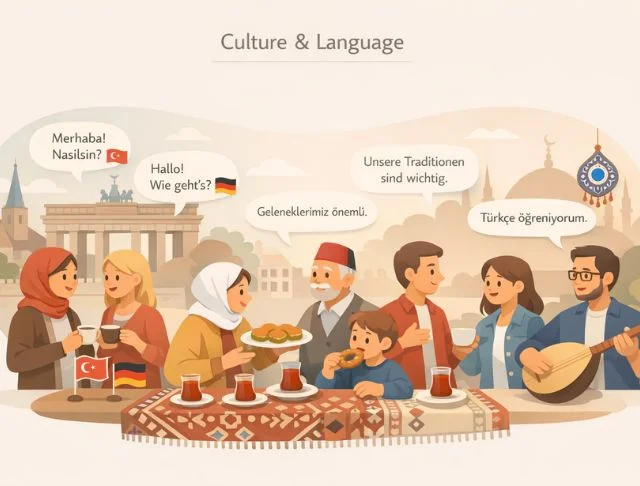
Language is one of the clearest signs of how deep a community’s roots go. For Turkish-Germans, those roots run across three generations and millions of households.
Out of roughly 15.5 million people who use a non-German language at home in Germany, 14% speak Turkish. That puts Turkish ahead of Russian at 12% and Arabic at 9%.
Language | Share of Non-German Speakers |
Turkish | 14% |
Russian | 12% |
Arabic | 9% |
At the national level, 77% of Germans speak only German at home. About 17% are bilingual and 6% use no German at home at all. Turkish speakers make up a significant slice of that last group.
Among the 21.4 million people in Germany with an immigration background, only 22% spoke German exclusively at home. Around 55% mixed German with another language and 23% used only a non-German language.
That middle group is where Turkish-German bilingualism lives. Mixing both languages in daily conversation is common across households where parents arrived from Turkey and children grew up here. It is not a sign of poor integration. It is just how language works in multicultural families.
Since 2000, children born in Germany to two Turkish parents have generally acquired German citizenship automatically. That legal shift helped cement German as a first language for a new generation while Turkish stayed alive at home.
Exact generational retention data is limited. But the broader numbers point to a clear pattern. The Turkish-origin community is now majority German-born. Over 52% were born in Germany. Many grew up speaking both languages from an early age.
Turkish tends to stay strong in families with close ties to relatives in Turkey. It fades faster in households where both parents already grew up in Germany. By the third generation, German often takes over as the dominant language while Turkish becomes a heritage language rather than a daily one.
Germany does not just have the largest Turkish community in Europe. It has more Turkish-origin residents than the next three countries combined.
The Netherlands had around 468,000 people of Turkish origin as of 2025. That breaks down to roughly 234,000 born in Turkey, 168,600 with two Turkish parents born in the Netherlands, and around 65,700 with one Turkish parent.
Germany’s 3.0 million Turkish-origin population is more than six times that figure. The guest-worker pipeline to Germany was simply far larger and ran for much longer.
France has close to 600,000 residents with Turkish nationality or Turkish-origin parents as of 2024. That puts France in second place among European countries by Turkish diaspora size.
Still, Germany’s total is five times larger. France drew fewer Turkish workers during the guest-worker era and had different immigration channels. The Turkish community in France is also more spread out across cities rather than concentrated in a few major urban hubs.
Austria had around 124,788 Turkish citizens as of January 2025. The total Turkish-origin population including naturalized Austrians likely sits higher. But even with that adjustment, Austria’s community is a fraction of Germany’s.
Country | Turkish-Origin Population |
Germany | 3,000,000 |
France | 600,000 |
Netherlands | 468,000 |
Austria | 124,800+ |
Sources: Mediendienst-integration, Cats-network, Cbs, Statistik
The Turkish community in Germany is the largest Turkish diaspora in Europe and one of the most established immigrant groups in the world. It took root through guest-worker agreements, grew through family reunification, and now sustains itself through second and third generations born right here in Germany.
With 2.9 million people of Turkish origin, a surging naturalization rate, and Turkish holding firm as the top non-German language in the country, this community is not just present in Germany. It is woven into it.
You are currently viewing a placeholder content from Calendly. To access the actual content, click the button below. Please note that doing so will share data with third-party providers.
More InformationYou are currently viewing a placeholder content from Calendly. To access the actual content, click the button below. Please note that doing so will share data with third-party providers.
More InformationYou need to load content from reCAPTCHA to submit the form. Please note that doing so will share data with third-party providers.
More InformationYou are currently viewing a placeholder content from Turnstile. To access the actual content, click the button below. Please note that doing so will share data with third-party providers.
More InformationYou are currently viewing a placeholder content from Vimeo. To access the actual content, click the button below. Please note that doing so will share data with third-party providers.
More InformationYou need to load content from reCAPTCHA to submit the form. Please note that doing so will share data with third-party providers.
More InformationYou are currently viewing a placeholder content from reCAPTCHA. To access the actual content, click the button below. Please note that doing so will share data with third-party providers.
More Information