
Employers need to pay employees’ insurance contributions in Germany. However, the different types of insurance, what they are, who pays what percentage, what each insurance covers, and the related insurance obligations can confuse and stress foreign employers.
There is a lot more to do and consider than just paying a fixed amount for insurance. When employers aren’t fully aware of the ins and outs, they can face legal issues. These could include penalties, restrictions, and more.
That’s why, in this guide, I discuss all the types of insurance you need to pay in Germany, how much to pay, and other important nuances. Let’s get started…

Author
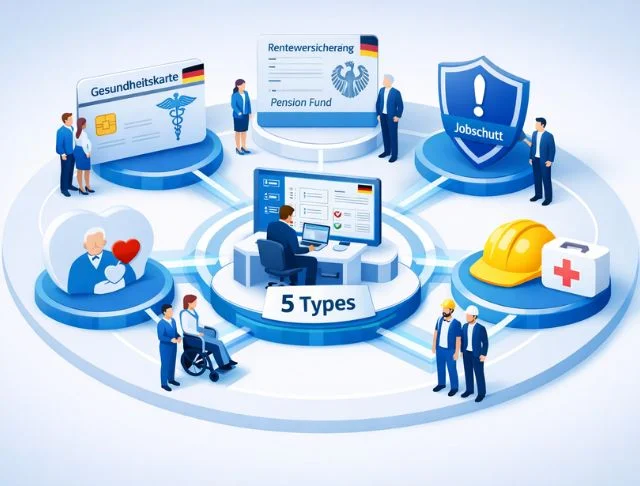
Employers need to pay employees’ insurance contributions in Germany. However, the different types of insurance, what they are, who pays what percentage, what each insurance covers, and the related insurance obligations can confuse and stress foreign employers.
There is a lot more to do and consider than just paying a fixed amount for insurance. When employers aren’t fully aware of the ins and outs, they can face legal issues. These could include penalties, restrictions, and more.
That’s why, in this guide, I discuss all the types of insurance you need to pay in Germany, how much to pay, and other important nuances. Let’s get started…
Author

Statutory health insurance (Gesetzliche Krankenversicherung – GKV) is a mandatory component of Germany’s social security system. It provides employees with comprehensive access to healthcare services, including medical treatment, hospital care, prescription medication, and preventive healthcare.
Employers and employees share the cost of statutory health insurance contributions equally through payroll.
Component | Rate |
Base health insurance | 7.3% of gross salary |
Additional contribution | 50% of the applicable health insurance fund’s additional contribution rate |
Total employer contribution | ~8.65% of gross salary |
The base rate of 7.3% is fixed nationwide. The additional contribution varies by health insurance fund and averages 2.9% in 2026 (so employers pay half: approximately 1.45%).
Important: Contributions apply only to salaries up to the contribution assessment ceiling of €69,750 annually (€5,812.50 monthly) in 2026.
Component | Rate |
Base health insurance | 7.3% of gross salary |
Additional contribution | 50% of the applicable health insurance fund’s additional contribution rate |
Total base employee contribution | ~8.65% of gross salary |
Statutory health insurance in Germany provides comprehensive healthcare coverage. Health insurance covers the following:

Pension insurance is a mandatory social security program in Germany. It provides employees with income security in retirement and financial protection in cases of reduced earning capacity or death.
Employers and employees jointly contribute to this insurance. The employer pays exactly 50% of the total pension insurance contribution, just as with health insurance.
Component | Rate |
Pension insurance | 9.3% of gross salary |
Total employer contribution | 9.3% of gross salary |
Important: Contributions apply only to salary up to the contribution assessment ceiling of €101,400 annually (€8,450 monthly) in 2026.
Component | Rate |
Pension insurance | 9.3% of gross salary |
Total employee contribution | 9.3% of gross salary |
Benefit Type | Description |
Standard Retirement Pension | Monthly pension payments after reaching the statutory retirement age. For employees born in 1964 or later, the standard retirement age is currently 67. Employees with at least 45 years of qualifying contribution periods may be eligible for retirement without deductions under specific conditions. |
Early Retirement Pension | Reduced pension payments may be available before the standard retirement age, depending on the employee’s age, contribution history, and applicable legal requirements. Pension reductions generally apply for early retirement. |
Disability Pension | Monthly financial support for employees who are unable to work fully or partially due to health-related limitations (reduced earning capacity pension– Erwerbsminderungsrente),subject to eligibility requirements. |
Survivors’ Pension | Financial support for surviving spouses and children of deceased insured persons. Benefits include widows’ and widowers’ pensions as well as orphan pensions, depending on eligibility criteria. |
Rehabilitation Benefits | Support measures designed to restore or maintain an employee’s ability to work, including medical rehabilitation and vocational reintegration programs. |
Vocational Training Support | Financial assistance and support for retraining or professional development measures when employees can no longer continue their previous occupation due to health reasons or other qualifying circumstances. |
Pension benefits use a point-based system:. Each year of employment earns pension points based on the employee’s annual salary compared with the average income of all pension-insured workers in Germany.
An employee with 45 years of average earnings (45 points) would receive approximately €1,913/month in standard retirement pension (45 × €42.52).

Unemployment insurance is a mandatory social security program in Germany, just like pension insurance and health insurance. It provides financial support and job placement assistance to employees who lose their jobs.
Both employers and employees share the cost of unemployment insurance (Arbeitslosenversicherung). The employer pays the same amount as the employee. Below are the details:
Component | Rate |
Unemployment insurance | 1.3% of gross salary |
Total employer contribution | 1.3% of gross salary |
Important: Contributions apply only up to the annual contribution assessment ceiling for unemployment insurance, which is linked to the pension insurance contribution ceiling.
Component | Rate |
Unemployment insurance | 1.3% of gross salary |
Total employee contribution | 1.3% of gross salary |
Benefit Type | Description | Eligibility |
Unemployment Benefit I (Arbeitslosengeld I) | 60% (67% for recipients with children) of the calculated net income.)For up to 12 months; longer periods are possible for older employees with longer insurance periods (up to 24 months). | Work 12+ months in last 30 months; registered as jobseeker |
Citizen’s Allowance (Bürgergeld) Social assistance benefits (not funded through unemployment insurance). | Basic welfare support for individuals who cannot cover their living costs and are not entitled to sufficient unemployment insurance benefits.
| Low income; registered as jobseeker |
Job Placement Services | Free career counseling, job matching, and application support through Federal Employment Agency | All registered jobseekers |
Training & Requalification | Funding for vocational training, certification programs, and skill development | Jobseekers needing new skills |
Startup Grant (Gründungsgeld) | Available to eligible unemployed persons starting self-employment, subject to approval by the Federal Employment Agency. | with business plan |
Relocation Assistance | Support for travel costs and relocation if new job is in different city | Job accepted outside current area |

Long-term care insurance is a mandatory social insurance program that helps cover the costs of care for individuals who become unable to manage daily activities due to illness, disability, or old age.
Long-term care insurance contributions are generally split equally between employer and employee, with a base rate of 1.8% each (3.6% total) in most federal states. Employees may pay a higher share due to the childless surcharge and regional differences (especially in Saxony).
In Saxony, the employer share is reduced to 1.3%, while employees pay 2.3% (with one child) or 2.9% (childless, age 23+), reflecting a historical public holiday offset arrangement.
Component | Rate |
Long-term care insurance | Long-term care insurance: 1.8% of gross salary (employer share in most federal states). |
Component | Rate | Employee Type |
Base long-term care insurance | 1.8% of gross salary (in most federal states) | All employees |
Additional childless surcharge | +0.6% of gross salary | Childless employees age 23+ |
Total employee contribution | Total employee contribution: 1.8% (in most federal states) for employees with children. | Employees with children |
Total employee contribution | Total employee contribution: 2.4% for childless employees aged 23+ (in most federal states). | Childless employees age 23+ |
Key distinction: Childless employees aged 23 and older pay an additional 0.6% surcharge, making their total 2.4%. However, employers do not share this cost.
Benefit Type | Description | Coverage Level |
Home Care Benefits (Hausliche Pflege) | Professional nursing care, personal assistance, and daily support at home | Up to €2,299/month (Pflegegrad 5, 2025/2026 level). |
Residential Care Benefits (Pflegeheim) | Full coverage for nursing home accommodation and care services | Partial coverage of nursing home care costs; accommodation, meals, and investment costs are generally paid privately. |
Day and Night Care (Tages-und Nachtpflege) | Partial care services during daytime or overnight hours | Up to €2,085/month for Pflegegrad 5 (amount depends on care level) |
Care Assistance Products | Home modifications, safety equipment, and care supplies | Up to €42/month for consumable care aids. |
Pension Contributions for Caregivers | Social security contributions paid for family caregivers working <30 hours/week | Full pension coverage for caregivers |
Preventive Care Services | Early intervention programs to delay need for intensive care | Free assessment and prevention programs |
Therapy and Rehabilitation | Physical therapy, occupational therapy, and medical rehabilitation | Full coverage for prescribed therapies |
Long-term care benefits are categorized into five care levels based on severity of need:
Care Level | Description | Monthly Home Care Benefit |
Pflegegrad 1 | “Merely impaired independence” | €128 |
Pflegegrad 2 | “Significant impairment” | €721 |
Pflegegrad 3 | “Severe impairment” | €1,357 |
Pflegegrad 4 | “Most severe impairment” | €1,685 |
Pflegegrad 5 | “Severe impairment of independence with special care needs.” | €2,085 |

This insurance protects employees against workplace accidents, commuting accidents, and occupational diseases.
Employers pay 100% of accident insurance (Berufsgenossenschaft/Arbeitsunfallversicherung) contributions in Germany. Variable depending on industry risk class, payroll, and the relevant Berufsgenossenschaft.
Component | Rate |
Accident insurance (employer-only) | Variable (0.7%-13%+ depending on industry |
Total contribution | 100% employer-paid |
Benefit Type | Description | Coverage |
Medical Treatment | Full coverage for doctor visits, hospital care, surgery, medications | 100% of costs for accident-related treatment |
Rehabilitation Services | Physical therapy, occupational therapy, medical rehabilitation | Full coverage for prescribed rehab to restore work ability |
Sick Pay (Verletztengeld) | Income replacement during recovery (after health insurance sick pay ends) | Approximately 80% of regular earnings, capped at the employee’s net income, during medically necessary recovery. |
Permanent Disability Pension | Monthly payments for workers with lasting impairment | Monthly pension based on the employee’s annual earnings before the accident (Jahresarbeitsverdienst) and the degree of reduced earning capacity (MdE). |
Survivors’ Pension | Monthly payments to widowed spouses and children of deceased workers | Survivor benefits are calculated based on statutory rules using the deceased employee’s annual earnings. |
Funeral Costs | Reimbursement for burial expenses if worker dies from accident | Funeral expenses may be covered according to statutory provisions. |
Vocational Retraining | Funding for training if worker cannot return to original job | Full coverage for requalification programs |
Home Modifications | Adaptations to homes for disabled workers (ramps, elevators, etc.) | Coverage for necessary home modifications based on individual rehabilitation needs. |
Scenario | Covered? | Examples |
During work hours at workplace | Slip/fall in office, machine injury in factory, car accident during work delivery | |
Work-related tasks off-site | Yes | |
Work meetings/ events | Yes | Conference, team meeting, company training session |
Company sports activities | Yes | Only officially organized and employer-related activities may be covered. |
Voluntary work for company | Yes | Covered only if the activity is considered part of the insured employment activity. |
Disease Type | Examples | Covered? |
Respiratory diseases | Asbestosis, silicosis, asthma from chemical exposure. | Covered if officially recognized as an occupational disease. |
Skin diseases | Contact dermatitis from chemicals, oils, solvents | Yes (if officially recognized) |
Hearing loss | Noise-induced hearing loss from industrial machiner | Covered if officially recognized as an occupational disease. |
Musculoskeletal disorders | Chronic back pain from repetitive lifting, vibration syndrome | Yes (if officially recognized) |
Infectious diseases | Hepatitis, TB for healthcare workers; Legionella for pool workers | Covered if officially recognized as an occupational disease. |
Cancer | Lung cancer from asbestos, bladder cancer from chemical dyes | Yes (officially listed occupational diseases) |
Scenario | Covered? | Conditions |
Direct home-to-work route | Yes | No significant deviations; standard commute |
Direct work-to-home route | Yes | Standard return journey |
Multiple workplace routes | Yes | Covered when travel is directly related to the insured employment activity. |
Daycare/school drop-off | Yes | Certain deviations for taking or picking up a child from daycare or school may be covered under statutory conditions. |
Grocery shopping/ errands | NO | Significant deviation from direct route |
Social activities during commute | NO | Meeting friends, shopping, gym before/after work |
You have understood that managing employee insurance in Germany is complex, especially for foreign companies that are unfamiliar with local employment regulations.
Through its Employer of Record (EOR) service, FMC Group can handle employee registration, payroll administration, and mandatory social insurance contributions, including health, pension, unemployment, long-term care, and accident insurance.
This service removes the need to establish a local entity in Germany, saves time, and makes the process hassle-free.
You are currently viewing a placeholder content from Calendly. To access the actual content, click the button below. Please note that doing so will share data with third-party providers.
More InformationYou are currently viewing a placeholder content from Calendly. To access the actual content, click the button below. Please note that doing so will share data with third-party providers.
More InformationYou need to load content from reCAPTCHA to submit the form. Please note that doing so will share data with third-party providers.
More InformationYou are currently viewing a placeholder content from Turnstile. To access the actual content, click the button below. Please note that doing so will share data with third-party providers.
More InformationYou are currently viewing a placeholder content from Vimeo. To access the actual content, click the button below. Please note that doing so will share data with third-party providers.
More InformationYou need to load content from reCAPTCHA to submit the form. Please note that doing so will share data with third-party providers.
More Information

