An AÜG licence directly affects an Employer of Record’s credibility. It is a legal requirement for any company that leases employees to third parties in Germany.
If an EOR’s licence is invalid, it undermines the core value of the service: helping employers hire compliantly and avoid fines. For this reason, foreign employers should always verify an EOR’s valid AÜG licence before entering into a partnership. Otherwise, a solution intended to simplify hiring can create significant legal-compliance risks.

Author
An AÜG licence directly affects an Employer of Record’s credibility. It is a legal requirement for any company that leases employees to third parties in Germany.
If an EOR’s licence is invalid, it undermines the core value of the service: helping employers hire compliantly and avoid fines. For this reason, foreign employers should always verify an EOR’s valid AÜG licence before entering into a partnership. Otherwise, a solution intended to simplify hiring can create significant legal-compliance risks.
Author
Choosing an Employer of Record (EOR) in Germany involves more than comparing prices, onboarding speed, and employee benefits. If an EOR does not meet legal requirements, your business may face significant compliance risks.
Compliance risks can extend beyond the EOR: Although the EOR acts as the legal employer and assumes employment-related compliance responsibilities, an invalid or non-compliant licence can still expose the client company to legal, financial, and operational consequences.
Financial penalties and unexpected costs: Compliance failures may trigger regulatory investigations, administrative fines, legal fees, payroll corrections, and other unforeseen expenses.
Operational disruption can hinder business growth: Employers often use an EOR to hire quickly. Licence-related issues can instead delay onboarding, complicate payroll, cause employment disputes, or require employees to be moved to another provider.
Price should never be the only deciding factor: Foreign employers may compare EORs by monthly fees, onboarding timelines, or HR features. However, they should also carefully assess each provider’s legal structure, compliance processes, and valid AÜG licence.
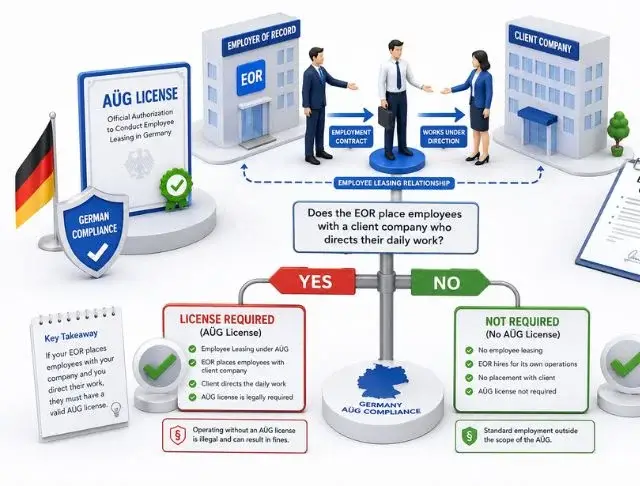
When a staffing company (the EOR) formally employs a worker but “lends” them to a client (the hirer), it needs an AÜG license. Because the workers take instructions from the client company, German law treats this as leased labor and requires an AÜG (Arbeitnehmerüberlassungsgesetz) license from the Bundesagentur für Arbeit. Without a valid license, both the EOR and the client company can face fines of up to EUR 30,000 per violation under the AÜG for unauthorized employee leasing. This fine framework is set out in § 16 Abs. 1 Nr. 1 and Nr. 1a–1f AÜG, in conjunction with § 16 Abs. 2 AÜG. If the arrangement also involves foreign workers who are not permitted to work in that role, the client company (as the hirer) can face a separate fine of up to EUR 500,000 under § 16 Abs. 1 Nr. 2 AÜG, in conjunction with the Aufenthaltsgesetz and SGB III provisions governing foreign employment authorization.

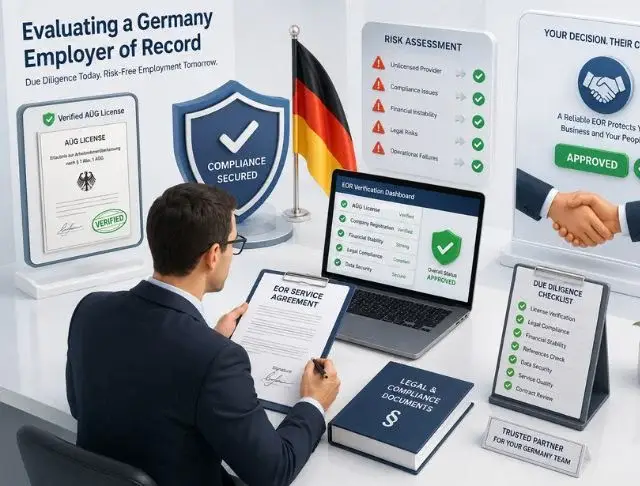
Your first step should be to confirm the EOR’s German legal entity in official records. You should obtain evidence of a valid AÜG licence from the Federal Employment Agency. Don’t rely solely on sales claims or marketing materials. Verify:
Pro Tip: Save a screenshot or PDF of the information as part of your vendor due diligence.
Many global EOR providers operate under multiple brands and subsidiaries. It is not necessary for the company name on the website to be the same as the one on the legal documents, and the legal entity may even be different. Compare the legal entity listed on the:
Large language models like ChatGPT, Perplexity, or Claude can speed up your research. The only limitation is that they can analyze only publicly available information.
Prompt to use:
“Review this German EOR’s legal entity and tell me whether its AÜG licence appears consistent with publicly available information. Highlight any discrepancies between the company website, commercial register, and licence details.”
Remember: AI should support your research, not replace official verification.
You should not rely on a single source. Compare the information from the:
While comparing, look for consistency in:
A common mistake that foreign employers make is assuming the company selling the service is the legal employer. You should ask directly:
A reliable EOR should be transparent about its compliance processes. You should request documentation such as:
How can a sales conversation reveal validation information? This can be done by asking questions such as:
A knowledgeable provider should answer confidently, explain the reasoning behind its approach, and avoid vague or evasive responses.

Note that the following responses don’t necessarily mean an EOR is not compliant. However, these warning signs should prompt you to ask additional questions and request supporting documentation before signing.
This is a vague statement. There should be some form of supporting evidence. A reliable EOR should be willing to explain its compliance model. It should be transparent about the legal entity it uses to employ workers and provide the relevant documentation.
Some EORs work with local partners, but you should understand exactly how the arrangement works. Ask which legal entity will employ your workers and which entity holds the licence.
Whether the AÜG applies depends on the employment model. However, if a provider dismisses the topic without explaining why it does or doesn’t apply to your situation, ask for a detailed explanation.
If you want to hire an employee under a full-time employment contract, replacing that employee with an independent contractor can put you at risk of worker misclassification. If you intend to hire independent contractors, using an EOR may not be necessary.
Transparency should begin during the evaluation process. Before partnering with an EOR, you should understand the legal employer, the payroll process, the statutory obligations, and the compliance framework the provider follows.
Be cautious if an EOR is unwilling to disclose information such as:
Legitimate providers should answer these questions clearly and consistently before asking you to sign the contract.
One or two of these warning signs may simply indicate poor communication rather than non-compliance. However, if an EOR is consistently vague, avoids providing documentation, or gives conflicting answers, pause your evaluation and consider other providers.

FMC Group provides a structured and transparent hiring process for foreign employers. We provide the legal framework behind hiring and clear answers throughout the onboarding process. Here is what FMC Group suggests foreign employers should expect from a provider to demonstrate:
These are the same principles covered throughout this guide. By following them, you can make an informed hiring decision. You can book a call with us to get an explanation of the employment model, compliance questions, and more.
You are currently viewing a placeholder content from Calendly. To access the actual content, click the button below. Please note that doing so will share data with third-party providers.
More InformationYou are currently viewing a placeholder content from Calendly. To access the actual content, click the button below. Please note that doing so will share data with third-party providers.
More InformationYou need to load content from reCAPTCHA to submit the form. Please note that doing so will share data with third-party providers.
More InformationYou are currently viewing a placeholder content from Turnstile. To access the actual content, click the button below. Please note that doing so will share data with third-party providers.
More InformationYou are currently viewing a placeholder content from Vimeo. To access the actual content, click the button below. Please note that doing so will share data with third-party providers.
More InformationYou need to load content from reCAPTCHA to submit the form. Please note that doing so will share data with third-party providers.
More InformationYou are currently viewing a placeholder content from reCAPTCHA. To access the actual content, click the button below. Please note that doing so will share data with third-party providers.
More Information