Remote work swept across Asia fast, but growth alone doesn’t tell the whole story. Behind the hiring numbers sit real gaps in pay, power, protection, and mental health that shape what remote work actually looks like on the ground. This piece breaks down both sides, the momentum and the friction, region by region.

Author
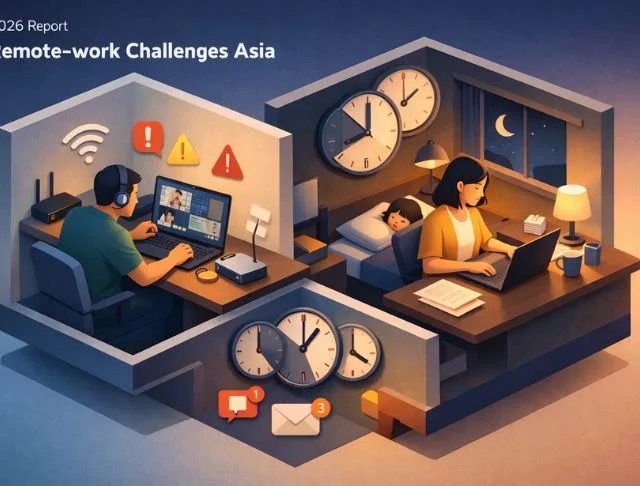
Remote work swept across Asia fast, but growth alone doesn’t tell the whole story. Behind the hiring numbers sit real gaps in pay, power, protection, and mental health that shape what remote work actually looks like on the ground. This piece breaks down both sides, the momentum and the friction, region by region.
Author

Remote work in Asia didn’t grow overnight. It moved step by step from a pandemic fallback to a real hiring strategy, and the shift shows up clearly once you break down the numbers year by year.
Back in 2020, most APAC companies were caught off guard. Only a small slice felt ready to send staff home, and a chunk admitted they weren’t prepared at all. Fast forward to today and the picture has flipped entirely. Full remote setups are now the norm at a majority of firms, and leadership across the region expects that trend to keep climbing over the next year or two.
Burnout crept in early too. Around a third of APAC workers pointed to blurred work-life lines as a top complaint once hybrid setups kicked in. Even so, the appetite for flexible roles kept growing, and by 2025 the vast majority of the region’s workforce said they’d take a remote or hybrid job if offered one.
Singapore stands out as the region’s frontrunner, pulling ahead of every other market when it comes to the share of its workforce working remotely. And looking ahead, most APAC firms say they plan to bring on more remote employees than they currently have, not fewer.
Job boards across Asia tell a clear story. Listings for remote roles jumped sharply in the last year, and the roles driving that surge say a lot about where the region is headed.
Software engineers topped the list, followed closely by marketing strategists and finance analysts. Hiring hot spots weren’t the usual suspects either. Vietnam, Taiwan, the Philippines, and India all saw a spike in demand for remote talent.
Asia isn’t just growing its own remote workforce. It’s also becoming a bigger part of global cross-border hiring, though it still trails one region by a wide margin.
Europe leads the pack when it comes to cross-border remote hires, but Asia has pulled ahead of North America. Within Asia itself, two countries stand out as the go-to hubs for global companies looking to hire remotely.
Growth hasn’t played out evenly across the region. Some subregions surged ahead while others moved at a much slower pace, and that gap sets up the challenges we’ll dig into next.
Singapore and the wider East Asia bloc have pulled ahead on adoption, while South Asia and Central Asia still lag behind despite having plenty of available talent.
Subregion | Total Population (2025) | Key Remote Work Indicators |
South Asia | 2.09 billion | India: 60–90 million projected remote workers by 2025; gig economy grew 38% in 2025; highest loneliness at 29% |
East Asia | 1.65 billion | South Korea: last globally at 0.5 hrs/week WFH; Japan and China at 0.6–0.7 hrs/week; Japan: 85% of companies plan remote full-time hiring |
Southeast Asia | 700 million | Singapore: 23% remote workers (global high); Philippines: 9% of global cross-border hires; Southeast Asia loneliness at 20% |
Western Asia (Middle East) | 314 million | GCC: 18% hybrid/remote overall; UAE leads at 21%; 87% of Gulf workers are open to remote or hybrid work |
Central Asia | 83.6 million | Platform and online freelance work is gaining traction; social protection gaps, irregular income, and limited skills development remain key challenges |
Resources: Remote, Ifcreview, Ews-limited, Remotlyjobs, Freshlybaked, Slasify, Hrmasia

Growth numbers only tell half the story. The real picture comes from looking at what’s actually holding remote workers back in each part of Asia, starting with the region carrying the heaviest structural load.
India dominates this region in sheer size, but size doesn’t mean things run smoothly. Workers here deal with a mix of thin infrastructure and overtime that never seems to let up.
Indian employees log more unpaid overtime than workers almost anywhere else in the world, and most say they’re stuck juggling work, health, and family without much breathing room. Gig work protection hasn’t caught up either.
Pakistan faces a tougher road. Power cuts and shaky internet keep the country ranked near the bottom for remote work readiness, and remote roles stay mostly confined to freelance and IT work. Bangladesh isn’t far behind, with mobile speeds among the lowest in the region and cybersecurity guidance that’s still thin on the ground.
Southeast Asia splits into two very different worlds. City-states run smoothly, while provincial and mainland markets still fight basic infrastructure problems.
Singapore sits at the top, leading the globe in remote worker share, with nearly half its professionals spending four days or fewer in the office each week. The Philippines tells a different story once you leave Metro Manila or Cebu. Power interruptions hit harder there than anywhere else in Asia, and provincial connectivity remains patchy at best.
Vietnam deals with a similar power problem. Outages can strike once or twice a week in some areas, and a major shortfall during 2023 heat waves left the north scrambling. Thailand, on the other hand, runs one of the best remote work setups in the region, with fast internet and rare outages, plus thriving co-working hubs in Bangkok and Chiang Mai.
Malaysia deserves a mention too. Burnout rates climbed sharply between 2022 and 2024, yet the country pushed through the world’s first comprehensive gig worker protection bill, covering over a million workers.
East Asia has the tech and infrastructure to support remote work easily. What it lacks is the culture to actually embrace it.
South Korea ranks dead last globally for actual remote work hours, and workplace engagement there sits at rock bottom too. Old habits around in-person supervision and seniority die hard. Japan isn’t much different. Despite strong hiring intent on paper, actual remote hours stay razor thin, and the country’s overwork culture still casts a long shadow.
China brings its own twist. Broadband speeds run fast, but the Great Firewall and VPN restrictions choke off access to tools like Zoom and Slack that most remote teams rely on. Taiwan fares a bit better on paper, with solid broadband and mobile speeds, though actual remote workdays per month stay modest.
Central Asia is still finding its footing. Freelance and platform work has opened doors, but the safety net underneath it barely exists.
Workers across Kazakhstan, Kyrgyzstan, Tajikistan, and Uzbekistan have found real opportunity in online freelance work, often earning more than they would in local job markets. The catch is that almost none of it comes with social protection or steady income.
Kazakhstan leads the pack on infrastructure, but the other three countries don’t even show up reliably in global connectivity rankings. A 2024 report on the region summed it up well: gig workers here operate in what amounts to a regulatory vacuum.
The Gulf presents an odd mismatch. Demand for remote work runs sky high, but adoption still lags far behind what workers actually want.
Most Gulf workers say they’d take a hybrid or remote role if given the chance, but only a small slice of managers feel confident their teams stay productive outside the office. Company policy hasn’t caught up either. Fewer than a third of firms have clear rules in place for how remote work should run.
Resources: Apecpublisher, Morganlewis, Secondtalent, Travelandtourworld, Reeracoen, Koreaherald, Asiae, Xisdxjxsu, Linkedin (Pakistan), Out-sourcy, Bayt, Remotlyjobs (MEA), Etf (europa), Joborbit, Talentshark, Eco-business, Singaporelawwatch

Culture and policy only explain part of the remote work puzzle. The rest comes down to something more basic: does the infrastructure actually hold up?
Speed varies wildly across the continent, and that gap alone decides whether remote work is even realistic in some markets.
Country | Fixed Broadband (Mbps) | Global Rank | Mobile (Mbps) | Notes |
Singapore | 386.96–624.19 | #1 | 127.75 | World leader |
Hong Kong (SAR) | 324.97–457.20 | #3–7 | — | Consistently in the global top 10 |
UAE | 318.42–413.2 | #4 | — | MENA leader |
South Korea | 259.62 | #9 | ~435 (5G) | Leading 5G infrastructure |
Thailand | 256.15 | #10 | — | Southeast Asia infrastructure leader |
Vietnam | 250.45 | #13 | — | Power reliability remains the key gap |
Taiwan | 248.13–172.44 | #14–46 | 113.96 | Performance varies by source and period |
China | 220–224.61 | #20–30 | — | VPN and firewall restrictions are a bigger issue than speed |
Kuwait | 229.63 | #19 | — | GCC leader after the UAE |
India | ~102 (fixed) | #102 | ~39–51 (mobile) | 69.6 Mbps average broadband; significant rural–urban gap |
Sri Lanka | 80.99–140.10 | #62–111 | — | Wide variation across reports |
Indonesia | 74.88 | #115 | 40.51 | Rural internet access remains a major barrier |
Cambodia | 81.17 (fixed) | #110 | 176.93 | Mobile internet is significantly faster than fixed broadband |
Pakistan | 47.48 | #97 | — | Among the slowest internet speeds in the region |
Bangladesh | 36.61 | — | — | Consistently below-average internet performance |
Afghanistan | 24.23 | #101 | — | Among the slowest internet speeds globally |
Fast internet means nothing if the power keeps cutting out. This turns out to be one of the biggest hidden threats to remote work across South and Southeast Asia.
The Philippines faces the worst of it, logging more annual supply interruptions than anywhere else in Asia. Vietnam isn’t far behind, with outages hitting once or twice a week in some regions. Bangladesh and Pakistan deal with non-scheduled load-shedding that can stretch six to twelve hours during peak seasons.
Country | Power Issue |
Philippines | 28 outages/year |
Vietnam | Weekly cuts |
Thailand | Rare outages |
India’s cities mostly dodge this problem, though rural and smaller cities still feel it, especially during monsoon season. Thailand remains the exception, with outages tied almost entirely to major storms. One risk shows up again and again in worker accounts from Vietnam and the Philippines: losing power mid-call with a client isn’t a hypothetical. It’s a real way people lose contracts.
Remote setups open the door to a whole new set of security headaches, and Asia has felt this sharply over the past few years.
Globally, most organizations dealt with a remote work security incident in 2024, and remote workers face triple the risk of falling for phishing attempts compared to office staff. The average breach now costs close to five million dollars, and ransomware attacks on remote systems climbed sharply since 2023.
Country | Attack Volume (2024) |
Vietnam | 19.87M attacks |
Indonesia | 14.7M attacks |
Thailand | 7.3M attacks |
Southeast Asia bore a heavy share of this. Kaspersky blocked tens of millions of brute-force attempts across the region in 2024 alone, averaging well over a hundred thousand attempts a day. Businesses in the region also faced hundreds of ransomware attacks daily, with Indonesia and Malaysia seeing the sharpest spikes.
Insider threats climbed too, and most organizations reported at least one such incident last year. The root cause, according to most APAC firms surveyed, comes down to one thing: employees simply don’t get enough training to spot these risks before it’s too late.
Resources: Statista, Speedtest, Worldpopulationreview, Datapandas, Seainfographics, Getwherenext, Cybersecasia, Securitybrief, Insiderisk, Csnp, Interpol, Itbrief, Worldbank

Money is often the real reason people chase remote roles in the first place, but the numbers reveal a picture that’s far more complicated than simple income growth.
Remote work has opened up serious earning potential for Asian professionals, especially those who land contracts with Western companies. An Indian tech worker earning a modest local salary can multiply that income tenfold by landing a US remote contract, all without ever leaving home.
That said, the gap isn’t always in the worker’s favor. Plenty of tech managers worldwide still lean toward hiring people willing to show up in person, and many will pay noticeably more for that. So even as remote pay climbs, plenty of companies quietly reward office presence over flexibility.
Country | Average Annual Tech Salary (Local) | Purchasing Power Adjusted | vs. US ($133,080) |
United States | $133,080 | $133,080 | Baseline |
Singapore | $71,352 | $79,280 | −40% nominal; −40% PPP |
India | $7,725 | $22,071 | −94% nominal; −83% PPP |
Philippines | ~$6,000–$8,000 (est. local) | — | ~−95% nominal |
Getting paid across borders sounds simple until you’re the one waiting on the transfer. Most freelancers worldwide have missed out on work or lost money simply because their currency didn’t play nice with a client’s payment system.
Most freelancers want their money within a day, but that’s rarely how it plays out. Banking systems in many countries just weren’t built for this kind of work, and a huge share of freelancers say local systems let them down. That’s part of why so many now want at least some of their income paid out in crypto or stablecoins, just to sidestep the volatility.
Platforms don’t make it free either. Wise takes a small FX cut, while Payoneer’s fees swing higher depending on the route the money takes. For freelancers in markets with shakier currencies like Pakistan, Bangladesh, or the Philippines, that gap between invoice date and payday can quietly eat into real earnings.
Resources: Highfive, Jobicy, Stealthagents, Globenewswire, Remotepass, Slasify, Singaporelawwatch, Etf (europa), Ibef

Pay and protection aside, the clock itself creates its own kind of pressure. Working remotely across time zones reshapes the whole rhythm of a person’s day, often in ways that quietly wear people down.
Long hours have become part of the deal for many remote workers in Asia, and the data backs that up clearly.
India tops the list for unpaid overtime worldwide. Singapore isn’t far behind either, with workers logging long weeks and barely any annual leave to recover. Japan and South Korea carry their own version of this problem, rooted in a culture that still glorifies overwork. Three of the five most overworked cities on the planet sit in Asia, while most cities known for healthy work-life balance are in Europe.
Time zones create a different kind of strain for Asian workers serving US or European clients. The overlap in working hours barely exists, and that forces some brutal schedules.
For anyone in Asia working with US clients, the only real overlap falls either very early in the morning or late into the night. Southeast Asia fits best for early risers who can jump on calls around dawn, since that lines up with evening hours on the US side.
| Route | Standard Business Hours Overlap (9am–5pm both sides) |
| India (IST, UTC+5:30) ↔ New York (EST, UTC-5) | Zero overlap (IST is 10.5 hrs ahead of EST) |
| Philippines (PHT, UTC+8) ↔ New York (EST) | Zero standard-hours overlap |
| Singapore (SGT, UTC+8) ↔ London (GMT, UTC+0) | 0–1 hours |
| Southeast Asia (UTC+7 to +9) ↔ US East Coast | Zero to minimal overlap |
| Middle East (UAE, UTC+4) ↔ London (UTC+0) | 4–5 hours |
| Asian Subregion | UTC Offset | Overlap with US EST (9–5) | Overlap with Western Europe (CET) |
| South Asia (India, Pakistan, Bangladesh) | +5:30 to +6 | None | 1.5–3 hrs (early CET morning) |
| Southeast Asia | +7 to +9 | None | 0–1 hr |
| East Asia (Japan, Korea, China) | +8 to +9 | None | 0–1 hr |
| Central Asia | +5 to +6 | None | 1–3 hrs |
| Middle East/West Asia | +3 to +4 | None | 3–5 hrs (best in region) |
Resources: Theaccessgroup, Hcamag, Hrhub, Worktime, Fmcgroup, Workanywhere, Eorquotes, Workinghours, Settlednomad

All these pressures, long hours, currency stress, weak protections, eventually show up somewhere. For a lot of Asian remote workers, that somewhere is their mental health.
Burnout numbers across Asia have climbed fast, and remote work sits right at the center of it.
Country/Market | Burnout Rate | Year | Source |
Malaysia | 67% | 2024 | Employment Hero Wellness at Work Report[^28] |
Singapore | 61% | 2024 | Employment Hero Wellness at Work Report[^53] |
Singapore (MOM data) | ~33% reporting stress/burnout | 2024 | Singapore Ministry of Manpower[^54] |
Asia-Pacific (remote workers) | ~1 in 3 | 2020–ongoing | Microsoft Work Trend Index[^4] |
Global (fully remote) | 86% | 2026 | WorkTime analysis[^48] |
Global (fully remote, Gallup) | More likely to report anger, sadness, loneliness than on-site | 2025 | Gallup[^55] |
Non-native/expat employees | 49% burnout from job | 2024 | AXA Global Healthcare Mind Health Report[^56] |
Malaysia’s jump stands out the most, climbing nine points in just two years. Singapore isn’t far off either, and younger workers there carry the heaviest load, with Gen Z and Millennials hit hardest. Oddly enough, fully remote Malaysian workers still rated their work-life balance higher than hybrid or in-office peers, which points to a strange paradox. Flexibility helps balance day to day life, but it also seems to feed burnout at the same time.
Working alone all day takes a toll that doesn’t always show up right away. A fifth of workers worldwide say they feel lonely on a daily basis, and remote workers report that far more than anyone else.
South Asia posts the highest loneliness numbers on the planet. South Korea backs this up from another angle too, with employee engagement sitting near rock bottom, and disengaged workers reporting loneliness at nearly double the rate of engaged ones.
Research out in 2026 dug into this further and found that most remote workers spend their entire day working completely alone. That same research tied remote work to a meaningful chunk of the overall decline in mental health seen over the past decade and a half, hitting people who live alone especially hard.
Here’s the twist though. Fully remote workers report feeling the most engaged at work globally, yet they’re also less likely to say they’re thriving in life overall compared to hybrid or in-office workers. Stress shows up more often for them too, on a day to day basis.
Resources: Hrhub, Hcamag (burnout), Gallup, Channelnewsasia, Science, Pmc, Stealthagents (mental), Stealthagents (loneliness), Threvi, Fastcompany, Straitstimes, Axa, Frontiersin, Techstorm

Remote work hasn’t treated everyone the same. For some women it opened doors that never existed before, while for others it just added new walls, and the numbers below show exactly why.
Teleworking among Asian women grew at a stunning pace in just five years, jumping from a tiny share in 2019 to nearly a third by late 2024. That’s real progress on paper, but it comes with a catch that often gets left out of the conversation.
Fully remote roles, which skew more female, come with a real career cost. Workers in these roles get promoted far less often than people who show up to an office, and a large study of nearly 30,000 workers confirmed the penalty hits women harder since they choose remote setups more often.
Saudi Arabia shows the upside of this shift. Women’s unemployment there dropped sharply between 2022 and 2024, and labor force participation more than doubled since 2016. But those wins cluster around educated, urban women in digital roles. Rural and lower-income women barely see the benefit. Pakistan sits at the other extreme, where the gap between male and female labor force participation still runs at 45 percentage points.
Resources: Siai, Av, Nationalpartnership, Weforum, Dergipark, Undp, Oecd, Tandfonline, Phys, Theglobaleconomy, Ilo, Nation, Hcamag, Forbes
Numbers at the regional level only go so far. Zooming into individual countries shows just how different the remote work experience really looks depending on where you are.
India’s remote workforce deals with a stack of overlapping problems that go far beyond just internet speed.
Multigenerational households often mean families have to coordinate schedules and space just to make a workday function. Power instability pushes some workers to buy backup systems on their own dime. Bandwidth gets split across several family members sharing the same connection, and surveillance software adds another layer of pressure on top of it all.
There’s an emotional cost too. Workers often have to manage family expectations around being physically present at home while staying professionally available at the same time. And the divide between cities and smaller towns remains stark. Rural and Tier 2/3 professionals face infrastructure and skill gaps that big-city workers simply don’t run into.
The Philippines shows just how uneven remote work access can be within a single country.
Metro Manila and Cebu can support remote work just fine, but step outside those hubs and things fall apart fast. Broadband in Eastern Visayas runs far slower than the capital, creating a real two-tier system depending on where you happen to live.
Power remains the biggest career risk though. With close to 30 supply interruptions a year, workers on live client calls face a real chance of getting cut off mid-conversation. Add in an underdeveloped digital payment system that still leans heavily on cash, plus a typhoon season that disrupts connectivity on its own schedule, and it’s clear why remote work here stays concentrated in just a couple of cities.
Pakistan trails most of its South Asian neighbors when it comes to remote work readiness.
Internet speeds sit well below the regional average, and non-scheduled power outages during peak seasons can knock workers offline for hours at a stretch. Layer on top of that is one of the lowest female labor force participation rates in the world, and the pool of women able to take on remote roles shrinks dramatically.
Most workers operate in the informal sector too, which means they often lack the kind of formal contracts that remote roles typically require. And with no national policy covering freelancers or gig workers, remote work stays mostly confined to Karachi, Lahore, and Islamabad.
Indonesia’s geography alone creates one of the toughest remote work landscapes in the region.
Spread across more than 17,000 islands, connectivity varies wildly between urban centers and everywhere else. The country’s Remote Worker Visa also excludes a lot of freelancers and self-employed workers, which limits who can actually take advantage of it legally.
Cybersecurity adds another layer of risk here, since Indonesia leads Southeast Asia in ransomware detections. On top of infrastructure and security concerns, cross-cultural communication issues have been well documented for Indonesian teams working with US and European clients, and AI adoption threatens to widen existing gaps among gig workers even further.
Vietnam presents an unusual mix of strengths and weaknesses that sets it apart from most of its neighbors.
Broadband speeds actually rank quite high globally, but power reliability tells a completely different story. Some markets see outages once or twice a week, and the country’s ongoing electricity generation shortfall means brownout risk isn’t going away anytime soon.
That makes Vietnam’s core problem different from most of Asia. It’s not bandwidth holding workers back, it’s the power grid. On top of that, English proficiency slipped noticeably last year, creating a real hurdle for anyone trying to work directly with international clients. Digital nomad visa rules remain unsettled too, leaving tax and compliance questions unresolved for foreign remote workers based there.
Resources: Worldbank (South Asia), Wjarr, Insightsonindia, Economictimes, Gizguide, Bworldonline, Dict, Getclaude, Pbs, Xisdxjxs
Asia’s remote work boom is real, but it isn’t simple. Growth numbers look strong on paper, yet infrastructure gaps, weak worker protections, and cultural resistance still hold large parts of the region back. Pay gaps, time zone strain, and burnout add further pressure, especially for women and workers outside major cities.
The path forward isn’t just about more hiring. It comes down to better infrastructure, fairer policy, and real investment in the people doing the work. Companies that get this right will find no shortage of skilled talent across the region ready to deliver.
You are currently viewing a placeholder content from Calendly. To access the actual content, click the button below. Please note that doing so will share data with third-party providers.
More InformationYou are currently viewing a placeholder content from Calendly. To access the actual content, click the button below. Please note that doing so will share data with third-party providers.
More InformationYou need to load content from reCAPTCHA to submit the form. Please note that doing so will share data with third-party providers.
More InformationYou are currently viewing a placeholder content from Turnstile. To access the actual content, click the button below. Please note that doing so will share data with third-party providers.
More InformationYou are currently viewing a placeholder content from Vimeo. To access the actual content, click the button below. Please note that doing so will share data with third-party providers.
More InformationYou need to load content from reCAPTCHA to submit the form. Please note that doing so will share data with third-party providers.
More InformationYou are currently viewing a placeholder content from Elfsight. To access the actual content, click the button below. Please note that doing so will share data with third-party providers.
More InformationYou are currently viewing a placeholder content from reCAPTCHA. To access the actual content, click the button below. Please note that doing so will share data with third-party providers.
More Information