
Hiring employees in Germany sounds simple.
It could be simple as long as foreign employers do not face German employment laws, payroll regulations, social contributions, and compliance requirements. Hiring becomes more challenging when companies want fast hiring, specific roles, or full compliance with the law.
A single mistake in contracts, tax withholding, or employee classification can lead to penalties and operational delays. That’s why most foreign employers want to outsource hiring to an Employer of Record service provider and get employees with the desired results. If you’re interested in how an Employer of Record works in Germany, whether it is right for you or not, then this post is for you.

Author

Hiring employees in Germany sounds simple.
It could be simple as long as foreign employers do not face German employment laws, payroll regulations, social contributions, and compliance requirements. Hiring becomes more challenging when companies want fast hiring, specific roles, or full compliance with the law.
A single mistake in contracts, tax withholding, or employee classification can lead to penalties and operational delays. That’s why most foreign employers want to outsource hiring to an Employer of Record service provider and get employees with the desired results. If you’re interested in how an Employer of Record works in Germany, whether it is right for you or not, then this post is for you.
Author
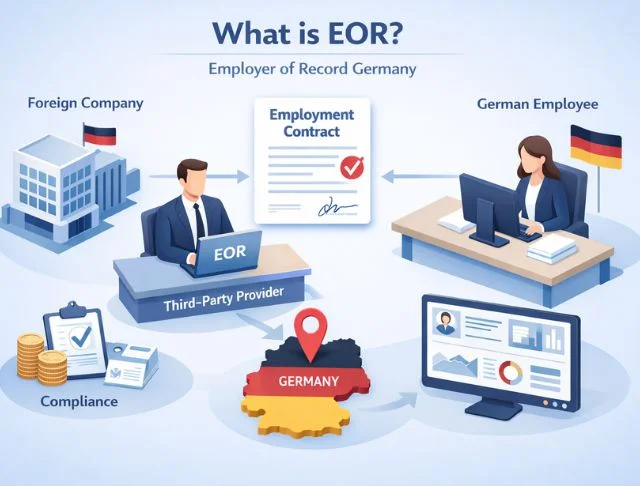
An Employer of Record (EOR) in Germany is a third-party company that legally employs workers on behalf of a foreign business. EOR services are structured under the Employee Leasing Act (Arbeitnehmerüberlassungsgesetz, AÜG). This means the EOR must hold a valid employee leasing license to legally employ and assign workers to client companies.
The EOR becomes the official legal employer, while foreign companies manage employees’ daily work and responsibilities. In Germany, an EOR handles employment-related obligations such as:
This service is especially useful for foreign companies that want to:
Before jumping into this structure, foreign employers should understand how an EOR works in Germany step by step. Let’s get into it.

The first step in the Employer of Record process is selecting a reliable EOR provider.
This decision is important because the EOR will handle sensitive responsibilities such as contracts, payroll, taxes, social contributions, and compliance with German labor laws.
Before choosing a provider, the foreign company usually defines its hiring goals, which include:
Once you have made the above requirements clear, your next step should be evaluating an EOR. A compliant EOR provider in Germany should be able to:
After setting company scaling goals and evaluating the Employer of Record service provider, you partner with it. Then, the next step the EOR takes is preparing the contract.
German labor laws are highly regulated. So, employment contracts must include specific terms and conditions that meet local legal requirements. At this stage, the foreign company shares the final hiring details with the EOR, which include:
Once the EOR receives the above information, it drafts the employment agreement according to German employment laws. The contract usually includes important terms such as:
After finalizing the contract, the EOR sends the offer to the candidate for review and signature. The employee is officially ready for onboarding and legal registrations in Germany once both parties sign the agreement.

After the employment contract is signed, the Employer of Record officially hires the employee in Germany and becomes the legal employer on record.
The EOR handles mandatory employment registrations, payroll setup, tax withholding, and social security enrollment according to German labor laws.
At this third stage, the EOR has legally employed the worker, and foreign companies can now manage the employee’s daily work, tasks, and performance.
Many countries require employers to register local entities before hiring, and an EOR removes this requirement. However, it is not essential in Germany to have a local entity for hiring.
Once onboarding and legal registration are completed, the employee officially starts working for the foreign company.
Does the EOR still remain the legal employer?
Yes, it does and charges monthly fees, not for this status, but for managing payroll, taxes, social contributions, and more. Meanwhile, foreign companies manage the employee’s daily responsibilities, projects, communication, and performance.
The employee works as part of the company’s internal team just like a regular employee. In essence, the company assigns tasks, sets goals, manages schedules, and conducts performance reviews. The EOR handles everything from a legal perspective.
After the employee starts working, the Employer of Record manages monthly payroll and salary payments in Germany.
Your selected Employer of Record service provider calculates gross-to-net salaries, withholds income taxes, and ensures payroll complies with German regulations.
The EOR also issues payslips, processes salary payments in the local currency, and submits required payroll reports to German authorities. That seems simple, but it is very complex, time-consuming, and comes with legal risks. That’s why companies avoid payroll errors, late tax filings, and compliance risks by using an EOR.

The Employer of Record also manages mandatory social security contributions and employee benefits.
This includes handling payments for health insurance, pension insurance, unemployment insurance, long-term care insurance, and other employer obligations.
In addition, the EOR administers employee benefits such as paid vacation, sick leave, parental leave, and public holiday entitlements.
The Employer of Record continuously monitors German labor laws. The reason is that these laws are continually updated. The EOR manages legal obligations related to payroll, working hours, employee protections, leave policies, tax reporting, and social contributions.
Ongoing compliance in Germany also includes proper record management, compliant HR processes, and GDPR requirements. This reduces compliance risks and helps foreign companies avoid penalties, legal disputes, and administrative issues.
The Employer of Record also handles ongoing HR and administrative support for employees in Germany.
This means the EOR’s experts manage onboarding documents, employee records, payroll information, and HR-related requests.
The EOR may also assist with leave management, contract updates, expense reimbursements, and employee offboarding when needed.
One hidden benefit that an EOR provides to companies is that it reduces the operational burden on the foreign company and manages employees smoothly throughout the employment lifecycle.
If the employment relationship ends, the Employer of Record manages the termination process according to German labor laws.
Elaborating on the point, the EOR handles legal requirements such as notice periods, final payroll calculations, unused vacation payments, and required employment documentation.
Since Germany has strict employee protection laws, improper termination can create legal and financial risks for foreign employers.
Responsibility Area | Foreign Company Responsibilities | Employer of Record (EOR) Responsibilities |
Daily Work Management | Assigns tasks, projects, and deadlines | No involvement in daily operations |
Employee Performance | Manages KPIs, reviews, and productivity | May support HR documentation if needed |
Team Integration | Includes employee in meetings, tools, and company culture | Handles administrative employment support |
Hiring Decisions | Selects and approves candidates | Legally hires the employee |
Employment Contract | Provides role and compensation details | Drafts compliant German employment contracts |
Payroll Processing | Approves compensation and bonuses | Processes payroll and salary payments |
Tax Withholding | No direct responsibility | Calculates and withholds German payroll taxes |
Social Security Contributions | No direct responsibility | Registers and manages mandatory contributions |
Employee Benefits | Decides benefit structure if applicable | Administers mandatory benefits and leave |
Legal Compliance | Follows operational employment practices | Ensures compliance with German labor laws |
HR Administration | Manages internal communication and expectations | Maintains employee records and HR documents |
Termination Decisions | Decides whether employment should end | Handles legally compliant termination process |
Data Protection | Follows internal security practices | Maintains GDPR-compliant employee data handling |
Legal Employer Status | Not the legal employer in Germany | Becomes the official legal employer on record |
FMC Group is a German-owned Employer of Record service provider. They have been providing EOR services for over 15 years in 45 countries. To operate as an EOR in Germany, a provider must be licensed, and we hold that license.
If you are interested in learning more about us, schedule a free 30-minute consultation call and discover how we can help scale your team in Germany.
You are currently viewing a placeholder content from Calendly. To access the actual content, click the button below. Please note that doing so will share data with third-party providers.
More InformationYou are currently viewing a placeholder content from Calendly. To access the actual content, click the button below. Please note that doing so will share data with third-party providers.
More InformationYou need to load content from reCAPTCHA to submit the form. Please note that doing so will share data with third-party providers.
More InformationYou are currently viewing a placeholder content from Turnstile. To access the actual content, click the button below. Please note that doing so will share data with third-party providers.
More InformationYou are currently viewing a placeholder content from Vimeo. To access the actual content, click the button below. Please note that doing so will share data with third-party providers.
More InformationYou need to load content from reCAPTCHA to submit the form. Please note that doing so will share data with third-party providers.
More InformationYou are currently viewing a placeholder content from Elfsight. To access the actual content, click the button below. Please note that doing so will share data with third-party providers.
More InformationYou are currently viewing a placeholder content from reCAPTCHA. To access the actual content, click the button below. Please note that doing so will share data with third-party providers.
More Information

