
As companies increasingly need to hire employees quickly, often across borders, Employer of Record (EOR) services are rapidly gaining popularity.
Many organizations rely on EOR providers to employ workers and manage payroll both locally and internationally without the need to establish a legal entity in each country.
As of 2026, there are approximately 800 EOR companies worldwide, transforming traditional hiring into a faster and more flexible process.
With that in mind, let’s explore how EOR providers are reshaping the global hiring industry.

Author

Co-author

As companies increasingly need to hire employees quickly, often across borders, Employer of Record (EOR) services are rapidly gaining popularity.
Many organizations rely on EOR providers to employ workers and manage payroll both locally and internationally without the need to establish a legal entity in each country.
As of 2026, there are approximately 800 EOR companies worldwide, transforming traditional hiring into a faster and more flexible process.
With that in mind, let’s explore how EOR providers are reshaping the global hiring industry.
Author
Co-author
Get in Touch with Us

Leah Maglalang
Business Coordinator UAE


An IEC Group survey identified 800+ EOR firms globally (2025).
Market size (2023–2025): The global EOR market grew from $4.4B (2023) → $5.2B (2024) → $5.5B (2025).
Client adoption: By 2024, 35% of companies used EORs for international hires. Mid-sized firms adoption rose to 47% for remote teams.
Market CAGR: Multiple sources estimate 6–8% annual growth through the late 2020s. Exactitude Consultancy projects 9.5% CAGR to 2034. Atlas (IEC) forecasts $10B by 2028.
Usage growth: One report cites 28% global growth in EOR usage in 2023 (Fueled by remote hiring). This reflects uptake but not provider count change.
New entrants: The IEC 2025 study highlights new “leadership entrants” (WorkMotion, Mercans, Skuad/Payoneer WFM) moving into top ranks. Other analysis notes dozens of regional EOR startups are active (e.g. G-P acquired Patycro for LATAM expansion).
Funding and M&A: EOR firms have raised $5.1B in venture/private capital to date, and large payroll/HR companies are partnering or acquiring EOR capabilities (e.g. ADP with Globalization Partners). This investment trend implies many new entrants, but exact counts are undetermined.
Market vs providers: The EOR market is expanding rapidly ($5.5B in 2025), and the number of providers is large (hundreds).
Fragmentation: The fact that 800+ providers serve the market implies many are small; market growth (6–9% CAGR) slightly outpaces a doubling of providers (if any). In other words, average revenue per provider may be rising as usage scales.
Reports project market size (e.g. $8–10B by 2030). Continuing market expansion (to $8–12B by 2030) implies more providers or larger scale for existing ones. Industry commentary expects more startups and even IPOs in 2025–26.
Sources: FMC Group, EINPressWire, OEMAmerica, DelanceyStreetPartners
Region | Share of Global EOR Market (approx.) |
North America (US, Canada) | 40–45% |
Europe | 28–30% |
Asia-Pacific | 22–24% |
Latin America | 4% |
Middle East & Africa | 9% |
Market share: North America (mainly the US) holds the largest share (≈40–45% of global revenue).
Key country (USA): The US drives this share, with 71% of companies allowing remote work in 2024. About 35% of US cross-border hires in 2024 were handled via EOR. Many top global EOR providers are US-founded.
Canada: Canada’s market is smaller but integrated; EORs simplify cross-border hiring under USMCA.
Market share: Europe accounts for 28–30% of global EOR activity. The EOR market in Europe is estimated at $1.93B in 2024.
Key hubs: Western Europe dominates – the UK, Germany, France and the Netherlands are the largest markets. (Brexit and varied EU labor laws have driven demand in the UK/EU).
Providers: Many EOR firms are European-based or have strong local operations (e.g. FMC Group, WorkMotion, TMF, Papaya). Europe’s regulatory complexity (GDPR, labor protections) underlies its large share.
Market share: APAC holds 22–24% of global EOR revenue. Dataintelo reports APAC $1.61B in 2024 with 17.1% CAGR. SSR forecasts 10% CAGR through 2034.
Key markets: India, China, Singapore, and UAE (though UAE straddles MEA) are major APAC hubs. APAC is the fastest-growing region.
Providers: Regional specialists (e.g. Multiplier, Globalization Partners Asia, Safeguard Global) operate here.
Market share: MEA (9% of global market) is smaller but rapidly growing. In the Middle East, the UAE and Saudi Arabia are focal points. 97% of UAE firms plan expansion and 41% will use external hiring partners (like EORs).
Drivers: Unique local rules (visa sponsorship, Saudization quotas) create demand for EORs. Africa’s EOR market is nascent; key countries include Nigeria, Kenya, South Africa.
Market share: Latin America is 4% of the global EOR market (much smaller than NA/EU).
Growth: However, demand is strong – one report notes 12% annual growth in LATAM EOR usage. A survey found 48% growth in LATAM EOR usage from 2022–2024.
Key countries: Brazil and Mexico are largest, with Colombia/Chile emerging (nearshoring by US/EU firms). Several regional EOR providers and G-P/Deel expansion have targeted LATAM.
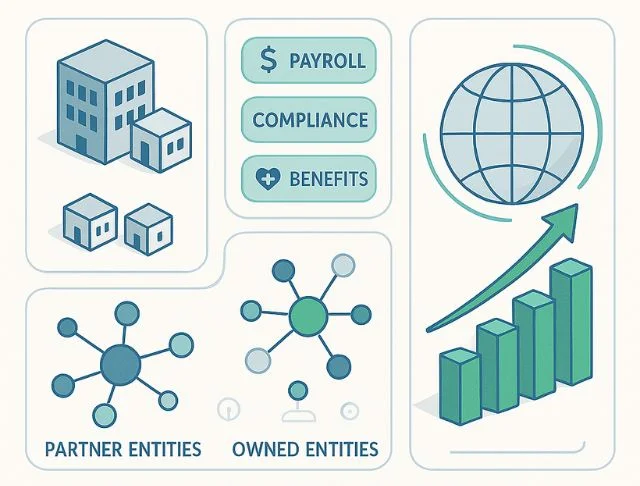
Client mix: SMEs (small/medium businesses) constitute 50%+ of EOR clients. Many popular EOR platforms (Deel, Oyster, Remote) initially targeted startups/tech SMBs.
Enterprise EOR: Global enterprises also use EORs; firms like Oracle, IBM partner with EORs for international staffing.
Service offerings: All EORs provide core services (local employment contracts, payroll, statutory benefits, taxes). Some bundle additional modules (contractor management, HRIS integration, global payroll orchestration).
Entity models: Providers differ by entity ownership. Valuates reports the aggregator model (partner networks) holds 68% market share, versus 32% in wholly-owned models.
Examples: G-P and Atlas HXM own many local entities, whereas Deel and Remote use partner networks. IEC notes that entity ownership is a key differentiator .
Tech adoption: 38% of providers use AI in payroll/compliance automation. 34% offer multilingual onboarding and real-time compliance features.
HRIS/Cloud: According to an SSR industry post, 38% of new EOR deployments use cloud-based HRIS platforms. AI-driven onboarding grew 32% year-over-year, and AI tools improved compliance error detection by 29%.
General: Many EORs emphasize tech integration (APIs, self-serve portals).
Global coverage: Leading platforms advertise very broad coverage. Examples: Deel supports employees in 150+ countries; Atlas HXM in 160+; Borderless AI in 170+. People-first EOR; FMC Group covers over 50 countries.
Small/local EORs: Smaller or regional providers cover far fewer markets. For instance, a specialized Latin American EOR might cover 2–5 countries.
Sources: SSR, WFA, GiniTalent

PEO scale (US): In the US, PEOs serve 208,000 businesses (3.9M worksite employees). PEOs (e.g. ADP TotalSource, TriNet) are dozens-to-hundreds in number (NAPEO lists 850 PEOs in the US).
Market presence: PEOs predominantly serve domestic clients; EORs serve cross-border clients. A 2025 guide notes “PEOs specialize in U.S. domestic HR, whereas EORs focus on international hiring”.
EOR vs gig platforms: Global employment platforms (Upwork, Fiverr, Deel’s contractor services, etc.) have thousands of clients but cater to contractors. EOR is a narrower category for employees.
Overlap: Some companies offer both EOR and contractor solutions (e.g. Deel). However, the number of “employment platforms” is much larger (e.g. LinkedIn, Upwork) and not directly comparable.
Legacy vs startup: Traditional payroll/HR outsourcers (ADP, Paychex, TriNet, Insperity) dominate the U.S. market, but these have only recently begun offering EOR-like services via partners.
EOR startups: Many modern EORs (Deel, Remote, Oyster, Papaya, Velocity) are VC-backed. Combined VC funding is $5.1B, indicating rapid growth.
Market presence: Legacy outsourcers have global payroll, but dedicated EOR startups now own most of the “pure-play” EOR market.

Market concentration: The five largest EOR firms account for roughly 47% of market share. (Globalization Partners, Deel, Remote, Multiplier, Oyster/Papaya are typically cited among the top vendors.)
Leaders: Globalization Partners (“G-P” on the IEC map) is consistently rated as the market leader. Multiplier and others occupy the high-performance quadrant as well.
Emerging leaders: The IEC study highlights new entrants (WorkMotion, Mercans, Skuad/Payoneer WFM) moving into top ranks.
Coverage: Top providers advertise vast coverage (150–170+ countries). Broad coverage and technology features are key competitive factors.
Recent shifts: Industry reports note some churn at the top. For example, IEC 2025 mentions “Downgrades: Several prior leaders lost position” and specifically that Deel was temporarily excluded due to controversies.
Regional concentration: As noted, NA (40–45%) and Europe (28–30%) dominate. APAC (22–24%) is significant; LATAM and MEA together are under 15%.
New entrants: The IEC report (May 2025) specifically names WorkMotion, Mercans, Skuad/Payoneer as new leaders joining the top ranks. These companies have rapidly expanded coverage and revenue in a few years.
Established firms: Legacy players (G-P, Multiplier, Papaya, Remote, Oyster, Velocity) continue to hold large shares. Many top providers (except G-P) launched in 2015–2020, so they are still “startups” in age.

Pricing tiers: EOR providers typically use tiered plans (e.g. “Startup/SMB” vs. “Enterprise”).
Typical fees: Most EORs charge a flat monthly fee per employee. Globally, the average EOR fee is roughly $200–$600 per employee per month (≈10–15% of salary).
Examples of pricing: Some providers market low entry prices (e.g. Remote People starts at $199/emp/mo), while others have higher base fees (e.g. Oyster’s EOR plan starts at $699/emp/mo).
Regional fee ranges: EOR costs vary by region (reflecting local labor complexities). Typical monthly fees per employee by region are:
Region | Typical EOR Fee (USD/emp/month) |
Latin America | $300–$500 |
Asia-Pacific | $350–$600 |
Middle East | $400–$700 |
Africa | $300–$550 |
Global average | $400–$600 (10–15% of salary) |
Pricing models: Nearly all EORs quote custom pricing on request; few publish standard packages. Flat per-employee fees are most common.
Cost vs in-house: EORs typically cost $300–$800 per emp/mo (depending on country/services), whereas establishing a local entity can cost $2,000–$10,000+ one-time plus overhead. Studies note EOR is more cost-effective when hiring ≲10–15 people in a country. In other words, EOR premiums often pay off in saved setup time and risk mitigation.
Many EOR vendors are listed on sites like G2 and Capterra. For instance, G2’s “Employer of Record” category (mid-2025) lists 82 products (English). (This approximates providers or software solutions in the EOR space.)
Few public NPS scores for EORs. Notably, Rippling reports a G2-based Net Promoter Score of 90 (as of Jan 2026), indicating exceptional customer satisfaction.
AI-driven platforms: Major EORs are embedding AI. Example: Globalization Partners (G-P) launched a next-gen EOR platform using “agentic AI” for compliance and support. Borderless AI (a vendor) also highlights AI for contract generation.
Self-service features: Most modern EORs offer client portals. G-P’s new EOR emphasizes self-service onboarding (users can complete hiring and onboarding themselves).
Automation: EORs leverage automation for workflows. For instance, Borderless AI touts automated contract generation and compliance checks, and G-P’s Global Compliance Engine auto-applies labor law rules in real time.
APIs & integration: Many EORs provide developer APIs. Deel’s API allows creating EOR contracts in 150+ countries. G-P’s platform is explicitly “API-first” with a developer portal for integration.
The EOR market is on the rise, and the number of Employer of Record companies is increasing due to the growing demand for remote and fast hiring.
As remote companies and remote workers continue to increase, EOR services are experiencing sustained growth.
For a detailed market overview of the EOR industry, consider reading Employer-of-Record Market: Size, Growth & Trends 2026.
You are currently viewing a placeholder content from Calendly. To access the actual content, click the button below. Please note that doing so will share data with third-party providers.
More InformationYou are currently viewing a placeholder content from Calendly. To access the actual content, click the button below. Please note that doing so will share data with third-party providers.
More InformationYou need to load content from reCAPTCHA to submit the form. Please note that doing so will share data with third-party providers.
More InformationYou are currently viewing a placeholder content from Turnstile. To access the actual content, click the button below. Please note that doing so will share data with third-party providers.
More InformationYou are currently viewing a placeholder content from Vimeo. To access the actual content, click the button below. Please note that doing so will share data with third-party providers.
More InformationYou need to load content from reCAPTCHA to submit the form. Please note that doing so will share data with third-party providers.
More Information