
Germany’s skilled worker shortage has moved well past the point of being a hiring headache. It is now a structural crisis driven by demographics, skill mismatches and a retirement wave that no visa program has fully offset yet.
The numbers tell a story that cuts across every sector and every region. From Bavaria’s rural districts to NRW’s construction sites, from hospital wards to IT departments, the gap between open roles and qualified people keeps showing up in the data, year after year.
This post breaks down the full picture with verified statistics covering vacancy trends, regional gaps, immigration data, wage pressure, sector breakdowns and demographic projections through 2035.

Author
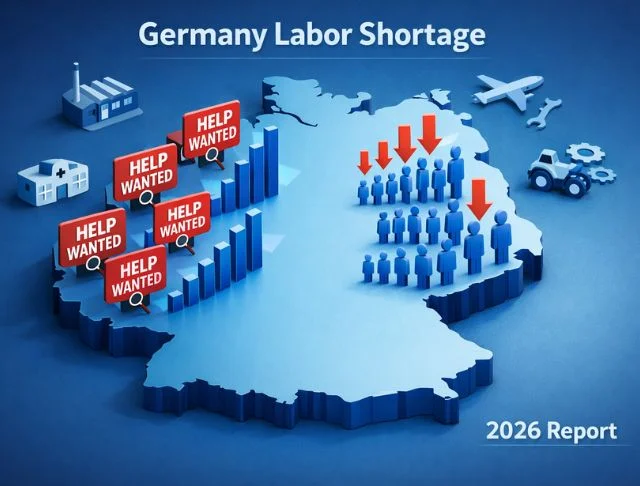
Germany’s skilled worker shortage has moved well past the point of being a hiring headache. It is now a structural crisis driven by demographics, skill mismatches and a retirement wave that no visa program has fully offset yet.
The numbers tell a story that cuts across every sector and every region. From Bavaria’s rural districts to NRW’s construction sites, from hospital wards to IT departments, the gap between open roles and qualified people keeps showing up in the data, year after year.
This post breaks down the full picture with verified statistics covering vacancy trends, regional gaps, immigration data, wage pressure, sector breakdowns and demographic projections through 2035.
Author
Germany’s skilled worker crisis is not a new story, but the numbers keep demanding attention. Here’s a clear breakdown of where things stand and where they’re headed.
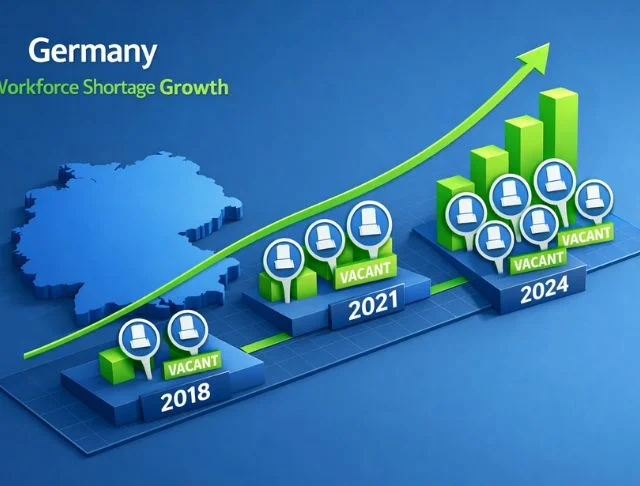
The gap between open jobs and qualified workers hit its peak around 2022–2023. According to KOFA (IW) data, roughly 532,000 positions went unfilled in 2023 due to a lack of qualified workers. That number dropped to around 487,000 in 2024 and further to about 369,516 in 2025.
But a drop doesn’t mean relief. One-third of all skilled vacancies still went unfilled in 2025.
Overall demand eased after 2023. Open vacancies for skilled workers fell about 4.3% from 2023 to 2024. That followed a 4.2% drop in 2023 already.
The sharpest fall came in ICT. IT vacancies dropped 26.2% in 2024, landing at around 46,400 openings.
Construction and personal services held on to the tightest shortages. As of January 2026, around 30.4% of construction firms still reported gaps. Transport and logistics firms came in at 30.6%, down from 42.7% previously. Manufacturing sat lower at around 16.6%.
Germany’s labor market stayed extremely tight through this period. In Q1 2024, the employment rate sat at around 77.4% with unemployment at just 3.3%, near historical lows.
Here’s what makes the situation tricky. Around 1.14 million skilled workers were unemployed in 2024. Yet hundreds of thousands of jobs still went unfilled.
The reason? A clear mismatch. Only about 25% of unemployed workers searched in bottleneck occupations. Meanwhile, roughly half of the 439,000 full-time skilled job postings in 2024 came from those exact shortage fields.
That mismatch left around 487,000 vacancies unfillable in 2024 and 369,000 in 2025.
Demographics sit at the core of this problem. The baby-boomer generation will retire over the next 10 to 15 years, and that will pull a massive chunk out of the active workforce.
Nursing shows the sharpest projection. Demand is expected to rise 33% by 2049, going from 1.62 million in 2019 to around 2.15 million. That could create a shortage anywhere between 280,000 and 690,000 nurses.
Research models from BIBB and IAB point to the same conclusion. Even with more women and older workers staying in the workforce, mid-skill shortages will persist well into 2030. The IW and BDA forecast up to 768,000 skilled positions going missing by 2028 as retirements accelerate.
The gap is expected to grow again in the near term. An IW study from August 2024 projects around 728,000 missing skilled workers by 2027 if trends from 2016 to 2023 continue. Social care, childcare and social work face the steepest deficits.
Sources: Iwkoeln, Ifo, Oecd, Arbeitsagentur, Destatis, Bibb, Arbeitgeber, Prognos

The skilled worker shortage does not hit every region the same way. Geography, industry mix and population density all shape how acute the problem gets on the ground.
Bavaria carries one of the largest absolute gaps in the country. In 2024, around 137,000 skilled positions were unfillable there. That followed a peak of about 161,000 in 2023.
The numbers eased slightly but remained high. Some Bavarian districts feel the pressure far more than others. Weiden district stood out with 77.5% of skilled vacancies having no suitable applicants. That was the highest rate in all of Germany.
Southern regions, especially Bavaria, consistently show much higher vacancy difficulty than eastern states.
NRW’s absolute gap is smaller. In 2025, around 56,392 skilled vacancies went unfilled. That puts 26.7% of all open vacancies without qualified applicants.
Most of the deficit fell at the trained-worker level. Construction trades led to the shortfall.
Baden-Württemberg averaged around 47,049 missing skilled workers in 2025. That works out to 34.9% of all vacancies without qualified candidates.
Certain areas within the state showed much sharper pressure:
District | Unfilled Rate |
Offenburg | 54.9% |
Ulm | 49.9% |
Ludwigsburg | ~30% |
Heidelberg | ~31% |
The largest gaps came at the vocational level, pointing to a shortage of trade-trained workers rather than university graduates.
The divide runs more North–South than East–West. KOFA data show southern Germany, especially Bavaria, carrying the most severe bottlenecks.
Out of 11 districts with unfilled vacancy rates above 70%, only two were in the East. The rest were in Bavaria. That said, some eastern districts still showed serious numbers. Riesa in Saxony posted a 64.6% unfilled rate.
Eastern urban centers fill vacancies at a better rate than many southern industrial regions. Berlin, for example, shows lower shortage percentages in comparable sectors than Munich.
Rural areas face a harder time filling roles. Between July 2023 and June 2024, 61.6% of skilled vacancies in sparsely populated districts had no suitable applicants. In major cities, that figure was 41.7%.
By total volume, cities still account for more unfilled openings. Around 286,600 unfillable positions sat in urban areas versus roughly 98,000 in remote rural zones.
Rural areas, though, face a unique pressure in essential services. Around 72.2% of vacant physician posts were in rural areas. That’s a coverage gap that goes well beyond economics.
Sources: Arbeitsmarktradar, Iwkoeln, Kofa

Germany’s skilled labor crisis looks different depending on which industry you zoom into. Some sectors have seen slight relief, but the structural gaps are far from closed.
Healthcare sits at the top of Germany’s shortage list, and it has for years. Destatis projects that by 2049, Germany will need around 2.15 million care nurses. That’s a 33% jump from 2019 levels, pointing to a gap of anywhere between 280,000 and 690,000 nurses depending on the scenario.
The problem is already showing up in real terms. KOFA data from 2024 shows that only about 64% of open nursing posts had applicants. That leaves 36% simply unfillable. Nursing roles consistently appear on Germany’s official bottleneck occupation list, known as Engpassberufe.
Rural healthcare feels the sharpest end of this. Around 73% of open physician positions in rural areas go unfilled. Vacancies in health professions also tend to stay open for months, which itself signals how deep the structural shortage runs.
The IT talent gap has narrowed a little, but it’s still very much a crisis. Bitkom reported in August 2025 that 109,000 IT professionals are currently missing across the German economy. That’s down from 149,000 two years earlier, but 85% of companies still say IT shortages hurt their operations.
The pullback reflects slower hiring, not lower demand. Software developers, cybersecurity specialists and cloud professionals remain structurally short. Many firms are turning to AI tools and internal retraining to bridge the gap, but with over 100,000 missing IT workers today, the underlying shortage isn’t going away.
Engineering and skilled manufacturing roles make up some of the hardest-to-fill positions in Germany. The automotive, metal and machinery industries consistently rank mechatronics technicians and electronics engineers at the top of their shortage lists.
BDA and IW forecasts project up to 768,000 missing workers by 2028, with engineering and technical trades taking a large share of that deficit. In 2025 alone, around 225,000 of all unfilled skilled positions were for vocationally trained technicians and craftspeople.
One data point stands out. Even in 2024, roughly 45% of open electrical engineering posts had no candidates at all. German plant production has taken a hit from these gaps, and firms consistently rank engineering roles among the hardest to staff.
Transport and logistics came into 2024 carrying some of the highest shortage rates of any sector. The ifo survey from January 2026 found that about 30.6% of logistics and transport firms still could not find the staff they needed. That’s an improvement from 42.7% previously, but it’s still nearly one in three companies struggling.
Construction holds one of the highest and most consistent shortage rates in Germany. As of January 2026, around 30.4% of construction firms reported vacancies they simply could not fill. Electricians, carpenters and masons sit at the center of that deficit.
Some specialties are actually getting worse. KOFA data from 2025 shows road and asphalt workers saw their shortage jump 38% compared to 2024. Public infrastructure programs likely drove that spike. Heavy machinery operators face a similar squeeze.
Sources: Destatis, Iwkoeln, Bitkom, Arbeitgeber, Ifo
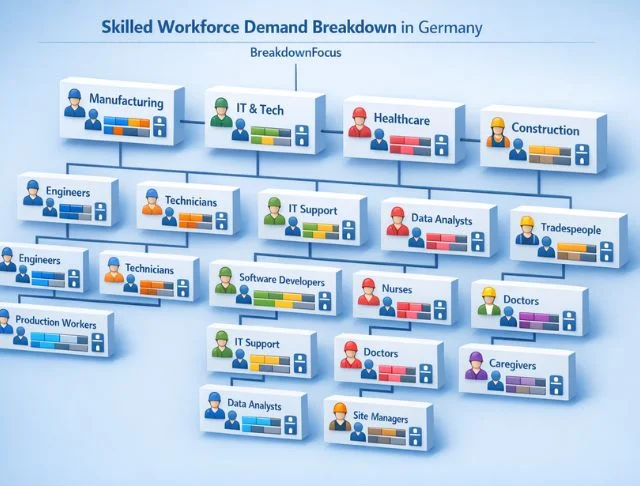
The shortage doesn’t split evenly between job types or education levels. Looking closer at the breakdown tells a more nuanced story.
Both sides of the workforce feel the pinch, but blue-collar trades carry the heavier load right now. Vocational roles in construction, manufacturing and logistics make up the bulk of unfilled positions across Germany.
White-collar shortages, especially in IT and engineering, tend to grab headlines. But in raw numbers, skilled tradespeople are harder to replace quickly. The pipeline for apprenticeship-trained workers moves slowly, and many young Germans have shifted toward academic tracks over the past decade.
The qualification breakdown from 2023 to 2024 shows a clear split:
Qualification Level | Vacancy Change |
Expert/academic level | Down ~15.5% |
Vocational trained | Down ~1.3% |
Expert-level vacancies fell sharply, largely due to cutbacks in high-complexity projects. Vocational positions held much steadier. That tells you the structural demand for trade-trained workers is more stable and less tied to economic cycles than highly specialized academic roles.
In 2025, vocational-level gaps made up the largest share of unfilled positions in states like Baden-Württemberg and NRW.
The Handwerk sector, Germany’s skilled trades, is one of the most strained corners of the labor market. Electricians, plumbers, heating engineers and roofers all show up repeatedly in regional shortage data.
In NRW alone, nearly 2,889 electrician posts went unfilled in 2025. Baden-Württemberg’s gap lies mainly at the vocational trade level. Bavaria’s rural districts face some of the country’s worst fill rates for trade roles.
The core issue is generational. Many master craftspeople are aging out, and not enough young workers are stepping in to replace them.

Germany can’t close its skilled worker gap from within. Foreign talent has become the primary driver keeping the labor market from falling apart entirely.
The foreign workforce in Germany has grown into a critical pillar of the economy. As of September 2025, 5.7 million foreign nationals held employment subject to social security contributions. That works out to 16.4% of all such employees.
More than half of those workers, about 55.7%, came from outside the EU. That shift toward non-EU talent reflects both policy changes and the limits of what EU free movement alone can supply.
The most telling data point comes from 2025 employment trends:
Worker Group | Employment Change (2025) |
Non-EEA nationals | +259,000 |
German nationals | -211,000 |
EEA nationals | -27,000 |
Foreign workers aren’t just filling gaps. They’re driving all net employment growth in Germany right now.
The composition of who comes to Germany for work has shifted noticeably. In 2024, about 47% of 586,000 new long-term immigrants arrived under EU free movement, roughly 275,000 people. Around 11%, or about 64,000, were classified as labour migrants from non-EU countries.
Non-EU labour migration has surged over the past decade. Destatis data shows 351,000 non-EU labour migrants arrived in 2022, up 19% from 2021 and four times the 85,000 recorded in 2010.
The share of third-country entrants with labour permits also rose, from 3.8% in 2022 to 6.4% in 2023. That upward trend reflects both rising demand and Germany actively opening more legal pathways.
Germany’s legislative changes have had a measurable effect. The Skilled Immigration Act of 2020, followed by its 2023 amendments, directly pushed visa numbers up.
In 2022 alone, 73,065 people received new residence permits for labour migration. That was a 77.8% jump over 2021. Of those, 38,820, or 53.1%, were skilled professionals with formally recognized qualifications under Section 18 of the Residence Act.
The German government set a target of around 200,000 skilled worker visas for 2024. They came close to hitting it. The law changes opened the door. Whether enough people walk through it remains the bigger question.
Ukraine, Romania and Syria ranked as the top three sending countries for immigrants to Germany in 2023. Ukrainian flows peaked sharply in 2022 following the war and have since moderated.
Historically, Poland and Turkey have been major sources, with Poles making up around 10% of Germany’s foreign-born population and Turks around 9%. Labor migration from India and other South Asian countries has also picked up in recent years, particularly for IT and engineering roles.
Germany approved roughly 198,000 skilled worker visas in 2024, a record figure. But that number looks smaller when placed next to the actual demand.
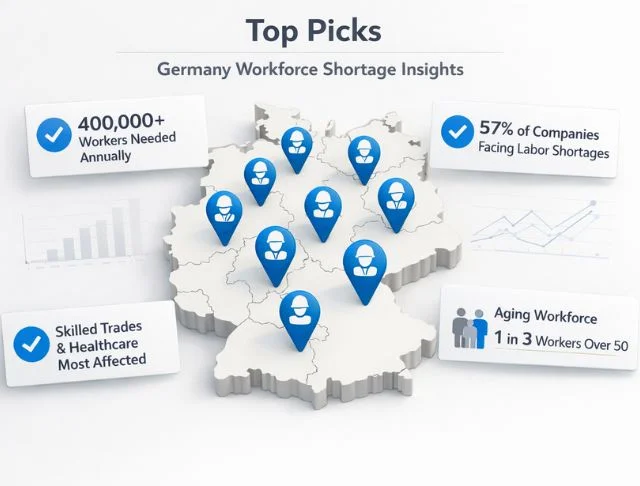
The Federal Employment Agency listed about 700,000 open job vacancies in mid-2024. IAB estimates that around 4.7 million employees will leave the German workforce by 2028, which points to a need for roughly 400,000 new skilled workers every year.
Sources: Destatis, Dgap, Statistik Arbeitsagentur, Oecd, Bamf, Prominencevisaservices, Eures

Germany’s labor shortage looks severe on its own. Measured against other economies, the picture gets more context and more nuance.
Germany and France both face skilled worker deficits, but the scale differs. Germany’s unemployment rate sat at 3.3% in mid-2024, well below France’s rate of around 7%. A lower unemployment rate alongside a high vacancy rate signals a tighter, more strained market.
Eurostat data from Q4 2025 puts Germany’s job vacancy rate at 2.8%, above the EU average of 2.0%. France’s vacancy rate has generally tracked closer to the EU average in recent years. French employers do report shortages in engineering and healthcare, but Germany’s sharper demographic decline makes its structural gap more acute.
The Netherlands actually posts a tighter labor market than Germany by vacancy rate. In Q4 2025, the Dutch job vacancy rate hit 3.9% against Germany’s 2.8%.
Both countries deal with aging workforces and shortages in STEM, healthcare and skilled trades. The difference is scale. Germany has around 46.1 million employed workers versus roughly 9 million in the Netherlands. Germany’s problem is bigger in absolute terms, even if the Dutch market is proportionally tighter.
The UK faces familiar problems. NHS staffing, construction trades and tech roles all show persistent shortages. UK unemployment sat at around 4.2% in mid-2024, slightly higher than Germany’s 3.3%.
Germany’s vacancy rate of 2.8% in Q4 2025 tracks close to the UK’s figure of around 3% in late 2024. Both countries run tight labor markets with high unfilled vacancy ratios. Post-Brexit disruption to UK labour flows adds a structural layer to the UK’s challenge that Germany doesn’t face in the same way within the EU.
The US and Germany face similar structural pressures from different angles. By May 2024, the US had 1.5 million fewer unemployed workers than available job openings, a net shortage by any measure. US unfilled vacancies ran at around 4.5% of labor demand in February 2025.
Germany’s Q4 2025 vacancy rate of 2.8% looks lower on that metric. But Germany’s overall employment rate of around 77% far exceeds the US rate of about 61%. Germany puts far more of its population to work, yet still can’t fill the roles it needs. That combination makes Germany’s shortage structurally harder to solve than raw vacancy numbers alone suggest.

When workers are scarce, wages move up. Germany’s labor shortage has pushed pay levels higher across the board, and employers are feeling the squeeze from multiple directions.
Nominal wage growth in Germany has picked up speed over the past few years. The nominal gross earnings index grew 2.6% in 2022. By Q4 2025, compensation per employee was rising at 4.1% year-on-year.
With inflation easing to around 2.2% in Q4 2025, real wages turned positive again, up about 1.9%. The 2024 collective bargaining rounds pushed wages even higher in shortage sectors, with many industries settling at 5% to 7% increases.
The shift in average pay over the past five years tells the story clearly. Average monthly gross earnings jumped from €4,317 in 2019 to €4,806 in 2022, then to €5,072 in 2023. That’s a 5.5% rise in a single year.
The 2022 inflation spike at 6.9% did cut into real wages temporarily. But from 2024 onward, negotiated raises began outpacing inflation again. Some sectors saw record rises of around 6% through collective agreements, a direct response to persistent shortages.
Sectors with the deepest shortages have seen the fastest pay growth. IT and telecom, healthcare, engineering and skilled trades all reported above-average wage increases by late 2024.
Sector | Wage Increase Signal |
Metal industry | Above 6% |
Health and elder care | ~5.5% |
IT and telecom | Above economy average |
Public sector | Elevated settlement |
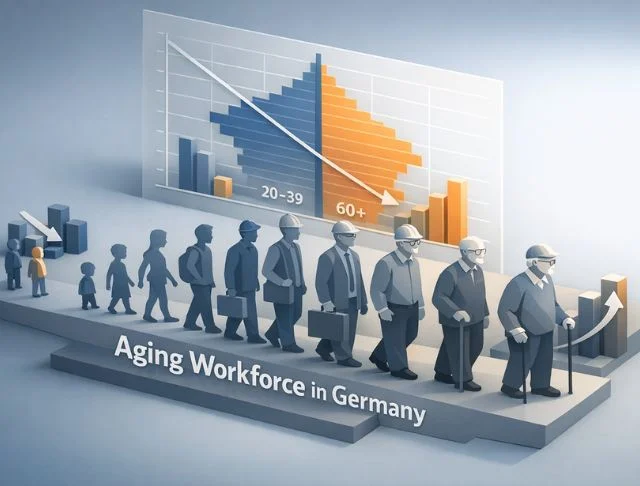
Germany’s labor shortage isn’t just a recruitment problem. It’s a demographic one, and demographics move slowly and don’t reverse easily.
The age structure of Germany’s population in 2024 makes the challenge visible. Only 18.8% of the population was under age 20. Meanwhile, 22.6% were aged 60 to 79, and another 7.2% were 80 and older.
Eurostat put Germany’s old-age dependency ratio at around 35.9% by late 2025, a record high. That means roughly 36 elderly people for every 100 working-age adults. Back in 2012, that ratio sat at 31.4%.
The Federal Employment Agency estimates that around 4.7 million Germans will exit employment through retirement between 2024 and 2028. Another projection puts total retirements at roughly 7 million by 2036 without offsetting measures.
New workforce entries aren’t keeping pace. In 2024, only about 60,000 foreign nationals came to Germany for vocational training. Germany’s birth rate sits at around 1.4 children per woman, well below the replacement level.
Retirements are outrunning new entries by a wide margin. That gap is the core engine driving the skilled worker shortage forward.
Germany’s old-age dependency ratio will keep climbing. The 2025 figure of around 36% is already among the highest in Europe. The EU average sat at roughly 34% in 2024. By 2035, Germany’s ratio could reach 42%.
Rural and eastern regions feel this more acutely than urban centers. High dependency ratios in those areas compound the local shortage problem, as fewer working-age residents are available to fill open roles.
Germany has actually done well at keeping older workers in employment. In 2023, around 74% of Germans aged 55 to 64 were employed, above the OECD average of 68%. The 60 to 64 employment rate climbed from about 50% in 2010 to 63% in 2023.
Prime-age workers between 25 and 54 posted an employment rate of about 86%. Younger workers aged 15 to 24 came in lower at around 60%.
The older cohorts are pulling more weight than before. But as they eventually retire, that contribution will disappear.
Women’s labor force participation in Germany is high but still trails men’s. In 2023, around 75.2% of women aged 15 and above participated in the labor market, compared to 83% to 85% for men.
The bigger issue is hours worked. Many women hold part-time positions, often due to childcare or eldercare responsibilities. That reduces the effective labor supply from a large segment of the workforce.
Sources: Destatis, Tradingeconomics, Oecd, Eures
Germany’s skilled worker shortage runs deeper than hiring cycles can fix. Demographics, mismatches and retirement waves make this a long-term structural challenge that will define the country’s economic trajectory for decades ahead.
You are currently viewing a placeholder content from Calendly. To access the actual content, click the button below. Please note that doing so will share data with third-party providers.
More InformationYou are currently viewing a placeholder content from Calendly. To access the actual content, click the button below. Please note that doing so will share data with third-party providers.
More InformationYou need to load content from reCAPTCHA to submit the form. Please note that doing so will share data with third-party providers.
More InformationYou are currently viewing a placeholder content from Turnstile. To access the actual content, click the button below. Please note that doing so will share data with third-party providers.
More InformationYou are currently viewing a placeholder content from Vimeo. To access the actual content, click the button below. Please note that doing so will share data with third-party providers.
More InformationYou need to load content from reCAPTCHA to submit the form. Please note that doing so will share data with third-party providers.
More InformationYou are currently viewing a placeholder content from Elfsight. To access the actual content, click the button below. Please note that doing so will share data with third-party providers.
More InformationYou are currently viewing a placeholder content from reCAPTCHA. To access the actual content, click the button below. Please note that doing so will share data with third-party providers.
More Information

