Who Works Remotely? 2026 Demographic Statistics & Insights

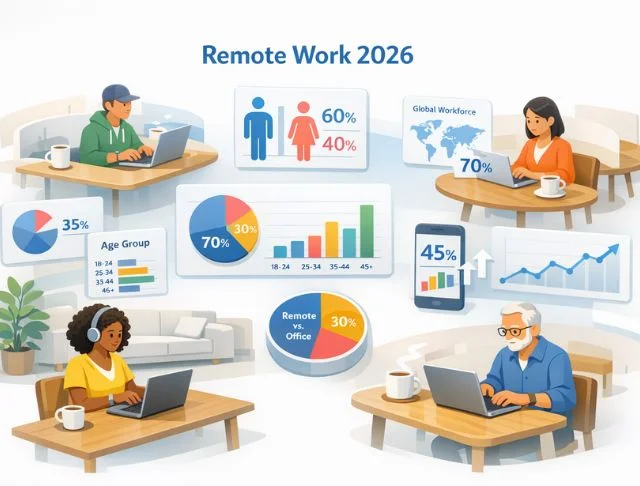
Remote work has evolved into a permanent feature of the global labor market. By 2026, it is no longer limited to a small segment of digital professionals. It now reflects broader shifts in how companies hire, manage teams, and structure operations.

This report presents a data-driven breakdown of who works remotely, focusing on global distribution, workforce share, and key demographic patterns across age, gender, and education.

Picture of Peter J. Heidinger
Peter J. Heidinger

Author

Picture of Leah Maglalang
Leah Maglalang

Co-author

Who Works Remotely 2026 Demographic Statistics Insights

Who Works Remotely? 2026 Demographic Statistics & Insights

Remote work has evolved into a permanent feature of the global labor market. By 2026, it is no longer limited to a small segment of digital professionals. It now reflects broader shifts in how companies hire, manage teams, and structure operations.

This report presents a data-driven breakdown of who works remotely, focusing on global distribution, workforce share, and key demographic patterns across age, gender, and education.

Picture of Peter J. Heidinger
Peter J. Heidinger

Author

Picture of Leah Maglalang
Leah Maglalang

Co-author

Table of Contents

Get in Touch with Us

leah

Leah Maglalang

Business Coordinator UAE

united states flag 

Remote Workers Demographics Stats (Editor Picks)

  • In the U.S., 16–24-year-olds telework at 7.9%.
  • U.S. workers aged 25–54 telework at 25.1%.
  • U.S. workers 55+ telework at 24.4%.
  • Women in the U.S. telework slightly more than men (24.9% vs 21.1%).
  • Men are more likely to work fully remote (38%) than women (30%).
  • U.S. workers without a high school diploma rarely telework (3.5%).
  • High school graduates: 8.5% telework; some college: 18.3%.
  • Bachelor’s degree or higher: 40.4% telework; advanced degrees: 43.6%.
  • Remote workers earn higher wages, about 12–13% more than on-site workers.
  • High-income U.S. households ($200K+) telework at 73.1%.
  • Low-income households (<$25K) telework at only 12.7%.
  • Europe telework rose from 14% in 2019 to 22% in 2023.
  • U.S. caregivers: 72% use telework, 84% say it is very helpful.
  • Finance & Insurance industry has the highest U.S. telework rate at 61.5%.
  • Professional/Technical Services: 54.8% telework; IT/Communications: 46.7%.
  • Entry-level roles: 10% fully remote; mid-level: 13%; senior-level: 17%.
  • U.S. freelancers: 64 million (38% workforce) work remotely.
  • Global independent workers operating remotely: 46.6%.
  • Gen Z U.S. telework (16–24 yrs): ~7.2%; 25–54 yrs: 25%; 55+ yrs: 23.7%.
  • Global projection: 92 million fully remote jobs by 2030, up from 73 million in 2023.

Age-Based Demographics of Remote Workers

Age Based Demographics of Remote Workers

Remote work participation varies significantly across age groups, with clear differences in access and adoption.

United States telework rates (Q1 2024):

  • 16–24 years: 7.9%
  • 25–54 years: 25.1%
  • 55+ years: 24.4%

Key Observations:

  • Workers aged 25 to 54 represent the largest share of remote workers
  • The 55+ group is nearly equal to the core working-age population in remote participation
  • The 16–24 group lags significantly behind, with less than one-third of the participation rate of older groups

Millennials vs Gen Z vs Gen X vs Baby Boomers

Generational differences highlight how remote work aligns with career stage and job function.

  • Gen Z (16–24): Lowest participation due to entry-level roles and limited remote eligibility
  • Millennials (25–34) and Gen X (35–54): Highest representation in remote roles, forming the core of the remote workforce
  • Baby Boomers (55+): Participation levels are now nearly equal to prime working-age groups

Age-Based Remote Work Adoption Rates

Adoption rates show steady growth across all age groups, with notable differences in pace.

Growth trends (recent years):

  • 55+ years: Increased from 20.4% to 24.4%
  • 25–54 years: Increased from 21.8% to 25.1%
  • 16–24 years: Increased from 6.8% to 7.9%

Key Observations:

  • The fastest growth is seen among workers aged 55 and above
  • Mid-career professionals continue to lead in overall adoption
  • Younger workers show only marginal growth

Productivity and Preference by Age Group

Work preferences vary by life stage, but productivity differences are minimal.

  • Employees with children are more likely to prefer hybrid work arrangements
  • Employees without children are more likely to be either fully remote or fully on-site
  • Research from Stanford indicates no significant productivity differences across age groups

Growth Trends in Older Workforce Participation

One of the most notable trends is the rise of remote work among older employees.

  • The 55+ group experienced the highest increase in telework participation
  • Their participation rate is now nearly equal to the 25–54 group
  • Remote work enables extended careers by reducing commuting and offering flexibility

Resources: Bls, Siepr, Weforum, Siepr, Census, Ons, Mckinsey

Gender-Based Remote Work Statistics

Gender Based Remote Work Statistics

Male vs Female Participation Rates

Remote work participation shows a consistent but moderate gap between men and women.

United States telework rates (Q1 2024):

  • Women: 24.9%
  • Men: 21.1%

Key Observations:

  • Women are more likely to work remotely than men
  • The gap is noticeable but not extreme, indicating relatively balanced access overall

Global Context:

  • Across a survey covering 40 countries, work-from-home rates are nearly identical between men and women
  • This suggests that gender differences are more pronounced at the country or industry level rather than globally

Gender Differences in Full-Time vs Hybrid Work

While overall participation is similar, differences emerge when comparing full-time and hybrid work models.

United States (2024):

  • Fully remote:
    • Men: 38%
    • Women: 30%
  • Part-time remote (hybrid):
    • Men: 23%
    • Women: 22%

Key Observations:

  • Men are more likely to work fully remote
  • Hybrid participation is nearly equal between genders

Additional Insight (Great Britain, 2024):

  • Male parents: 41% follow hybrid work
  • Female parents: 30% follow hybrid work

Remote Work Impact on Women’s Workforce Participation

Remote work plays a significant role in shaping workforce participation among women.

  • Women are more represented in remote-capable roles in some sectors
  • At the same time, many women work in fields such as education and healthcare, where remote options are limited
  • Flexibility provided by remote work can support continued employment and retention, especially for those balancing caregiving responsibilities

Gender-Based Preference Trends for Remote Work

Preferences for remote work are broadly similar across genders, with some differences driven by life circumstances.

  • Surveys indicate that women are just as likely as men to prefer working from home
  • Employees with caregiving responsibilities often prefer hybrid arrangements
  • Men show slightly higher representation in fully remote roles, while women are more evenly distributed across work models

Resources: Bls, Forbes, Siepr, Ons

Education-Level Distribution of Remote Workers

Education Level Distribution of Remote Workers

Remote Work by Education Level

Remote work participation increases significantly with higher education levels. In the United States (workers aged 25+), telework rates are as follows:

  • Less than high school: 3.5%
  • High school (no college): 8.5%
  • Some college or associate degree: 18.3%
  • Bachelor’s degree or higher: 40.4%
  • Advanced degree holders (Master’s/PhD): 43.6%

Key Observations:

  • College-educated workers are far more likely to work remotely than those with lower education levels
  • Telework is extremely rare among workers without a high school diploma

Telework Rates by Degree Level

Telework adoption rises sharply with degree attainment:

  • High school graduates: Limited access, mostly in hybrid or part-time remote roles
  • Bachelor’s and advanced degree holders: Predominantly in professional, management, or knowledge-based roles that allow full remote work

Skill-Based vs Non-Skill-Based Remote Roles

Remote work aligns closely with skill and job type:

  • Professional and management roles are most likely to allow remote work
  • Manual, service, and frontline roles remain largely on-site, regardless of preference
  • Higher education often correlates with digital or knowledge-based skills, which are critical for remote work

Education Inequality in Remote Work Access

Remote work access is unevenly distributed by education:

  • Only 3.5% of those without a high school diploma teleworked in the US
  • College graduates have over 40% telework participation, highlighting a large gap
  • Globally, countries with a higher proportion of tertiary-educated workers show higher WFH adoption
    • English-speaking developed countries average 1.5–2 days per week
    • Latin America and Africa average around 1 day per week, reflecting workforce skill differences

Resources: Bls, Census, Siepr, Weforum

Income-Level Demographics of Remote Workers

Income Level Demographics of Remote Workers

Income Distribution of Remote Workers

Remote work is strongly associated with higher income levels. In the United States:

  • By 2023, 13.8% of workers (≈22 million people) usually worked from home, more than double the 5.7% (≈9 million) in 2019
  • Remote workers tend to have higher median earnings, for example:
    • Houston: ≈$65,700 for remote workers vs $30,700 for public-transit commuters
  • Demographics: Remote workers are generally older (median age 43.5 vs 41.7) and more likely to be white (≈67%)
  • Poverty rates among remote households are lower (~3.6%) compared to on-site workers (~9.3%)

High-Income vs Low-Income Remote Work Participation

Income level is a key predictor of remote work eligibility.

  • Households earning $200,000 or more: 73.1% participated in remote work during the pandemic
  • Households earning less than $25,000: Only 12.7% participated
  • Remote-capable jobs are skewed toward well-paid occupations, and half of the observed wage premium for remote work comes from worker characteristics such as education and prior wages

Salary Comparison: Remote vs In-Office Workers

Remote work is associated with higher pay even after adjusting for demographics:

  • U.S. BLS data (2021): Remote workers earned ~13.3% higher hourly wages than on-site workers
  • SF Fed / French data: Remote or hybrid employees earned about 12% more, with a 6% “work-from-home premium” after controlling for worker characteristics
  • Median wages in major cities show similar patterns, reflecting the economic advantage of remote-capable roles

Resources: Census, Census, Fortune, BLS

Geographic and Regional Demographics

Geographic and Regional Demographics

Remote Work Distribution by Region

Remote work adoption varies widely across the globe, reflecting differences in economy, industry composition, and infrastructure.

North America

  • United States: About 24–25% of workers teleworked at least part-time in early 2024, with 13.8% primarily working from home in 2023 (American Community Survey)
  • Canada: Approximately 20% of employees worked mostly from home in late 2023, down from ~30% in early 2022

Europe

  • European Union: ≈22% of workers (ages 15–64) worked from home in 2023
  • Great Britain (UK): ~14% fully remote and 28% hybrid in late 2024
  • English-speaking developed countries (US, UK, Canada, Australia) show the highest levels of remote work, whereas many Asian and developing economies remain lower

Asia-Pacific and Other Regions

  • Australia: ≈46% of workers performed some work from home (July 2024–June 2025)
  • New Zealand: ~17.7% “mostly” WFH in 2023, up from 11.9% in 2018
  • Asia (Japan, South Korea, China): WFH rates remain low, generally single-digit percentages; China allows occasional flex days
  • Latin America: 30–50% of companies offer hybrid/remote policies; one survey reported ~40% of employees worked remotely in 2023 (up from 30% in 2019)
  • Middle East/Africa: Remote work is concentrated in high-tech hubs (UAE, Israel ~20–30%), but under 15% in most countries

Urban vs Rural Remote Worker Demographics

Remote-capable jobs are heavily concentrated in urban areas:

  • OECD analysis finds cities have about a 13 percentage-point higher share of teleworkable jobs than rural areas
  • Workers in dense metropolitan areas generally have more WFH options
  • Rural regions, with a higher proportion of manual and physical jobs, see far lower remote participation

Top Countries by Remote Workforce Share

High-Remote Countries

  • United States, Canada, UK, and Australia consistently rank highest for remote-work prevalence
  • English-speaking countries average roughly 2 days/week WFH (Stanford SIEPR, 2025)
  • Nordic and Western European nations, such as Denmark and the Netherlands, also report relatively high telework shares

Lower-Remote Regions

  • Asia, Latin America, and Africa report lower WFH averages:
    • Latin America/Africa: ~1 day/week
    • Asia: ~0.5 day/week
  • Cultural and industrial factors, such as preference for face-time in Japan, contribute to regional differences

Resources: FMCGroup, Census, Stanford, OECD

Family and Household Demographics

Family and Household Demographics

Remote Workers with Children vs Without Children

Parental status plays a major role in shaping remote work patterns.

  • Employees with children are more likely to work hybrid schedules (1–3 days per week from home)
  • Employees without children are often either fully remote or fully on-site
  • Example: A Swiss study found parents averaged 1.47 WFH days per week, compared with 1.69 days for colleagues without children

Key Observation:

Parents generally prefer more remote days, but practical challenges such as interruptions and limited managerial support often restrict their options.

Parental Status and Work Flexibility

Caregiving responsibilities strongly influence the demand for flexible work arrangements:

  • A 2024 U.S. S&P/AARP survey found 72% of working caregivers with telework options used them
  • 84% of caregivers rated remote work as very helpful
  • Despite this, nearly 49% of remote caregiving employees felt penalized for their responsibilities, compared with 29% of on-site employees

Household Income Structures in Remote Families

Remote work correlates with higher household income:

  • U.S. data (ACS 2020) show that nearly 75% of households earning $200K+ teleworked during the pandemic
  • Remote work is more common in dual-income or high-earning households
  • Lower-income households often face limited remote options, with one parent staying home or no flexibility available

Key Observation:

Remote work access is strongly shaped by household resources and the ability to work in skilled, remote-capable roles.

Remote Work Adoption Among Caregivers

  • Employees responsible for childcare or eldercare place a premium on remote and hybrid arrangements
  • Employer policies significantly affect adoption, with more supportive companies enabling higher remote participation
  • Remote caregiving employees value flexibility but may still face career penalties if responsibilities interfere with work expectations

Resources: Stanford, DeFacto, SPGlobal, Census

Industry-Based Demographics of Remote Workers

Industry Based Demographics of Remote Workers

Top Industries Employing Remote Workers

Remote work is concentrated in knowledge-intensive industries, where tasks can be completed digitally. In the United States (late 2023–2024):

Industry

Telework Rate

Finance & Insurance

61.5%

Professional/Technical Services

54.8%

Information Technology / Communications

46.7%

Management, Admin & Waste Services

9.8%

Education Services

5.0%

Accommodation & Food Services

3.8%

Key Observations:

  • Finance, IT, and professional services dominate remote work adoption
  • Industries requiring physical presence, such as hospitality or education, show minimal remote participation
  • Creative and media sectors fall in the middle, with moderate remote opportunities

Knowledge Workers vs Manual Workers Distribution

  • Knowledge-intensive roles (finance, IT, professional services) account for the majority of telework
  • Manual or physical jobs (hospitality, retail, manufacturing) have near-zero remote participation
  • This divide shapes the demographic profile of remote workers, concentrating them among educated, skilled professionals

Role Seniority (Entry-Level vs Senior-Level Remote Workers)

Remote work opportunities increase with experience and seniority:

  • Entry-level roles: 10% of fully remote job postings
  • Mid-level roles: 13% fully remote
  • Senior-level roles: 17% fully remote (Robert Half, 2024)

Additional Insights:

  • Post-pandemic remote workers are often higher-paid and more senior, with flexibility negotiated as part of compensation
  • Specialized roles with autonomy and digital deliverables are more likely to be fully remote

Freelancers vs Full-Time Employees

  • Freelancers and contractors form a large remote cohort:
    • In the U.S., ≈64 million workers (38% of workforce) freelanced in 2023
    • Globally, ≈46.6% of independent workers operate remotely
  • Freelance and contract roles are often location-independent, especially in IT, design, and consulting
  • The freelance sector contributes trillions to the economy and accounts for many fully remote positions

Key Observation:

Independent work has expanded the remote workforce, complementing full-time employment in knowledge-based sectors.

Resources: PhiladelphiaFed, FMCGroup, MarcoPolo

Growth Trends in Remote Work Demographics

Growth Trends in Remote Work Demographics

Pre- vs Post-Pandemic Demographic Shifts

The COVID-19 pandemic caused a dramatic surge in remote work adoption.

  • United States: Remote work share increased from 5.7% in 2019 to 17.9% in 2021, then stabilized at 15.2% in 2022 and 13.8% in 2023 (ACS data)
  • Europe: Telework rose from 14% in 2019 to 22% in 2023
  • Hybrid schedules have become the norm, with about 52% of remote-capable U.S. workers following a hybrid model

Key Observation:

The pandemic accelerated long-term adoption of remote work, shifting it from a niche option to a mainstream work arrangement.

Expansion in Emerging Markets

Remote work is expanding outside Western countries, but adoption remains uneven:

  • Asia, Latin America, and Africa lag Western nations in average WFH days
  • Global projections estimate 92 million fully remote jobs by 2030, up from ~73 million in 2023
  • Many future remote roles will be in digital and tech sectors, but scaling requires skills development and infrastructure investment in lower-middle-income countries

Key Observation:

Emerging markets represent a significant growth opportunity for remote work, contingent on economic development and digital capability.

Future Demographic Projections (2026–2030)

  • Remote and hybrid work is expected to remain well above pre-pandemic levels
  • WEF and TimeDoctor (2024) project ≈92 million global digital jobs fully remote by 2030
  • The majority of these positions will be high-wage, knowledge-based roles (software, finance, professional services)
  • Aging workforce, digitalization, and changing management norms will reinforce the hybrid/remote work norm

Key Insight:

Remote work is no longer a temporary trend. Demographics, technology, and organizational preferences indicate that hybrid and fully remote work will remain a standard practice through 2030.

Resources: Census, FMCGroup, Stanford, BLS, WorldEconomicForum, TimeDoctor

Conclusion

Remote work has transformed the global workforce, reshaping who can work from home, where, and under what conditions. Across age, gender, education, income, geography, family status, and industry, clear patterns emerge.


Looking forward, remote and hybrid work will remain well above pre-pandemic levels, with global projections estimating 92 million fully remote-capable roles by 2030. These roles will continue to concentrate among higher-skilled, higher-paid workers, shaping both economic opportunity and workplace flexibility.

Get In Touch With Leah​

We are looking forward to hearing from you

Schedule a Meeting