
Germany is one of those countries that have the strictest employee data protection laws. Many foreign employers underestimate the heavy regulations around this data processing.
From recruitment records and payroll information to employee monitoring and health data, foreign employers must comply with both EU-wide GDPR rules and Germany’s own employment-specific data protection laws.
If you fail to follow these German laws, it can lead to major GDPR fines, legal disputes, reputational damage, and conflicts with works councils. That’s why this guide explains the most important data protection laws in Germany.

Author

Germany is one of those countries that have the strictest employee data protection laws. Many foreign employers underestimate the heavy regulations around this data processing.
From recruitment records and payroll information to employee monitoring and health data, foreign employers must comply with both EU-wide GDPR rules and Germany’s own employment-specific data protection laws.
If you fail to follow these German laws, it can lead to major GDPR fines, legal disputes, reputational damage, and conflicts with works councils. That’s why this guide explains the most important data protection laws in Germany.
Author
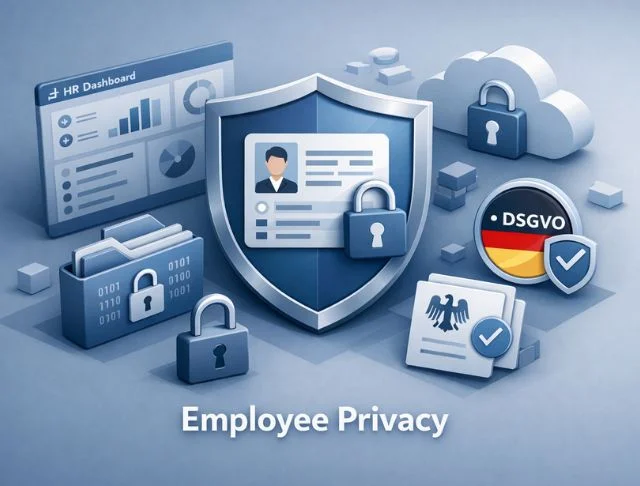
Employee data protection in Germany refers to the legal rules that govern how employers collect, process, store, monitor, and share employees’ personal information.
When handling workforce data, employers have to comply with both the GDPR and the Federal Data Protection Act (BDSG).
Protected employee data can include names, addresses, payroll details, bank information, health records, performance data, emails, device usage, biometric information, and monitoring data. These laws cover the entire employment lifecycle, from recruitment to termination.
As Germany places a strong emphasis on individual privacy rights, the country has strict employee privacy regulations. Employers must follow strict transparency, security, and lawful processing requirements. These laws must be followed when monitoring employees or handling sensitive personal data.

The GDPR is directly applicable across the EU and sets comprehensive rules for processing personal data, including employee data. The GDPR says you must keep employee data safe and only use it for clear and valid reasons. Due to this rule, employees have the right to see their own data and can ask for changes.
This is Germany’s own law that works with the GDPR. It adds extra rules about how you can collect and use employee data in Germany.
So, as a foreign employer, you must follow both laws. You can get fined if you don’t. These laws are in favor of employees to protect their privacy and prevent the misuse of their personal information.

You can only collect and use employee data if you need it for employees’ jobs, hiring, or termination. According to Section 26 BDSG, you can’t use it for other reasons without permission.
Some employee data is extra sensitive, like health information, race, religion, or union membership. Employers usually can’t use such data unless the worker agrees in writing or the law allows it.
Section 24 BDSG allows further processing for purposes other than the original one only under strict conditions, particularly when compatible with the original purpose or necessary for legal claims or public security. The key point in deciding whether this is a valid reason is checking whether it falls under one of these three reasons:
Examples of these other purposes include:
You must appoint a Data Protection Officer (DPO) if any of these are true:
Situation | When DPO is Required |
Employee count | In Germany, a Data Protection Officer is required if at least 20 employees regularly process personal data using automated systems (§38 BDSG). |
Special data + impact assessment | You must do a Data Protection Impact Assessment (DPIA), even with fewer than 20 employees |
Selling/sharing data | Your business commercially collects/stores data to sell or transfer (personalized or anonymized) |
Market/opinion research | Your business purpose is market or opinion research using personal data |
Public bodies | You are a public authority or government body (no employee limit) |
Large-scale special data | You process sensitive data (health, race, religion) on a large scale globeriadatenschutz |
Systematic monitoring | Your core business is regularly monitoring people (like tracking cameras or online behavior) |
The DPO must have:

Works councils are subject to GDPR and BDSG obligations; however, their exact role (controller vs. separate body) is legally complex and still debated in German case law. They must:
When the Works Council handles employee data, GDPR rules still apply. This means:

This law applies if your company works in telecommunications or digital services, such as:
Then you have to protect user data more strictly. For example, you must keep communications private, get permission before tracking people, and clearly mention to users and employees what data is collected. Cookie consent requirements primarily stem from the EU ePrivacy Directive (implemented in Germany via TDDDG) together with GDPR rules on consent.
Some jobs have special data rules because they handle sensitive information. Examples include healthcare, banking and finance, insurance, government, transport, and retail businesses that use cameras.

Employers can check work emails and internet use if there are specific reasons, such as finding technical issues. Employers should not rely on consent as the primary legal basis due to the imbalance of power in employment relationships; instead, data processing is typically justified under §26 BDSG or legitimate interest (Art. 6 GDPR). Accessing personal communications is highly restricted and generally only permissible in exceptional cases, such as suspected criminal activity, and often requires additional safeguards.
CCTV cameras can be used for real safety reasons, like stopping theft. They should not be hidden. They also can’t be installed in private places like break rooms or locker rooms.
GPS tracking of workers is allowed for certain reasons, such as monitoring delivery drivers or service vehicles. Employees should know about it. It is not allowed to track them while they are at home unless they have company equipment for work. Continuous or excessive monitoring is generally considered disproportionate and unlawful unless strictly necessary and justified.
The collection of biometric data depends on an absolute need for security or access. Explicit consent is only valid in exceptional cases where it is truly voluntary; otherwise, biometric data processing must be justified by necessity under §26 BDSG or Art. 9 GDPR. This is allowed when there is no easier way to do it. For example, if you can’t use a key card, then biometric data may be used instead.
Employee consent for monitoring is only valid if:
Requirement | What It Means |
Free choice | Worker can say no without losing their job |
Written | Worker signs or writes their agreement |
Clear | Worker knows exactly what you will monitor |
Specific | Consent is for one reason, not “everything” |
Can be taken back | Worker can cancel consent later |
No pressure | Boss cannot force or threaten the worker |

Under the GDPR, employers can only send employee data outside the EU if:
The most common way employers can legally send data is by following Standard Contractual Clauses (SCCs). These are:
You can find them on the European Commission website.
You can transfer employee data outside the EU if:
Country has EU approval (like UK, Switzerland, Japan) | No extra steps needed |
Country has no EU approval (like US, India, China) | Sign SCCs + check if extra protection is needed |
Explicit consent is possible but rarely recommended due to strict requirements and revocability; SCCs or adequacy decisions are preferred. | Written consent + worker can cancel anytime |
Needed for the employment contract | Only for specific job reasons (like paying salary) |

Employers must give workers a privacy notice that explains:
The notice must be easy to understand, written clearly, and given before collecting the data.
Data minimization means you only collect data that is needed for the job. Employers can’t collect extra information “just in case.” For example, employers don’t need employees’ religious beliefs for most jobs.
Retention policies mean keeping data only as long as needed and deleting data when it is no longer needed. For example, employers should delete job application data if the person is not hired (usually within 3–6 months).
Employers can do a DPIA when they:
A DPIA is a risk check that asks:
You must keep a record of all data processing, including:
What to Record | Example |
Why you collect data | Payroll, hiring, safety |
What data you collect | Name, address, salary, health |
Who you share it with | Bank, insurance, government |
How long you keep it | Retention periods depend on legal obligations (e.g., 6–10 years for tax records under German commercial and fiscal law). |
Security measures | Passwords, encryption, locked files |
Employers must train workers who handle personal data, such as HR staff, managers, and IT teams. They should know how to protect the data and avoid breaches. Employers should also have written policies for data protection. Training should be updated at least once a year.
Workers have the right to ask you for:
Request | What You Must Do |
See their data | Respond within one month (can be extended by two additional months in complex cases). |
Fix their data | Correct wrong info quickly |
Delete their data | Remove it if the law allows |
Stop using their data | Halt processing if they object |
Move their data | Send data to another company if asked |
You must:
Protecting employees’ data in Germany is not easy. Many foreign employers try to handle it themselves but face legal issues. The best approach is to use an Employer of Record service provider like FMC Group. They handle data carefully, hire employees without needing your local entity, manage payroll and monthly contributions, and more.
You are currently viewing a placeholder content from Calendly. To access the actual content, click the button below. Please note that doing so will share data with third-party providers.
More InformationYou are currently viewing a placeholder content from Calendly. To access the actual content, click the button below. Please note that doing so will share data with third-party providers.
More InformationYou need to load content from reCAPTCHA to submit the form. Please note that doing so will share data with third-party providers.
More InformationYou are currently viewing a placeholder content from Turnstile. To access the actual content, click the button below. Please note that doing so will share data with third-party providers.
More InformationYou are currently viewing a placeholder content from Vimeo. To access the actual content, click the button below. Please note that doing so will share data with third-party providers.
More InformationYou need to load content from reCAPTCHA to submit the form. Please note that doing so will share data with third-party providers.
More InformationYou are currently viewing a placeholder content from Elfsight. To access the actual content, click the button below. Please note that doing so will share data with third-party providers.
More InformationYou are currently viewing a placeholder content from reCAPTCHA. To access the actual content, click the button below. Please note that doing so will share data with third-party providers.
More Information

