Seems very simple to hire employees in Germany using an Employer of Record. But many foreign employers underestimate the legal risks involved.
EOR providers operate under the Employee Leasing Act (AÜG) in the country, which makes compliance more complex. If you think that an EOR handles every legal obligation, it can lead to costly mistakes and unexpected liabilities.
Today’s guide explains the 11 key CONTRACTUAL and STATUTORY legal risks every foreign employer should understand before signing an EOR agreement.

Author

Seems very simple to hire employees in Germany using an Employer of Record. But many foreign employers underestimate the legal risks involved.
EOR providers operate under the Employee Leasing Act (AÜG) in the country, which makes compliance more complex. If you think that an EOR handles every legal obligation, it can lead to costly mistakes and unexpected liabilities.
Today’s guide explains the 11 key CONTRACTUAL and STATUTORY legal risks every foreign employer should understand before signing an EOR agreement.
Author
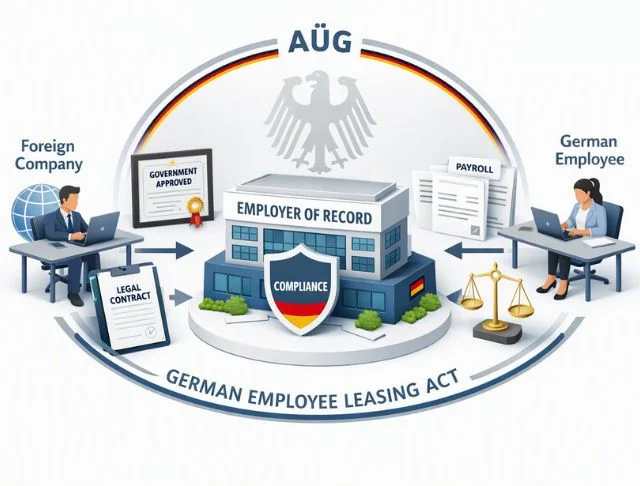
Employers of Record services are legal in Germany unless they don’t have an operating license. As the core purpose of an EOR is to hire employees on behalf of a foreign company, German law classifies it as employee leasing (Arbeitnehmerüberlassung) under the Employee Leasing Act (AÜG). This means EOR providers have to comply with specific legal requirements that don’t exist in many other countries.
At the center of every EOR arrangement is a tripartite employment relationship. Simply stated, it is a relationship where three parties, the EOR provider, the employees, and the client company, are involved. The EOR becomes the legal employer and handles employment contracts, payroll, taxes, statutory benefits, and HR tasks. The client company handles day-to-day operational tasks and manages the employees, while the employees handle company-specific tasks.
Germany treats this model differently because lawmakers want to prevent businesses from using employee leasing to bypass labor protections. The AÜG establishes rules on licensing, equal treatment, assignment duration, and employer responsibilities. Understanding the distinction between the legal employer and the operational employer is essential.


The short answer is NO.
An EOR can reduce legal risk to a large extent, but not completely. Germany imposes certain statutory obligations (that you’ll learn about below) that can’t be transferred to third parties.
An EOR typically assumes responsibility for employment contracts, payroll processing, tax withholding, social security contributions, statutory benefits, and many day-to-day HR administration tasks. In these areas, an EOR eliminates legal risks by avoiding payroll errors, missed filings, and non-compliant employment documentation.
However, some legal responsibilities remain with the client company. Let’s say you supervise employees, determine their day-to-day work, or conduct long-term business activities in Germany. Does the EOR face exposure to these legal obligations? No. You have to comply with them.
It’s also important to distinguish between contractual obligations and statutory obligations.
Contractual obligations are responsibilities agreed upon between you and the EOR provider. These can usually be negotiated and documented in the EOR agreement.
Statutory obligations arise directly under German law. These include requirements such as AÜG compliance, equal pay rules, employee leasing restrictions, payroll taxes, and social security contributions. A contract cannot override these legal requirements. The table below summarizes the difference.
Area | Can the EOR Manage It? | Can a Contract Eliminate the Risk? |
Payroll processing | ✅ Yes | ✅ Yes |
Employment contracts | ✅ Yes | ✅ Yes |
HR administration | ✅ Yes | ✅ Yes |
Hidden fees and service scope | ✅ Yes | ✅ Yes |
Intellectual property ownership | ✅ Yes | ✅ Yes |
GDPR responsibilities | ✅ Shared | ⚠️ Partially |
AÜG (Employee Leasing Act) compliance | ⚠️ Shared | ❌ No |
Equal pay obligations | ⚠️ Shared | ❌ No |
Permanent establishment (PE) risk | ⚠️ Shared | ❌ No |
Workplace management and employee supervision | ❌ Client responsibility | ❌ No |

In this section, we’re going to discuss eleven legal risks that fall under the CONTRACTUAL obligations category. These can be eliminated if the contract agreement complies with German law.
Clearly define who is the legal employer, who controls daily work, and who makes employment decisions. Avoid co-employment confusion through precise contract wording.
Make sure the agreement clearly lists payroll, benefits, leave, onboarding, immigration, termination, and compliance support. Ask: “What exactly is included?”
Your contract should require the EOR to update employment terms, payroll, policies, and collective bargaining compliance whenever German laws change.
Clearly allocate responsibility for labor law compliance, payroll taxes, social security, registrations, filings, and government inspections to avoid accountability gaps.
The agreement should address German notice periods, dismissal procedures, severance obligations, required documentation, and offboarding responsibilities to reduce legal disputes.
Review pricing for onboarding, foreign exchange margins, benefit markups, visa support, payroll changes, off-cycle payroll, and employee offboarding before signing.
Define who is responsible for employment claims, payroll errors, back taxes, regulatory penalties, and legal defense costs if compliance issues arise.
Confirm the contract clearly assigns ownership of software, source code, designs, research, patents, confidential information, and trade secrets to your business.
Verify GDPR compliance, a Data Processing Agreement (DPA), secure cross-border transfers, breach notification procedures, and protection of employee records.
Set measurable service standards for payroll deadlines, HR response times, escalation procedures, service-level agreements (SLAs), and remedies for missed commitments.
Plan for employee transfers, migration to your own German entity, record handover, audit cooperation, and realistic transition timelines before signing the agreement.

This section covers legal risks that fall under statutory obligations. It means an EOR can’t override mandatory German employment laws. Certain legal obligations arise directly from legislation. Simply stated, they apply regardless of what your contract says.
If an EOR arrangement falls under Germany’s Employee Leasing Act (AÜG), the provider may need a valid employee leasing license.
German law generally limits how long a leased employee can be assigned to the same client company to 18 consecutive months, though collective bargaining agreements in the client’s industry can extend this to 24 months or more. Exceeding the limit can invalidate the employment contract with the EOR, trigger a legally presumed direct employment relationship with the client company, and expose the client to fines of up to €30,000.
Leased employees are generally entitled to equal pay with comparable employees of the client company after 9 months of assignment, unless a collective bargaining agreement with a graduated pay approach applies, in which case equal pay can be deferred to up to 15 months.
If an arrangement is treated as employee leasing but fails to comply with AÜG requirements, authorities may consider it unlawful. This can put both the EOR provider and the client company at legal and financial risk.
In certain circumstances, German law may deem the employee to have an employment relationship directly with the client company, regardless of what the EOR contract states.
Using an EOR does not automatically eliminate permanent establishment (PE) risk. Depending on your business activities in Germany, tax authorities may determine that your company has created a taxable presence.
German employers must comply with payroll tax withholding and social security contribution rules.
Risk | Can an EOR Contract Reduce It? |
Employer responsibilities | ✅ Yes |
Scope of services | ✅ Yes |
Hidden fees and pricing | ✅ Yes |
Liability and indemnity | ✅ Yes |
Intellectual property (IP) ownership | ✅ Yes |
Confidentiality obligations | ✅ Yes |
GDPR and data processing | ✅ Yes |
Service levels (SLAs) | ✅ Yes |
Termination and exit process | ✅ Yes |
Employee transfer provisions | ✅ Yes |
Dispute resolution | ✅ Yes |
Governing law and jurisdiction | ✅ Yes |
AÜG licensing requirements | ❌ No |
18-month assignment limit | ❌ No |
Equal pay obligations | ❌ No |
Illegal employee leasing | ❌ No |
Payroll tax compliance | ❌ No |
Social security obligations | ❌ No |
Permanent establishment (PE) risk | ⚠️ Partially |
A practical rule of thumb: if the risk is created by your contract, it can usually be negotiated. If the risk is created by German law, compliance, not contract wording, is the solution.

Choosing an EOR based solely on price is rarely the right decision. So, what is the best provider? A provider that understands local employment laws by having headquarters in Germany, its own German entity, or German ownership. Such providers understand the requirements of German legal authorities and the ins and outs of German employment law. Our advice is to look for a provider that:
Does FMC Group fit these criteria! As it:
You are currently viewing a placeholder content from Calendly. To access the actual content, click the button below. Please note that doing so will share data with third-party providers.
More InformationYou are currently viewing a placeholder content from Calendly. To access the actual content, click the button below. Please note that doing so will share data with third-party providers.
More InformationYou need to load content from reCAPTCHA to submit the form. Please note that doing so will share data with third-party providers.
More InformationYou are currently viewing a placeholder content from Turnstile. To access the actual content, click the button below. Please note that doing so will share data with third-party providers.
More InformationYou are currently viewing a placeholder content from Vimeo. To access the actual content, click the button below. Please note that doing so will share data with third-party providers.
More InformationYou need to load content from reCAPTCHA to submit the form. Please note that doing so will share data with third-party providers.
More InformationYou are currently viewing a placeholder content from reCAPTCHA. To access the actual content, click the button below. Please note that doing so will share data with third-party providers.
More Information