
As of 2026, AI has been directly cited in approximately 175,796 U.S. job cuts since tracking began in 2023. And that number only counts the cases where employers said it out loud. The real figure, factoring in quiet hiring freezes, reduced headcount, and restructuring that never makes a headline, runs much higher.
This isn’t a future-tense conversation anymore. AI displacement is active, accelerating, and showing up across industries, education levels, and career stages in ways the data now makes hard to dispute. Below, you’ll find the most current statistics on how many jobs AI has replaced, which sectors took the biggest hits, and what the trajectory looks like through 2030 and beyond.

Author

Co-author
As of 2026, AI has been directly cited in approximately 175,796 U.S. job cuts since tracking began in 2023. And that number only counts the cases where employers said it out loud. The real figure, factoring in quiet hiring freezes, reduced headcount, and restructuring that never makes a headline, runs much higher.
This isn’t a future-tense conversation anymore. AI displacement is active, accelerating, and showing up across industries, education levels, and career stages in ways the data now makes hard to dispute. Below, you’ll find the most current statistics on how many jobs AI has replaced, which sectors took the biggest hits, and what the trajectory looks like through 2030 and beyond.
Author
Co-author
Get in Touch with Us

Leah Maglalang
Business Coordinator UAE


The numbers are in, and they’re hard to ignore. AI-driven job cuts have gone from a footnote to a headline, and the data tells you exactly how fast this shift is picking up speed.
Before 2023, no one was officially counting. Challenger, Gray & Christmas only started tracking AI as a layoff reason in 2023, so pre-2023 figures simply don’t exist in any reliable form.
Here’s what the data looks like from 2023 onward:
Period | AI-Linked U.S. Job Cuts |
2023–2024 | ~71,825 (cumulative) |
2025 (full year) | 54,836 |
Jan–Apr 2026 | 49,135 |
April 2026 alone accounted for 21,490 cuts. That’s a single month outpacing entire quarters from just two years ago.
The acceleration here is the real story. In the first seven months of 2025, AI was cited in roughly 10,375 U.S. layoffs. By year-end, that figure hit 54,836.
That’s a roughly 5× jump within a single year.
To put it in broader context, total U.S. layoffs rose 58% in 2025, reaching 1.206 million cuts. AI’s share of that number kept climbing month over month. This wasn’t a slow build. It was a sharp turn.
A few specific releases kicked off the displacement curve. ChatGPT launched in November 2022 and pulled in one million users within five days. That kind of adoption signaled something new was happening.
A 2024 MIT study found AI can now perform skills that cover 11.7% of total U.S. wages, roughly $1.2 trillion worth of labor. That figure speaks to reach, not just speed.
Multimodal models, AI agents, and RPA tools rounded out the automation toolkit. Tasks like drafting content, writing code, and processing data shifted from human to machine faster than most analysts predicted.

AI didn’t hit every industry at once. Some sectors felt it early; others are catching up fast. Here’s how the displacement breaks down across the industries most in the data.
This is one of the earliest and most consistent targets for automation. Secretaries, data-entry clerks, and basic office roles were the first wave.
Bank tellers and cashiers once numbered over five million across the U.S. By 2033, that group is projected to shrink by hundreds of thousands as digital tools and AI take over routine transactions. No single headline number captures the full clerical loss, but the direction is clear and consistent across reports.
AI chatbots and automated helpdesks now handle a large portion of what human agents used to do. Exact job-cut figures for this category aren’t tracked in isolation, but demand for call-center workers has dropped noticeably.
Routine inquiries, ticket routing, and basic troubleshooting no longer require a human on the other end. Companies cut headcount here quietly, without major layoff announcements, which is why the data doesn’t always show up in the big Challenger reports.
Manufacturing took the earliest and largest hit. Roughly 1.7 million manufacturing jobs have disappeared since 2000 due to robots and AI-driven factory automation.
This sector moved first because the tasks were repetitive, physical, and easy to systematize. Industrial robots didn’t need a generative AI boom to displace workers here. The automation was already decades in motion before ChatGPT entered the conversation.
Retail saw a sharp jump in 2025. U.S. retailers announced roughly 92,989 layoffs that year, a 123% increase from 2024. AI-driven inventory systems, automated checkout, and demand-forecasting tools all played a role. Retailers didn’t always name AI directly, but technology and automation showed up consistently as contributing factors in their announcements.
U.S. media companies cut around 17,163 jobs in 2025, up 15% from 2024. AI-generated content, automated publishing workflows, and shifts in digital distribution reshaped how outlets staff their operations.

Some job titles carry more automation risk than others. These are the roles where AI has already moved in or is clearly on its way.
These roles were first in line. Clerical assistants, transcriptionists, and data processors handle repetitive, rule-based tasks. That’s exactly what automation does well.
No complex judgment. No nuanced communication. Just volume and accuracy, and machines now do both faster and cheaper. This category didn’t wait for GPT-4. Basic automation tools were already eating into it years earlier.
AI chatbots took over a large share of what telemarketers and back-office sales staff used to handle. Routine inquiries, lead qualification, and follow-up sequences now run on automation.
Human telemarketers already faced a tough road before AI. Add conversational AI to the mix and the business case for keeping large phone teams gets hard to justify.
Entry-level accounting work is largely algorithmic. Invoice processing, reconciliations, and basic bookkeeping follow predictable rules and AI-driven software now handles most of it.
This doesn’t wipe out the accounting profession. Senior roles, audits, and strategic finance still need human judgment. But the junior rungs of the career ladder are shrinking fast.
Language tasks are highly automatable and the data backs that up. Studies show interpreters and translators face over 98% automation exposure, one of the highest rates across any occupation.
AI translation tools already handle the bulk of basic language work. What’s left for human translators sits mostly in high-stakes, nuanced, or culturally sensitive content where machine output still falls short.
Junior white-collar roles felt a quiet but measurable squeeze. U.S. entry-level job postings dropped roughly 15% over one year as employers began adjusting their hiring to reflect what AI could now cover.
Corporate assistants, junior analysts, and early-career generalists are entering a job market where the first rung looks different than it did five years ago. Companies aren’t eliminating these roles entirely, but they’re hiring fewer people to fill them.

AI-driven cuts don’t look the same across every company. The scale of displacement shifts depending on whether you’re looking at a Fortune 500 firm or a local shop.
Large corporations moved first and moved big. Amazon cut roughly 14,000 corporate roles to redirect resources toward AI projects. Microsoft followed with around 15,000 cuts, also tied to AI-driven restructuring. Salesforce trimmed about 4,000 positions with similar reasoning.
These weren’t quiet efficiency trims. They were public, large-scale signals that enterprises were rethinking headcount around what AI could now handle.
The middle of the market tells a different story, mostly because the data is thin. Mid-sized firms are adopting AI tools for efficiency, but large-scale layoff announcements tied directly to AI are rare in this segment.
That doesn’t mean nothing is happening. It means the changes are slower and less documented. Gradual tool adoption, reduced hiring, and internal restructuring tend to replace headline-grabbing cuts.
Most small businesses are still in early stages. Surveys show many SMBs use AI for productivity tasks, things like drafting emails, managing schedules, or handling basic customer queries. But mass layoffs linked directly to AI at the small-business level aren’t showing up in any major dataset yet.
For now, small businesses are mostly using AI to do more with the same team, not to cut that team down.
The research data doesn’t include specific figures for startups. What’s clear from broader trends is that AI-native startups are being built leaner from day one, often skipping roles that older companies still staff. The displacement here shows up less in layoffs and more in jobs that simply never get created.

Not every role carries the same exposure. Automation risk concentrates around a specific set of job characteristics, and some titles show up in every study that looks at this.
The pattern is consistent across research. Roles built around routine, rule-based tasks top every high-risk list. Data-entry clerks, telemarketers, payroll clerks, and basic support staff score among the highest for automation potential.
The common thread isn’t the industry. It’s the task structure. Predictable inputs, predictable outputs, no complex judgment required.
Assembly line and routine manufacturing jobs have already taken the hit. Millions of positions in this category disappeared over the past two decades, long before generative AI entered the picture.
The same logic now applies to white-collar equivalents. Medical transcription, basic legal research, and simple coding tasks all follow strict rules and clear workflows. That’s the profile AI handles well.
The office isn’t the safe zone it once seemed. Administrative assistants, junior analysts, and entry-level corporate roles are losing ground. Many of the tasks these roles were hired to cover, things like formatting reports, processing data, and drafting routine documents, now fall inside what AI tools do by default.
Employers aren’t always cutting these roles outright. Many are just hiring fewer people to fill them.
The numbers here are worth paying attention to. Around 50 million U.S. entry-level jobs face risk of transformation or replacement. U.S. cashier employment alone is projected to drop by roughly 353,000 positions by 2033 as digital checkout spreads. For anyone early in their career, this isn’t abstract. It shapes which roles are actually available and what those roles look like compared to five years ago.

For all the disruption, plenty of roles carry low automation risk. The pattern here is just as clear as the high-risk side.
Doctors, nurses, eldercare aides, and similar roles depend on human judgment, empathy, and real-time adaptability. Those are qualities AI can approximate but not replace in any meaningful clinical or caregiving sense.
Healthcare is widely flagged across research as a low-risk category. The interpersonal layer of the work is too complex and too consequential to hand off to automation.
Electricians, plumbers, and carpenters work in physical environments that change with every job. Manual dexterity, on-the-spot problem-solving, and spatial judgment don’t reduce to a workflow AI can follow.
These roles are also in demand. As automation grows in other sectors, skilled trades are projected to expand, not contract.
Senior management depends on contextual understanding, accountability, and strategic thinking across shifting conditions. AI can support these decisions with data and analysis. It can’t make the call or carry the responsibility.
High-level roles involve too many variables and too much organizational nuance to automate in any practical near-term sense.
Teachers and trainers bring adaptability, mentorship, and human connection to their work. Educational technology keeps improving, but it assists educators rather than replaces them.
The relational core of teaching is what makes it durable. Students don’t just need information. They need someone who can read the room, adjust in real time, and build trust.
Original creative work, advanced interpersonal roles, and jobs built around novel thinking sit at the low end of automation risk. Artists, designers, and certain R&D roles require outputs that AI can mimic but not originate in any authentic sense.
Research from National University points to healthcare, technology, and skilled trades as categories projected to expand even as automation accelerates across other parts of the economy.

Displacement is only one side of this story. AI is also generating demand for roles that didn’t exist a decade ago, and the net math matters for how you frame this shift.
The World Economic Forum projects 170 million new AI-related jobs globally by 2030. These include AI specialists, data scientists, and technical roles built around managing and maintaining AI systems.
Goldman Sachs points to historical precedent. Past waves of tech-driven automation led to entirely new job categories, IT support, web development, digital marketing, that eventually drove long-run employment growth. The expectation is that AI follows a similar pattern.
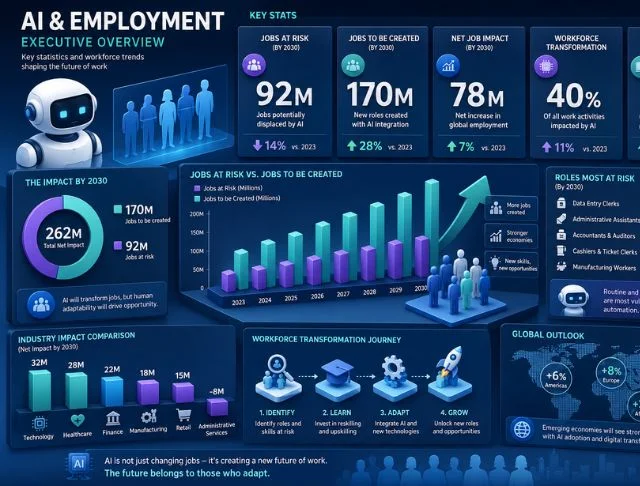
The WEF’s headline number puts the net impact at +78 million jobs by 2030, with 170 million created against 92 million displaced. McKinsey and similar forecasters land in moderate net-positive territory once new roles are factored in.
In the near term, the demand picture for AI-focused roles is strong. LinkedIn’s 2025 hiring data shows AI Engineer, Machine Learning Architect, and Prompt Engineer among the fastest-growing job categories in tech. These aren’t niche titles anymore. They’re showing up across software, finance, and healthcare as companies build out their AI capabilities.
Software, finance, and healthcare lead the list. These sectors are actively adding roles to develop, integrate, and manage AI systems. The jobs aren’t just for engineers either. Legal, compliance, ethics, and communication roles are being created around AI governance and deployment.

Workers and employers are both adjusting, some faster than others. The adaptation gap is real and the data gives you a clear sense of where things stand.
Between 20% and 40% of U.S. workers already use AI on the job. A Federal Reserve analysis of multiple surveys confirmed that range by early 2024. In tech-heavy fields, the adoption rate runs higher, and younger workers report even greater usage across the board.
Around 59% of U.S. workers will need upskilling or reskilling by 2030 because of AI and automation impacts. That’s not a small slice of the workforce. It’s a majority.
The pressure to learn new tools, pick up technical skills, or pivot into different roles is already affecting hiring expectations. Employers are increasingly factoring AI literacy into what they look for, even in non-technical positions.
Major corporations are putting money into this. Microsoft, Amazon, and IBM have all launched internal AI training programs. Government-backed public-private training initiatives also ramped up through 2024 and 2025.
Precise spending figures vary across sources, but the direction is consistent. Companies that bet heavily on AI tools are also investing in getting their existing workforce up to speed on those tools.
Early evidence puts the productivity boost from AI adoption between 10% and 25%, according to estimates from Accenture and McKinsey. Companies using AI tools across data analysis, coding, and customer service reported measurable efficiency gains.
The gains aren’t automatic. They depend on how well AI is integrated into existing workflows. But for teams that get it right, the output difference is significant.

Automation risk doesn’t spread evenly across the workforce. Your education level shapes your exposure in ways that might surprise you.
Common assumption says lower-skilled workers face the highest AI risk. The data tells a more complicated story. Only about 12% of U.S. workers with a high school diploma hold jobs in the top quartile of AI exposure. That’s actually lower than the rate for college graduates.
Current AI technologies concentrate in cognitive, analytical work, not the manual and physical roles that dominate lower-education job categories. Manufacturing automation hit this group hard over decades, but today’s AI wave is landing somewhere else.
Four-year degree holders sit in the highest-exposure zone. Pew Research finds 27% of college-educated U.S. workers hold high-AI-exposure jobs, compared to 12% for those without a degree. Brookings puts the gap even wider, estimating bachelor’s degree holders face roughly five times the AI exposure of high-school-only workers. The jobs that degrees unlock, analytics, finance, content, tech, are exactly where AI is moving fastest.
Graduate and professional degree holders face some of the steepest exposure. Brookings finds workers with master’s or doctoral degrees face nearly four times the AI exposure of high-school-only workers.
One analysis found about 17.4% of workers in the most-exposed occupations hold graduate degrees, compared to just 4.5% in the least-exposed group. The more specialized and cognitive the role, the more AI can chip away at it.

Who’s actually absorbing the impact right now? The breakdown by age and gender reveals patterns that go well beyond which industries are cutting jobs.
Younger workers are taking the hardest hit. A Stanford and ADP study found that U.S. workers aged 22 to 25 in high-AI-exposure occupations saw employment fall by roughly 13% between 2022 and 2025.
Older workers in those same fields saw little to no decline. In fact, employment for workers in their 30s and beyond grew 6 to 9% across the same AI-exposed occupations where younger workers lost ground.
The gender picture is more layered. Pew Research finds 21% of female workers hold high-exposure jobs versus 17% of male workers. Women hold a slight numerical edge in overall AI exposure.
But the highest-risk occupations, programming, engineering, finance, skew male. Brookings notes that men’s concentration in analytic and technical roles gives them higher average AI exposure scores. Women’s heavier presence in interpersonal care and education provides some protection at the extreme end.
Neither group is insulated. The exposure just looks different depending on which layer of the data you examine.
The entry-level squeeze is well-documented. From late 2022 to mid-2025, entry-level jobs in software engineering and customer service fell by about 20%, even as employment for older workers in those same fields grew.
The reason is straightforward. AI tools now handle the routine, lower-complexity tasks that junior hires traditionally owned. Employers get the output without the headcount. Young workers get routed around before they even land the role.
Seasoned workers have held their ground. The tacit knowledge, communication ability, and institutional context that experienced professionals bring to their work aren’t easy for AI to replicate.
For every point of decline in younger-worker employment across AI-exposed fields, older worker employment in those same fields grew 6 to 9%. The pattern holds consistently. Experience functions as a buffer right now, though there’s no guarantee that remains true as AI capabilities expand.

The data available today points to a specific direction. How far it goes depends on how fast AI develops and what policy and market forces shape the transition.
The World Economic Forum’s 2025 Future of Jobs report projects that roughly 22% of global jobs will face disruption from technology, including AI, by 2030. In concrete terms, WEF estimates 170 million new roles created against 92 million displaced, a net gain of 78 million jobs worldwide.
Growth is expected in healthcare, education, and green energy. Decline is projected in cashier, administrative, and clerical roles. The U.S. Bureau of Labor Statistics confirms a similar direction through 2034: healthcare and social services grow while many clerical categories shrink.
Long-range projections carry more uncertainty but point toward continued acceleration. A PwC study suggests up to 30% of jobs could be automatable by the mid-2030s. Some analysts project that by around 2045, up to half of all work tasks could fall within AI’s reach if current trends hold.
These figures assume broad deployment of advanced AI across many occupations. Actual outcomes depend heavily on adoption rates, regulation, and how quickly new roles emerge to absorb displaced workers.
Technology, finance, and knowledge-work sectors carry the highest exposure based on current AI task coverage. Computer programmers, customer service representatives, and data entry clerks rank among the top ten most exposed occupations according to Anthropic’s exposure index.
Brookings adds that higher-paying professional fields including IT, business, finance, and law contain a dense concentration of high-exposure roles. On the service side, retail and clerical roles face steep projected declines, with the WEF flagging cashiers and administrative assistants as among the hardest hit by 2030.
Core growth sectors sit on the opposite end: healthcare, education, and green technology, all of which depend on human skills AI can’t yet replicate at scale.
The skill mix the market rewards is shifting fast. On the technical side, the WEF identifies AI and big data skills, cybersecurity, and software development among the fastest-growing by 2030. Nearly 40% of core job skills are expected to change within this decade.
At the same time, human-centric abilities are gaining ground. Analytical thinking, creativity, resilience, leadership, and collaboration top the WEF’s list of critical skills for the AI era. PwC’s AI Jobs Barometer finds that AI-exposed roles increasingly demand empathy, judgment, and creativity over pure technical output.
Skill Type | Examples |
Technical | AI/data, cybersecurity, software |
Human-centric | Judgment, creativity, leadership |
One notable shift: junior roles in AI-impacted fields now often demand what used to be senior-level capabilities, things like strategic thinking and independent decision-making, much earlier in a career.
The data makes one thing clear: AI displacement is real and accelerating, but it’s not the whole story. New roles are emerging, productivity is climbing, and the net employment picture through 2030 looks moderately positive on paper.
What matters most right now is who absorbs the disruption and how fast reskilling keeps pace. The 175,796 U.S. job cuts cited since 2023 are an early count. The trajectory over the next few years will tell a much bigger story.
You are currently viewing a placeholder content from Calendly. To access the actual content, click the button below. Please note that doing so will share data with third-party providers.
More InformationYou are currently viewing a placeholder content from Calendly. To access the actual content, click the button below. Please note that doing so will share data with third-party providers.
More InformationYou need to load content from reCAPTCHA to submit the form. Please note that doing so will share data with third-party providers.
More InformationYou are currently viewing a placeholder content from Turnstile. To access the actual content, click the button below. Please note that doing so will share data with third-party providers.
More InformationYou are currently viewing a placeholder content from Vimeo. To access the actual content, click the button below. Please note that doing so will share data with third-party providers.
More InformationYou need to load content from reCAPTCHA to submit the form. Please note that doing so will share data with third-party providers.
More InformationYou are currently viewing a placeholder content from Elfsight. To access the actual content, click the button below. Please note that doing so will share data with third-party providers.
More InformationYou are currently viewing a placeholder content from reCAPTCHA. To access the actual content, click the button below. Please note that doing so will share data with third-party providers.
More Information