

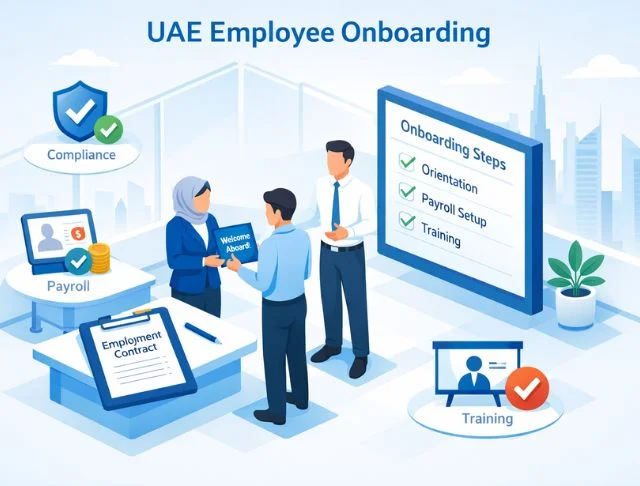

Sending an offer letter and setting a start date isn’t onboarding in the UAE. Employers must navigate employment contracts, work permits, visa requirements, payroll registration, compliance obligations, and workplace integration.
It is even more challenging when employers want to hire expatriate employees. Without a structured onboarding process, employers may face administrative bottlenecks.
A well-planned onboarding process helps in many ways. Employers stay compliant, improve employee engagement, and accelerate productivity from day one. This step-by-step guide explains everything about successful onboarding.
Author
Co-author
Sending an offer letter and setting a start date isn’t onboarding in the UAE. Employers must navigate employment contracts, work permits, visa requirements, payroll registration, compliance obligations, and workplace integration.
It is even more challenging when employers want to hire expatriate employees. Without a structured onboarding process, employers may face administrative bottlenecks.
A well-planned onboarding process helps in many ways. Employers stay compliant, improve employee engagement, and accelerate productivity from day one. This step-by-step guide explains everything about successful onboarding.
Author
Co-author
Get in Touch with Us
Leah Maglalang
Business Coordinator UAE
Complying with local labor laws helps employers avoid penalties and streamline hiring processes. Whether employers want to hire local or foreign talent, all onboarding procedures must align with current employment regulations.
The UAE Labor Law establishes the framework for employment contracts, working hours, probation periods, leave entitlements, termination procedures, and employee rights. Therefore, employers should understand these requirements before moving to the next steps.
Employers have several responsibilities to fulfill before an employee starts work. These may include preparing employment contracts, collecting required documents, arranging work permits and visas for expatriate employees, setting up payroll records, and providing access to necessary tools and systems.
Employers must prepare an employment contract that complies with UAE labor regulations. The contract should clearly define the employee’s job title, duties, compensation, benefits, working hours, probation period, leave entitlements, and termination conditions.
Before proceeding with onboarding, employers should collect all required information and supporting documents. These commonly include copies of passports, educational certificates, professional licenses (where applicable), passport-sized photographs, contact information, and other documents required for employment verification and immigration processes.
After finalizing the employment contract, employers must complete the necessary registration procedures. The primary purpose of registering employees is to ensure compliance with UAE regulations and formal recognition of the employment relationship.
Employers must apply for a work permit on behalf of expatriate employees. The application process typically involves submitting employment contracts, company documentation, and employee identification documents to the relevant authorities. Once approved, the work permit grants the employee authorization to work for the sponsoring employer.
Once a work permit has been obtained, employers must proceed with the residence visa process for expatriate employees. This process includes document verification, medical fitness examinations, proving health insurance, biometric registration, and other immigration requirements.
Employers need to register new employees with the appropriate government authorities as part of the onboarding process. For this purpose, they must submit employment-related information, update workforce records, and ensure that all regulatory requirements have been met.
The Emirates ID is a mandatory identification card for all UAE residents. Employers assist employees throughout the application process. This involves submitting personal information, biometric data, and supporting documents.
Most expatriate employees must complete a medical fitness examination as part of the residence visa process. Employers should ensure that all mandatory requirements are completed on time to avoid delays in employees’ legal work status.
Employers should set up payroll systems that accurately calculate salaries, allowances, deductions, and other compensation elements.
Implementing a reliable payroll process reduces administrative errors. It also contributes to a positive employee experience.
The Wage Protection System (WPS) is an electronic salary transfer system that ensures employees receive their wages accurately and on time. Employers subject to WPS requirements must register with the system.
In addition to base salary, employers should clearly define any benefits and allowances provided to employees. Some benefits are optional, while others are mandatory under UAE labor laws.
Before the employee starts, employers need to arrange all necessary equipment, software, and system access. This may include laptops, mobile devices, security credentials, email accounts, and access to internal platforms.
Effective communication is essential for employee success. Employees should have access to communication and collaboration tools, and employers should introduce them to relevant communication channels.
Employers should also focus on creating an environment that supports employee productivity, engagement, and well-being. Providing a comfortable workspace, clear expectations, and access to necessary support resources are some of the steps that improve the workplace experience.
The employee handbook serves as a valuable resource. It outlines company policies, procedures, and employment practices. Employers should review key topics with new hires, including working hours, attendance requirements, leave policies, performance expectations, and workplace procedures.
Employers should clearly explain the company’s code of conduct and ethical expectations. This includes standards related to professionalism, workplace behavior, conflict-of-interest policies, anti-discrimination practices, and responsible business conduct.
Employees should also receive training on relevant health, safety, and data protection requirements. Depending on the industry and role, this may include workplace safety procedures, emergency protocols, cybersecurity practices, confidentiality obligations, and data privacy policies.
Employers must clearly explain employees’ responsibilities, performance expectations, and short- and long-term objectives. Establishing measurable goals helps employees understand what success looks like in their roles. Clear expectations also reduce uncertainty.
Comprehensive training is essential for helping employees develop the skills and knowledge required to perform their roles successfully. Employers should provide role-specific training and introduce key processes and workflows. Ongoing learning and professional development opportunities can further enhance employee performance.
Successful onboarding helps employees build relationships within the organization. Employers should encourage collaboration and facilitate introductions to colleagues and stakeholders. Promoting inclusion and cross-cultural understanding is key to improving employee engagement.
Regular check-ins during the onboarding and probation periods are beneficial for employers to assess progress, address challenges, and provide constructive feedback. Employers should encourage a workplace culture that supports feedback. This improves employee satisfaction, increases retention, and contributes to long-term organizational success.
Employers remain compliant with UAE regulations when they have a structured onboarding process. New hires become productive and engaged team members when each step is completed correctly.
However, managing employment compliance, visa sponsorship, payroll administration, and onboarding requirements can be complex. These responsibilities become much simpler when employers partner with an experienced Employer of Record.
FMC Group’s Employer of Record services work in a way that allows companies to hire and onboard employees in the UAE quickly and compliantly without establishing a local legal entity.
From employment contracts and visa processing to payroll management and HR support, FMC Group handles the complexities of employment administration so businesses can focus on growth and operational success.
You are currently viewing a placeholder content from Calendly. To access the actual content, click the button below. Please note that doing so will share data with third-party providers.
More InformationYou are currently viewing a placeholder content from Calendly. To access the actual content, click the button below. Please note that doing so will share data with third-party providers.
More InformationYou need to load content from reCAPTCHA to submit the form. Please note that doing so will share data with third-party providers.
More InformationYou are currently viewing a placeholder content from Turnstile. To access the actual content, click the button below. Please note that doing so will share data with third-party providers.
More InformationYou are currently viewing a placeholder content from Vimeo. To access the actual content, click the button below. Please note that doing so will share data with third-party providers.
More InformationYou need to load content from reCAPTCHA to submit the form. Please note that doing so will share data with third-party providers.
More Information