
In this post, I’m going to explain all the important labor laws that you need to follow when hiring in Germany.
In fact, at FMC Group, we’ve been hiring employees on behalf of other companies for 17 years and know what matters most for foreign employers.
I’m specifically discussing laws related to employment relations, onboarding, contracts, leave, payroll, and much more.
Without further ado, let’s get into it…

Author

In this post, I’m going to explain all the important labor laws that you need to follow when hiring in Germany.
In fact, at FMC Group, we’ve been hiring employees on behalf of other companies for 17 years and know what matters most for foreign employers.
I’m specifically discussing laws related to employment relations, onboarding, contracts, leave, payroll, and much more.
Without further ado, let’s get into it…
Author
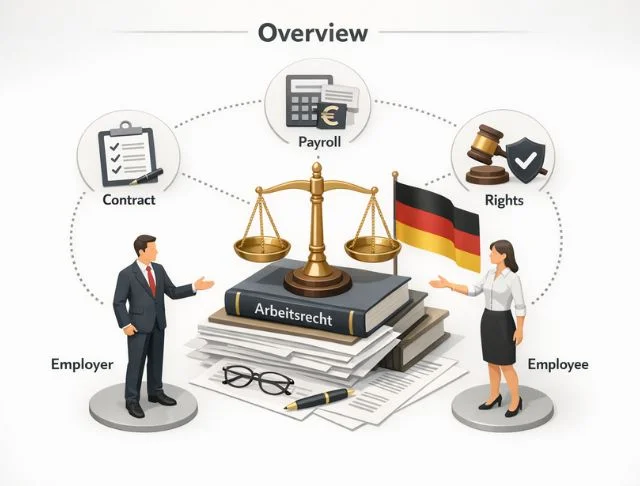
The real purpose of German labor laws is to create a balance between employers and employees. These laws focus on providing job security and social protection to employees. The key reasons behind strict regulations are providing protection for employee culture, maintaining a strong social market economy, upholding a collective bargaining tradition, and ensuring EU alignment.
German employment rules come from multiple legal frameworks that work together:
BGB (German Civil Code): Forms the basic foundation of employment contracts.
KSchG (Protection Against Dismissal Act): Regulates when and how employees can be terminated.
Arbeitszeitgesetz (Working Hours Act): Governs working time limits, rest periods, night work, and maximum weekly hours.
AGG (General Equal Treatment Act): Prohibits discrimination based on gender, age, religion, disability, race, or sexual orientation.
EU Directives: Germany also implements European Union labor regulations. These cover working time, health & safety, parental leave, and equality standards.
I crafted this guide for:
It is especially useful for companies that are new to the German market. So, let’s start understanding the complex labor laws in a simple, easy way without any fluff or overly explanations.
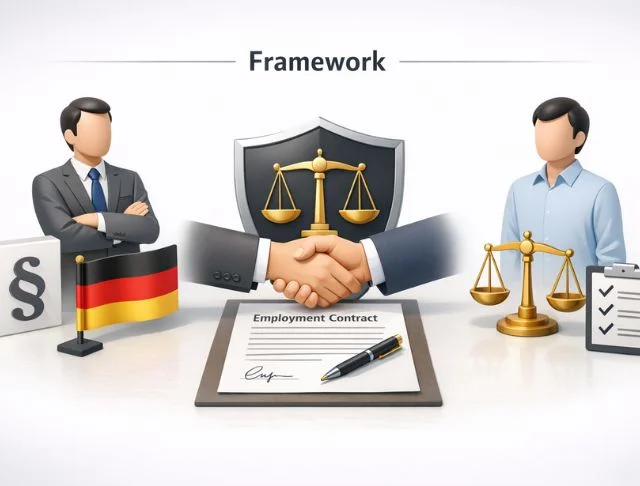
It is very critical to classify the workers in Germany. Misclassification can lead to penalties, back payments, and legal disputes.
An employee is someone who:
An independent contractor:
Note that Germany strictly monitors “false self-employment” (Scheinselbstständigkeit).
Below are the obligations that employers in Germany must comply with throughout the employment lifecycle. The key responsibilities include:
Collective representative structures influence Germany’s labor environment.
These are agreements between employers (or employer associations) and trade unions that define:
These can set the binding standards in many industries and override individual employment contracts.
A works council is an employee-elected body within a company that represents workforce interests. Their role includes:

Job advertisements in Germany must comply with the Allgemeines Gleichbehandlungsgesetz (AGG). Due to this rule, employers can’t favor or exclude candidates based on personal characteristics such as gender, age, ethnicity, religion, disability, or sexual orientation.
Job descriptions should be neutral and inclusive. Requirements must be job-related. Avoid languages that imply preference for a specific group.
Employers can only ask questions that are directly relevant to the job role. Permissible topics are professional experience, qualifications, skills, competencies, availability, and eligibility. Employers are not allowed to ask questions about personal matters.
In Germany, there should be clear distinctions between a job offer and a formal employment contract. Yes, a job offer can be considered legally binding if it is according to the general contract principles under the Bürgerliches Gesetzbuch (BGB). My suggestion is that to mitigate this risk, employers should issue a formal written employment contract separately.
After hiring the candidate, employers must comply with documentation requirements under the Nachweisgesetz. Due to this law, employers have to provide written confirmations of key employment terms. These include:
A key requirement is that employers must provide this documentation at or before the start of employment. Following the 2025 reform of the Nachweisgesetz (under the Fourth Bureaucracy Relief Act / BEG IV, effective 1 January 2025), a physical signature is no longer required. Employers may now fulfil the obligation in Textform — for example, by e-mail or PDF — as long as the employee can store and print the document and confirms receipt.
A permanent contract is the standard and most common form of employment in Germany. It has no fixed end date and continues until either the employer or employee terminates it. This contract offers strong job security under dismissal protection laws. This is the default option for employers when no time limit is specified.
As the name shows, a fixed-term contract is limited to a specific duration or purpose. It automatically ends on a specific date or when the defined project is completed.
Fixed-term contracts must comply with the Teilzeit- und Befristungsgesetz. There are two main scenarios:
Employers can justify a fixed-term contract based on:
In this case, there is more flexibility in duration and renewals.
If there is no valid reason:
This is where most legal risks occur.
All the fixed-term contracts that don’t have an objective reason have a maximum duration of 2 years and can be renewed three times. This is valid when the employee has not worked for the company before, and any change in contract terms may count as a new contract.
During such contracts, employees work fewer hours than full-time staff but still receive rights and benefits. According to German laws, employees have the right to request part-time work.
These are special types of low-income employment arrangements in Germany.
You can hire freelancers in Germany, but officials strictly monitor worker classification. A freelancer operates independently, is not integrated into the company structure, and works without direct control. So, if a freelancer behaves like an employee, it may be false self-employment (Scheinselbstständigkeit).
Multiple laws, including the Bürgerliches Gesetzbuch, guide the exact requirements, but the following details are considered essential:
Under the Nachweisgesetz, employers have to provide employees with written proof of essential employment terms. As noted above, employers must provide this documentation at or before the start of employment. Since 1 January 2025, a physical (handwritten) signature is no longer required — documentation in Textform (e.g., e-mail or PDF with confirmed receipt) is legally sufficient.
Certain contact clauses can create legal problems. Common risks include:
Employment contracts in Germany often include a probation period. The key rules of this probation period are following:

The primary law that governs the working hours and overtime is the Arbeitszeitgesetz. German law sets clear limits on how long employees can work.
This extension to ten hours is allowed when the average working time over 6 months (or 24 weeks) does not exceed 8 hours per day. In practice:
Employees can enjoy the rest and break periods during the workday:
Breaks must be:
The minimum rest between working days is 11 consecutive hours between shifts. For example, if an employee finishes at 8 pm, the next shift can’t be started again before 7 am the next day.
Germany has very strict rules regarding work on Sunday and public holidays. Sunday work is generally prohibited, and public holidays are treated similarly. The healthcare, hospitality, emergency services, and transportation sectors are exceptional. If employees work on Sunday, they must receive a compensatory rest day (usually within 2 weeks).
Overtime in Germany is allowed, but it is not automatically free or unlimited.
Employers have to pay when overtime goes beyond the agreed working hours. In Germany, this typically applies when:
In these cases, employees are compensated overtime either through additional pay or time off in lieu (compensatory leave).
Overtime can be included in salary when:

Germany has a structured wage system that combines a statutory minimum wage, industry-level agreements, and anti-discrimination laws.
As of January 2026, the statutory minimum wage is €13.90 per hour (gross). This minimum wage applies to full-time, part-time, mini-job, and foreign workers’ employment. Apprentices and individuals under 18 without vocational training are exceptions.
In addition to the statutory minimum wage, many industries in Germany follow collective agreements (Tarifverträge). These agreements are often set:
For example, the construction, healthcare, and logistics sectors follow Tarifverträge.
Germany enforces equal pay through two key laws:
This law ensures that employees are not discriminated against in compensation based on:
This law focuses specifically on salary transparency and gender pay equality.
Key rights include:

The Federal Vacation Act regulates paid annual leave.
Note that employers must grant leave as time off (it cannot be replaced with cash). As a rule, unused leave expires at the end of the calendar year. Carry-over to 31 March of the following year is only permitted if there are urgent operational or personal reasons (e.g., illness or pressing business needs). Importantly, employers must proactively inform employees in writing about the risk of forfeiture — otherwise, the leave entitlement does not automatically expire (per ECJ and BAG case law).
Sick leave is a legally protected right in Germany. Key employer obligations:
Employees have to be informed immediately and provide a medical certificate after 3 to 4 days.
Public holidays are separate from annual leave and are also paid days off. If employees work during these days, they must receive compensatory rest or additional compensation. Public holidays vary by state. However, 10 to 13 days per year is the range.
Germany provides strong protection for parents through maternity and parental leave systems.
Maternity leave is governed by strict protection laws.
Total duration = 14 weeks (6 weeks before birth and 8 weeks after birth)
Key protections:
Parental leave (Elternzeit) provides extended time off for childcare.
Key features:
Elternzeit is usually unpaid by the employer. However, employees may receive government parental allowance.

Contributions are calculated as a percentage of gross salary, and pension insurance is one of the largest components.
Health insurance is mandatory for most employees in Germany.
Employer share: Around 8.6%–8.8%, depending on the insurer. This covers medical treatment, hospital care, and sick pay.
This provides income support if an employee loses their job.
This covers care for individuals who cannot care for themselves due to age or illness.
When you combine all mandatory contributions:
Total employer social contribution = ~20% to 22% of gross salary.
Additionally, employers must also pay for accident insurance separately.

The legal framework is primarily based on the Bürgerliches Gesetzbuch (BGB) and the Kündigungsschutzgesetz(KSchG). Termination must be justified, and there are three main legally accepted reasons:
Notice periods in Germany increase with the employee’s length of service (for employer-initiated termination).
Length of Service | Notice Period |
During probation (≤6 months) | 2 weeks |
< 2 years | 4 weeks (to 15th or end of month) |
2 years | 1 month (end of month) |
5 years | 2 months |
8 years | 3 months |
10 years | 4 months |
12 years | 5 months |
15 years | 6 months |
20 years | 7 months |
During the probation period:
The Kündigungsschutzgesetz (KSchG) provides strong employee protection.
It applies when:
When dismissal is applicable, termination must be socially justified, and the employer must prove valid legal reasons.
Germany does not automatically require severance pay (Abfindung). However, it is commonly used in practice. When severance is paid:

The main body responsible for employee representation at the company level is the works council, which oversees Betriebsverfassungsgesetz.
A common misconception is that works councils are mandatory, but a works council can be formed when a company has at least 5 employees and at least 3 are eligible for election.
Employees must initiate and elect it themselves. Employees can’t prevent or interfere with its formation.
Works councils have different levels of rights, but the most important is co-determination. In certain areas, employers need approval from the works council. Key areas include:
This is where works councils directly impact business operations.
In companies with more than 20 employees, the works council must:
The employer must consult the works council before dismissal. If not, the termination can be legally invalid. Even if the reason is valid, skipping this step is equal to an automatic risk
For major operational changes (e.g., layoffs, restructuring):
Employer must:
In larger companies, an additional structure comes into play. When required, companies with more than 100 employees must establish an economic committee. It acts as a bridge between management and work councils and focuses on business and financial matters like company performance, investment plans, and restructuring strategy.

Germany follows different rules based on the candidate’s nationality. No work permit is required for EU, EEA, and Swiss citizens. They can live and work freely here. In simple terms, hiring EU candidates is almost the same as hiring local German employees.
Hiring non-EU citizen requires a work permit and a residence permit. In many cases, the job also must meet qualification and salary standards.
Non-EU employees need a national work visa before entering Germany and a residence permit.
Key requirements include:
The EU Blue Card is a special residence permit that is designed for highly qualified non-EU workers.
As of 2026:
Additional criteria include:
Employers play a critical role in immigration compliance. Their key responsibilities include: Providing a valid and compliant employment contract.

A genuinely self-employed contractor operates independently and runs their own business. Key characteristics include:
Germany uses the term Scheinselbstständigkeit for misclassification. It occurs when:
Authorities assess factors such as:
Choosing the right model is critical.
This is the classic misclassification case in Germany.

German authorities monitor employment compliance through tax audits, social security inspections, and customs investigations. If violations are identified, employers may face:
In more serious cases, authorities can prosecute criminals, and penalties can include fines or imprisonment.
One of the most significant financial risks comes from unpaid or incorrectly paid social contributions. If non-compliance is discovered, the employer must pay both employer and employee portions and may face interest on late payments or surcharges. In cases of misclassification, e.g., false freelancing, authorities may go back up to 4 years.
Germany’s employee protection framework makes litigation a common risk. If an employee challenges termination, they can file a claim within 3 weeks.
Beyond financial and legal penalties, non-compliance can damage a company’s reputation. Risks include:
Use this checklist to ensure full compliance when hiring and managing employees in Germany, from pre-hiring to ongoing employment obligations.
☐ Define the role correctly (employee vs contractor) to avoid misclassification
☐ Ensure job description is non-discriminatory (AGG compliant)
☐ Confirm salary meets minimum wage and industry standards
☐ Check if a collective agreement (Tarifvertrag) applies
☐ Verify work authorization (EU vs non-EU candidate)
☐ If non-EU: confirm visa/work permit eligibility (e.g., EU Blue Card)
☐ Prepare a clear and legally compliant job offer
☐ Align interview process with legal restrictions (no personal/discriminatory questions)
☐ Draft a written employment contract (mandatory under law)
☐ Include all key terms:
☐ Job title and responsibilities
☐ Start date
☐ Salary and payment terms
☐ Working hours
☐ Vacation entitlement
☐ Notice period
☐ Clearly define probation period (max 6 months)
☐ Ensure fixed-term contracts comply with legal limits (if applicable)
☐ Avoid invalid clauses (e.g., vague overtime, broad non-compete)
☐ Provide written documentation as required under Nachweisgesetz
☐ Register employee with the Social Security system
☐ Set up payroll tax withholding
☐ Enroll employee in:
☐ Health insurance
☐ Pension insurance
☐ Unemployment insurance
☐ Long-term care insurance
☐ Calculate employer contributions (~20–22% on top of salary)
☐ Register with relevant tax authorities
☐ Set up compliant payroll system
☐ Ensure minimum wage compliance and proper payslips
☐ Track working hours and comply with legal limits
☐ Ensure proper breaks and rest periods
☐ Manage paid leave and public holidays correctly
☐ Handle sick leave payments (up to 6 weeks full pay)
☐ Comply with maternity (Mutterschutz) and parental leave (Elternzeit) rules
☐ Apply correct notice periods and termination procedures
☐ Consult works council (if applicable) for HR decisions
☐ Regularly review employment classification (employee vs contractor)
☐ Maintain proper documentation and records
☐ Stay updated on minimum wage and legal changes
No, a probation period is not legally mandatory in Germany. However, it is commonly included in employment contracts.
No. Dismissal in Germany is strictly regulated and not “at-will.” Employers must have a legally valid reason.
The total cost of hiring is higher than the gross salary due to mandatory employer contributions. For example, upon gross salary, 20% to 22% social security contributions employers have to pay.
It depends on nationality. EU, EEA, and Switzerland citizens don’t need visas, and non-EU citizens need work visas, residence permits, or blue cards.
Overtime must be properly compensated, but rules depend on the contract. The compensations included extra pay or time off in lieu (compensatory leave).
Let’s be honest, hiring in Germany isn’t simple. The labor laws are detailed, and payroll obligations are strict. If you get employee classification wrong, you may quickly turn into back payments, fines, or worse. Even companies with solid HR teams can find themselves caught off guard.
That’s where we come in. For over 17 years, FMC Group has been helping international companies hire in Germany the right way, without the headaches. We take care of compliant contracts, payroll, and day-to-day HR administration, so you can focus on actually running your business.
Curious about how it works? Learn more about FMC Group’s Employer of Record services in Germany.
You are currently viewing a placeholder content from Calendly. To access the actual content, click the button below. Please note that doing so will share data with third-party providers.
More InformationYou are currently viewing a placeholder content from Calendly. To access the actual content, click the button below. Please note that doing so will share data with third-party providers.
More InformationYou need to load content from reCAPTCHA to submit the form. Please note that doing so will share data with third-party providers.
More InformationYou are currently viewing a placeholder content from Turnstile. To access the actual content, click the button below. Please note that doing so will share data with third-party providers.
More InformationYou are currently viewing a placeholder content from Vimeo. To access the actual content, click the button below. Please note that doing so will share data with third-party providers.
More InformationYou need to load content from reCAPTCHA to submit the form. Please note that doing so will share data with third-party providers.
More InformationYou are currently viewing a placeholder content from Elfsight. To access the actual content, click the button below. Please note that doing so will share data with third-party providers.
More InformationYou are currently viewing a placeholder content from reCAPTCHA. To access the actual content, click the button below. Please note that doing so will share data with third-party providers.
More Information

