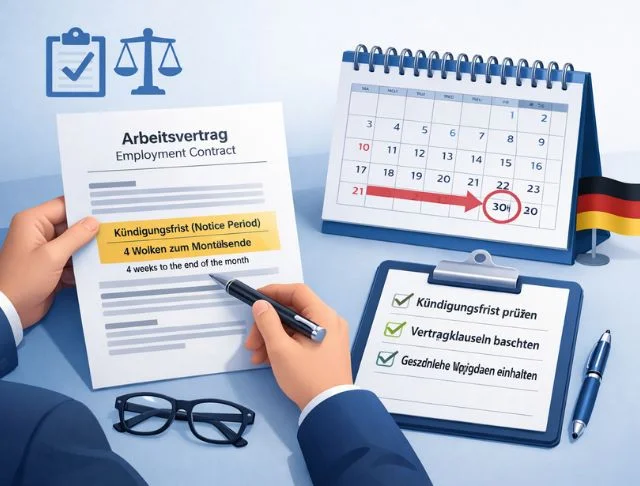
Notice Periods in Germany: Complete Guide for Foreign Employers

Employees do not remain with a company permanently. They leave, but not in the same way they enter.

As Germany has many laws governing hiring, onboarding, and ongoing compliance, certain rules and regulations also apply when an employee leaves under notice period requirements.

This is not a simple notice of resignation and company acceptance. The company must follow legal requirements; otherwise, it may face serious issues while operating in Germany.

That’s why, in this post, we discuss all the important laws that every foreign employer must know regarding notice periods.

Picture of Stephan Dorn
Stephan Dorn

Author

Notice Periods in Germany Complete Guide for Foreign Employers

Notice Periods in Germany: Complete Guide for Foreign Employers

Employees do not remain with a company permanently. They leave, but not in the same way they enter.

As Germany has many laws governing hiring, onboarding, and ongoing compliance, certain rules and regulations also apply when an employee leaves under notice period requirements.

This is not a simple notice of resignation and company acceptance. The company must follow legal requirements; otherwise, it may face serious issues while operating in Germany.

That’s why, in this post, we discuss all the important laws that every foreign employer must know regarding notice periods.

Picture of Stephan Dorn
Stephan Dorn

Author

Table of Contents

Get in Touch with Us

Stephan Dorn Photo

Stephan Dorn

Managing Partner

united states flag germany flag

Understanding the Notice Period in Germany

Understanding the Notice Period in Germany

What Is a Notice Period in Germany (Kündigungsfrist)?

A notice period (Kündigungsfrist) in Germany is the legally defined time between when a termination is formally communicated and when the employment relationship officially ends.

During this period, employees continue working and receive their salary. Terminations that do not follow notice period rules can be invalid, and employers may be exposed to legal disputes. Notice periods apply to:

  • Employer-initiated terminations
  • Employee resignations
  • Most standard employment contracts (unless specific exceptions apply)

Why Notice Periods Matter for Foreign Employers Hiring in Germany

Notice periods in Germany directly impact workforce planning, legal compliance, and termination costs. For foreign employers, the importance is even higher because:

  • Strict legal enforcement: German courts strongly protect employees.
  • Longer employer obligations: Notice periods increase with employee tenure, so senior employees may require months of continued employment or pay.
  • Operational planning: In most cases, staff cannot be terminated immediately.
  • Contract alignment: Employment contracts must be carefully drafted to align with statutory rules.

German Employment Law on Notice Periods

German Employment Law on Notice Periods

Legal Framework Under the German Civil Code (BGB)

The German Civil Code (Bürgerliches Gesetzbuch – BGB), Section 622 governs notice periods in Germany. This law defines the minimum legal requirements for terminating employment relationships.

The BGB ensures that both employees and employers follow standardized termination rules. It protects employees from sudden job loss and also helps employers with workforce management.

Individual employment contracts or collective agreements can modify the terms, but they cannot go below the statutory minimum protections set by the BGB.

Minimum Statutory Notice Periods in Germany

German law sets clear baseline notice periods that apply when no special contractual or collective agreement exists. The minimum notice period is 2 weeks, but only when a probationary period (Probezeit) has been expressly agreed in the employment contract. A probationary period may last a maximum of 6 months.

When Do Notice Period Rules Apply? (Employees vs Employers)

Notice period rules in Germany apply to both employers and employees, but they are not always the same.

Employees usually follow a standard notice period (commonly 4 weeks).

Employers must follow statutory or longer notice periods based on employee tenure.

Contract vs law: If an employment contract defines notice periods, they must still comply with the minimum standards set by the BGB.

Standard Notice Periods in Germany (Statutory Rules)

Standard Notice Periods in Germany Statutory Rules

Default Notice Period During Probation Period

During the probation period (commonly up to 6 months), unlike the standard notice period, the 2-week probation notice is not tied to the 15th or end of the month, it can take effect on any calendar day. However, even during probation, employers must provide termination in writing. If no probationary period is expressly agreed in the employment contract, the standard 4-week notice period applies from the very first day of employment.

Standard Notice Period After Probation

Once the probation period ends, the standard statutory notice period under German law becomes 4 weeks to either the 15th or the end of a calendar month. A contract or collective agreement can modify this; otherwise, it applies equally to both employees and employers.

Employee Notice Period vs Employer Notice Period Differences

In Germany, employee and employer notice periods are not always the same.

Employees are usually required to give a standard 4-week notice after probation, unless their contract specifies a longer period.

Employers must follow legally extended notice periods based on tenure, which are often much longer than employee obligations.

Notice Period Table in Germany (By Length of Service)

Notice Period Table in Germany By Length of Service

Notice Periods for Employees with Less Than 2 Years

For employees with up to 2 years of service, the statutory notice period is short. The standard notice period during this time frame is 4 weeks to either the 15th or the end of a calendar month. During this tenure, no extended employer protection rules apply yet. After probation, employers and employees generally follow the same baseline notice period.

Extended Notice Periods for Long-Term Employees

Once an employee exceeds 2 years of service, German law introduces progressively longer employer notice periods.

The notice period increases in stages:

  • 2 years → 1 month
  • 5 years → 2 months
  • 8 years → 3 months
  • 10 years → 4 months
  • 12 years → 5 months
  • 15 years → 6 months
  • 20 years → 7 months

These extensions apply only to employer-initiated terminations, not employee resignations.

Employment Contracts and Notice Period Clauses

Employment Contracts and Notice Period Clauses

Can Employers Set Custom Notice Periods in Germany?

Yes, employers can define custom notice periods in employment contracts. However, compliance with German legal minimum standards is mandatory. Notice periods can be longer than statutory rules but not shorter. Employee-friendly rules are allowed, and contracts must comply with the German Civil Code.

When Contractual Notice Periods Override Statutory Rules

A contractual notice period will apply instead of statutory rules only when it meets the following conditions:

  • Clearly written in the employment contract
  • Legally compliant (not below minimum statutory requirements)
  • Not overridden by a collective bargaining agreement (if applicable)

Invalid Notice Period Clauses to Avoid

Certain contract clauses are not enforceable under German law, including:

  • Notice periods shorter than the statutory minimum
  • One-sided clauses that favor only the employer
  • Unclear or ambiguous termination timelines
  • Clauses conflicting with collective agreements (Tarifverträge)

Special Notice Period Rules in Germany

Special Notice Period Rules in Germany

Notice Periods During Probation (Probezeit)

As mentioned earlier, during the probation period, notice periods are shorter, with a standard of 2 weeks. This applies to both employers and employees.

Notice Periods for Temporary Contracts

Fixed-term (temporary) contracts in Germany usually end automatically on the agreed date, meaning no notice period is required at expiry. Early termination is only possible if the employer explicitly includes this option in the contract.

Notice Periods for Part-Time Employees

Part-time employees follow the same statutory notice rules as full-time employees:

  • No legal distinction in notice period length
  • Based on tenure and contract type, not working hours
  • Equal protection under German labor law

Notice Periods in Small Businesses (Kleinbetriebe)

In small businesses (those regularly employing 10 or fewer employees, counted pro-rata for part-time staff), the Dismissal Protection Act (KSchG) does not apply. However, statutory notice periods still apply, and employers must still respect minimum BGB requirements.

How Collective Bargaining Agreements (Tarifverträge) Affect Notice Periods

Collective bargaining agreements can significantly modify notice rules:

  • They may set longer or industry-specific notice periods
  • They override individual contracts if applicable
  • They are common in sectors such as manufacturing, logistics, and public services

Calculating Notice Periods in Germany

Calculating Notice Periods in Germany

When Does the Notice Period Start?

In Germany, the notice period starts when the notice of termination is received by the other party, not when it is sent. The termination must be delivered and received to be legally effective. An important nuance is that under § 623 BGB, terminations must be in strict written form, meaning a letter with an original wet-ink signature on paper. Termination via email, fax, SMS, or verbal notice is always legally invalid, regardless of any prior agreement between the parties. The countdown begins on the day the notice is received.

End-of-Month vs Fixed-Date Terminations

German notice periods often end on specific dates, depending on the contract or statutory rule. The two main structures are:

  • Fixed-date termination: Ends on a specific date stated in law or contract (commonly the 15th or the end of the month)
  • End-of-month termination: Employment ends on the last day of the month after the notice period expires

Example: If the notice period is 4 weeks to month-end, termination may end on the 31st of the month rather than exactly 28 days later.

How Employer of Record Services Manage Notice Periods

Employer of Record (EOR) service providers, such as FMC Group in Germany, allow companies to hire employees without establishing a legal entity. They handle payroll, maintain employment records, manage leave, onboard employees, and process taxes and social contributions. They also manage employee terminations on behalf of the client company in accordance with German labor law.

During this process, EORs ensure that notice period requirements are properly applied and help reduce the risk of non-compliance. If you want to learn more about this service, you can book a free 30-minute call to receive a customized hiring plan.

Get In Touch With Stephan

We are looking forward to hearing from you