
In this post, I’m going to explain all the labor laws that a foreign employer must know while hiring in the United Arab Emirates.
In fact, at FMC Group, we follow all these labor laws and get employees hired for other companies, acting as an Employer of Record.
This post covers all the requirements that a foreigner must comply with before hiring, alternative options to direct hiring, employee handling rules, payroll rules, and the risks of hiring in the UAE.
Without further delay, let’s get started.

Author

Co-author

In this post, I’m going to explain all the labor laws that a foreign employer must know while hiring in the United Arab Emirates.
In fact, at FMC Group, we follow all these labor laws and get employees hired for other companies, acting as an Employer of Record.
This post covers all the requirements that a foreigner must comply with before hiring, alternative options to direct hiring, employee handling rules, payroll rules, and the risks of hiring in the UAE.
Without further delay, let’s get started.
Author
Co-author
Get in Touch with Us

Leah Maglalang
Business Coordinator UAE


As of May 2026, a modernized, enforcement-heavy framework governs all private-sector employment in the UAE. This framework is built around Federal Decree-Law No. 33 of 2021 and its subsequent amendments (2023–2024).
Foreign employers underestimate the centralization and controlled employment in the UAE, but here are the non-negotiables in 2026:
Penalties can reach AED 1 million per violation and authorities actively audit contracts, payroll, and hiring structures.
The foundation of UAE employment law is Federal Decree-Law No. 33 of 2021, which replaced the older 1980 labor law framework.
What this law covers:
It applies to all private-sector employers and both UAE nationals and expatriates.
The difference between Mainland and Free Zone directly affects your hiring process, employee sponsorship, payroll operations, and compliance.
Area | Mainland (Onshore UAE) | Free Zone |
Regulatory Authority | Ministry of Human Resources & Emiratisation (MOHRE) | Individual Free Zone Authority |
Applicable Labor Law | Federal Decree-Law No. 33 of 2021 (fully enforced) | Same law applies in most zones; DIFC & ADGM have separate laws |
Market Access | Can hire and operate across the UAE without restriction | Typically limited to Free Zone + international markets |
Employee Visa Sponsorship | Direct through MOHRE + immigration | Managed by Free Zone authority (simplified process) |
WPS (Payroll Compliance) | Mandatory for all employees | May be optional depending on Free Zone |
Emiratisation Requirements | Mandatory for eligible companies (50+ employees) | Generally not required |
Employment Contracts | Standardized MOHRE contracts (fixed-term only) | Similar structure, but issued via Free Zone system |
Office Requirement | Physical office required | Flexible (flexi-desk, virtual office options available) |
Hiring Flexibility | More regulated, stricter compliance | More flexible setup and faster onboarding |
Ability to Hire at Scale | Easier for large teams (no strict visa caps tied to packages) | Often limited by visa quotas based on license |
Compliance Burden | Higher (WPS, audits, Emiratisation, MOHRE oversight) | Lower, but still subject to Free Zone rules |
Best Use Case | Companies targeting UAE market or scaling local teams | Startups, remote teams, international-first companies |
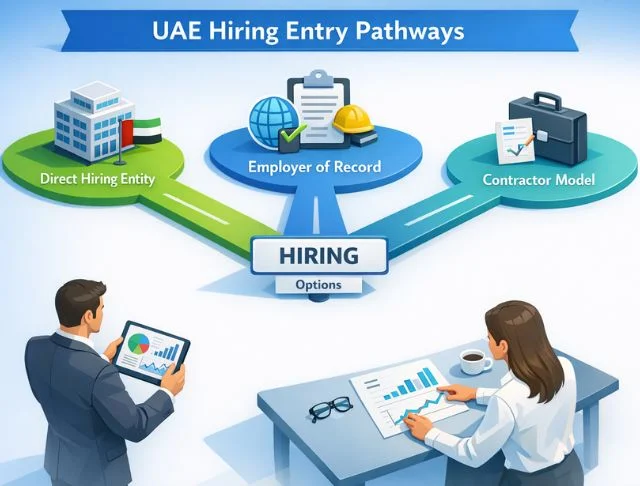
Foreign companies have three main ways to hire employees in the UAE, and one of them is “Direct Hiring,” where you set up a legal entity and hire employees yourself without a third party. If you go with this option, then it involves:
Key benefits that you get are full control over employment contracts, payroll, and IP, with the ability to operate commercially in the UAE.
But remember that this process can take 1–3 months or longer, requires ongoing compliance, and involves higher fixed costs with compliance risk.
An Employer of Record (EOR) is the fastest and most compliant way for foreign companies to hire in the UAE without setting up an entity.
How EOR Works:
Key advantages of partnering with an EOR lie in fast hiring without a legal entity, full compliance, and suitability for testing the UAE market.
Higher per-employee costs and less direct control over the employment structure are trade-offs when working with an EOR.
Free Zones offer a middle ground between full entity setup and EOR.
You set up a Free Zone company (simpler than Mainland)
The Free Zone authority helps with, Licensing, Visa quotas, Basic HR/admin processes.

Every employee in the UAE must have a written employment contract. Employers must register it with MOHRE in the Mainland and the respective authority in the Free Zone. It must be in Arabic (English can be attached).
Clause | Requirement |
Job Title & Role | Clearly defined scope of work |
Salary Structure | Basic salary + allowances |
Contract Duration | Fixed-term (mandatory) |
Working Hours | As per UAE law (typically 8 hrs/day) |
Leave Entitlements | Annual, sick, maternity, etc. |
Probation Period | If applicable (max 6 months) |
Notice Period | 30–90 days (post-probation) |
Termination Terms | Grounds + compensation rules |
As of 2026, the UAE has fully eliminated unlimited (open-ended) contracts. Key rules foreign employers must understand:
If termination is without valid reason, the employer has to compensate up to 3 months’ salary.
The UAE government strictly regulates the probation period.
Scenario | Notice Requirement |
Employer terminates employee | Minimum 14 days’ written notice |
Employee resigns (leaving UAE) | Minimum 14 days’ notice |
Employee switches to another UAE employer | 30 days’ notice + compensation obligations |
Remember that there is no payable gratuity during the probation period, and termination cannot be discriminatory or retaliatory.

In the UAE, employees cannot legally work until both labor approval (work permit) and the residency visa are completed.
Employer issues a formal offer aligned with MOHRE standards
Employer applies for a work permit through MOHRE or Free Zone authority
Allows the employee to enter or remain in the UAE legally
Mandatory health screening + biometric registration
Employee becomes a legal resident under employer sponsorship
Final step, employee can legally start working
The UAE maintains a strict documentation standard. If submissions are incomplete or inconsistent, this can be a major cause of delays or rejections.
Document | Requirement |
Passport Copy | Minimum 6 months validity |
Passport-size Photo | UAE-compliant format |
Signed Job Offer / Contract | Issued via MOHRE system |
Educational Certificates | Required for skilled roles (attested if applicable) |
Medical Fitness Certificate | Completed in UAE |
Entry Permit / Visa Application Forms | Submitted by employer |
Employers must have a valid trade license, an establishment card, an approved visa quota, and a clean compliance record.
Emiratisation is a mandatory workforce nationalization policy supervised by MOHRE. It applies exclusively to mainland private sector companies most free zone companies are exempt.
Who It Applies To
Companies with 50+ employees must achieve a 10% Emirati representation in skilled roles (occupational levels 1–5) by December 2026. This is built on a cumulative schedule of 2% annual growth (broken into two 1% half-year increments), starting from 2023. The 2026 milestone targets are 8% by mid-2026 and 10% by year-end.
Companies with 20–49 employees operating in 14 designated economic sectors — including banking, finance, insurance, real estate, IT, healthcare, manufacturing, hospitality, and telecommunications — must employ a minimum of 2 Emirati nationals by end of 2026.

For foreign employers, understanding salary composition is critical. It is contract-driven but legally structured.
Component | Description |
Basic Salary | Fixed wage stated in contract (core legal reference) |
Allowances | Housing, transport, food, or other benefits |
Total (Gross) Salary | Basic salary + allowances |
There is no universal minimum wage for expatriates, but employers must set the agreed salary in the contract and pay it in full. For UAE nationals, the minimum salary in the private sector is AED 6,000 per month, effective 1 January 2026. Note that gratuity is calculated only on the basic salary, not total compensation, and allowances are contractual (not mandatory).
The Wage Protection System (WPS) is the UAE’s core payroll enforcement mechanism.
Requirement | Rule |
Payment frequency | At least once per month |
Payment deadline | 1st of every Gregorian month with no grace period (effective on 1 June 2026) |
Currency & method | Bank transfer or approved payroll channel |
Data reporting | Mandatory SIF submission |
The AED 50,000 figure is the maximum cap on fines, and not a flat penalty. WPS enforcement is tiered: MOHRE flags the company at Day 15, suspends work permit services at Day 17, refers companies with 50+ employees to Public Prosecution at Day 30, and imposes fines of AED 5,000 per employee (up to AED 50,000) from Day 60. Repeated non-compliance results in permanent permit suspension until arrears are cleared.
The UAE law partially mandates the employee benefits and employers offer them partially by market competitiveness.
Benefit | Requirement |
End-of-Service Gratuity (EOSB) | 21–30 days’ basic salary per year of service |
Annual Leave | Minimum 30 days/year after 1 year |
Sick Leave | Up to 90 days (paid + unpaid structure) |
Health Insurance | Mandatory in Dubai & Abu Dhabi (employer-provided) |
WPS Salary Payment | Mandatory payroll compliance system |
Benefit | Common Practice |
Housing Allowance | Standard for expat employees |
Transport Allowance | Widely offered |
Bonuses / Incentives | Performance-based |
Private Health Upgrades | Beyond minimum coverage |
Education Allowance | Optional benefit |

Employers must track time, overtime, and payroll records for compliance audits in the UAE.
Scenario | Compensation |
Overtime (regular hours) | +25% of hourly wage |
Night overtime (10 PM – 4 AM) | +50% of hourly wage |
Work on rest day | Substitute day off or overtime pay |
Leave entitlements in the UAE are statutory rights.
Service Period | Entitlement |
6–12 months | 2 days per month |
1+ year | 30 calendar days per year |
Total entitlement: 90 days per year
Maternity leave: 60 days total (45 full pay + 15 half pay)
Additional unpaid leave may apply in medical cases
Parental leave: 5 days paid leave (for both parents, within 6 months of birth)
End-of-service gratuity (EOSB) is a mandatory statutory payment. It is one of the largest financial liabilities for employers in the UAE. Employees must complete at least 1 year of continuous service to get this.
Service Period | Entitlement |
First 5 years | 21 days’ basic salary per year |
After 5 years | 30 days’ basic salary per year |

Under UAE labor law, termination must be based on valid and legally recognized grounds. At-will termination does not apply.
Scenario | Explanation |
Contract expiry | Fixed-term contract ends and is not renewed |
Mutual agreement | Both parties agree in writing |
Performance or business reasons | Must be justified and documented |
Redundancy / restructuring | Allowed with proper notice |
Termination must not be arbitrary (unjustified dismissal) and retaliatory (e.g employee filed complaint).
Allowed only in serious misconduct cases, such as:
The UAE enforces strict notice period rules. Here are the notice period requirements:
Rule | Requirement |
Minimum notice | 30 days |
Maximum notice | 90 days |
Contract governs exact duration | Must be stated in MOHRE contract |
During the notice period, employees must continue working and employers have to pay full salary with benefits.

UAE labor law imposes strict anti-discrimination and equal opportunity standards. These come under Federal Decree-Law No. 33 of 2021 and related legislation.
Employers in the UAE have a legal duty of care. It means they have to ensure a safe and compliant working environment. Core requirements:
Area | Scope |
Physical safety | Workplace hazards, equipment, site safety |
Health protection | Medical fitness, insurance compliance |
Mental wellbeing | Increasing focus in HR policies |
Remote work safety | Ergonomics + digital work environment |
Data protection is a critical compliance area for employers in the UAE, especially with the enforcement of the Personal Data Protection Law (PDPL).
Federal Decree-Law No. 45 of 2021 (PDPL) governs collection, processing and storage of personal data. Separate regimes apply in DIFC and ADGM.
Area | Requirement |
Lawful data processing | Must have clear legal basis (e.g., employment necessity) |
Employee consent | Required for certain data uses |
Data security | Protect against breaches and unauthorized access |
Cross-border transfers | Must comply with UAE data transfer rules |
Data retention | Store only as long as necessary |

Misclassification is among the highest-risk compliance issues for foreign employers in the United Arab Emirates.
If a worker operates under control, supervision, and exclusivity, the government considers it an employee, not an independent contractor.
Indicator | Risk |
Fixed working hours set by company | Indicates employment relationship |
Exclusive service to one company | Not a true contractor |
Company-provided tools/equipment | Signals employer control |
Long-term engagement (12+ months) | Looks like disguised employment |
The Wage Protection System (WPS) is the UAE’s primary enforcement tool. It is the most common failure point for foreign employers as well.
Risk Area | What Goes Wrong |
Late salary payments | No grace period” and Day 5 sanction trigger (effective on 1st June 2026) |
Incorrect salary reporting | Mismatch between contract and WPS file |
Off-system payments | Paying outside WPS is non-compliant |
Partial payments | Underpaying or delaying allowances |
UAE labor law imposes significant financial and operational penalties.
Violation | Potential Consequence |
WPS non-compliance | Fines up to AED 50,000 |
Labor law violations (general) | Fines ranging from AED 5,000 to AED 1,000,000 |
Fake Emiratisation | Heavy fines + backdated penalties |
Misclassification / illegal hiring | Fines + business restrictions |
Severe or repeated violations can result in work permit suspension, company blacklisting or restrictions on future hiring. Employees can also fine claims through MOHRE.

In the UAE, employee disputes start informally and if the employer does not handle it properly, it escalates quickly into formal legal processes.
Area | Example Issues |
Unpaid wages | Salary delays, WPS discrepancies |
Termination disputes | Arbitrary dismissal, unpaid notice |
Gratuity issues | Incorrect calculation or delayed payment |
Workplace violations | Discrimination, contract breaches |
The Ministry of Human Resources and Emiratisation (MOHRE) is the primary authority handling private-sector labor disputes in the Mainland UAE. MOHRE’s receive employee complaints via online portals, call centers and service centers. It conducts mediations between employers and employees. Under the 2024 amendment, MOHRE can now issue binding executive decisions for claims not exceeding AED 50,000 — enforceable without going to court, with a 15-working-day appeal window to the Court of First Instance.”
Timeline: Typically a few days to a few weeks
If unresolved → escalates to labor court
If mediation fails, the case is referred to the UAE labor courts, where it becomes a formal legal proceeding.

We have been providing employer of record services for over 15 years. Now we offer these services in 50 countries, including the UAE. FMC Group handles hiring, payroll, employee benefits, and everything an employer needs to hire employees. Book a 30-minute consultation call to get a detailed plan for your next hire in the UAE.
You are currently viewing a placeholder content from Calendly. To access the actual content, click the button below. Please note that doing so will share data with third-party providers.
More InformationYou are currently viewing a placeholder content from Calendly. To access the actual content, click the button below. Please note that doing so will share data with third-party providers.
More InformationYou need to load content from reCAPTCHA to submit the form. Please note that doing so will share data with third-party providers.
More InformationYou are currently viewing a placeholder content from Turnstile. To access the actual content, click the button below. Please note that doing so will share data with third-party providers.
More InformationYou are currently viewing a placeholder content from Vimeo. To access the actual content, click the button below. Please note that doing so will share data with third-party providers.
More InformationYou need to load content from reCAPTCHA to submit the form. Please note that doing so will share data with third-party providers.
More InformationYou are currently viewing a placeholder content from Elfsight. To access the actual content, click the button below. Please note that doing so will share data with third-party providers.
More InformationYou are currently viewing a placeholder content from reCAPTCHA. To access the actual content, click the button below. Please note that doing so will share data with third-party providers.
More Information