
Deciding between an EOR and common law can be frustrating, especially when you are unsure what works best.
Things mess up when thinking about what you have to do to get started with either type of hiring, and the hurdles and consequences involved.
Understanding this, I write this post as per the golden rule of making any thoughtful decision. That is: think about the pros, the cons, and match them with personal needs. You’ll have an informed basis for a decision.
Without further ado, let’s enter thinking mode…

Co-author

Co-author
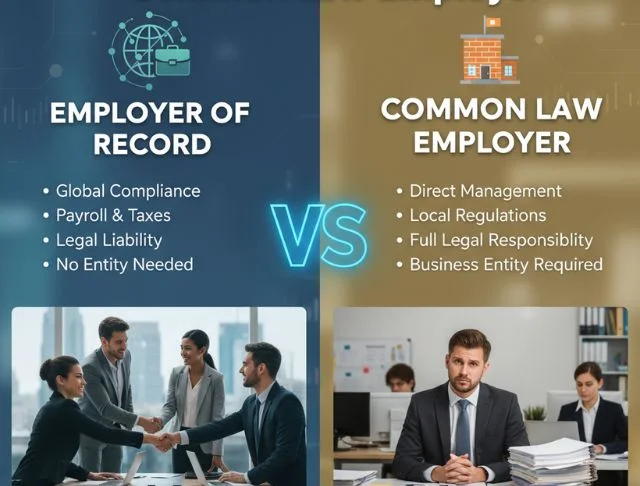
Deciding between an EOR and common law can be frustrating, especially when you are unsure what works best.
Things mess up when thinking about what you have to do to get started with either type of hiring, and the hurdles and consequences involved.
Understanding this, I write this post as per the golden rule of making any thoughtful decision. That is: think about the pros, the cons, and match them with personal needs. You’ll have an informed basis for a decision.
Without further ado, let’s enter thinking mode…
Co-author
Co-author
Get in Touch with Us

Leah Maglalang
Business Coordinator UAE

An Employer of Record (EOR) is a third-party organisation that employs workers on your behalf by using its own local business entity. You don’t need to register a local entity in your required country, but you still handle employees legally.
EOR is not just an alternative to registering a local business legal structure, but this service has many other subservices as follows:
EOR handles payroll cycles for employees and also taxes. They take care of the methods employees have to receive payments.
An EOR ensures delivery of salaries within required deadlines. They also handle deductions or any payment-related terms that an employer company has.
Working terms, contracts, type of employment, what comes in each contract, and everything is taken care of.
That’s a useful feature, as understanding local laws, their changes, and behavior of employees takes time and effort. As EORs are already familiar with them, they can work more efficiently.
Keeping records of holidays, paid leave, sick leave, overtime, and calculating salaries every month based on those records is also handled by EOR.
In addition, EOR also handles statutory benefits required by law, like public healthcare and pension or retirement funds.
This includes new hiring, employment eligibility verification, policy acknowledgment, and more.
Yes, in addition to payroll and taxes, insurance and workers’ compensation are also fulfilled by an EOR.
EOR helps in support with disciplinary actions and terminations, employee record management, etc.
This service also handles employment liability in specific cases, such as when an employee complains about payroll. Due to this service, exposure to compliance penalties is significantly reduced.
Getting started with an EOR is super easy. It is much easier than becoming a common law employer; here is how it works:
Step#1. You select the employee
Step#2. The EOR legally hires the employee
Step#3. Onboard and handle employment setup
Step#4. Payroll, Taxes & Compliance Managed by the EOR
Step#5. You manage day-to-day Work
Step#6. EOR also handles termination & offboarding (if required)
Let’s say your company is registered in Germany. As a business development manager, you want to hire an email marketer from Dubai.
Either you register your local entity in Dubai, understand local labor laws, manage visas and insurance, onboard the employee, set up a bank to transfer funds, and handle contract agreements.
OR
Hire an EOR either in Germany, operating globally like FMC Group, or another global provider; they handle everything, and you get employees quickly and assign day-to-day tasks.

When you register a business with the local government and hire employees, you are a common law employer. In this situation, you’re handling all processes, including onboarding, payroll, HR responsibilities, and all other tasks that an EOR offers.
If you want to hire employees on your own, you do the following things:
Day-to-day work and operational responsibilities are additional.
If you want to hire employees by yourself, the process involves more steps, time, and effort. From registering a company to payroll, insurance setup, and more.
You’ll have full flexibility and avoid third-party fees, but the process is slower, with many sub-tasks under each step:
Step#1. Business registration & setup
Step#2. Recruitment & hiring
Step#3. Employee onboarding
Step#4. Payroll & tax management
Step#5. Ongoing compliance & HR management
Step#6. Day-to-Day employee management
Step#7. Termination & offboarding (If Required)
You want to hire an employee in Vietnam. Vietnam is considered an emerging country for remote work, and its legal rules are continually changing.
This is the reason very few EOR companies operate in such markets, often offering limited service quality.
You move to the next step and decide to register a local company in Vietnam, understand the local labor laws and other rules required to fulfil employees’ benefits. In this case, you’re a common law employer.

Hiring employees is not an easy task, such as hiring employees yourself. One hurdle is deciding whether to hire employees directly or use freelancers, staffing agencies, PEO, EOR, or other services. But thinking deeply can help you make the right decision.
To solve this issue, the following two sections are goldmines and can make the burden lighter on your shoulders:
Below are the most common cases to use an EOR instead of hiring employees directly:
Becoming a common law employer can be a strong option if the following conditions are met:
Factor | Employer of Record | Common Law Employer |
Legal employer | EOR | Company |
Entity setup | Not required | Required |
Compliance | EOR-managed | Self-managed |
Payroll | EOR-handled | In-house |
Hiring speed | Fast | Slower |
Risk level | Lower | Higher |
Model | Pros | Cons |
Employer of Record | Fast hiring | Service fees |
Employer of Record | Low risk | Less control |
Common Law Employer | Full control | High compliance |
Common Law Employer | Lower scale-cost | Slow expansion |
Cost Area | Employer of Record | Common Law Employer |
Setup cost | Minimal | High |
Ongoing cost | Monthly fee | Fixed overhead |
HR staff | Not required | Required |
Legal cost | Included | Additional |
Scalability | Flexible | Costly |
If you run a company in the USA and want to hire employees from different states, this situation requires additional compliance steps.
This scenario resembles hiring from different countries but is less complex. Here is an overview:
Below tasks are much like hiring in other countries, but as you are in the same country, the process can be simpler yet time-consuming:
Factor | Employer of Record | State Registration |
Setup time | Very fast | Very slow |
Initial cost | Low upfront | High upfront |
Ongoing cost | Monthly fees | Fixed overhead |
Compliance burden | Provider managed | Employer managed |
Legal risk | Reduced risk | Full risk |
Admin effort | Minimal effort | Heavy workload |
Should you use EOR or become a common law employer for state-wise hiring?
Here are conditions, if you fall under them, choose the common law employer model:
When hiring employees from different states, an EOR can be a better alternative if:
Still unsure whether you should choose an EOR? Here are a few questions that you can ask yourself to make a decision:
If you’re a founder or hiring manager exploring different options, FMC Group can help you, as it has provided EOR services for over fifteen years.
Book a free 30-minute call and discuss with us what your requirements and goals are for internal hiring. What problems are you facing in your hiring process, and what can directly benefit you?
This is a good option to move beyond written communication and test ideas through real discussion.
No, EOR is not the same as a PEO. Professional employer organisations help you with many hiring tasks. They work in co-employment and manage processes side by side. They do not hire using their own entity on your behalf.
Yes, you can switch later from an EOR to a common law employer, but during this process, you need to prepare and transition to direct employment.
Yes, it is.
No, an EOR does not reduce the employer’s liability completely. As an EOR takes care of payroll, employee benefits, insurance, and administrative tasks, it handles legal complaints related to those areas.
But all conflicts related to the workplace or work-related issues like harassment will be handled by the employer company.
You are currently viewing a placeholder content from Calendly. To access the actual content, click the button below. Please note that doing so will share data with third-party providers.
More InformationYou are currently viewing a placeholder content from Calendly. To access the actual content, click the button below. Please note that doing so will share data with third-party providers.
More InformationYou need to load content from reCAPTCHA to submit the form. Please note that doing so will share data with third-party providers.
More InformationYou are currently viewing a placeholder content from Turnstile. To access the actual content, click the button below. Please note that doing so will share data with third-party providers.
More InformationYou are currently viewing a placeholder content from Vimeo. To access the actual content, click the button below. Please note that doing so will share data with third-party providers.
More InformationYou need to load content from reCAPTCHA to submit the form. Please note that doing so will share data with third-party providers.
More InformationYou are currently viewing a placeholder content from reCAPTCHA. To access the actual content, click the button below. Please note that doing so will share data with third-party providers.
More Information