
The hiring process varies widely when you enter the global market.
Local labor law requirements increase. From local entity setup to employee insurance, everything must comply with applicable legal requirements. However, the basics of the hiring process remain the same.
Traditional hiring can be used for building remote global teams, but the benefits depend on the company’s needs.
Here, we examine Employer of Record vs. traditional hiring in depth to pick the right one.

Author

Co-author
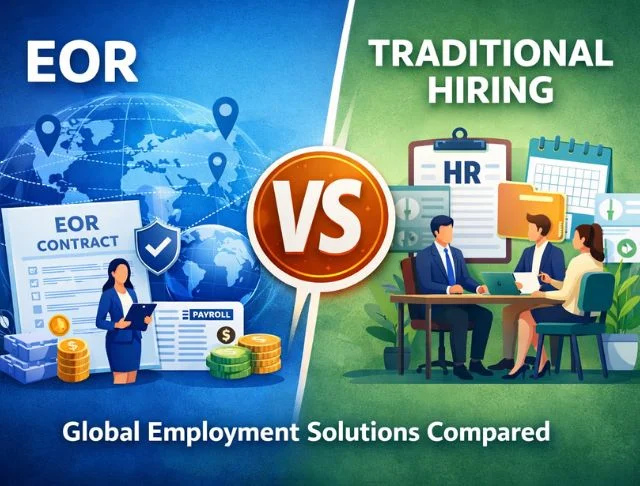
The hiring process varies widely when you enter the global market.
Local labor law requirements increase. From local entity setup to employee insurance, everything must comply with applicable legal requirements. However, the basics of the hiring process remain the same.
Traditional hiring can be used for building remote global teams, but the benefits depend on the company’s needs.
Here, we examine Employer of Record vs. traditional hiring in depth to pick the right one.
Author
Co-author
Get in Touch with Us

Leah Maglalang
Business Coordinator UAE

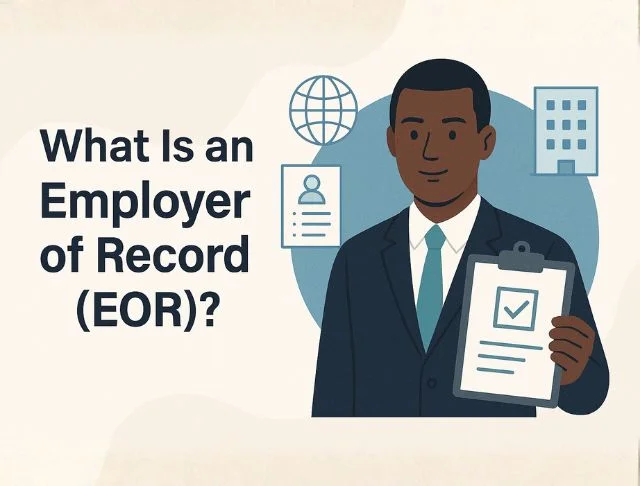
An Employer of Record (EOR) is a hiring company that employs workers in different countries on behalf of its clients under its own legal name and identity.
This service makes the hiring process fast, smooth, and hassle-free because it includes many additional benefits.
An EOR handles more than fifty responsibilities.
From payroll and tax handling to employee benefits, legal compliance, and recruitment assistance, it covers everything.
An EOR service includes a wide range of tasks that help you hire employees quickly and keep ongoing operations running smoothly.
You do not need to handle payroll or local taxes. An EOR manages the following:
Local labor laws require statutory employee benefits, which an EOR manages, including:
You save time by avoiding complex and difficult-to-understand local labor laws because an EOR not only understands them but also manages:
An EOR acts as an external HR department for remote global hiring and handles:
An EOR completes fifty tasks and hires international employees.
Alternatively, you can follow five easy steps to get remote teams, fully comply with laws, and do so quickly.
Although there may be some additional costs, it is worth it if you want fast, hassle-free hiring.
First, decide what type of employees you want and in which country. Then, pick the right EOR service provider by checking their years of experience, online presence, local resources, and reputation. After that, the real work begins:
At this stage, a fully experienced team starts working to bring the world’s best talent to you.
The EOR begins with job postings. You may interview and select candidates, but the EOR also manages this process and provides offer letters while familiarizing employees with onboarding procedures.
Once you have employees from your required countries, you can assign tasks and manage day-to-day work. When it comes to payroll and benefits, the EOR handles everything: salary processing, tax compliance, benefits administration, deductions, and bonuses.
EOR service providers work closely with you to ensure all processes adhere to local laws, file taxes correctly, regulate reporting, and prevent risks.
Your responsibility is to stay informed about the administration of hiring. The EOR provides regular reports, including payroll data, HR analytics, employee queries, and contract updates.
An Australian company wants to hire a remote team from Abu Dhabi. They contract with an EOR that has a strong network, local resources, and even entities in Abu Dhabi. The EOR understands local requirements, including insurance, banks, and visas. Employees are hired within a week, and the company pays for the EOR’s services.

Traditional hiring occurs when a company’s internal HR department hires employees directly, manages payroll internally, and is fully responsible for HR duties. Such companies comply with local laws through in-house teams, and all recruitment happens internally.
What does traditional hiring involve? Or, in other words, can it hire remote teams from different countries?
Yes, it can. However, the process is slower and may result in legal penalties.
Below are the responsibilities of the HR department, including additional steps required for global hiring, such as registering a local entity, setting up local banks, arranging insurance, and fulfilling other country-specific requirements.
In traditional hiring, companies advertise roles, collect resumes, create talent pools, and reach out to candidates.
The internal HR team evaluates qualifications, filters candidates, shortlists top applicants, and conducts pre-interviews.
They schedule interviews, conduct assessments, evaluate skills, and check references if available. This step is critical, as incorrect hiring can lead to serious consequences.
The HR department prepares offers, discusses salary, negotiates terms, and finalizes contracts.
After completing all prior steps, the HR team conducts orientation sessions, role-specific training, and policy introduction. They also provide access to systems and tools.
For remote international hiring, traditional methods can work but are slower, riskier, and increase the burden on the HR department.
This may even create the need for an Employer of Record. Working with an internal team in such cases is tiring, slower, and riskier; a better option is to work with an Employer of Record.
Traditional hiring works in a few simple steps.
Although these steps are also part of the EOR process, an EOR includes additional tasks.
Traditional hiring follows the same method as an EOR if hiring globally using the company’s local business entity.
In traditional hiring, the HR department first creates job descriptions that include required skills, experience level, and scope of work.
After defining the job requirements, the HR team advertises the role, receives applications, conducts screening processes, and shortlists candidates.
When it is time to select the right candidate, applicants are interviewed, evaluated using performance assessments, references are checked, and the final decision is made.
During this step, shortlisted candidates are offered contracts, legal compliance is ensured, agreements are signed, and all necessary documentation is completed.
At this stage, employees are onboarded. The HR team guides the onboarding process, introduces employees to the team, monitors performance, and provides ongoing support.
Companies with internal HR departments hire locally. The internal HR team manages payroll, handles requirements, contracts, and benefits in-house, and provides training and onboarding. In summary, all hiring tasks are maintained and performed internally.

Below are simple conditions. If they are met, select the corresponding hiring option:
Aspect | EOR | Traditional Hiring |
Legal employer | EOR entity | Company entity |
Entity setup | Not required | Required |
Hiring speed | Very fast | Slow setup |
Compliance handling | Fully managed | In-house managed |
Payroll & taxes | EOR managed | Company managed |
Benefits provision | EOR provided | Company arranged |
HR workload | Minimal | High workload |
Global hiring | Easy expansion | Complex process |
Compliance risk | Low risk | Higher risk |
Cost structure | Service fee | Fixed overhead |
| Benefit Area | EOR | Traditional Hiring |
| Hiring speed | Rapid onboarding | Slow setup |
| Legal compliance | Fully managed | Self-managed |
| Entity setup | Not needed | Required |
| Payroll handling | Outsourced payroll | In-house payroll |
| Benefits access | Local benefits | Self-arranged |
| Global expansion | Easy entry | Complex entry |
| HR workload | Low effort | High effort |
| Risk exposure | Minimal risk | Higher risk |
| Flexibility | High flexibility | Low flexibility |
| Scalability | Easy scaling | Limited scaling |
Cost Factor | EOR | Traditional Hiring |
Setup cost | No setup | Entity registration |
Hiring cost | Fixed fee | Variable costs |
Payroll setup | Included | Separate setup |
Compliance cost | Included | Legal expenses |
HR staffing | Minimal need | Dedicated staff |
Benefits cost | Bundled pricing | Separate contracts |
Ongoing overhead | Predictable costs | High overhead |
Expansion cost | Low entry | High entry |
Termination cost | Managed exit | Legal exposure |
Cost visibility | Transparent pricing | Complex budgeting |
☐ No local entity exists
☐ Hiring overseas quickly
☐ Need full compliance support
☐ Limited HR resources
☐ Small or remote team
☐ Short-term hiring needs
☐ Testing a new market
☐ Want predictable costs
☐ Avoid legal risk
☐ Local entity already registered
☐ Long-term expansion plan
☐ Large workforce hiring
☐ In-house HR expertise
☐ Full employment control needed
☐ Cost optimization priority
☐ Country-specific compliance knowledge
☐ Permanent local presence
☐ Do we need speed?
☐ Can HR manage compliance?
☐ Is this a long-term hire?
☐ Do we want low risk?

Below are the key points that explain the need for EOR services, even when HR software is available:
Legal & Compliance: EOR is the legal employer, handles labor laws, ensures compliance, and mitigates risk, while HR software is just a tool.
Payroll & Taxes: EOR manages payroll, files taxes, and handles benefits deductions, whereas HR software only tracks these processes.
Employee Benefits: EOR provides benefits such as health insurance, retirement plans, and perks, while many HR software tools do not provide benefits.
Hiring & Onboarding: EOR can hire globally, while HR software only assists in the process and cannot employ directly.
Global Reach: EOR operates worldwide, whereas HR software is limited to the platform.
Cost & Administration: EOR works on a service fee, while HR software typically uses a subscription model.
Support & Risk: EOR providers offer ongoing support, while HR software generally provides only technical support.
Still not sure which option suits your company’s needs?
FMC Group is here to guide you through your hiring process for free. With over twenty-seven years of global experience, our experts are ready to help you make the best decision for your team.
You are currently viewing a placeholder content from Calendly. To access the actual content, click the button below. Please note that doing so will share data with third-party providers.
More InformationYou are currently viewing a placeholder content from Calendly. To access the actual content, click the button below. Please note that doing so will share data with third-party providers.
More InformationYou need to load content from reCAPTCHA to submit the form. Please note that doing so will share data with third-party providers.
More InformationYou are currently viewing a placeholder content from Turnstile. To access the actual content, click the button below. Please note that doing so will share data with third-party providers.
More InformationYou are currently viewing a placeholder content from Vimeo. To access the actual content, click the button below. Please note that doing so will share data with third-party providers.
More InformationYou need to load content from reCAPTCHA to submit the form. Please note that doing so will share data with third-party providers.
More InformationYou are currently viewing a placeholder content from Elfsight. To access the actual content, click the button below. Please note that doing so will share data with third-party providers.
More InformationYou are currently viewing a placeholder content from reCAPTCHA. To access the actual content, click the button below. Please note that doing so will share data with third-party providers.
More Information