
When expanding a company into the Turkish market, it is very confusing to select the right service between an Employer of Record and payroll management.
To get rid of this confusion, you should have deep knowledge about both services before you select one of them. So, I’m covering a lot in this post to help you distinguish between these two employee management services.
This post is full of tables and short, easy-to-read pieces of content. You don’t need to put your eyeballs on long, messy paragraphs. Let’s get started…

Author

Co-author

When expanding a company into the Turkish market, it is very confusing to select the right service between an Employer of Record and payroll management.
To get rid of this confusion, you should have deep knowledge about both services before you select one of them. So, I’m covering a lot in this post to help you distinguish between these two employee management services.
This post is full of tables and short, easy-to-read pieces of content. You don’t need to put your eyeballs on long, messy paragraphs. Let’s get started…
Author
Co-author
Get in Touch with Us
Alp Atasoy
Sales and Business Development Consultant


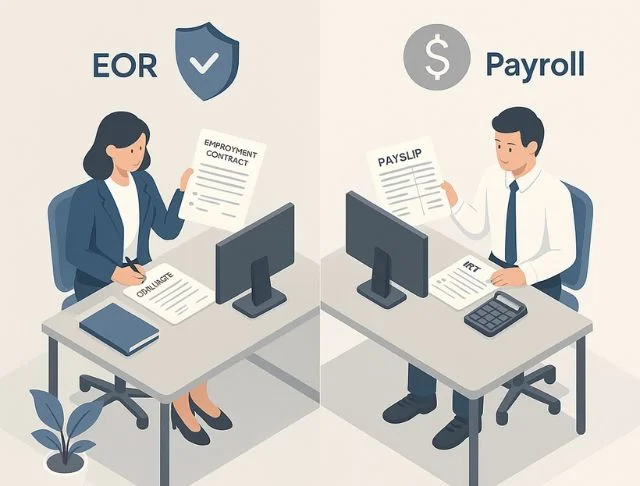
Scaling teams in the Turkish market can be beneficial due to its strategic location between Europe and the Middle East. It is also quite challenging due to the complexities of local laws, the time required for hiring, and the cost of managing employees.
Employer of Record, payroll management, and Professional Employer Organization all serve different purposes, are not interchangeable, and the main difference lies in legal employer status and the level of complexity of complying with laws.
An employer should have a strong strategy to work in Türkiye and make decisions based on factors such as entity presence, risk tolerance, hiring speed, and cost structure. This section is the foundation to understand the key differences between EOR and payroll services.
An Employer of Record (EOR) is a service provider that becomes the official legal employer of the worker. The client does not need to register a legal entity in the hiring country. The client company retains control over day-to-day tasks and performance management.
The EOR signs the employment contract, registers the employee with tax and social security authorities, manages payroll, administers statutory benefits, and ensures compliance with local labor laws.
So, an EOR is your go-to solution for fast hiring and full compliance with local laws. This service is ideal for testing new markets. Small teams prefer to use an EOR service instead of registering a separate entity.
A payroll company’s main job is to manage employee payroll. This company does not become the legal employer and requires clients to have a legal entity registered in the specific country.
Payroll companies’ key roles include withholding and filing taxes, issuing payslips with limited compliance scope (only payroll). They do not draft contracts and do not manage the recruitment or termination process.
Payroll companies charge lower service fees than an EOR due to fewer responsibilities. This service is best for long-term operations. It works well with internal HR teams. In contrast to an EOR, this service is suitable for large teams that have a legal entity.
How a Professional Employer Organization Differs from an EOR and a Payroll Company?
A Professional Employer Organization (PEO) introduces a third model. A PEO operates under a co-employment structure. This means both the client and the PEO share certain employer responsibilities.
However, unlike an EOR, a PEO requires the client to have a legal entity registered in the specific country, similar to a payroll company. The PEO supports HR administration and benefits management.

Role / Responsibility | Employer of Record | Payroll Company |
Legal Employer Status | Becomes the legal employer | Client remains legal employer |
Employment Contracts | Drafts & signs contracts | Does not draft or sign contracts |
Onboarding Employees | Manages full onboarding | Processes payroll data only |
Employee Registration | Registers employees with authorities | May assist but client responsible |
Work Permits & Visas | Handles work permits | Not responsible |
Payroll Processing | Runs payroll | Runs payroll |
Salary Disbursement | Pays employees directly | Pays on behalf of client |
Tax Withholding | Calculates & remits taxes | Calculates & remits taxes |
Social Security Contributions | Files & pays contributions | Files & pays contributions |
Benefits Administration | Manages statutory benefits | Limited or none |
Private Benefits (Health, etc.) | Can arrange benefits | Not included |
Employment Law Compliance | Full responsibility | Advisory only |
HR Policy Compliance | Ensures compliance | Not responsible |
Termination Management | Handles legal termination process | Processes final payroll only |
Severance Calculations | Calculates & manages | Calculates if instructed |
Labor Inspections | Represents employer | Client responsible |
Workplace Risk Liability | Shares legal liability | No employer liability |
Disciplinary Actions | Advises & manages | Not involved |
Employee Record Keeping | Maintains official records | Maintains payroll records only |
IP & Confidentiality Clauses | Includes in employment contract | Not involved |
Entity Requirement | No local entity needed | Client must have local entity |
Expansion Support | Enables market entry | Supports existing entity only |
Cost Structure | Per employee service fee | Payroll processing fee |
Ideal Use Case | Hiring without local entity | Managing payroll for existing entity |
Risk Exposure | Reduced for client | Higher for client |

| Benefit Category | Employer of Record | Payroll Company |
| No Local Entity Required | Yes | No |
| Faster Market Entry | Yes | No |
| Full Legal Compliance | Included | Partial (payroll only) |
| Reduced Legal Risk | High risk reduction | Limited risk reduction |
| Employment Contract Management | Included | Not included |
| Work Permit Support | Included | Not included |
| HR Administration | Full-service | Minimal |
| Statutory Benefits Management | Included | Payroll-related only |
| Private Benefits Setup | Can arrange | Usually not included |
| Termination Risk Management | Managed legally | Client responsible |
| Labor Law Expertise | Included | Limited to payroll rules |
| Government Representation | Yes | No |
| Employee Onboarding | Fully managed | Not included |
| Employee Offboarding | Fully managed | Payroll processing only |
| Single Point of Contact | Yes | Usually payroll contact only |
| Scalability Across Countries | Multi-country support | Typically single-country |
| Administrative Burden | Very low for client | Moderate for client |
| Compliance Updates | Proactively handled | Payroll compliance only |
| Cost Predictability | Fixed per employee | Variable processing fees |
| Ideal for Remote Hiring | Yes | No |
| Ideal for Existing Local Entity | Optional | Yes |
| Suitable for Short-Term Expansion | Yes | Limited |
| Suitable for Long-Term Entity Setup | Transitional solution | Requires entity |

Cost Component | Employer of Record | Payroll Company |
Setup Fee | Often minimal or included | Low setup fee |
Monthly Service Fee | Fixed per employee | Per payslip / employee fee |
Legal Employer Liability | Included in fee | Not included |
Entity Formation Cost | Not required | Required (separate cost) |
Local Director Requirement | Not required | Required in most countries |
Accounting & Corporate Filing | Not required | Ongoing cost |
Office Address / Registered Address | Not required | Required |
Work Permit Processing | Often included or managed | Not included |
Employment Contract Drafting | Included | Not included |
HR Administration | Included | Not included |
Compliance Monitoring | Included | Payroll compliance only |
Termination Handling | Included | Client manages |
Severance Risk Exposure | Shared / reduced | Fully client risk |
Labor Inspection Representation | Included | Not included |
Payroll Processing | Included | Included |
Tax Filing | Included | Included |
Social Security Filing | Included | Included |
Employee Benefits Setup | Often included | Not included |
Insurance Administration | Included or managed | Not included |
Hidden Compliance Penalties | Lower risk | Higher risk |
Internal HR Headcount Cost | Reduced | Required internally |
Time-to-Hire Cost | Faster | Slower (entity setup first) |
Expansion Exit Cost | Easy to exit | Entity closure cost |
Cost Predictability | High (fixed monthly) | Variable + entity overhead |
Best for Small Team (1–5 hires) | Cost-effective | Expensive due to entity setup |
Best for Large Long-Term Team | May become expensive | More cost-efficient long-term |

Scenario / Situation | Use an EOR | Use a Payroll Service |
No local entity in country | Yes | No |
Testing a new market | Yes | No |
Hiring 1–5 employees abroad | Yes | Usually not practical |
Need fast hiring (weeks, not months) | Yes | No |
Avoid company registration process | Yes | No |
Unsure about long-term expansion | Yes | No |
Want minimal legal risk | Yes | No |
No internal HR in target country | Yes | No |
Need work permit support | Yes | No |
Require full employment contracts | Yes | No |
Expanding into multiple countries | Yes | Limited |
Already have a registered local entity | Optional | Yes |
Have in-house HR & legal team | Optional | Yes |
Only need salary processing | No | Yes |
Need tax & social security filing only | No | Yes |
Large long-term workforce in country | Sometimes costly | More cost-efficient |
Want full control over employment | No (shared) | Yes |
Managing permanent establishment risk | Yes | No |
Handling complex terminations | Yes | Client responsible |
Undergoing labor inspection | EOR represents | Client responsible |
Scaling up or down quickly | Yes | Less flexible |
Planning to open own entity later | Good transitional solution | Requires entity first |
Short-term project hiring | Yes | Usually not |
Cost-sensitive but entity already exists | No | Yes |
Strategic market entry support needed | Yes | No |

Decision Question | EOR | Payroll Company |
Do you lack a registered legal entity in the target country? | ☐ | ☐ |
Do you want to hire quickly without company setup delays? | ☐ | ☐ |
Do you want to avoid entity registration costs? | ☐ | ☐ |
Do you need full employment contract management? | ☐ | ☐ |
Do you require work permit or visa support? | ☐ | ☐ |
Do you want reduced exposure to labor law risk? | ☐ | ☐ |
Do you need government registration of employees handled for you? | ☐ | ☐ |
Do you prefer outsourcing HR administration entirely? | ☐ | ☐ |
Do you want termination and severance handled legally? | ☐ | ☐ |
Are you testing a new market with a small team? | ☐ | ☐ |
Do you already have a registered entity in the country? | ☐ | ☐ |
Do you only need payroll calculation and salary processing? | ☐ | ☐ |
Do you have an in-house HR/legal team locally? | ☐ | ☐ |
Do you want full control as the direct legal employer? | ☐ | ☐ |
Is long-term large-scale hiring planned (20+ employees)? | ☐ | ☐ |
Are you optimizing purely for lowest per-employee processing cost? | ☐ | ☐ |
Do you need multi-country hiring support? | ☐ | ☐ |
Do you want predictable fixed monthly costs? | ☐ | ☐ |
Do you want minimal internal administrative workload? | ☐ | ☐ |
Are you concerned about permanent establishment risk? | ☐ | ☐ |

FMC Group is your cross-border and local hiring partner. If you want to make the payroll process smooth, we offer this service under two main services: EOR and Accounting Management in Türkiye.
Recruitment is our third service that we offer in Türkiye. You can either get it separately, or we also offer it under EOR.
FMC Group has been providing different services like market research, supplier searching, and many others in Türkiye for over 27 years. We added the EOR service in Türkiye 15 years ago due to hiring demand.
Schedule a free 30-minute call with our expert team to discuss your business needs. In this call, you’ll discuss your business expansion plans, and we’ll guide you on the right type of entity in Türkiye, market research, compliance, and more.

Concrete forecasts for RTO compliance are limited. Analysts predict that the hybrid and remote share of the workforce, which was approximately 35–40% in 2022, will remain stable through 2024 and then increase modestly. This trend suggests that overall RTO compliance rates may slightly decline as workplace flexibility continues to grow.
Employers are continuing to adapt their RTO policies. In the Asia-Pacific region, 42% of firms plan to expand office space, compared with only 20% planning reductions, indicating expectations to maintain or increase attendance requirements. Specific enforcement trends through 2028 have not been quantified.
Analysts generally anticipate that hybrid models will persist across sectors, with technology and professional services remaining the most flexible. Manufacturing and finance sectors are expected to maintain stronger in-office work requirements. For example, Canadian data indicate that approximately 63% of employees expect to be in the office three to four days per week by 2026.
In 2026, the office isn’t disappearing, but it’s evolving. Hybrid work remains popular, yet stricter RTO policies are reshaping attendance patterns, enforcement, and employee sentiment.
Compliance rates are high when rules are clear, but commuting, parental responsibilities, and flexibility continue to influence choices.
Companies and employees alike are adjusting to this “new normal,” balancing in-office requirements with productivity and engagement.
You are currently viewing a placeholder content from Calendly. To access the actual content, click the button below. Please note that doing so will share data with third-party providers.
More InformationYou are currently viewing a placeholder content from Calendly. To access the actual content, click the button below. Please note that doing so will share data with third-party providers.
More InformationYou need to load content from reCAPTCHA to submit the form. Please note that doing so will share data with third-party providers.
More InformationYou are currently viewing a placeholder content from Turnstile. To access the actual content, click the button below. Please note that doing so will share data with third-party providers.
More InformationYou are currently viewing a placeholder content from Vimeo. To access the actual content, click the button below. Please note that doing so will share data with third-party providers.
More InformationYou need to load content from reCAPTCHA to submit the form. Please note that doing so will share data with third-party providers.
More InformationYou are currently viewing a placeholder content from reCAPTCHA. To access the actual content, click the button below. Please note that doing so will share data with third-party providers.
More Information