
Hiring in Germany as a foreign employer can be a lucrative way to scale your business. Most employers already understand the importance of complying with local laws before, during, and after the hiring process.
One part of Germany’s complex labor laws is working time regulations. Misunderstanding or failing to comply with these rules is like missing one piece of the puzzle and losing the whole game.
That’s why, in this post, we cover all the important rules and regulations that every foreign employer must follow regarding working time when hiring in Germany.

Author
Author
Hiring in Germany as a foreign employer can be a lucrative way to scale your business. Most employers already understand the importance of complying with local laws before, during, and after the hiring process.
One part of Germany’s complex labor laws is working time regulations. Misunderstanding or failing to comply with these rules is like missing one piece of the puzzle and losing the whole game.
That’s why, in this post, we cover all the important rules and regulations that every foreign employer must follow regarding working time when hiring in Germany.
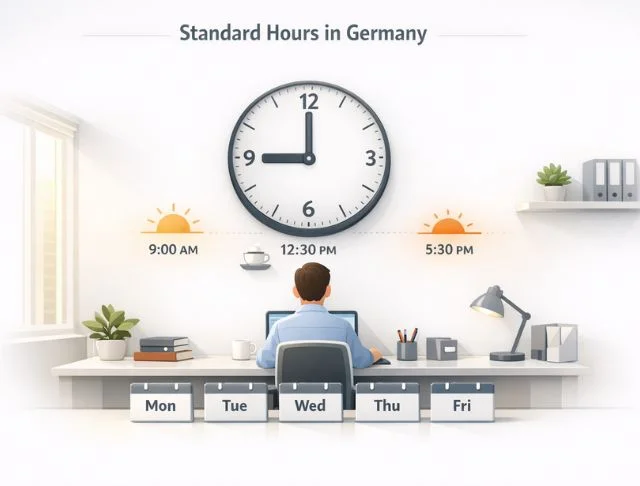
German law does not define ‘standard working hours’ as a single fixed schedule. Instead, working time is governed by statutory maximum limits, collective bargaining agreements (Tarifverträge), and individual employment contracts.
Germany imposes strict rules to protect workers. These rules become stricter when it comes to maximum working time and rest periods.
The law sets a baseline limit of 8 hours per working day. This is the key benchmark to consider when planning to hire in Germany. However, working time can be extended up to 10 hours per day, provided that the average does not exceed 8 hours per working day over the applicable reference period.
This means that the employee’s average working time must not exceed 8 hours per working day over 6 calendar months or 24 weeks.
This gives employers flexibility during busy periods, but longer working days must be balanced by shorter days or time off so that the average remains compliant.
Night work is also subject to working time limits, and employees may be entitled to compensation or time off under the applicable rules. Night work is defined as work performed between 11 p.m. and 6 a.m. (§6 ArbZG). Night workers are entitled to health assessments and additional health protections.
Because the Working Time Act measures working time in working days, the legal maximum corresponds to 48 hours per week when calculated over 6 working days (6 × 8 hours).
You can temporarily extend working time up to 60 hours per week (6 × 10 hours), provided the average is later reduced back to the equivalent of 48 hours per week over the reference period.
In practice, many businesses in Germany operate on a 5-day workweek, which often results in around 40 working hours per week.
German law does not prescribe exact start or end times.
In most offices, work starts between 08:00 and 09:00 and ends between 16:30 and 18:00.
In practice, this schedule aligns with an 8-hour workday and a 30–60 minute break.
Germany has adopted flexible working structures, such as:
Foreign employers often misunderstand the concept of maximum working time in Germany.
The absolute daily cap is 10 hours per day, which is the strict upper limit and cannot be exceeded.
Under the averaging rule, if employees work more than 8 hours on some days, the average must return to 8 hours per day over 6 months (or 24 weeks).
The ArbZG measures working time in working days (Monday–Saturday), so the legal caps of 48 and 60 hours per week are calculated on a 6-day basis. In practice, the vast majority of German businesses operate on a 5-day workweek, which produces different real-world figures:
6-day week (legal basis) | 5-day week (typical practice) | |
Standard maximum | 48 hours/week | 40 hours/week |
Temporary maximum | 60 hours/week | 50 hours/week |
Long-term average target | 48 hours/week | 40 hours/week |
The averaging rule applies regardless of how many days are worked: if employees temporarily work up to 10 hours per day, the average must return to 8 hours per working day over 6 calendar months (or 24 weeks).
Certain sectors — such as healthcare, hospitality, and transport and logistics — may have specific deviations from these limits under collective bargaining agreements or statutory exceptions.
The Arbeitszeitgesetz (Working Time Act) is the core legal framework. It defines employees’ working time, their rest periods, and how employers should structure schedules. It is fundamentally about protecting employee health, safety, and preventing overwork and burnout.
The Arbeitszeitgesetz is broader than most employers expect.
It regulates the entire structure of working time, not just the hours worked. It covers:
Germany enforces strict recovery rules.
Why does this matter for foreign employers?
These are the areas where most foreign employers make mistakes.
Breaks are mandatory, unpaid, and must be scheduled, they are not optional.
Key points include that employees cannot skip breaks voluntarily, and employers must ensure that breaks are actually taken.
Employees must receive at least 11 consecutive hours of rest between shifts. For example, if work ends at 18:00, the next shift cannot start before 05:00.
Importantly, employees may not work more than 6 consecutive hours without a break.
Sunday and public holiday work is generally prohibited unless required by a specific industry or compensated with rest provided by the employer. If employees work on a Sunday, they must receive a compensatory rest day within two weeks (including the Sunday worked). If employees work on a public holiday falling on a weekday, the compensatory rest day must be granted within eight weeks.
Annual leave is governed by a separate law but is tied to working time. Employers must provide a minimum of 20 days of paid leave (based on a 5-day workweek) (24 days on a 6-day workweek), as guaranteed by the Bundesurlaubsgesetz (BUrlG). In practice, employers commonly provide 25 to 30 days.
A 2019 ruling by the European Court of Justice (C-55/18) required all EU member states to ensure employers implement objective, reliable, and accessible systems to track working time.
Since the German legislature did not implement a statutory law, Germany’s Federal Labour Court (Bundesarbeitsgericht, BAG) stepped in on September 13, 2022 (1 ABR 22/21), ruling that all employers, regardless of company size, must record employees’ full working hours, not just overtime.
As of December 2025, a Federal Labor Court ruling requires all employers to record working hours electronically, capturing start time, end time, breaks, and overtime. The 2025 coalition agreement between CDU/CSU and SPD further reinforces this obligation.
Small employers with fewer than 10 employees may
benefit from transitional arrangements, but the general obligation to record working time applies to all employers now.
To understand this properly, you need to distinguish between legal limits and actual practice.
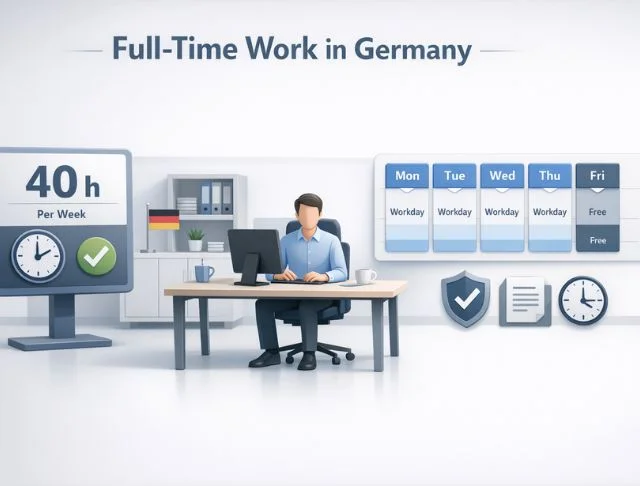
Under German law, the standard working time is 8 hours per day, with a maximum of 10 hours per day. The weekly maximum is 48 hours on average. This defines the ceiling, not the norm.
Most full-time employees work:
Office working hours in Germany follow a structured but flexible pattern.
Most corporate roles operate within:
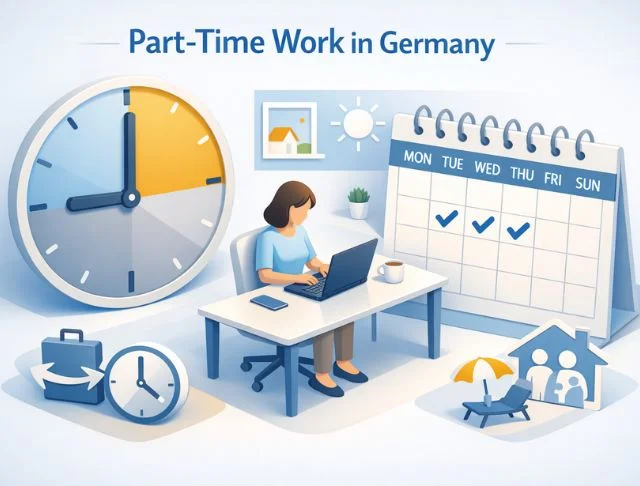
The Teilzeit- und Befristungsgesetz (TzBfG) and the Arbeitszeitgesetz (Working Time Act) govern part-time work in Germany. An employee is considered part-time if they work fewer hours than a comparable full-time employee. There is no fixed minimum or maximum number of hours.
The most common arrangement is around 20 hours per week for part-time work. In general, this ranges from roughly 15–30 hours per week, depending on the role.
Employers must treat part-time employees equally to full-time employees. This includes pro-rated salary, equal access to benefits, and equal career opportunities.
Germany has one of the most structured family-support systems in employment law. There is no gender-specific law, but there are strong protections.
Germany does not provide additional laws specifically for women, but employees can take parental leave (Elternzeit) of up to 3 years per child, shared between both parents. Up to 24 months may be deferred and taken before the child’s eighth birthday. They can also request part-time work. Under the Mutterschutzgesetz, working hours are restricted during pregnancy.
You can hire employees in Germany without a local entity by using an Employer of Record service.
FMC Group uses its own legal entity to hire employees on your behalf.
In addition, the company manages payroll under this service. Schedule a free 30-minute call to receive expert consultation about your future hiring plans.
You are currently viewing a placeholder content from Calendly. To access the actual content, click the button below. Please note that doing so will share data with third-party providers.
More InformationYou are currently viewing a placeholder content from Calendly. To access the actual content, click the button below. Please note that doing so will share data with third-party providers.
More InformationYou need to load content from reCAPTCHA to submit the form. Please note that doing so will share data with third-party providers.
More InformationYou are currently viewing a placeholder content from Turnstile. To access the actual content, click the button below. Please note that doing so will share data with third-party providers.
More InformationYou are currently viewing a placeholder content from Vimeo. To access the actual content, click the button below. Please note that doing so will share data with third-party providers.
More InformationYou need to load content from reCAPTCHA to submit the form. Please note that doing so will share data with third-party providers.
More InformationYou are currently viewing a placeholder content from reCAPTCHA. To access the actual content, click the button below. Please note that doing so will share data with third-party providers.
More Information

