
For employers hiring in Germany, providing benefits to employees is mandatory, but not all benefits are required.
That’s why understanding only the benefits mandated by German law helps you stay compliant while saving time and budget.
In this post, we cover only the benefits where missing even one can lead to legal issues such as penalties, fines, or restrictions.

Author
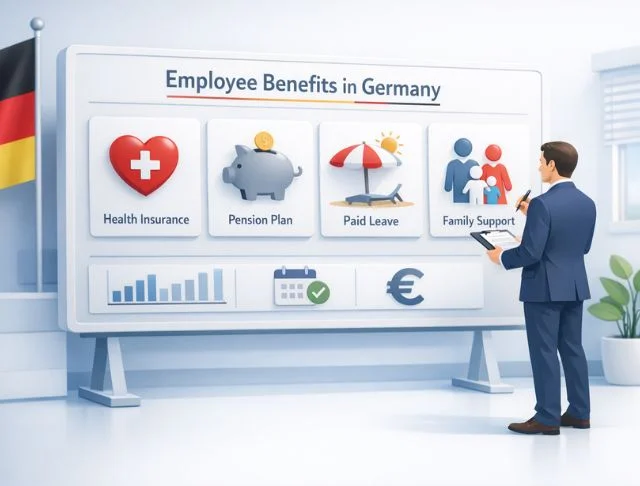
For employers hiring in Germany, providing benefits to employees is mandatory, but not all benefits are required.
That’s why understanding only the benefits mandated by German law helps you stay compliant while saving time and budget.
In this post, we cover only the benefits where missing even one can lead to legal issues such as penalties, fines, or restrictions.
Author

Mandatory employee benefits in Germany refer to legally required entitlements that employers must provide to employees under national labor laws. These benefits are not optional or performance-based. The law enforces them and applies to most employment relationships. They primarily include:
Both employers and employees share the cost of these benefits through statutory contributions, which employers deduct from employee payrolls.
A well-defined legal framework governs mandatory employee benefits in Germany. It consists of multiple labor and social security laws that establish minimum standards employers must follow. Key legal foundations include:

Health insurance is mandatory for all employees in Germany and provides access to medical treatment, hospital care, and preventive services.
Employees who earn below the statutory threshold, set at €77,400 per year (€6,450/month) in 2026, must enroll in the public healthcare system. Those earning above this threshold may opt for private health insurance.
This type of insurance allows employees to receive retirement income after reaching the statutory retirement age.
It also covers disability pensions and survivor benefits. Employers and employees share these contributions, and it is one of the largest components of social security deductions.
Unemployment insurance provides financial support and job placement assistance if an employee loses their job. The law requires employers to contribute alongside employees.
Long-term care insurance covers the cost of nursing care and support services for individuals who are unable to care for themselves due to illness, disability, or age.
This type of insurance is mandatory and linked to health insurance. Contributions are shared between employers and employees, with slight variations depending on personal circumstances.
Employers fully fund accident insurance, which covers workplace accidents, occupational illnesses, and commuting accidents.
It includes medical treatment, rehabilitation, and compensation for reduced earning capacity. Unlike other social security contributions, employees do not contribute to this insurance.

Employees in Germany are legally entitled to a minimum of 20 paid vacation days per year based on a five-day workweek (or 24 days for a six-day workweek). In practice, many employers offer 25–30 days, but they cannot offer fewer than the statutory minimum.
Germany has public holidays (Feiertage) that are treated as paid non-working days, and employees receive their normal salary on these days. The exact number of public holidays varies by region.
If an employee becomes ill, the employer must pay the full salary for up to six weeks per illness under German law. After this period, statutory health insurance (Krankenkasse) pays sickness benefits (Krankengeld) directly to the employee at 70% of gross salary (capped at the social security ceiling and at no more than 90% of net salary), for up to 78 weeks. To receive these benefits, employees must provide a medical certificate (Arbeitsunfähigkeitsbescheinigung) by the fourth calendar day of illness at the latest. Employers may contractually require it earlier, even from day one.

Maternity protection is a legally guaranteed benefit for pregnant employees and new mothers. It provides both health protection and financial security during pregnancy and shortly after childbirth. Key protections include:
Parents (mothers or fathers) can take parental leave, which is unpaid but job-protected, to care for their child after birth. Key features include:
Note that parental leave itself is unpaid, but employees receive parental allowance for financial support.
Parental allowance is a state-funded financial benefit that supports parents who reduce or pause their work to care for their newborn. Key points include:
Employers need to pay employees’ salaries in certain circumstances, even when work is not performed. Key situations include:
In Germany, bonuses are generally not universally mandatory, but they can become legally binding under specific conditions:
Common examples of statutory bonuses include holiday bonuses and Christmas bonuses.
Statutory accident insurance is 100% funded by the employer. It provides protection against workplace accidents, commuting accidents, and occupational diseases. This insurance covers medical treatment and rehabilitation, compensation for reduced earning capacity, and survivor benefits in severe cases.
Employers are also required to co-finance the broader social security system, meaning they contribute alongside employees to key insurance schemes. These include:
Contributions to health, pension, and unemployment insurance are split equally (50/50) between employer and employee. Long-term care insurance is an exception: the employer share is fixed at 1.8%, while employees pay between 1.7% and 2.4% depending on the number of children. Employers are responsible for calculating total contributions, withholding the employee portion, and paying the full amount to the relevant authorities.
Pregnant employees benefit from strong legal protections under maternity laws. Key entitlements include:
Employers must provide additional workplace protections and support measures to employees with recognized disabilities. Key benefits include:
German law provides equal treatment to part-time and fixed-term employees, the same as full-time workers. Key protections include:
You now understand the benefits you need to provide to employees as a foreign employer in Germany.
The next question is how to provide these statutory benefits.
You can either handle them yourself, which requires significant time and carries a risk of non-compliance, or choose a third party and gain additional employer benefits such as hiring without a legal entity, payroll management, tax handling, monthly contribution submissions, and more under one service: an employer of record (EOR).
To learn more about how FMC Group acts as an EOR, book a free 30-minute consultation call.
You are currently viewing a placeholder content from Calendly. To access the actual content, click the button below. Please note that doing so will share data with third-party providers.
More InformationYou are currently viewing a placeholder content from Calendly. To access the actual content, click the button below. Please note that doing so will share data with third-party providers.
More InformationYou need to load content from reCAPTCHA to submit the form. Please note that doing so will share data with third-party providers.
More InformationYou are currently viewing a placeholder content from Turnstile. To access the actual content, click the button below. Please note that doing so will share data with third-party providers.
More InformationYou are currently viewing a placeholder content from Vimeo. To access the actual content, click the button below. Please note that doing so will share data with third-party providers.
More InformationYou need to load content from reCAPTCHA to submit the form. Please note that doing so will share data with third-party providers.
More InformationYou are currently viewing a placeholder content from Elfsight. To access the actual content, click the button below. Please note that doing so will share data with third-party providers.
More InformationYou are currently viewing a placeholder content from reCAPTCHA. To access the actual content, click the button below. Please note that doing so will share data with third-party providers.
More Information

