
Employment contracts must follow UAE labor laws and regulations. These aren’t simple, formal written agreements that bind both parties.
If the contracts don’t comply with legal rules, it can lead to fines and restrictions for employers. Budget-friendly hiring can become a source of financial, mental, and time-related chaos.
Being a member of FMC Group’s expert team for years, I can show you what your employment contracts in the UAE should look like and how to stay compliant through this post.

Author

Co-author

Employment contracts must follow UAE labor laws and regulations. These aren’t simple, formal written agreements that bind both parties.
If the contracts don’t comply with legal rules, it can lead to fines and restrictions for employers. Budget-friendly hiring can become a source of financial, mental, and time-related chaos.
Being a member of FMC Group’s expert team for years, I can show you what your employment contracts in the UAE should look like and how to stay compliant through this post.
Author
Co-author
Get in Touch with Us

Leah Maglalang
Business Coordinator UAE

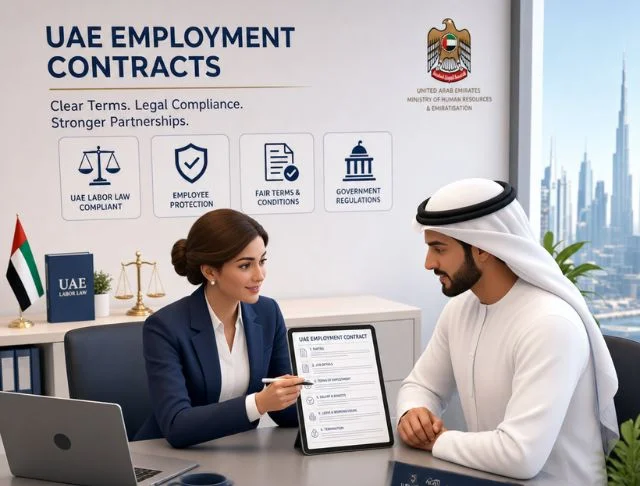
An employment contract in the UAE is a legally binding agreement between an employer and an employee. It defines the terms of employment, including salary, job title, working hours, leave entitlements, notice periods, and termination conditions.
Employers in the UAE must issue a written employment contract. It must include the essential employment terms. The contract must clearly mention:
Federal Decree-Law No. 33 of 2021 regulates employment contracts in the UAE. It became effective on 2 February 2022 and replaced the previous labor law framework. The law introduced mandatory fixed-term contracts, modern work models, stronger employee protections, and clearer termination procedures.
An offer letter is a document that outlines the proposed terms of employment before the employee officially joins the company. It usually includes the job title, salary, benefits, and joining date.
An employment contract, however, is a legally enforceable agreement officially registered with MOHRE or the relevant authority.

Under Federal Decree-Law No. 33 of 2021, all private-sector employment contracts in the UAE must be fixed-term contracts. There is no prescribed maximum duration for a fixed-term contract. The 3-year cap that existed in the original Federal Decree-Law No. 33 of 2021 was removed by Federal Decree-Law No. 14 of 2022, employers and employees may agree to any duration by mutual consent. Contracts are commonly structured for 1–3 years in practice, but multi-year contracts beyond 3 years are legally valid. The key requirement is that the contract must have a defined end date; open-ended or permanent contracts are not permitted in mainland and it applies extensively to freezones as well in the UAE.
The UAE previously recognized both limited and unlimited employment contracts under the old labor law framework. Unlimited (open-ended) employment contracts are no longer legally permitted in the UAE private sector. Federal Decree-Law No. 33 of 2021 abolished unlimited contracts effective 2 February 2022, and all pre-existing unlimited contracts were required to be converted to fixed-term agreements by 31 December 2023. Employers and employees may freely agree to any contract duration, and contracts can be renewed for the same, shorter, or longer period by mutual agreement.
An individual employment contract is a direct agreement between a private-sector employer and a single employee. The contract contains all employment terms such as compensation, job responsibilities, benefits, working hours, probation period, and termination rules.
Employment contracts for UAE nationals and expatriate employees follow the same labor law framework in the private sector.

UAE employment contracts must clearly define the employee’s job title, duties, reporting structure, salary, allowances, and working schedule.
Employers should also specify overtime eligibility, workplace location, and payment frequency to avoid disputes.
Under UAE labor law, standard working hours cannot exceed 8 hours per day or 48 hours per week for most private-sector employees.
The probation clause must comply with UAE labor law requirements and cannot exceed six months. The probation clause must comply with UAE labor law and cannot exceed six months under Article 9 of Federal Decree-Law No. 33 of 2021. Key rules:
Important: Immediate termination without notice is only permitted during probation in the serious misconduct cases listed under Article 44 (e.g., fraud, workplace violence, unauthorized absence). It is not a general probation right.
Employment contracts in the UAE must include termination procedures, notice periods, and lawful grounds for dismissal or resignation.
Employment contracts in the UAE must include termination procedures, notice periods, and lawful grounds for dismissal or resignation.
Under Article 43 of Federal Decree-Law No. 33 of 2021, the post-probation notice period is:
Scenario | Minimum Notice | Maximum Notice |
Post-probation (standard) | 30 calendar days | 90 calendar days (as specified in contract) |
During probation | 14 calendar days | As per contract |
Gross misconduct (Article 44) | None (immediate) | N/A |
Contracts may specify up to 90 days but cannot specify less than 30 days for post-probation notice. During the notice period, the employee continues working and the employer pays full salary and benefits. Employers may offer payment in lieu of notice if the contract permits it.
A non-compete clause restricts employees from joining competitors or starting competing businesses after leaving the company. Under Article 10 of Federal Decree-Law No. 33 of 2021, the restriction must be reasonable in duration, geographic scope, and nature of work.
Under Article 10 of Federal Decree-Law No. 33 of 2021, a non-compete clause is only valid where the employee’s role has given them access to the employer’s clients or business secrets. The clause must:
Courts scrutinise non-compete clauses closely and may reduce the duration or scope if it is disproportionate to the genuine commercial interest being protected.
Two automatic voidance rules employers must know:
A competition clause protects an employer’s commercial interests, trade secrets, client relationships, and sensitive business information. Employers use these clauses for senior employees, sales professionals, and staff with access to confidential data.
Employers in the UAE include confidentiality and intellectual property clauses to protect sensitive business information, proprietary processes, client databases, and company-created work. These clauses clarify the ownership of intellectual property and related things.
Employment contracts should clearly outline annual leave, sick leave, public holidays, maternity leave, employee benefits, and end-of-service gratuity entitlements. End-of-service gratuity: 21 days’ basic salary per year (first 5 years), 30 days thereafter (Article 51). Employees receive 2 days’ paid annual leave per month in the first year (pro-rated), increasing to 30 calendar days per year after one full year (Article 29).

Employment contracts in the UAE must follow the standard format that MOHRE approves or that the relevant free zone authority approves. The contract should include all mandatory employment terms. Arabic remains the official legal language for employment contracts in the UAE.
Employers should use a UAE-compliant employment contract template that aligns with MOHRE regulations and the company’s operational requirements. Beyond mandatory clauses, employers often include provisions related to confidentiality, intellectual property, remote work, performance expectations, and dispute resolution.
A MOHRE employment contract sample provides the minimum legal structure that is required for private-sector employment in the UAE.
Best practices include using clear language, avoiding conflicting clauses, ensuring consistency between the offer letter and employment contract, and reviewing all terms for compliance with Federal Decree-Law No. 33 of 2021 before employee onboarding.
Employers can use an addendum to an employment contract when they need to modify or add specific employment terms after the original agreement has been signed. For example, employers may use an addendum for salary adjustments or role changes.

Foreign employers must prepare and submit the contract through MOHRE as part of the work permit and onboarding process. Mainland UAE contracts require MOHRE approval. Free zone contracts follow zone-specific authorities (DIFC, ADGM, etc.). Once approved, the contract becomes the official, legally recognized employment agreement.
For work permit and employment contract approval, employers need to obtain quota approval, issue a job offer, apply for a work permit, sign the employment contract, and complete the employee’s residence visa and Emirates ID procedures.
You can complete the employment contract registration and approval procedures online through MOHRE’s digital platforms and approved service centers. Free zones also provide separate online portals for this purpose.

Under UAE labor law, employers can renew fixed-term employment contracts automatically or through mutual agreement between both parties. If they continue the contract after its expiration and without formally renewing, the contract is considered renewed.
If an employer does not want to renew a contract, the employee must receive written notice according to the notice period legal rules.

Under Federal Decree-Law No. 33 of 2021, employers can terminate employment contracts in the UAE under several recognized circumstances.
Employers may terminate employees immediately in specific misconduct-related situations, including:
Employees may resign without serving notice in legally protected cases, such as:
Employees can file complaints through MOHRE if disputes arise during resignation or termination.
Employment contract disputes in the UAE commonly arise due to multiple reasons.
Foreign employers operating in the UAE may face legal and financial risks if employment contracts do not comply with the laws, including:
The UAE labor dispute resolution process generally follows these stages:
≤ AED 50,000: MOHRE reviews the case files and issues a final, enforceable judgment directly.Claims
> AED 50,000: MOHRE refers the case onward to the Federal/Emiratisation Labour Court.Final Judgment:
Foreign employers face many challenges in managing employment contracts. These could be labor law compliance, payroll obligations, and employee onboarding.
FMC Group helps international companies hire and manage employees in the UAE with fully compliant employment solutions.
We manage contracts, payroll, work permits, HR administration, and ongoing compliance support.
You are currently viewing a placeholder content from Calendly. To access the actual content, click the button below. Please note that doing so will share data with third-party providers.
More InformationYou are currently viewing a placeholder content from Calendly. To access the actual content, click the button below. Please note that doing so will share data with third-party providers.
More InformationYou need to load content from reCAPTCHA to submit the form. Please note that doing so will share data with third-party providers.
More InformationYou are currently viewing a placeholder content from Turnstile. To access the actual content, click the button below. Please note that doing so will share data with third-party providers.
More InformationYou are currently viewing a placeholder content from Vimeo. To access the actual content, click the button below. Please note that doing so will share data with third-party providers.
More InformationYou need to load content from reCAPTCHA to submit the form. Please note that doing so will share data with third-party providers.
More InformationYou are currently viewing a placeholder content from reCAPTCHA. To access the actual content, click the button below. Please note that doing so will share data with third-party providers.
More Information