
When hiring employees in Germany as a foreign employer, one of the core things that needs extra attention is salary.
Because multiple things depend on the salary before hiring (like salary negotiation) and after hiring (like calculating taxes and paying monthly premiums).
That’s why, in this post, we’ll cover all the important information you should know about hiring in Germany, such as the key difference between gross and net salary, what comes under gross salary, examples of both, and more.

Author

When hiring employees in Germany as a foreign employer, one of the core things that needs extra attention is salary.
Because multiple things depend on the salary before hiring (like salary negotiation) and after hiring (like calculating taxes and paying monthly premiums).
That’s why, in this post, we’ll cover all the important information you should know about hiring in Germany, such as the key difference between gross and net salary, what comes under gross salary, examples of both, and more.
Author
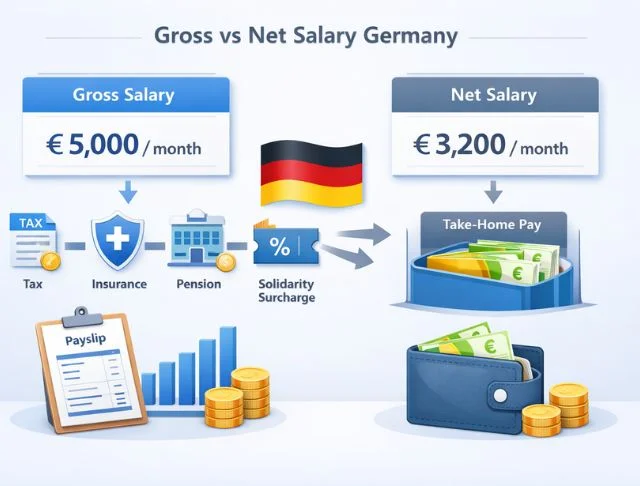
Gross salary in Germany refers to the total amount an employee earns before any taxes or mandatory deductions are applied. Employers state this amount in employment contracts and job offers.
Net salary is the amount employees actually receive in their bank accounts after deductions such as income tax, health insurance, pension contributions, unemployment insurance, and long-term care insurance.
In many cases, employees receive only around 55%–70% of their gross salary as take-home pay, depending on tax class, income level, marital status, and benefits. As the difference between gross and net salary in Germany is significant, employers must know what comes under gross salary and what amount they should set for hiring.

The base salary (Grundgehalt) is the fixed, contractual compensation you agree to pay an employee for their regular working hours. This is the foundation of employee payroll calculations and determines the baseline for social security contributions and overtime rates.
What employers need to know:
Bonuses (Prämien) and performance incentives (Leistungszulagen) are variable payments you may award based on individual, team, or company performance.
These are fully taxable, and employers must include them in gross salary calculations. Annual performance bonuses, commissions, profit-sharing, and signing bonuses are some common types that employers usually account for.
Overtime payments (Überstundenvergütung) compensate employees for hours worked beyond their contracted schedule. In Germany, employers can pay monetarily or compensate with time off. If they pay monetarily, overtime is fully taxable. Some contracts mandate higher overtime rates (e.g., 125% or 150% of the hourly rate). Note that unpaid overtime is legally permissible only if explicitly stated in the contract, which is common for managerial and senior roles.
Many German employers provide holiday bonuses (Urlaubsgeld) and Christmas bonuses (Weihnachtsgeld). These are often referred to as 13th- and 14th-month payments.
Income tax (Lohnsteuer) is the largest deduction from an employee’s gross salary. It is a progressive tax based on the employee’s annual income, tax class (Steuerklasse), and applicable allowances. It is the employer’s responsibility to withhold income tax from employee salaries based on their tax class and pay it to the tax authorities.
The solidarity surcharge (Soli) is an extra charge of 5.5% on the calculated Lohnsteuer, but since 2021 it only applies to higher-income earners. The German government introduced it to fund reunification costs. Employers also withhold it.
Church tax (Kirchensteuer) applies only to employees who are registered members of a recognized religious community (e.g., Catholic or Protestant). The rate is 8% (in most states) or 9% (in Bavaria and Baden-Württemberg) of the calculated income tac. Employers withhold church tax automatically based on the employee’s electronic payroll tax certificate (ELStAM), which reflects the employee’s registered religious affiliation.
Health insurance (gesetzliche Krankenversicherung, GKV) is mandatory for most employees earning below the income threshold (Versicherungspflichtgrenze, €77,400/year in 2026). Employers are responsible for withholding 50% of the total contributions from gross salary and paying the other 50% directly to the health insurance fund.
Pension insurance (gesetzliche Rentenversicherung, GRV) funds the state pension system. Both the employee and employer contribute equally. Employers withhold 9.3% from an employee’s gross salary and contribute the same amount themselves.
Unemployment insurance (Arbeitslosenversicherung, ALV) funds job placement services and unemployment benefits (Arbeitslosengeld). Foreign employers withhold 1.3% from the employee’s gross salary and pay a matching 1.3% as the employer contribution.
Long-term care insurance (Gesetzliche Pflegeversicherung) covers nursing care costs. The employer contribution rate is always 1.8%, while the employee rate varies between 2.4% and 0.8% depending on the number of children.

A single employee in Tax Class I with a monthly gross salary of €5,000 may receive approximately:
The exact amount depends on factors such as federal state, insurance provider, and additional benefits.
A married employee in Tax Class III with the same €5,000 gross salary may receive a higher net salary because of lower income tax deductions.
This is why married employees in Germany often have noticeably higher take-home pay than single employees earning the same gross salary.
Germany uses tax classes (“Steuerklassen”) to determine payroll tax deductions. The most common include:
Tax class mainly affects monthly net salary, not the employee’s total annual tax liability.
Two employees with identical gross salaries may receive different net salaries because deductions depend on:

In other countries, employers may bear payroll taxes, while in Germany, the employer’s main cost is contributing to social security. There is no distinct “employer payroll tax,” but employers must fund 50% of all mandatory insurance contributions.
Beyond the standard social security split, employers face additional mandatory insurance obligations. These include work accident insurance, employer liability insurance, and continued wage payment obligations.
Germany mandates a minimum of 20 paid vacation days per year (based on a 5-day workweek), but most collective agreements and contracts provide 25–30 days. Employers must pay for unused vacation days upon termination.
Under the Continued Wage Payment Act (Entgeltfortzahlungsgesetz), employers must pay 100% of the gross salary for up to 6 weeks per illness episode. After 6 weeks, health insurance takes over.
Upon termination (resignation or dismissal), employers must pay out all unused vacation days in the final settlement (Abfindung or Endabrechnung).
Vacation Payout = (Annual Gross Salary ÷ 250 Working Days) × Unused Vacation Days
Example: Employee earns €60,000/year with 10 unused days:
Daily Rate = €60,000 ÷ 250 = €240
Vacation Payout = €240 × 10 Unused Days = €2,400

German salary calculators help employers estimate employee take-home pay and total payroll costs quickly. These tools calculate:
Many foreign companies work with German payroll specialists to avoid compliance mistakes. Local experts help employers:
An Employer of Record (EOR) can manage payroll, tax filings, employment contracts, and statutory contributions on behalf of foreign companies hiring in Germany.
Using an EOR helps employers:
FMC Group has been providing employer of record services for more than 15 years in more than 50 countries, including Germany. Although employers can hire employees without registering a local entity by using an EOR, FMC Group also manages payroll, taxes, monthly contributions, and leave administration in full compliance with German labor laws. Schedule a call with us to learn how we can help scale your company.
You are currently viewing a placeholder content from Calendly. To access the actual content, click the button below. Please note that doing so will share data with third-party providers.
More InformationYou are currently viewing a placeholder content from Calendly. To access the actual content, click the button below. Please note that doing so will share data with third-party providers.
More InformationYou need to load content from reCAPTCHA to submit the form. Please note that doing so will share data with third-party providers.
More InformationYou are currently viewing a placeholder content from Turnstile. To access the actual content, click the button below. Please note that doing so will share data with third-party providers.
More InformationYou are currently viewing a placeholder content from Vimeo. To access the actual content, click the button below. Please note that doing so will share data with third-party providers.
More InformationYou need to load content from reCAPTCHA to submit the form. Please note that doing so will share data with third-party providers.
More InformationYou are currently viewing a placeholder content from reCAPTCHA. To access the actual content, click the button below. Please note that doing so will share data with third-party providers.
More Information

