
If employers hire foreign talent in the UAE, they gain access to specialized skills and can scale their teams quickly. However, many employers struggle to understand the country’s visa and work permit requirements.
Foreign companies are usually unfamiliar with the UAE’s employment framework. Employers often get involved with mainland and free zone entities and multiple government authorities. Delays, rejected applications, and unexpected costs are common when employers lack a clear understanding of the process.
This guide explains everything employers need to know about obtaining a UAE work visa. We cover sponsorship responsibilities, application procedures, required documents, processing timelines, costs, and key compliance considerations.

Author

Co-author
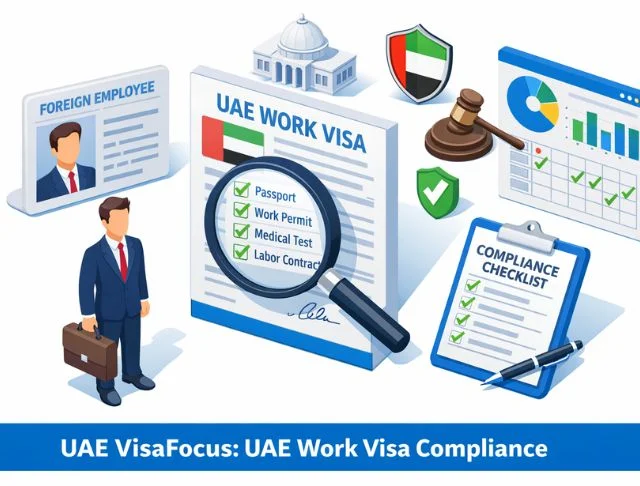
If employers hire foreign talent in the UAE, they gain access to specialized skills and can scale their teams quickly. However, many employers struggle to understand the country’s visa and work permit requirements.
Foreign companies are usually unfamiliar with the UAE’s employment framework. Employers often get involved with mainland and free zone entities and multiple government authorities. Delays, rejected applications, and unexpected costs are common when employers lack a clear understanding of the process.
This guide explains everything employers need to know about obtaining a UAE work visa. We cover sponsorship responsibilities, application procedures, required documents, processing timelines, costs, and key compliance considerations.
Author
Co-author
Get in Touch with Us

Leah Maglalang
Business Coordinator UAE


A UAE work visa is an immigration authorization that allows a foreign national to live and work legally in the United Arab Emirates.
A UAE work visa is generally required for:
Common work visa categories include:
UAE work visa processing usually takes 2 to 4 weeks. The processing time depends on the company type, document readiness, and approval speed.
The cost of sponsoring a work visa depends on the visa category, labor fees, medical tests, Emirates ID, and service charges. Many employment visas cost around AED 4,000 to AED 7,500.
A work permit is the authorization that allows a foreign national to perform work activities for a specific employer in the UAE. It is typically issued before employment begins. A work permit confirms that the employer has permission to hire the worker.
A work visa, on the other hand, refers to the immigration authorization that allows the employee to enter, reside, and work in the UAE. The work visa is generally issued as part of the broader employment sponsorship process.

Employers have to write the employment contract, sign it, and register it with the relevant authority. It must state the job title, salary, and terms of employment.
Employers must obtain the work permit or entry permit before the employee starts working. The visa process also typically requires medical testing, Emirates ID registration, and residency processing before full onboarding is complete.
Health insurance is mandatory. Employers are responsible for arranging and paying for it. In Dubai, proof of active coverage is required for residence visa processing or renewal.
Employers must register employees for payroll and pay wages through the Wages Protection System, where applicable. WPS helps ensure that salaries are paid correctly and on time, and non-compliance can trigger penalties.
Employers must keep work permits, visas, and records valid and renew them on time. They must also update the authorities when an employee’s status changes. Failure to maintain labor and immigration compliance can result in fines, suspensions, or visa-related delays.

The process begins when the employer selects a candidate. After a formal job offer, both parties must agree on key employment terms. This employment contract serves as the foundation of the work visa application. Employers must ensure that the contract complies with applicable labor laws.
After finalizing the employment agreement, the employer submits an application for a work permit through the relevant government authority.
Mainland employers typically apply through the Ministry of Human Resources and Emiratisation (MOHRE), while free zone companies apply through their respective free zone authorities.
If the employee is located outside the UAE, an entry permit may be required before the individual can enter the country. In some situations, employees already residing in the UAE may not need a separate entry permit.
Foreign employees must undergo a government-approved medical fitness examination after arriving in the UAE. It is mandatory and includes health assessments and laboratory tests conducted at authorized medical centers. Employers need to schedule the appointments.
The employee must apply for an Emirates ID. This serves as the primary identification document for UAE residents. As part of the registration process, biometric information such as fingerprints and photographs may be collected. The Emirates ID is used for various employment, banking, housing, and government-related activities within the UAE.
Once the medical examination and Emirates ID procedures are completed, the employer can proceed with the residence visa application. Government authorities review the employee’s documentation and supporting materials. If everything complies with legal requirements, the residence visa is issued.
After all immigration and employment requirements have been completed, the employee can officially begin work. Employers should register the employee within their payroll systems. They must provide any required benefits, arrange health coverage, and focus on ongoing compliance.

| Aspect | UAE Mainland | UAE Free Zone |
| Sponsoring authority | The mainland employer sponsors the visa through MOHRE and Immigration (GDRFA/ICP). | The free zone company sponsors the visa via its Free Zone Authority and Immigration. |
| Employment law | Governed by UAE Federal Labour Law (Law 33/2021) and MOHRE regulations. | Governed by the specific Free Zone’s employment rules plus general UAE labour principles . |
| Visa processing | Processed via federal systems (MOHRE + GDRFA); more formal and sometimes slightly slower. | Processed via free zone internal systems; often faster and more streamlined administratively. |
| Work flexibility | Employees can work across the UAE market for that mainland employer, subject to permits. | Employees are generally restricted to working within the specific Free Zone, unless extra permits are obtained. |
| Business access | Can trade directly in the UAE local market and bid for government contracts | Primarily suited for free zone and international activity; local UAE trade often needs an agent/distributor. |
| Payroll and compliance | Must comply with federal labour law, WPS payroll, Emiratisation, and MOHRE rules. | Must comply with the Free Zone’s employment regulations, plus core UAE labour and immigration standards. |
| Best for | Companies needing full UAE market access and government tenders. | Startups, exporters, and firms focused on international business or simplified setup. |
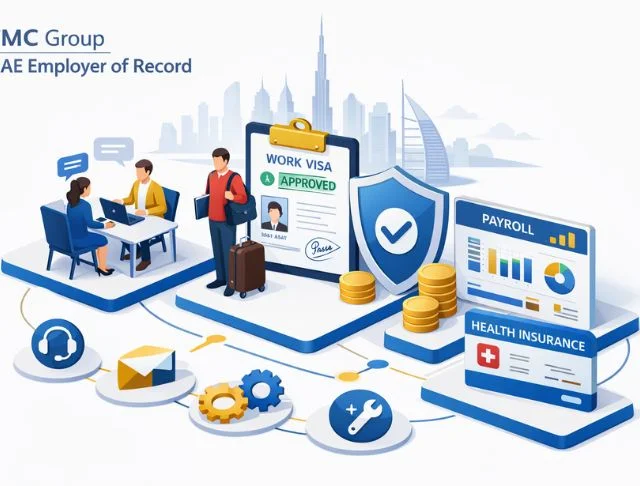
It is challenging for employers to obtain work visas for their employees. The main reason is their unfamiliarity with local labor and immigration regulations.
FMC Group can make the process hassle-free with local expertise, compliance support, and employment solutions. Through its Employer of Record (EOR) services, FMC Group can hire employees on behalf of foreign companies in the UAE. If you use this service, FMC Group can support you by:
You are currently viewing a placeholder content from Calendly. To access the actual content, click the button below. Please note that doing so will share data with third-party providers.
More InformationYou are currently viewing a placeholder content from Calendly. To access the actual content, click the button below. Please note that doing so will share data with third-party providers.
More InformationYou need to load content from reCAPTCHA to submit the form. Please note that doing so will share data with third-party providers.
More InformationYou are currently viewing a placeholder content from Turnstile. To access the actual content, click the button below. Please note that doing so will share data with third-party providers.
More InformationYou are currently viewing a placeholder content from Vimeo. To access the actual content, click the button below. Please note that doing so will share data with third-party providers.
More InformationYou need to load content from reCAPTCHA to submit the form. Please note that doing so will share data with third-party providers.
More InformationYou are currently viewing a placeholder content from reCAPTCHA. To access the actual content, click the button below. Please note that doing so will share data with third-party providers.
More Information