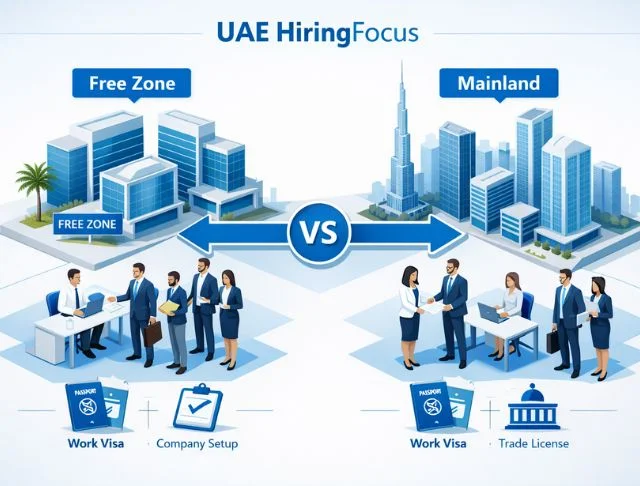
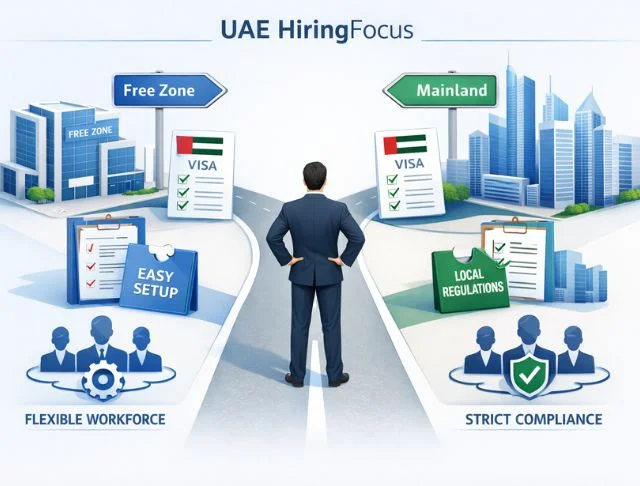
When an employer chooses between Free Zone and Mainland, it significantly impacts hiring in the UAE. This decision affects costs, compliance obligations, and the ability to manage employees.
Both options allow foreign businesses to hire talent legally. However, they differ in sponsorship requirements, operational flexibility, and regulatory oversight.
This guide compares Free Zone vs. Mainland hiring across key areas. After reading this post, you’ll be able to determine the most suitable hiring structure for your business goals.
Author
Co-author
When an employer chooses between Free Zone and Mainland, it significantly impacts hiring in the UAE. This decision affects costs, compliance obligations, and the ability to manage employees.
Both options allow foreign businesses to hire talent legally. However, they differ in sponsorship requirements, operational flexibility, and regulatory oversight.
This guide compares Free Zone vs. Mainland hiring across key areas. After reading this post, you’ll be able to determine the most suitable hiring structure for your business goals.
Author
Co-author
Get in Touch with Us
Leah Maglalang
Business Coordinator UAE
Free Zone hiring refers to employing workers through a company registered in one of the UAE’s designated free zones.
Under this model, the Free Zone authority oversees company registration, employee sponsorship, and related administrative requirements. International businesses, startups, and companies in specific industries commonly use this option.
Mainland hiring refers to employing workers through a company licensed to operate in the UAE mainland.
Relevant government authorities regulate these businesses. Such companies can conduct commercial activities throughout the UAE. If you require broad market access, serve customers across the country, or need more flexibility in your business operations, then Mainland hiring may be the better option.
| Factor | Free Zone | Mainland |
| Sponsor | Relevant Free Zone Authority (FZA). | MOHRE and GDRFA. |
| Governing Authority | Individual Free Zone Authority (e.g., DMCC, JAFZA, DIFC, ADGM). | Ministry of Human Resources and Emiratisation (MOHRE) and GDRFA. |
| Labor Regulations | Most free zones follow UAE Labour Law, while DIFC and ADGM operate under separate employment laws. | Governed by UAE Federal Labour Law with standardized MOHRE employment contracts. |
| Wage Protection System (WPS) | Requirements vary by Free Zone. Some zones require WPS, while others allow approved payroll alternatives. | Mandatory for all mainland employers. |
| Administrative Oversight | Lower administrative burden with reporting primarily handled through the Free Zone Authority. | Higher compliance obligations with regular reporting to MOHRE and other government authorities. |
Factor | Free Zone | Mainland |
Visa Validity | Up to 2 years. | Up to 2 years. |
Visa Processing Time | Typically 5–10 business days through the Free Zone Authority. | Typically 7–15 business days through MOHRE and GDRFA. |
Visa Cost | Generally AED 4,000–7,000+ per employee. | Generally AED 4,000–7,000+ per employee. |
Sponsorship Transfer | Transfers to another Free Zone or mainland employer often require a No Objection Certificate (NOC) and visa transfer process. | Transfers between mainland employers are generally simpler, subject to contract and regulatory requirements. |
| Factor | Free Zone | Mainland |
| Primary Market Access | Primarily designed for international trade, exports, imports, and re-exports. | Full access to the UAE domestic market across all seven emirates. |
| UAE Mainland Market Access | Cannot generally sell directly to mainland customers without a mainland distributor, branch, or approved structure. | Can sell directly to mainland customers without restrictions. |
| Employee Work Location | Employees are generally expected to work within the Free Zone. Mainland work may require a temporary permit costing approximately AED 500–1,000. | Employees can work anywhere in the UAE without location restrictions. |
| Geographic Coverage | Operations are primarily tied to the Free Zone and emirate where the company is licensed. | Can operate throughout all seven emirates under a single mainland license. |
| Branch Expansion | May require additional entities, permits, or structures to expand operations beyond the original Free Zone. | Can establish branches and offices across the UAE under the mainland framework. |
| Best Suited For | Exporters, importers, re-export businesses, international service providers, and companies serving global markets. | Businesses targeting UAE customers, retail operations, construction firms, healthcare providers, and local service companies. |
Factor | Free Zone | Mainland |
Licensing Authority | Regulated by the relevant Free Zone Authority (e.g., DMCC, JAFZA, DIFC, ADGM). | Licensed through the Department of Economy and Tourism (DET) or Department of Economic Development (DED). |
Work Permit Authority | Work permits are issued directly by the Free Zone Authority. | Work permits are issued by MOHRE. |
Labor Regulations | Most Free Zones follow UAE Labour Law, while DIFC and ADGM operate under separate employment frameworks. | Governed by UAE Federal Labour Law. |
Employment Contracts | Uses Free Zone-specific employment contracts and offer letters. | Uses MOHRE-registered employment contracts and offer letters. |
MOHRE Registration | Generally not required unless conducting certain mainland activities. | Mandatory for all employers. |
Corporate Tax | Qualifying income may benefit from a 0% corporate tax rate, while non-qualifying income is generally taxed at 9%. | Taxable income above AED 375,000 is generally subject to 9% corporate tax. |
Economic Substance Requirements | Required for businesses seeking Free Zone tax benefits and qualifying status. | Not applicable under the standard mainland tax framework. |
VAT Registration | Mandatory when annual taxable supplies exceed AED 375,000; voluntary from AED 187,500. | Same VAT requirements apply. |
Emiratisation Requirements | Generally exempt, although certain sectors may have specific requirements. | Mandatory for eligible employers with 50+ skilled employees, with quotas increasing annually. |
License Renewal | Annual renewal through the Free Zone Authority. | Annual renewal through DET/DED. |
Mainland Operations Approval | May require a mainland branch license, temporary activity permit, and approvals from relevant authorities before operating on the mainland. | No additional approvals required for mainland operations. |
Factor | Free Zone | Mainland |
Visa Quota Costs | Typically AED 1,500–3,000 per visa quota, depending on the Free Zone package. | Usually lower application fees, with quotas based on office size, license type, and business activity. |
Work Permit Fee | Approximately AED 279 per employee. | Approximately AED 279 per employee. |
Labor Fees | Usually included within Free Zone packages or charged separately by the zone. | Additional labor fees may apply, ranging from AED 1,285–3,550 depending on company classification. |
Total Visa Costs | Generally AED 3,500–6,000 per employee. | Generally AED 4,000–6,000+ per employee depending on employee category and permit requirements. |
Entry Permit (Inside UAE) | Approximately AED 780. | Approximately AED 1,165. |
Entry Permit (Outside UAE) | Typically AED 600–750. | Approximately AED 600. |
Change of Status Fee | Approximately AED 920. | Approximately AED 675. |
Medical Examination | AED 470 (standard) or AED 750 (urgent). | AED 470 (standard) or AED 750 (urgent). |
Emirates ID | Approximately AED 385 for a 2-year validity period. | Approximately AED 385 for a 2-year validity period. |
Visa Issuance and Stamping | Approximately AED 550–755. | Approximately AED 550–755. |
Labor Insurance | Approximately AED 180 per employee. | Approximately AED 180 per employee. |
Bank Guarantee | Usually not required, although some Free Zones may require a guarantee of up to AED 3,000 per employee. | May require a refundable bank guarantee of approximately AED 3,000 per employee. |
Total Hiring Cost per Employee | Typically AED 4,000–7,000 for a standard 2-year employment visa. | Typically AED 7,000–10,000 depending on employee category, labor fees, and sponsorship requirements. |
Work Permit Processing Time | Usually 3–5 business days. | Usually 5–7 business days. |
Total Visa Processing Time | Typically 5–10 business days. | Typically 7–15 business days. |
End-to-End Visa Timeline | Generally 7–12 days from entry permit issuance to visa activation. | Generally 10–18 days from entry permit issuance to visa activation. |
Urgent Processing | Available in many Free Zones, reducing processing times to 1–2 days for additional fees of approximately AED 1,000–2,000. | Express processing is available, typically reducing processing times to 1–2 days for additional fees of approximately AED 500–1,000. |
Additional Fee for Employees Over 60 | Approximately AED 5,000. | Approximately AED 5,000. |
Health Insurance | Usually mandatory, with annual costs commonly ranging from AED 1,500–3,000 per employee. | Mandatory, with annual costs commonly ranging from AED 1,500–3,000 per employee. |
Dependent Visa Costs | Typically AED 3,500–4,500 per dependent. | Typically AED 3,500–4,500 per dependent. |
WPS Setup Costs | May cost AED 500–1,000 where required by the Free Zone. | Typically AED 500–1,000 for payroll and bank setup. |
Hiring employees in the UAE requires visa sponsorship, labor law compliance, payroll administration, employment contracts, and ongoing regulatory obligations.
FMC Group helps foreign companies meet these requirements and provides compliant hiring and workforce management solutions in the UAE.
Book a free 30-minute consultation call with our experts and get guidance and customized plans for scaling your team in the UAE.
You are currently viewing a placeholder content from Calendly. To access the actual content, click the button below. Please note that doing so will share data with third-party providers.
More InformationYou are currently viewing a placeholder content from Calendly. To access the actual content, click the button below. Please note that doing so will share data with third-party providers.
More InformationYou need to load content from reCAPTCHA to submit the form. Please note that doing so will share data with third-party providers.
More InformationYou are currently viewing a placeholder content from Turnstile. To access the actual content, click the button below. Please note that doing so will share data with third-party providers.
More InformationYou are currently viewing a placeholder content from Vimeo. To access the actual content, click the button below. Please note that doing so will share data with third-party providers.
More InformationYou need to load content from reCAPTCHA to submit the form. Please note that doing so will share data with third-party providers.
More Information