
Foreign employers face different challenges while hiring in the UAE. One of the biggest decisions is whether to hire through an Employer of Record (EOR) or establish a local entity for direct hiring. If they choose the wrong approach, it can lead to high costs, slower expansion, and compliance risks.
This guide compares EOR vs. direct hiring in the UAE. I’ll also explain how each model works, their costs, legal responsibilities, advantages and drawbacks, and the situations where each is the better choice. By the end of this post, you’ll have a clear understanding of which option is best for you in the UAE.

Author

Co-author
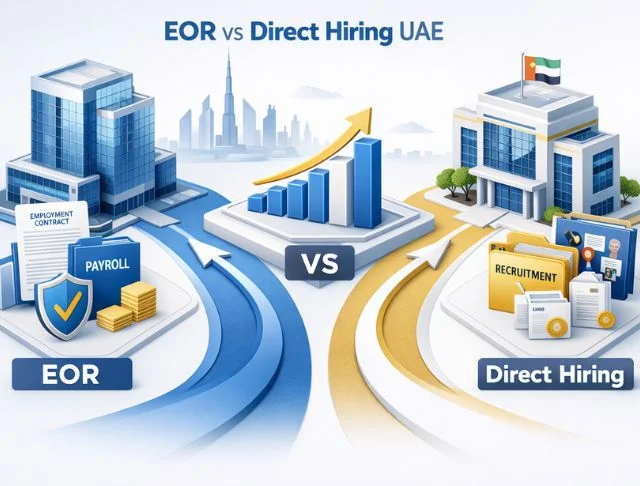
Foreign employers face different challenges while hiring in the UAE. One of the biggest decisions is whether to hire through an Employer of Record (EOR) or establish a local entity for direct hiring. If they choose the wrong approach, it can lead to high costs, slower expansion, and compliance risks.
This guide compares EOR vs. direct hiring in the UAE. I’ll also explain how each model works, their costs, legal responsibilities, advantages and drawbacks, and the situations where each is the better choice. By the end of this post, you’ll have a clear understanding of which option is best for you in the UAE.
Author
Co-author
Get in Touch with Us

Leah Maglalang
Business Coordinator UAE


An Employer of Record (EOR) is a third-party organization. It legally employs workers on behalf of your company. The EOR handles employment contracts, payroll, statutory benefits, work visa sponsorship, and compliance with UAE labor laws.
With an EOR, you select the employee and oversee their daily responsibilities. As the EOR hires them through its local entity, it manages the legal obligations.
Direct hiring means your company employs workers through its own registered UAE entity. As the legal employer, you recruit employees, issue employment contracts, process payroll, sponsor work visas, provide benefits, and comply with UAE labor laws.
First, you register a legal entity in the UAE. Second, you recruit employees. Third, you offer employment contracts. Fourth, you register with the relevant authorities, such as WPS. Fifth, you sponsor work visas and obtain work permits. In simple terms, you’ll handle everything involved in hiring an employee.
Choose an Employer of Record (EOR) if you want to hire employees quickly without establishing a UAE entity. Also choose an EOR if you need support with payroll, statutory benefits, and compliance.
Choose direct hiring if you already have a registered UAE company and plan to build a long-term local presence. You also want full control over employment and HR operations.
The key differences between both hiring models lie in legal responsibilities, company setup requirements, payroll management, compliance obligations, and overall flexibility. Understand these key differences by reading the table below, which compares both options in an easy way.
Feature | Employer of Record (EOR) | Direct Hiring |
Legal Employer | The EOR is the legal employer on your behalf. | Your company is the legal employer. |
UAE Legal Entity Required | No. The EOR hires through its existing UAE entity. | Yes. You must establish a registered UAE entity. |
Company Setup | Not required. | Required before hiring employees. |
Employment Contracts | Prepared and managed by the EOR. | Prepared and managed by your company. |
Work Visa Sponsorship | Sponsored by the EOR. | Sponsored by your company. |
Payroll Processing | Fully managed by the EOR. | Managed by your company’s payroll team or provider. |
HR Administration | Handled primarily by the EOR. | Fully managed by your company. |
Compliance Responsibility | The EOR manages employment compliance. | Your company is responsible for complying with UAE labor laws. |
Employee Benefits | Administered by the EOR. | Managed by your company. |
Hiring Speed | Fast, as no local entity is required. | Slower due to company setup and registration requirements. |
Operational Control | You manage employees’ daily work while the EOR handles employment administration. | Your company has full control over all employment and HR functions. |
Best For | Foreign companies entering or testing the UAE market. | Companies with an established UAE entity and long-term hiring plans. |

The cost of hiring through an EOR or direct hiring depends on many factors. However, hiring through an EOR is often much less expensive if your goal is not long-term expansion or if you just need to test the market. The table below compares the costs of both options.
Cost Category | Direct hiring with own UAE company | Hiring through EOR in UAE |
Company registration & trade licence | One‑off licence and registration package – realistic total AED 25,000–60,000 depending on free zone vs mainland, including immigration files and basic approvals. | Not required; EOR uses its own licensed entity, so you pay no registration or trade licence. |
Office / flexi‑desk lease (to obtain visas) | Mandatory lease for most free zones/mainland, often AED 15,000–40,000 per year or more for compliant office/flexi‑desk space tied to visa quotas. | Not required; office space is on EOR’s side, you can operate fully remote or with coworking if you wish, but it is not a legal hiring requirement. |
Bank account setup & minimum balance | Bank onboarding, possible fees and maintaining typical minimum balance or capital (AED 20,000–50,000+ locked funds depending on bank and structure). | Not required; payroll and collections run through EOR’s bank accounts. |
Government registrations (MOHRE, WPS, etc.) | Setup for MOHRE, WPS, and other portals; internal time or consultancy fees to register and maintain accounts. | Included in EOR service; they already run compliant WPS, MOHRE registrations and portals on your behalf. |
Visa & work permit issuance per employee | Visa package per employee typically AED 3,000 -7,500 in realistic cases including medical, Emirates ID, typing, and immigration costs; amortised over visa validity. | Included or transparently recharged inside EOR’s per‑employee fee; no separate visa budgeting or handling on your side. |
Annual licence & establishment renewals | Yearly licence renewal, establishment card renewals, immigration file renewals – often AED 10,000–25,000 per year depending on structure. | Covered by EOR’s own renewals; you have no annual licence renewals tied to hiring. |
Local accounting, tax, and audit | Costs for bookkeeping, VAT (if applicable), and audits under UAE’s 9% corporate tax framework – can easily be AED 20,000+ per year for a small entity. | No local entity ⇒ no direct accounting/audit obligations for you in the UAE; EOR’s own entity bears its corporate/tax compliance. |
HR, payroll & compliance operations | Internal HR/payroll time or outsourced payroll, drafting compliant contracts, policies, leave tracking, WPS file creation, and responding to inspections. | Fully included in EOR fee: compliant contracts under UAE labour law, payroll, WPS, leave management, end‑of‑service gratuity calculations. |
Statutory employee costs (gratuity, insurance, visas) | Ongoing per‑employee costs: end‑of‑service gratuity accrual, mandatory health insurance, visa renewal amortisation, plus any ILOE/other schemes. | Same statutory base costs apply in substance, but they are bundled, calculated and administered by EOR; you see them as part of the single monthly invoice rather than separate local processes. |
Per‑employee EOR fee | Not applicable; per‑employee cost is salary + statutory + your HR/admin overhead.[2][4 | EOR fee per employee per month, covering payroll, compliance and HR administration. |
If you add up the full direct hiring model, you have heavy upfront cost (for example, AED 35,000–40,000 for a lean free-zone structure or AED 50,000–60,000 for a typical mainland setup), plus recurring renewals, office rent, payroll and HR operations, and statutory employment costs.
If, instead, you hire through an EOR, you only pay the per-employee monthly fee on top of the agreed salary.
In practice, you can estimate a simple break-even point by dividing your total projected entity setup and annual overhead (e.g., AED 50,000–60,000 for a mainland/freezone setup) by your EOR provider’s quoted monthly fee per employee, which will tell you how many employee-months of EOR usage it takes before setting up your own entity becomes more cost-effective. That is roughly more than two years. In essence, for short-term hiring, an EOR is the best option because it is lower cost, faster, and hassle-free.


An Employer of Record is ideal for businesses that are entering the UAE, hiring remote employees, or expanding quickly without setting up a local entity.
Direct hiring is best suited for companies that already have an established presence in the UAE and want full control over recruitment, HR, payroll, and long-term workforce management.

When you switch between an Employer of Record and direct hiring, first you need to review employment agreements. Second, transfer employees to the new employment model. Third, update payroll and benefits. Fourth, ensure compliance with work visa requirements. Fifth, comply with UAE labor laws.

We provide Employer of Record services in the UAE.
We have been providing EOR services for over 15 years.
We charge a monthly fee per employee and can help you hire the employees.
Before proceeding further, book a free 30-minute consultation call so we can help you decide which hiring model best suits your business.
You are currently viewing a placeholder content from Calendly. To access the actual content, click the button below. Please note that doing so will share data with third-party providers.
More InformationYou are currently viewing a placeholder content from Calendly. To access the actual content, click the button below. Please note that doing so will share data with third-party providers.
More InformationYou need to load content from reCAPTCHA to submit the form. Please note that doing so will share data with third-party providers.
More InformationYou are currently viewing a placeholder content from Turnstile. To access the actual content, click the button below. Please note that doing so will share data with third-party providers.
More InformationYou are currently viewing a placeholder content from Vimeo. To access the actual content, click the button below. Please note that doing so will share data with third-party providers.
More InformationYou need to load content from reCAPTCHA to submit the form. Please note that doing so will share data with third-party providers.
More Information