
An estimated 10.4 million companies in the United States and the United Kingdom use recruitment agencies, including approximately 5.5 million U.S. businesses and 4.85 million UK businesses. Globally, more than 160,000 recruitment agencies operate across 40+ countries, helping millions of employers hire permanent, temporary, and contract workers. Surveys across developed markets consistently show that 67% to over 90% of companies rely on recruitment agencies for at least part of their hiring process.
In this article, we’ll examine the latest data on how many companies use recruitment agencies, including adoption rates by company size, region, industry, hiring type, recruitment stage, recruitment costs, and market trends to understand how recruitment agencies have become an essential part of modern hiring.

Author
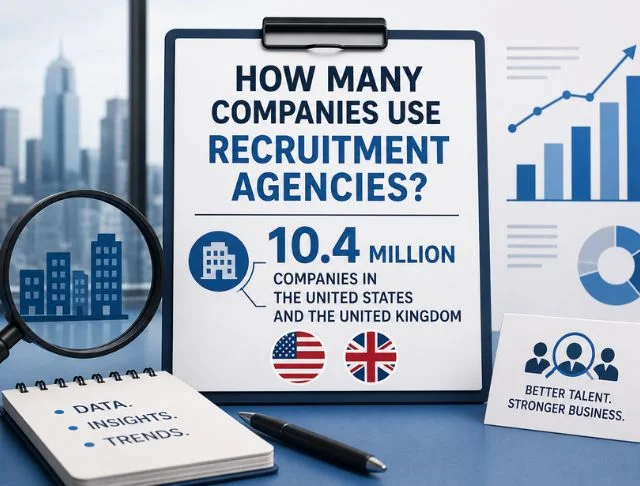
More companies lean on outside recruiters than ever before, and the numbers back that up. Let’s start with how widespread this practice has become across U.S. and global employers.
Staffing agencies now sit at the core of hiring plans for most U.S. businesses. 82% of U.S. employers planned to use staffing agencies in 2024, and over 87% of U.S. companies turn to recruitment agencies for at least some of their hiring needs. The trend runs even deeper in industrial sectors. 97% of industrial companies (manufacturing, logistics, construction) use temporary workers, and staffing agencies serve as the main channel for that talent.
Globally, the picture looks similar. 68% of employers plan to increase their use of contingent labor over the next 12 months, while 76% of companies say they will adopt or expand a flexible staffing strategy.
Year | U.S. Staffing Market Revenue | YoY Change |
2018 | ~$152B | +8.4% (peak employment: 16.8M temps) |
2019 | ~$149B | ↓ -4.76% temp employment |
2020 | ~$131B | ↓ -15% (COVID shock) |
2021 | ~$140B | ↑ +3.68% |
2022 | $159.1B | ↑ +3.55% (all-time high) |
2023 | $145.9B | ↓ -8.3% |
2024 | $124.0B (temp/contract only) | ↓ -11.8% |
2025 | $178.9B (total staffing incl. perm) | Stabilized |
2026 (proj.) | $183.3B | ↑ +2% (return to growth) |
The staffing industry has been through a rough patch and is now bouncing back. The U.S. staffing market peaked at $159.1 billion in 2022, then dropped for three straight years before growth kicked back in during 2026. Revenue picked up fast too. U.S. staffing revenue grew a median 5% year-over-year in April 2026, the fastest pace in three years.
The market size tells its own story. U.S. staffing revenue hit $178.9 billion in 2025 and is set to reach $183.3 billion in 2026. On a global scale, the staffing market was worth an estimated $620 billion in 2024, with the U.S. making up over 25% of that total. Zoom out further and the broader recruitment and staffing market was valued at $584.10 billion in 2024, with projections pointing to $945.11 billion by 2034 at a 6.20% CAGR.
Firms themselves are feeling this upswing. 56% of recruitment firms grew revenue in 2025, up sharply from 40% in 2024.
Resources: Worldmetrics, Pin Blog, Gitnux Staffing, Accurate Staffing LinkedIn

Not every company leans on agencies the same way. Small businesses, mid-market firms, and enterprises each bring different needs to the table, and the data splits out clearly once you break it down by size.
Small businesses make up the largest chunk of agency clients by far. 67% of hiring managers at small-to-mid-sized companies use outsourced staffing or recruiting services.
In the UK, businesses with 0 to 49 employees account for 99.2% of the entire business population (5.64 million companies), making them the top client segment by sheer volume. That lines up with the fact that 60% of staffing industry revenue comes from businesses with 50 or fewer employees.
Why do small businesses turn to agencies in the first place? Speed matters most. 35% cite speed of hire as their top reason, alongside access to a wider talent pool. Since the pandemic, small employers have become 2x more likely to use staffing agencies for remote roles compared to before.
Cost plays a role too. 55% of employers say agencies help cut down recruitment costs, which matters a lot when there’s no dedicated HR team to fall back on.
Mid-market firms sit in a tricky spot. They’re growing fast but often don’t have the internal recruiting muscle to keep pace. 77% of employers reported using staffing agencies to fill roles in 2023, and mid-market companies (50 to 999 employees) have become the fastest-growing client segment by headcount need. 68% of employers plan to increase contingent labor use over the next year too, a trend that’s concentrated heavily among mid-market firms scaling up.
AI skills shortages hit this group hardest. 72% of employers worldwide report trouble filling roles in 2026, and AI skills top the list of hardest categories to source. Mid-market firms have responded by leaning into AI-enabled recruiting tools at a steady clip.
Speed remains the driving factor overall. 57% of employers use staffing agencies to fill roles faster than they could through internal recruiting, a benefit that hits especially hard for mid-market companies without a full-scale HR department.
Even the biggest players don’t skip agencies. 90%+ of companies, including large enterprises, use staffing agencies in some capacity. UK survey data backs this up further. 91% of large UK employers say it’s important to increase their employment of agency workers, and 86% say agency workers bring fresh perspectives that drive innovation.
Among Forbes Global 2000 companies surveyed, more than 80% use flexible employees, a group that spans agency workers, contractors, and self-employed talent. 86% of UK respondents from these same companies said their organization has started working more strategically with HR services providers.
Tech plays a big role at this level too. 95% of large staffing firms use social media for candidate sourcing, and enterprises expect that capability as standard. AI adoption follows a similar upward curve.
Resources: Worldmetrics, PACEStaffing, Gitnux Staffing, Taleva AI Recruiting, DOIT Software, Gitnux Industrial

Agency usage doesn’t look the same everywhere. Numbers shift a lot once you break things down by region, so let’s walk through each one.
U.S. Industry | % of Establishments Using Recruiters/Agencies (BLS 2022) |
Healthcare & Social Assistance | 12.3% |
Accommodation & Food Services | 14.9% |
Manufacturing | 11.1% |
Educational Services | 9.6% |
Transportation & Warehousing | 7.1% |
All Private Sector | 7.0% |
Retail Trade | 5.9% |
Financial Activities | 4.4% |
The U.S. remains the most agency-reliant market in the world. Between 82% and 90%+ of U.S. companies use staffing or recruiting agencies for at least some of their hiring, and 67% of hiring managers specifically report using outsourced staffing firms. The infrastructure behind this is massive. Around 27,000 staffing and recruiting companies operate out of roughly 54,000 offices across the country.
Some sectors lean on agencies even harder. 97% of industrial companies (manufacturing, logistics, construction) use temporary staffing workers. BLS data backs this widespread pattern up further. 7% of all U.S. private-sector establishments had recently started using new recruiters or talent agencies, which works out to 625,521 establishments and 28.8 million workers.
The UK shows strong agency reliance too, though the market has cooled a bit recently. 86% of UK employers used a recruitment agency in 2024, and more than 80% of UK Forbes 2000 respondents use flexible employees such as agency workers and contractors. Large employers feel especially strongly about this. 91% say it’s important to increase their use of agency workers, and 96% say offering temporary contracts matters.
Placement volume has dropped though. On any given day in 2024, 872,000 temporary or contract workers were on assignment, down 17.6% from the year before. Permanent placements fell even harder, dropping to 536,400 in 2024 from 806,400 in 2023, a 33.5% decrease. That points to weaker hiring conditions overall rather than companies pulling back from agencies.
The sector itself hasn’t shrunk despite this. The UK had 31,345 recruitment enterprises in 2025, up from 29,635 in 2023, and generated £40.6 billion in sector GVA during 2024. Turnover for the sector hit £39.6 billion in 2024. Over 70% of UK employers still rely on agencies for hard-to-fill or specialist roles, and the UK’s agency staffing penetration rate tops 3% of the employed workforce, among the highest anywhere in the world.
Europe presents a more mixed picture than the U.S. or UK. Employment placement agencies across Europe generated approximately €65.4 billion in revenue through 2025, even after a contracted period. Overall penetration sits at 1.37% of the employed workforce, below both the global average of 1.8% and U.S. levels, though this varies widely by country. The Netherlands leads the pack with a penetration rate above 3%, putting it on par with the UK as Europe’s most agency-reliant market.
Growth has picked back up slightly. WEC Q2 2026 data shows Europe posted modest agency work growth of 1.2% in Q1 2026, with Spain and Denmark showing positive momentum while the Netherlands and Ireland stayed in negative territory. Globally, private employment agencies across 40+ countries placed 61 million people in 2024, though North America and Europe both contracted, with the U.S. and UK together accounting for a decline of nearly 2 million placements.
Beyond mainland Europe, more than 60% of firms in the GCC (Gulf) region use recruitment partners for specialist and international hiring.
APAC has become the engine room of global recruitment growth. The region is now the largest market by job placements, led by India and China. APAC’s staffing market pulled in $159 billion in revenue in 2024, which accounts for 26% of the entire global staffing market. Penetration also runs high, averaging 2.1% against a global average of 1.8% and Europe’s 1.37%.
Country-level numbers show where the strength comes from. China sits at 2.9% staffing penetration, Australia at 2.5%, and Japan holds the title of the largest APAC IT staffing market. The broader contingent workforce market across APAC is valued at $120 billion and is projected to grow at a 6.3% CAGR between 2023 and 2032.
Resources: Worldmetrics, IBISWorld, BLS BRS 2022, PACEStaffing

Industry matters just as much as region when it comes to agency reliance. Some sectors treat agencies as a core part of how they hire, and the data shows exactly which ones lean hardest.
Tech companies have made agency staffing the norm rather than the exception. 73% of tech companies now rely on an IT staffing agency as of 2026, described by industry watchers as the new baseline. 61% of IT leaders say contract staffing is essential just to deliver tech projects on time.
Speed drives a lot of this. Agencies enable 58% faster hiring in tech compared to internal recruiting, filling roles in 7 to 10 days versus 6 to 10 weeks through internal channels.
Specialist demand keeps pushing growth too. AI/ML and data science job postings hit 49,200 in 2025, up 163% year-over-year, while cybersecurity roles grew 124%. AI-related postings tripled in early 2026, and AI-trainer ads alone jumped 281%. It’s no surprise then that 78% of enterprise-level technology companies have already adopted AI in their own recruiting processes, putting tech ahead of every other sector on this front.
Healthcare depends on agencies just to keep facilities running safely. 62% of healthcare facilities report ongoing reliance on external staffing to maintain minimum safe staffing levels, and 54% rely on agency staffing weekly to cover chronic shift gaps. About 54% of all healthcare facilities also use a Managed Service Provider for staffing, a more structured layer of agency dependency that’s growing around 10% per year.
Financial services show a cautious but steady reliance on agencies. 70% of financial services hiring managers expect demand to bounce back, and a significant majority already rely on recruitment agencies for specialist roles. BLS data shows 4.4% of Financial Activities establishments had newly started using recruiters or talent agencies, representing 41,719 firms and 1.57 million workers.
AI adoption runs high in this sector too. Financial services shows 65% AI adoption in recruiting as of 2026, trailing only technology, with year-over-year growth of +13% driven by resume parsing, compliance screening, and regulatory verification tools..
Manufacturing leans on agencies more heavily than almost any other sector. 97% of industrial companies (manufacturing, logistics, construction) use temporary staffing workers, often filling 5% to 20% of total staff this way. BLS data shows 11.1% of Manufacturing establishments had newly adopted recruiter or talent agency use, the highest share of any goods-producing sector, covering 39,014 establishments and 4.2 million workers.
Retail and hospitality turn to agencies mostly to handle demand spikes. 70% of employers use staffing agencies for seasonal peak periods like holiday retail, making this one of the most common use cases across consumer-facing sectors. BLS data confirms just how common this is. 14.9% of Accommodation & Food Services establishments had recently started using new recruiters or talent agencies, the highest rate of any private-sector industry surveyed, covering 106,913 establishments and 2.75 million workers. Retail showed a 5.9% adoption rate, covering 60,141 establishments.
Related sectors show similar pressure. Construction’s demand for staffing rose 18% in 2023 due to labor shortages, and retail-adjacent sectors saw parallel increases. The hospitality staffing agency market was valued at $42.6 billion in 2025 and is projected to hit $74.3 billion by 2034 at a 6.4% CAGR.
Resources: AITACS, DOIT Software, Taleva AI Recruiting, PRNFunding, Alta Lake Partners, RefAssured, GM Insights, BLS BRS 2022, Goodman Masson Financial Services Survey 2024, Taleva AI Recruiting, Agency Leads
Not all agency work looks the same. Permanent placements, temp staffing, and executive search each run on different fee structures and growth patterns, so let’s break them apart.
Permanent placement fees follow a pretty clear tier system. Fees range from 11% to 30% of first-year salary, with entry-level roles averaging 18%, mid-level 22%, senior management 27%, and executive or C-suite roles topping out at 30%.
Permanent hiring has cooled off in several markets though. In Canada’s employment services sector, permanent placements and contract staffing made up 42.7% of total sales in 2024, while temporary staffing edged ahead at 48.2%. UK agencies on the Firefish platform saw permanent placements drop 4% year-over-year in 2025, the second straight year of decline, driven by a 5% reduction in permanent jobs created.
Temp and contract work has become the real growth engine for staffing agencies. Temporary and contract placements grew 23% year-over-year in 2025, making this segment the dominant driver across the global industry. 97% of industrial companies (manufacturing, logistics, construction) use temporary workers, often for 5% to 20% of total staff.
Executive search sits in its own tier entirely, both in cost and market size. The global executive search market was valued at $23.1 billion in 2026 and is projected to reach $42.2 billion by 2035 at a 6.94% CAGR. A separate estimate from Mordor Intelligence puts the market at $22.71 billion in 2026, growing to $31.78 billion by 2030 at an 8.8% CAGR.
Companies clearly trust this channel. 50% of companies use executive search firms to source and hire executive-level candidates, tying with professional contacts as the top sourcing method for these roles. Confidence in the sector’s future looks strong too. 94% of executive search firms expect revenue growth to continue through 2026.

Agencies don’t just fill roles, they plug into specific stages of the hiring process. Sourcing, screening, and executive-level search each pull different values out of an agency relationship.
Sourcing remains one of the biggest reasons companies bring in outside help. 71.3% of employers rely on employee referrals as a sourcing method, while 46.1% use LinkedIn and 43.5% use social media, channels where agencies carry real influence through their own databases. Agencies hold a natural edge here. About 70% of the global workforce counts as passive talent not actively job hunting, and agencies maintain the databases needed to reach them.
Agencies play a heavy filtering role once candidates enter the pipeline. Staffing agencies deliver roughly a 42% interview rate per 100 applications submitted through them, compared to just about 2% for direct applications. That gap shows exactly how much screening value agencies add before a candidate ever reaches a hiring manager.
Executive-level hiring leans on agencies more than almost any other stage. 50% of companies use executive search firms to source executive candidates, according to SHRM’s 2025 benchmarking data. The stakes at this level run high too. The median cost-per-hire for executive roles reached $35,879 in 2025, up 21% since 2022 and 113% since 2017, with most of that cost flowing straight to search firms.
Resources: iHire / SHRM via Pin Blog, ScaleSuite, SHRM Talent Access via LinkedIn, Phylicia Seymour LinkedIn, Matchr, Staffing Hub / Employ Inc

Agencies rarely work alone. They sit alongside internal teams, referrals, job boards, and social media, each channel pulling its own weight. Here’s how they stack up against each other.
In-house recruiting has shrunk a bit since its pandemic-era peak. 55% of U.S. organizations have dedicated in-house recruiters in 2025, down from 58% in 2022 but still up from 48% in 2017. 36% of organizations rely heavily on internal recruitment processes overall.
Referrals punch well above their weight in volume terms. They account for only 2% to 7% of applications yet yield 11% to 40% of hires, making referred candidates 10x more likely to get hired than job-board applicants. Referred candidates land offers 30% of the time versus just 7% for job board applicants pulled from the same postings.
Job boards bring in a lot of volume but convert poorly. They generate 49% to 61% of all applications yet produce only 24.6% to 42% of actual hires, making them the lowest-converting channel in active use. CareerPlug’s 2025 data puts this in sharp focus. Job boards generated 61% of applications but only 42% of hires, while company career pages brought in just 13% of applicants yet accounted for 26% of hires, meaning career-page applicants convert 4x better than job board ones.
Social media and agency recruiting overlap more than they compete. 92% of companies recruit on social media while 82% to 90%+ use agencies, and 94% of agencies themselves rely on social media as part of their own sourcing process. LinkedIn leads the pack, used by 71% of organizations for direct social sourcing, ahead of Facebook, Instagram, X, YouTube, and TikTok.
Direct applicants convert well once they reach an interview, but few get there. Direct applicants show a 27% to 30% offer conversion per interview versus 8% to 15% for agency-submitted candidates. Total volume flips this picture though. Agencies generate about 3.36 offers per 100 applications against just 0.6 for direct applicants, making agencies nearly 6x more productive across the full application pool.

Cost is often the deciding factor in whether a company brings in an agency at all. Fees, company size, and long-term retention outcomes all shape that decision differently.
Most agencies land in a fairly predictable fee range. Contingency-based fees run 15% to 25% of first-year base salary, payable only after a successful hire. Retained models cost more, at 25% to 33% of first-year base, paid in stages regardless of outcome, and get used mostly for senior, confidential, or hard-to-fill leadership roles. Embedded or RPO arrangements work differently altogether, charging a flat $5,000 to $20,000 per month for sustained or high-volume hiring engagements.
Fee structures shift quite a bit depending on company size. Small businesses paying the standard 18% to 20% contingency rate on a $70K to $80K hire end up paying $12,600 to $16,000 per placement, often the single largest invoice these companies face for recruiting. Mid-market companies negotiate differently, typically landing volume agreements at 15% to 20% contingency or flat fees of $3,000 to $7,500 per mid-level role.
Enterprise companies play an entirely different game. They typically use RPO or MSP models, or negotiate master service agreements at discounted rates of 12% to 18% for high-volume roles, with retained search running 25% to 30%+ for leadership positions.
Baseline numbers vary depending on which benchmark you use. SHRM’s 2025 report puts average cost-per-hire for non-executive U.S. roles at $4,700. Executive roles cost far more, reaching $35,879, up 21% since 2022 and 113% since 2017, with search firm fees driving most of that increase.
Agency fees on a $100K role typically run $15,000 to $28,000, which works out to 150% to 595% of the internal cost-per-hire baseline. Factor in vacancy losses though, and true cost-per-hire often exceeds $25,000 to $62,000 per position, a number that changes the calculus around whether an agency is worth it versus letting a role sit open.
Retention numbers actually favor specialist agencies quite a bit. Over 90% of candidates placed by specialist recruiters remain in their roles after 12 months, compared to about 70% for in-house hires. Agency placements post a first-year turnover rate of 15% to 20%, well below the 30% to 50% turnover seen with less-screened internal hires, where nearly 17% of employees leave within the first 90 days.
Resources: Valuable Recruitment, Leonar, Second Talent, The Resource, RecruitBPM, Rent A Recruiter, Leonar, Valuable Recruitment, Second Talent, Pin Blog / SHRM, Raffi, Leonar, Teamed
Recruitment agencies have become a key hiring channel worldwide, with millions of companies relying on them to find talent faster. As hiring needs evolve, their role in supporting efficient and flexible recruitment is expected to keep growing.
You are currently viewing a placeholder content from Calendly. To access the actual content, click the button below. Please note that doing so will share data with third-party providers.
More InformationYou are currently viewing a placeholder content from Calendly. To access the actual content, click the button below. Please note that doing so will share data with third-party providers.
More InformationYou need to load content from reCAPTCHA to submit the form. Please note that doing so will share data with third-party providers.
More InformationYou are currently viewing a placeholder content from Turnstile. To access the actual content, click the button below. Please note that doing so will share data with third-party providers.
More InformationYou are currently viewing a placeholder content from Vimeo. To access the actual content, click the button below. Please note that doing so will share data with third-party providers.
More InformationYou need to load content from reCAPTCHA to submit the form. Please note that doing so will share data with third-party providers.
More Information

