
When a foreign employer decides to hire talent in the UAE, a question pops up: Should you hire an employee or work with an independent contractor? While you can access skilled professionals using both options, they have different impacts on your company.
If the wrong hiring model is selected, your company can face unnecessary expenses, operational challenges, or even worker misclassification issues.
This guide explains the differences between employees and independent contractors in the UAE from an employer’s perspective. You’ll also learn which hiring model to use if you choose to hire employees, such as direct hiring or an Employer of Record.

Author

Co-author
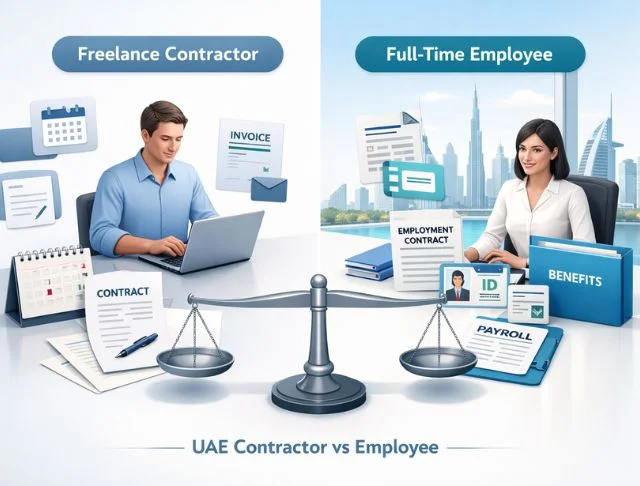
When a foreign employer decides to hire talent in the UAE, a question pops up: Should you hire an employee or work with an independent contractor? While you can access skilled professionals using both options, they have different impacts on your company.
If the wrong hiring model is selected, your company can face unnecessary expenses, operational challenges, or even worker misclassification issues.
This guide explains the differences between employees and independent contractors in the UAE from an employer’s perspective. You’ll also learn which hiring model to use if you choose to hire employees, such as direct hiring or an Employer of Record.
Author
Co-author
Get in Touch with Us

Leah Maglalang
Business Coordinator UAE


You should understand the legal distinction between an employee and an independent contractor before hiring. An employee works under an employment contract and is subject to the employer’s direction and supervision. On the other hand, an independent contractor provides services under a commercial or service agreement rather than an employment contract.
Yes, an independent contractor can work only for one client, but they have the legal right to work with multiple clients. However, if the contractor:
the relationship may resemble employment and put you at legal risk.
Unlike employees, independent contractors are not entitled to statutory employment benefits under UAE law. They don’t automatically receive paid annual leave, public holiday pay, sick leave, maternity or paternity leave, or end-of-service gratuity. However, if both parties agree, these benefits may be included in the agreement.
In many cases, yes. A foreign company does not need to have a local entity to work with a contractor. For example, a UK software company hires a UAE-based freelance UX designer for a three-month project.
However, the contractor themselves is generally required to hold a valid UAE freelance permit or trade licence (issued by authorities such as DDA, IFZA, or SHAMS) to legally provide services and invoice clients. Working with an unlicensed contractor can create compliance risk for both parties, even if your company has no UAE entity.

Choosing between an employee and an independent contractor affects your company’s hiring budget. It also influences the control you have over workers, your legal responsibilities, and the long-term success of your workforce. The table below explains these differences in detail to help guide you in selecting the right model.
Factor | Employee | Independent Contractor | Why Employers Care |
Working Relationship | Hired under an employment contract to perform ongoing work for the business. | Engaged under a service agreement to complete specific projects or provide professional services. | Determines whether you need a long-term team member or short-term expertise. |
Control Over Work | The employer decides working hours, location, reporting structure, and daily responsibilities. | The contractor decides how, when, and where to complete the agreed work. | The more control you exercise, the greater the risk that the contractor may be viewed as an employee. |
Project Duration | Usually hired for permanent or long-term positions. | Typically engaged for fixed-term projects or defined deliverables. | Helps employers choose the most cost-effective hiring model based on business needs. |
Payroll and Payment | Paid through payroll at regular intervals, such as monthly salaries. | Paid according to invoices, milestones, or completed deliverables. | Different payment methods require different administrative processes and contractual arrangements. |
Employment Benefits | Eligible for statutory benefits such as annual leave, sick leave, and end-of-service benefits where applicable. | Benefits are not mandatory and only apply if agreed in the service contract. | Mandatory benefits increase the total employment cost and should be considered during budgeting. |
Work Permits and Visas | Employers are generally responsible for obtaining work permits and sponsoring employment where required. | Contractors are typically responsible for maintaining their own legal authorization to provide services. | Visa responsibilities affect compliance, hiring timelines, and administrative workload. |
Equipment and Resources | Employers commonly provide laptops, software, office space, and business tools. | Contractors usually use their own equipment unless otherwise agreed. | Providing extensive company resources may strengthen the appearance of an employment relationship. |
Exclusivity | Employees usually work exclusively for one employer. | Contractors may work for multiple clients simultaneously unless restricted by contract. | Businesses seeking full-time commitment often prefer employees over contractors. |
Business Integration | Employees become part of the company’s organizational structure and daily operations. | Contractors remain external service providers focused on delivering agreed outcomes. | Highly integrated roles are generally better suited to employment rather than contracting. |
Termination | Employment ends according to the employment contract and applicable labour requirements. | The service agreement usually specifies when and how either party can terminate the relationship. |

Stronger Retention and Team Stability: Employees are more committed to the company’s long-term success as they become part of the organization.
Greater Control Over Daily Operations: Employers can define working hours, assign priorities, establish internal policies, and directly supervise employees.
Better Collaboration and Company Culture: Employees participate in meetings, training, performance reviews, and strategic planning. All of this makes them an integral part of the business.
Higher Employment Costs: Employers may need to budget for statutory benefits, payroll administration, visa sponsorship, insurance, recruitment, onboarding, and training. The cost of registering a legal entity is additional.
More Administrative Responsibilities: As an employer, you are responsible for employment contracts, payroll processing, compliance, leave management, and maintaining employment records.
Reduced Workforce Flexibility: Permanent employees are better suited for ongoing work than short-term projects. This means businesses with seasonal demand or uncertain growth may struggle.
Lower Overall Hiring Costs: Employers pay contractors for completing the work or agreed-upon milestones. So, they can control labor costs.
Access to Specialized Expertise: Contractors often possess niche skills developed through working with multiple businesses and industries.
Faster Hiring: Hiring a contractor takes significantly less time than recruiting a permanent employee.
Less Control Over Daily Work: Independent contractors determine how they perform their work, but they deliver the agreed-upon results.
Lower Long-Term Commitment: Once a project is complete, contractors may move on to other clients. However, they are a good option for ongoing projects like marketing.
Potential Worker Misclassification Risks: Employers may treat contractors as employees and face legal and compliance issues.

Worker misclassification occurs when a business labels someone as an independent contractor, but the actual working relationship resembles that of an employee.
In the UAE, the title in the contract is less important than how the worker performs their work on a day-to-day basis. One of the biggest warning signs is employer control. Ask yourself these questions:
If the answer is yes, the law may treat the relationship as employment rather than an independent contractor arrangement.
For example, a foreign technology company hires a software developer as an “independent contractor.” The developer works Monday to Friday from 9:00 a.m. to 6:00 p.m., reports to the engineering manager every morning, uses a company laptop and email address, and is not allowed to work for other clients. Despite the agreement calling the developer an independent contractor, the actual relationship is employment.
If misclassification occurs, employers may need to reclassify the relationship, backdate the worker’s statutory entitlements (such as annual leave and end-of-service gratuity), and face fines, rejected work permit applications, or other penalties from labour authorities. Since the UAE has no social security scheme for non-GCC nationals, back-payments typically relate to gratuity and leave rather than social security contributions.

An employee is usually the better option when the role requires long-term commitment, close collaboration, and ongoing management.
You should hire an employee if you:
✓ Need someone for a full-time, long-term position
✓ Require fixed working hours and daily supervision
✓ Want the individual integrated into your team and company culture
✓ Need to protect confidential business information through a long-term employment relationship
✓ Are building or expanding your local workforce in the UAE
✓ Expect the role to continue beyond a single project
Example: A company opening a UAE office needs a sales manager. It wants to build customer relationships, attend weekly meetings, and manage a local team. Since the role requires continuous involvement and direct supervision, hiring an employee is the most appropriate choice.
An independent contractor is often the better choice for project-based work or when specialized expertise is required for a limited period.
You should hire an independent contractor if you:
✓ Need support for a short-term project
✓ Require highly specialized skills that your team does not have
✓ Experience seasonal or fluctuating workloads
✓ Want greater flexibility in managing hiring costs
✓ Care more about the final deliverable than the worker’s daily schedule
✓ Do not need to supervise the work closely
Example: A manufacturing company hires a cybersecurity consultant to conduct a six-week security audit. The consultant works independently, delivers a final report, and leaves once the project is complete. In this case, an independent contractor is a practical and cost-effective solution.

Many employers think that independent contractors and Employers of Record are competing hiring models. In reality, they solve different business problems.
You have learned when an independent contractor is the ideal choice. However, an Employer of Record (EOR) enables you to hire a legal employee in the UAE without establishing your own local entity. The EOR becomes the worker’s legal employer, handling payroll, employment contracts, statutory benefits, and compliance, while you manage the employee’s day-to-day work.
Business Situation | Hiring an Independent Contractor | Hiring Through an Employer of Record |
Hiring one full-time salesperson in Dubai | May create misclassification risks if you control working hours and daily activities. | Employ the salesperson legally without establishing a UAE company. |
Six-week website redesign | Ideal for project-based work with defined deliverables. | Usually unnecessary because the work is temporary. |
Expanding into the UAE market | Contractors can validate the market but may not suit permanent business functions. | Build a compliant local team while testing the market without incorporating a legal entity. |
Building a long-term customer support team | Contractors may not provide the stability and integration required. | Hire dedicated employees who become part of your business while the EOR manages employment compliance. |
A UK startup wants to hire one salesperson in Dubai but does not have a UAE entity.
The salesperson works Monday to Friday, attends daily sales meetings, follows company policies, and reports to the sales director.
Potential Challenge: The company treats the contractor like a full-time employee. This increases the risk of worker misclassification.
The salesperson is legally employed through an EOR. The startup directs the employee’s daily work, while the EOR manages payroll, employment contracts, statutory benefits, and local compliance.
Benefit: The company hires a full-time employee without opening a UAE legal entity.
A manufacturing company needs a cybersecurity expert for a six-week security assessment.
In this case, an independent contractor is usually the better choice because the work is project-based, requires specialized expertise, and ends once the final report is delivered. Using an EOR would generally add unnecessary employment administration for a short-term engagement.

Whether you’re hiring one employee or an entire team, you may face many challenges in the UAE, especially if you don’t have a local entity. Here’s how FMC Group can remove those hiring barriers:
Employer Challenge | How FMC Group Helps |
No legal entity in the UAE | Employs your workers through its compliant local entity, allowing you to hire without establishing a company. |
Complex UAE employment regulations | Prepares compliant employment contracts and helps ensure employment practices align with local labour requirements. |
Payroll administration | Processes payroll accurately and on time while managing statutory employment obligations. |
Work permits and visas | Supports work permit, residence visa, and onboarding processes where required. |
HR administration | Manages employment documentation, employee records, and day-to-day HR administration. |
Compliance risks | Monitors changes in employment regulations to help reduce compliance risks. |
Expanding into a new market | Enables you to test the UAE market quickly without the cost and time required to incorporate a local business. |
You are currently viewing a placeholder content from Calendly. To access the actual content, click the button below. Please note that doing so will share data with third-party providers.
More InformationYou are currently viewing a placeholder content from Calendly. To access the actual content, click the button below. Please note that doing so will share data with third-party providers.
More InformationYou need to load content from reCAPTCHA to submit the form. Please note that doing so will share data with third-party providers.
More InformationYou are currently viewing a placeholder content from Turnstile. To access the actual content, click the button below. Please note that doing so will share data with third-party providers.
More InformationYou are currently viewing a placeholder content from Vimeo. To access the actual content, click the button below. Please note that doing so will share data with third-party providers.
More InformationYou need to load content from reCAPTCHA to submit the form. Please note that doing so will share data with third-party providers.
More Information