
Today, we are specifically going to discuss the comparison between using an Employer of Record service and registering a German subsidiary for your hiring needs.
Germany doesn’t require employers to register any kind of subsidiary to hire employees, unlike many other countries. So, is an EOR worth partnering with? Because the core benefit of these services is removing the need to register a company.
The detailed answer lies in this blog post. We will understand all the major hiring options in Germany and the detailed differences between hiring with an EOR and hiring through your own legal entity, covering time, effort, costs, and more.
Without further delay, let’s start comparing an EOR vs. opening a German subsidiary.

Author
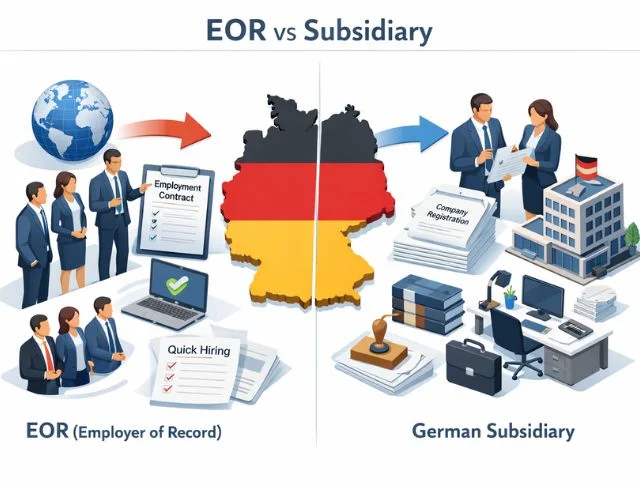
Today, we are specifically going to discuss the comparison between using an Employer of Record service and registering a German subsidiary for your hiring needs.
Germany doesn’t require employers to register any kind of subsidiary to hire employees, unlike many other countries. So, is an EOR worth partnering with? Because the core benefit of these services is removing the need to register a company.
The detailed answer lies in this blog post. We will understand all the major hiring options in Germany and the detailed differences between hiring with an EOR and hiring through your own legal entity, covering time, effort, costs, and more.
Without further delay, let’s start comparing an EOR vs. opening a German subsidiary.
Author
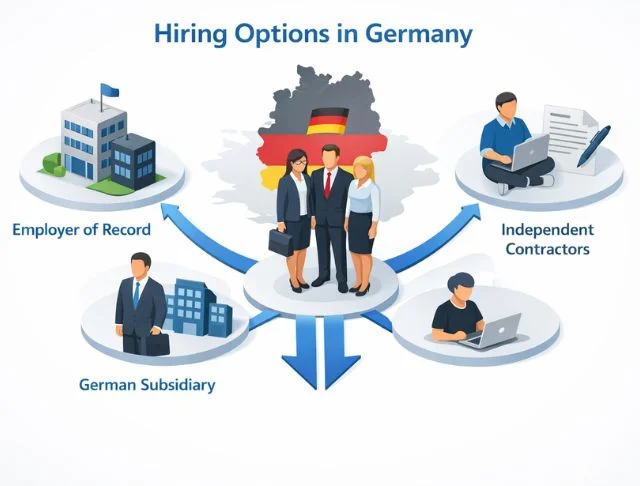
Unlike many countries such as Türkiye and the UAE, Germany does NOT require employers to establish a legal entity before hiring employees. This gives foreign employers three reliable ways to hire employees. Each comes with different levels of administrative responsibility, compliance risk, and long-term commitment.
When foreign employers hire employees in Germany without having a local entity, they must register them with the relevant German authorities. These include payroll, wage tax, and social security authorities. This option offers greater control but also places the full compliance burden on the employer.
An Employer of Record hires employees on your behalf while you retain day-to-day management of their work. The EOR acts as the legal employer. It handles employment contracts, payroll, tax withholding, social security registration, statutory benefits, HR administration, and compliance with German employment laws. Using an EOR, you can hire quickly without establishing a legal presence or building local HR infrastructure.
Opening a German subsidiary creates a permanent legal entity. This option provides full operational independence and supports long-term business expansion. However, it requires company registration, ongoing corporate administration, accounting, tax filings, payroll management, and compliance with both corporate and employment regulations. This option is best suited for businesses planning a substantial, long-term presence in Germany.

If you’re deciding between using an Employer of Record (EOR) and opening a German subsidiary, the right choice depends on several factors. These could include your hiring timeline, budget, compliance capabilities, and long-term business goals.
Factor | Employer of Record (EOR) | German Subsidiary |
Definition | A third-party organization legally employs workers on your behalf while you manage their day-to-day work. | A locally registered company that directly employs workers and conducts business in Germany. |
Best For | Testing the German market, hiring quickly, or employing a small team. | Companies planning a long-term presence and significant business operations in Germany. |
Legal Employer | Employer of Record | Your German subsidiary |
Setup Time | Days to a few weeks | Several weeks to several months |
Initial Investment | Low | High |
Compliance Responsibility | Primarily handled by the EOR | Fully managed by your company |
Long-Term Scalability | Ideal for early-stage expansion; can later transition to your own entity. | Best suited for long-term growth and large-scale operations. |

One of the biggest differences between an Employer of Record (EOR) and a German subsidiary is who the legal employer is. The table below compares the legal structure of each option.
Legal Aspect | Employer of Record (EOR) | German Subsidiary |
Legal Employer | The EOR is the legal employer and assumes employer obligations. | Your German subsidiary is the legal employer. |
Corporate Registration | No company registration in Germany is required. | A German company must be incorporated and registered before hiring employees. |
Employment Contracts | The EOR signs compliant employment contracts with employees. | Your subsidiary signs employment contracts directly with employees. |
Employer Liability | The EOR assumes most employer-related compliance responsibilities, while you manage employees’ daily work. | Your company is fully responsible for employment law compliance, payroll, taxes, and statutory obligations. |
Local Legal Entity Requirement | Not required. | Required before operating as a local employer. |

The time and effort required to start hiring in Germany vary significantly between these two options. The table below compares the setup process from the perspective of time and effort for each option.
Setup Step | Employer of Record (EOR) | German Subsidiary |
Company Registration | Not required | Required before employing staff |
German Business Bank Account | Not required | Required for business operations and payroll |
Tax Registration | Handled by the EOR | Your subsidiary must register with the German tax authorities |
Payroll Setup | Managed by the EOR | Your company must establish and administer a compliant payroll system |
Employee Onboarding | The EOR prepares employment contracts, completes registrations, and onboards employees | Your HR team manages contracts, registrations, and onboarding |
Average Implementation Time | Typically a few days to a few weeks | Typically several weeks to several months, depending on the incorporation process |

Here’s a practical cost comparison for hiring in Germany: an EOR is usually cheaper up front and simpler to manage. A German subsidiary has much higher setup and ongoing compliance costs but becomes more economical as your headcount grows.
Cost item | EOR in Germany | German subsidiary (typically GmbH) |
Initial setup costs | Usually €0 setup; some providers charge onboarding only, with monthly fees starting around €175–€599 per employee. | Typically about €3,000–€5,000 to incorporate a standard GmbH, excluding share capital; broader ranges of €330–€5,000+ appear depending on structure and complexity. |
Monthly operating costs | EOR service fee is commonly €175–€599 per employee per month, plus employer social contributions of about 20–23% of gross salary. | Ongoing costs often include bookkeeping, tax filing, registered office, payroll, and compliance; a realistic range is about €1,200–€6,000+ annually for accounting/tax compliance, plus payroll and other admin costs. |
Payroll administration | Usually included in the EOR fee: payroll processing, withholding, social insurance registration, leave tracking, and offboarding. | Must be handled in-house or by a provider; you need local payroll setup, monthly filings, social insurance reporting, and wage tax administration. |
Accounting | Usually bundled into the service, so you do not need a German in-house finance function for the employee. | Requires local bookkeeping, annual financial statements, and tax returns; accounting is one of the biggest recurring entity costs. |
Legal compliance | EOR assumes day-to-day employer compliance, including contracts, payroll, and labor-law administration. | You carry the compliance burden: employment law, tax, corporate filings, and ongoing statutory obligations. |
Government fees | Usually none beyond normal employment taxes and contributions; the EOR handles registrations. | Commercial register and trade office fees apply; incorporation-related official charges are commonly around €165–€250, plus notary and filing costs. |
Hidden costs | Lower, but can include extra fees for visas, equipment, benefits, or non-standard admin. | Higher risk of hidden costs: legal advice, translations, address service, audit or advisory fees, penalties for late filings, and extra payroll/compliance tools. |

Managing employees in Germany involves many responsibilities. Employers must administer payroll, withhold taxes, register employees for social security, maintain employment records, manage statutory leave, and fulfill ongoing reporting obligations. The table below compares how employers and EORs handle HR and administrative responsibilities.
HR & Administrative Responsibility | Employer of Record (EOR) | German Subsidiary |
Payroll Administration | Managed by the EOR | Managed by your company’s HR or payroll team |
Wage Tax Withholding | Calculated, withheld, and remitted by the EOR | Your subsidiary is responsible for withholding and remitting taxes |
Social Security Administration | Employee registration, contribution calculations, and payments handled by the EOR | Your subsidiary registers employees and manages social security contributions |
Employment Contracts | Drafted and signed by the EOR in compliance with German labor law | Drafted and signed by your subsidiary |
Leave Management | The EOR administers statutory leave, sick leave, and other employee absences | Your company manages employee leave in accordance with German law |
Employee Records | Maintained and updated by the EOR | Your company maintains legally required personnel records |
Reporting Obligations | The EOR submits required payroll and employment reports to relevant authorities | Your subsidiary is responsible for all mandatory payroll and employment reporting |

Germany has one of Europe’s most regulated employment environments. This means stricter but well-structured rules and regulations. If you fail to meet these obligations, it can result in financial penalties, legal disputes, and government enforcement actions. The table below compares how compliance responsibilities and legal risks differ between an Employer of Record and a German subsidiary.
Compliance Area | Employer of Record (EOR) | German Subsidiary |
Labor Law Compliance | The EOR ensures employment contracts and HR practices comply with German labor laws. | Your company is fully responsible for complying with German employment regulations. |
Payroll Compliance | Payroll calculations, statutory deductions, and salary payments are managed by the EOR. | Your subsidiary must operate a compliant payroll system and meet all payroll obligations. |
Tax Compliance | The EOR withholds and remits wage taxes in accordance with German tax regulations. | Your subsidiary is responsible for payroll tax registration, withholding, reporting, and payments. |
Employee Disputes | The EOR supports compliant employment practices and assists with employment-related issues as the legal employer. | Your company manages employee disputes and bears the associated legal responsibilities. |
Government Inspections | The EOR maintains employment records and supports compliance during labor or payroll inspections. | Your subsidiary must maintain documentation and respond directly to inspections by German authorities. |
Risk of Penalties | Lower, as the EOR manages ongoing employment compliance and administrative obligations. | Higher if your company fails to meet German employment, payroll, or tax requirements. |
As your business grows, your hiring strategy can adapt to changing workforce needs and expansion plans. While both an EOR and a German subsidiary offer flexibility and scalability, the level of each differs. The table below compares how each option performs as your business scales.
Business Need | Employer of Record (EOR) | German Subsidiary |
Hiring One Employee | Ideal for hiring a single employee quickly without establishing a local entity. | Generally less cost-effective due to the time and expense of setting up and maintaining a subsidiary. |
Hiring Multiple Employees | Well-suited for building small to medium-sized teams with minimal administrative effort. | Suitable for businesses planning larger teams and long-term local operations. |
Entering New Markets | Easily expand into Germany and other countries through the EOR’s existing global infrastructure. | A new legal entity typically needs to be established in each country where you expand. |
Downsizing | Workforce reductions are managed by the EOR in compliance with local employment laws. | Your company is responsible for managing restructuring, redundancies, and termination compliance. |
Exiting Germany | Relatively simple, as there is no local entity to wind up. | More complex, requiring the closure or liquidation of the subsidiary and completion of all legal, tax, and corporate obligations. |
An EOR shifts most German payroll and employment compliance responsibilities to the provider. On the other hand, a subsidiary makes your company directly responsible for German tax, payroll, and accounting obligations.
Responsibility | EOR in Germany | German subsidiary (typically GmbH) |
Corporate tax filing | The EOR usually handles the employer-side employment administration, but the client company generally does not file German corporate tax returns just for the hired employee. | The GmbH must file corporate income tax, trade tax, and related annual tax returns in Germany. |
Payroll tax | Usually handled by the EOR, including wage tax withholding, social security reporting, and payroll remittances. | The subsidiary must run payroll locally and withhold/remit wage tax and social contributions. |
VAT obligations | Usually none for the hiring arrangement itself, unless the foreign company has a separate taxable German business presence. | A GmbH may have VAT registration and recurring VAT return obligations if it makes taxable supplies. |
Annual financial statements | Not usually required for the EOR customer as the legal employer is the EOR entity. | The GmbH must prepare annual financial statements and, in many cases, publish them. |
External accounting requirements | Minimal for the client company; accounting is generally embedded in the EOR service. | A GmbH normally needs professional bookkeeping and often a Steuerberater or external accounting support. |
The best hiring model depends on your business objectives, growth strategy, budget, and long-term plans in Germany. An Employer of Record is the better option for companies seeking speed and flexibility. Opening a German subsidiary is also a useful option, but it is better suited for businesses establishing a permanent presence and managing operations directly.
When to Choose an Employer of Record (EOR) | When to Choose a German Subsidiary |
You want to hire employees quickly without establishing a legal entity. | You plan to build a long-term business presence in Germany. |
You’re testing the German market before making a larger investment. | You intend to establish a local office or conduct ongoing business operations. |
You only need to hire one or a small number of employees. | You expect to build a large workforce over time. |
You want to outsource payroll, HR administration, and compliance responsibilities. | You have the resources to manage payroll, HR, tax, and compliance internally. |
You want to minimize setup costs and administrative burden. | You’re prepared to invest in company formation and ongoing corporate administration. |
You need the flexibility to scale your workforce up or down quickly. | You want full control over employment, HR policies, and business operations. |
You want to enter the German market with minimal legal and compliance risk. | Your long-term strategy requires a permanent legal and operational presence in Germany. |
You may establish your own German entity later as your business grows. | You have already validated the market and are committed to long-term expansion. |

If you want to scale your business in Germany by hiring employees, you don’t need to spend time and money establishing a local subsidiary. This is because FMC Group enables you to hire employees quickly while remaining compliant with local labor laws.
When you partner with FMC Group, you continue managing your employees’ day-to-day responsibilities. On the other hand, our experts assume the legal employer obligations and handle the administrative workload.
At FMC Group, we have been managing the following for our clients for 15 years:
So, whether you want to hire your first employee in Germany or build a local team, you can book a free 30-minute consultation with us at any time.
You are currently viewing a placeholder content from Calendly. To access the actual content, click the button below. Please note that doing so will share data with third-party providers.
More InformationYou are currently viewing a placeholder content from Calendly. To access the actual content, click the button below. Please note that doing so will share data with third-party providers.
More InformationYou need to load content from reCAPTCHA to submit the form. Please note that doing so will share data with third-party providers.
More InformationYou are currently viewing a placeholder content from Turnstile. To access the actual content, click the button below. Please note that doing so will share data with third-party providers.
More InformationYou are currently viewing a placeholder content from Vimeo. To access the actual content, click the button below. Please note that doing so will share data with third-party providers.
More InformationYou need to load content from reCAPTCHA to submit the form. Please note that doing so will share data with third-party providers.
More InformationYou are currently viewing a placeholder content from reCAPTCHA. To access the actual content, click the button below. Please note that doing so will share data with third-party providers.
More Information

