
2026 has brought the biggest changes in UAE labor law since the introduction of Federal Decree-Law No. 33 of 2021. Now, employers face greater compliance risks due to new payroll deadlines, stricter Wage Protection System (WPS) rules, higher Emiratisation obligations, and tougher enforcement.
Missing even a single update can lead to delayed work permits, financial penalties, and labor disputes. For employers hiring directly in the UAE, staying updated is no longer an option.
This guide explains every major UAE labor law change in 2026, what each update means for employers, and the practical steps you should take to remain compliant. Let’s get into it.

Author

Co-author
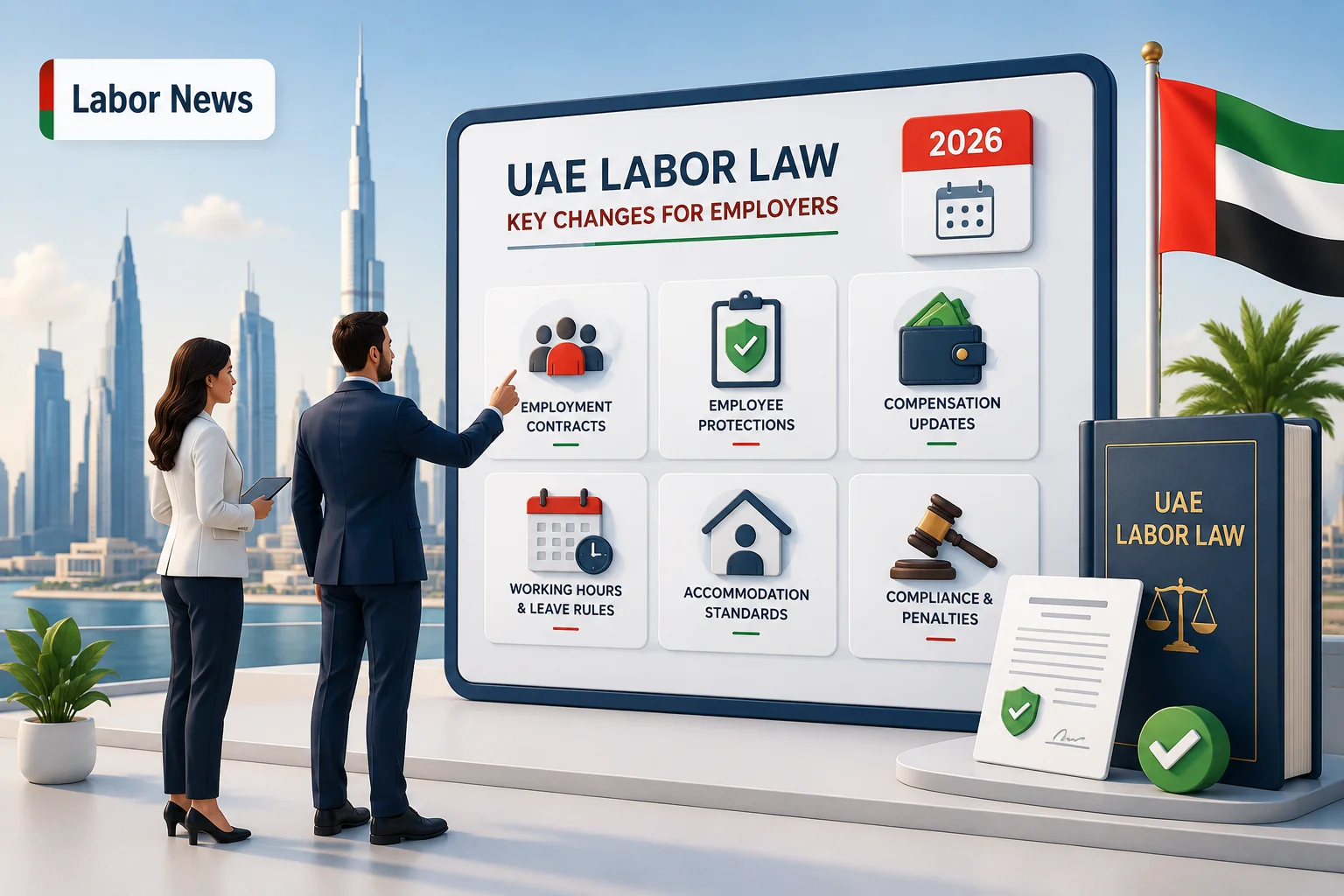
2026 has brought the biggest changes in UAE labor law since the introduction of Federal Decree-Law No. 33 of 2021. Now, employers face greater compliance risks due to new payroll deadlines, stricter Wage Protection System (WPS) rules, higher Emiratisation obligations, and tougher enforcement.
Missing even a single update can lead to delayed work permits, financial penalties, and labor disputes. For employers hiring directly in the UAE, staying updated is no longer an option.
This guide explains every major UAE labor law change in 2026, what each update means for employers, and the practical steps you should take to remain compliant. Let’s get into it.
Author
Co-author
Get in Touch with Us

Leah Maglalang
Business Coordinator UAE

Area | What Changed | Effective Date |
Wage Protection System | Ministerial Resolution No. 340 of 2026 repealed the 2022 WPS framework, tightening timing and enforcement escalation | 1 June 2026 |
Salary Payment Deadline | Wages now due on the 1st of the following month, with no 15-day grace period | 1 June 2026 |
WPS Compliance | Threshold raised from 80% to 85% of wages paid on time to count as compliant | 1 June 2026 |
Emirati Minimum Wage | New/renewed work permits for UAE nationals must reflect at least AED 6,000/month | 1 Jan 2026 |
Emiratisation | Quotas rising toward 10% for large firms; monthly fine per unfilled slot up to AED 9,000 (AED 108,000/year) | 2026 |
Labor Accommodation | Ministerial Resolution No. 122 of 2026 set new standards (security, cleaning, medical facilities for large complexes | 18 Feb 2026 |
ILOE (Unemployment Insurance) | Automated cross-checks against work-permit data now catch non-subscription quickly; unresolved liabilities can delay permits/visas | 2026 |
Court Decisions | Rulings reinforced that employers must prove wage payment and formal termination via documentation, or face full back-pay/gratuity awards | 2026 |

UAE has introduced a new Wage Protection System (WPS) under Ministerial Resolution No. 340 of 2026. It was issued by the Ministry of Human Resources and Emiratisation (MOHRE) on 12 May 2026 and became effective on 1 June 2026.
This updated rule applies to every MOHRE-registered private-sector establishment, regardless of headcount. It aims to strengthen the employment process. Failure to meet the new requirements means legal risks for employers.
Ministerial Resolution No. 340 of 2026 introduced several major changes to the Wage Protection System, including:
Beginning 1 June 2026, employers must pay wages for the previous Gregorian month on the first day of the following month. The 15-day grace period before salaries were considered overdue has been removed.
An employer is considered compliant only if at least 85% of the total wages due are transferred by the salary deadline, an increase from the previous 80% threshold.
The previous WPS framework allowed employers a 30-day grace period before newly hired employees became subject to WPS reporting requirements. Under Ministerial Resolution No. 340 of 2026, that exemption has been removed. Now, employers have to comply with WPS requirements from an employee’s very first salary cycle.
Timeline | Enforcement Action |
Salary Due Date | Electronic monitoring begins immediately once wages become due. |
Day 2 | MOHRE issues notifications and warnings to the employer. |
Day 5 | MOHRE may suspend the issuance of new work permits. |
Day 11 | Repeat violations within six months may trigger administrative fines and possible reclassification to MOHRE’s Third Category. |
Day 16 | Automatic labor dispute registration and work permit suspension apply to any non-compliant establishment with 25 or more employees; for construction, transport, security, cleaning, and recruitment-agency employers, the 25-employee count is aggregated across commonly owned establishments. |
Day 21 | Employers may face precautionary asset attachment, travel bans, and referral to the Public Prosecutor. |
Ministerial Resolution No. 340 of 2026 provides limited exemptions from standard WPS obligations for:
This rule became effective on 1 January 2026 and states that new or renewed work permits for Emirati nationals in the private sector must provide a minimum monthly salary of AED 6,000.
Employers with existing Emirati employees hired before 2026 had until 30 June 2026 to increase salaries to the new minimum.
The new salary requirement also supports the UAE’s Emiratisation program, as only compliant Emirati employees count toward an employer’s required Emiratisation quotas.

The UAE has further strengthened its Emiratisation program in 2026.
New quota requirements: Companies with 50 or more employees in 14 strategic sectors must continue increasing Emiratisation by approximately 2% annually, reaching 10% by 31 December 2026 for firms that achieved 8% by the end of 2025. Companies with 20–49 employees in the 14 designated sectors must have hired one UAE national by the end of 2024 and a second by the end of 2025; in 2026, these companies must maintain both hires to remain compliant.
Higher penalties: The monthly financial contribution for each unfilled Emirati position increased to AED 9,000 per month in 2026, or AED 108,000 per year. Note that, some legal trackers cite a further rise to AED 10,000 per month later in 2026 , employers should confirm the current rate directly with MOHRE or Nafis before budgeting.
AI monitoring: MOHRE now uses AI-assisted monitoring to identify potential non-compliance and suspicious Emiratisation practices.
Fake Emiratisation enforcement: Authorities have intensified enforcement against fictitious Emiratisation. Dubai courts prosecute fake hiring schemes as criminal fraud.
Ministerial Resolution No. 122 of 2026, effective 18 February 2026, introduced updated labor accommodation standards for private-sector employers with 50 or more workers earning AED 1,500 or less per month.
The new requirements include 24/7 security with CCTV and professional cleaning contracts. For accommodation complexes housing 1,000 or more workers, a 24-hour medical clinic, on-site medical staff, first-aid and isolation rooms, recreational facilities, and remittance services are required.

Employers must know several important employment rule updates. They affect contracts, leave entitlements, termination, and workplace protections.
Fixed-term contracts only: Unlimited contracts have been fully abolished. All private-sector employment must now use fixed-term contracts, typically for up to three years, and they are renewable.
Five official contract types: MOHRE recognizes full-time, part-time, temporary, flexible, and remote work contracts.
Maternity leave: Eligible employees are entitled to 60 days of maternity leave, with 45 days at full pay followed by 15 days at half pay.
Annual leave: Annual leave now accrues from the first day of employment and may be carried forward or encashed by mutual agreement.
Maximum 90-day notice period: Employment contracts cannot require a notice period exceeding 90 days. Any longer contractual notice period is unenforceable beyond 90 days.
Whistleblower protection: Employees who file legitimate complaints with MOHRE are protected from retaliatory dismissal.
Immediate termination rules: Employers may dismiss an employee without notice for specific misconduct, including workplace assault, disclosure of confidential information, intoxication at work, criminal conviction, repeated violations after a written warning, or unexplained absence for seven consecutive or 20 non-consecutive days in a year.
The Involuntary Loss of Employment (ILOE) insurance scheme remains mandatory for private- and federal-sector employees. In 2026, MOHRE will have an automated cross-check system that checks work permit databases and identifies employees without ILOE. Employers should be aware of the following:
Mandatory enrollment: Eligible employees must remain enrolled in the ILOE scheme.
Stricter enforcement: Automated checks can detect non-subscription within weeks.
Penalties: Non-subscription results in an AED 400 fine, while missing premium payments for three consecutive months leads to policy cancellation and an additional AED 200 fine.
Impact on permits: Outstanding ILOE liabilities can delay new work permits, visa renewals, and labor card transfers for the sponsoring employer.

Several visa and work permit changes in 2026 have a direct impact on employer sponsorship and hiring processes.
WPS now affects permit approvals: MOHRE now checks WPS compliance in real time when processing employment visa applications.
In-country status change: Visit visa and job-seeker visa holders who secure employment can now change to an employment residence visa without leaving the UAE by using a 60-day entry permit to complete medical examinations, biometrics, and Emirates ID processing.
Golden Visa updates: In April 2026, the UAE further expanded Golden Visa eligibility to include AI and data specialists, climate-tech founders, long-serving nurses, and educators, alongside e-sports professionals and content creators, who had already qualified since 2024. In February 2026, the UAE also removed the previous requirement to pay 50% of a property’s value upfront, meaning mortgaged and off-plan properties now qualify as long as the total registered value reaches AED 2 million.
Several UAE court rulings in 2026 reinforced that employers must maintain proper employment records and follow formal legal procedures.
UAE courts confirmed that employers must be able to prove salary payments through reliable documentation, particularly WPS records.
The Abu Dhabi Court of Cassation reinforced that stopping salary payments alone does not end an employment relationship. Employers must issue formal termination documentation.
The Abu Dhabi Court of Cassation confirmed that employees can file claims for their rights within two years of termination.
This doesn’t look like a major change, but the 2026 rulings consistently demonstrate that UAE labor courts place significant weight on documented evidence. Employers must maintain accurate WPS records, written employment agreements, and formal termination documents.
Federal Decree-Law No. 9 of 2024 amended Articles 54 and 60. MOHRE can now issue binding decisions for employment disputes involving claims of AED 50,000 or less.
If MOHRE cannot resolve a dispute within 14 working days, the case is automatically referred to the labor court. The court must schedule a hearing within three working days and issue a judgment within 30 days.
Note that, during an unresolved dispute, MOHRE may also require the employer to continue paying the employee’s salary for up to two months.

Several major changes in UAE labor laws took place in 2026, but employers must continue to monitor upcoming changes for compliance.
End-of-Service Benefits (EOSB) Scheme: MOHRE has completed a public consultation on expanding the voluntary Alternative End-of-Service Benefits Savings Scheme. Although legal commentators suggest a phased mandatory rollout may be considered, MOHRE has not confirmed any change, so employers should monitor official announcements.
Future Emiratisation quotas: Emiratisation targets for companies with 50 or more employees are expected to continue increasing beyond the 10% target by 31 December 2026. Additional requirements are likely to be introduced in 2027.
Further WPS updates: MOHRE has stated that enforcement of Ministerial Resolution No. 340 of 2026 will follow a gradual approach.
Visa quota reviews: Employer visa quota allocations are now reviewed twice a year instead of annually.
The growing number of labor law changes in 2026 has made compliance more complex for foreign employers in the UAE. An EOR like FMC Group not only works as your legal employer, but it also removes the need for a local entity and takes full responsibility for legal compliance. An EOR can help businesses stay compliant by handling:
For companies expanding into the UAE without establishing a local entity, an Employer of Record can reduce the administrative burden, lower compliance risk, and help ensure employment practices remain aligned with the latest UAE labor law requirements. To learn whether an EOR is the right fit for your business, schedule a free 30-minute consultation call with FMC Group.
You are currently viewing a placeholder content from Calendly. To access the actual content, click the button below. Please note that doing so will share data with third-party providers.
More InformationYou are currently viewing a placeholder content from Calendly. To access the actual content, click the button below. Please note that doing so will share data with third-party providers.
More InformationYou need to load content from reCAPTCHA to submit the form. Please note that doing so will share data with third-party providers.
More InformationYou are currently viewing a placeholder content from Turnstile. To access the actual content, click the button below. Please note that doing so will share data with third-party providers.
More InformationYou are currently viewing a placeholder content from Vimeo. To access the actual content, click the button below. Please note that doing so will share data with third-party providers.
More InformationYou need to load content from reCAPTCHA to submit the form. Please note that doing so will share data with third-party providers.
More InformationYou are currently viewing a placeholder content from reCAPTCHA. To access the actual content, click the button below. Please note that doing so will share data with third-party providers.
More Information