
This guide is to give you a deep understanding of EOR services without any fluff or overly detailed explanations.
In fact, after reading this blog, you’ll be able to select the right EOR service provider or work confidently as an employee.
I am going to cover EOR basics, working model, legal compliances, EOR alternatives, top EOR service providers, and much more.
Let’s dive deep…

Author

Co-author

This guide is to give you a deep understanding of EOR services without any fluff or overly detailed explanations.
In fact, after reading this blog, you’ll be able to select the right EOR service provider or work confidently as an employee.
I am going to cover EOR basics, working model, legal compliances, EOR alternatives, top EOR service providers, and much more.
Let’s dive deep…
Author
Co-author
Get in Touch with Us

Leah Maglalang
Business Coordinator UAE

This section is designed to explain EOR with a definition, examples, as well as pros and cons:
An Employer of Record (EOR) is a third-party ORGANIZATION that legally employs workers on your behalf in a specific country.
In this case, the EOR becomes the official legal employer. But your company has full operational control over the employee’s daily work. That’s it.
Below are three examples with different case scenarios to get you a better idea of EOR use cases:
A US-based software company decided to hire a senior developer in Germany. Either they register a local entity or work with someone who already has one to hire on their behalf and charge a service fee.
So, instead of registering a German entity, the company uses an EOR like FMC Group (German-owned). That EOR legally employs the developer, manages payroll, taxes, social security, and benefits under German labor law.
The software company manages the developer’s work.
A UK company plans to expand its team in the Middle East. It wants to validate the Dubai market before establishing a permanent presence and registering a local entity.
The company hires sales and operations staff through an EOR in the target country.
That results in market entry with minimum risk.
A growing global company employs team members across several countries. Each country has its own labor laws and payroll requirements.
They have to manage multiple vendors and legal entities in this case. So, they use an EOR service to centralize employment.
That company achieves simplified global hiring with consistent compliance across regions.
Employers of Record services offer strong advantages for global hiring. At the same time, they aren’t a universal solution. Understanding both sides can help you avoid costly mistakes.
When you hire employees using an EOR service without setting up a local entity in your target country, you enjoy the following benefits, which make EOR services in demand:
EOR service also comes with some limitations when certain conditions are not met:
Employee onboarding time is significantly faster when you use an EOR than when setting up a local entity. Onboarding times vary by country, role, and documentation readiness.
Typical EOR Onboarding Timelines

You’ve understood the basics of EOR services, and in this section, we’ll go deeper with types, scope, ideal use cases, selection criteria, costs, and global coverage.
EOR providers differ in how they operate, their global reach, and the services they offer. If you understand these types, then you can easily choose the right partner:
These providers operate human-led teams and local legal entities.
They handle payroll, contracts, taxes, and compliance through personalized service, not a software interface.
This model is best for companies that want full legal support without tech dependency and prefer more customized, consultation-based service rather than automated solutions.
Examples: FMC Group, Pleb.
Combine personal service with a simple dashboard or portal to track employees and payroll.
Useful for companies that want more automation but still rely on human expertise for compliance.
Examples: Deel, Remote.
Feature | Traditional EORs | Hybrid EORs |
Service Model | Fully human-led; experts handle contracts, payroll, compliance | Human-led with partial automation; combines expert support with dashboards/portals |
Technology Use | Minimal; mostly email/phone communication | Higher; portals for payroll tracking, reporting, onboarding |
Speed of Onboarding | Medium-fast; depends on manual processes | Faster; dashboard accelerates document submission and tracking |
Compliance Accuracy | Very high; experts manage all legal and tax obligations | Medium; relies on experts, but some processes automated |
Scalability | Moderate; adding countries/employees requires more human resources | High; dashboards allow managing multiple employees and countries efficiently |
User Experience | Relies on account managers; limited self-service | Self-service for payroll, benefits, reporting |
Customization | High; contracts and processes can be fully tailored to client needs | Medium; templates and dashboard options, customization limited |
Ideal For | Companies needing hands-on support in complex regulatory environments | Companies needing balance of expert support + operational visibility |
Cost | Often higher due to manual handling | Slightly lower per employee due to automation efficiency |
Remember that when an EOR service provider is primarily a platform, they are less experienced in providing people-first service for manual issues. They push their customers to use their platform. This is not bad in many cases, but the preferable EOR service should be a people-first team.
So far, you have learned about EOR services.
But what is included in an EOR service?
The following scope defines what the EOR legally handles:
In short, the EOR handles all legal, compliance, payroll, and benefits obligations.
EOR services are best suited for companies that want to hire internationally without establishing a local legal entity. Key scenarios include:
While EORs offer flexibility, some businesses are not ideal candidates:
When choosing an EOR, evaluate based on service quality, compliance, and fit with your business needs:
Here are some common mistakes that you need to avoid when considering EOR service:
Note: If an EOR has its own local entity registered in the country or works with local partners, both options are reliable. The key point is to confirm their access and presence in the local market of that country.
You should avoid starting work with an EOR service provider if it has the following signs:
Pricing varies by provider, country, and service level. Understanding cost components helps companies budget realistically.
Percentage of Salary: 10–20% of the employee’s gross monthly salary. Common for full-service EORs.
Fixed Monthly Fee: $300–$1,500 per employee per month, depending on country and benefits.
Setup Fees: One-time onboarding charges, often $300–$1,000 per employee.
EORs differ in geographic reach, which is critical for international hiring.
These companies operate in 50 to 150+ countries. They either have their own registered local entities or use trusted partners.
These companies focus on a single country or region, e.g., Middle East, Asia Pacific. They offer deep local compliance and are good for scaling companies to a specific region.
An EOR is the legal employer of record for your employees, but your company remains responsible for operational management.
If you understand the legal framework, it will ensure compliance, risk mitigation, and smooth operations.
A standard EOR agreement includes:
You can customize the agreement based on your needs if an EOR is flexible with the terms.
An EOR takes on the legal responsibilities of being the employer. This means your company doesn’t have to worry about breaking local laws when hiring employees in another country. Key assurances include:
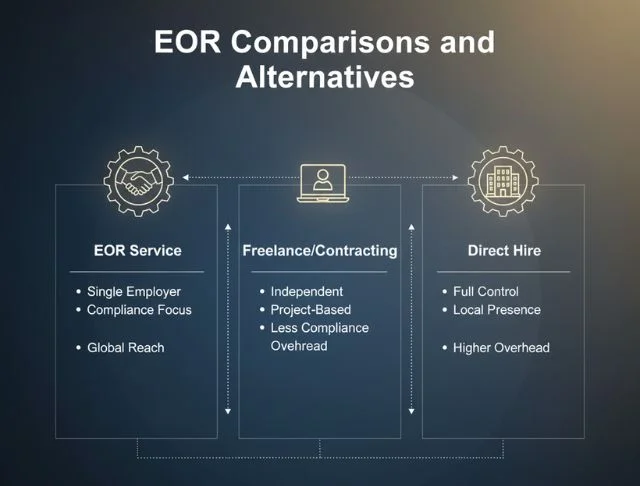
I added this section to give you an overview of EOR alternatives, or if you already have some in mind, you can use it to compare them:
If you’re debating whether to use an EOR or hire a freelancer, this table can help you reach a decision:
Feature | EOR | Freelance |
Legal Employer | Yes | No |
Payroll & Taxes | Managed | Self-managed |
Benefits | Provided | None |
Compliance Risk | Low | High |
Operational Control | Full | Limited |
Contract Length | Long-term | Project-based |
Companies expanding internationally can either hire through an EOR or become a common law employer by setting up their own local entity:
Feature | EOR | Common Law Employer |
Legal Employer | EOR | Company |
Local Entity Required | No | Yes |
Payroll & Taxes | Managed by EOR | Managed by company |
Benefits | Provided by EOR | Company-managed |
Compliance Risk | Lower | Higher |
Setup Time | Fast | Slow |
International hiring can be done through an EOR or by engaging independent contractors. The main difference is as follows:
Feature | EOR | Contractor |
Legal Employer | EOR | Contractor (self-employed) |
Employment Status | Employee | Independent contractor |
Payroll & Taxes | Managed by EOR | Self-managed or invoiced |
Benefits | Provided | Not provided |
Compliance Risk | Low | High |
Engagement Type | Long-term | Project-based |
An Employer of Record (EOR) and an Agent of Record serve different purposes. The key difference is who holds legal employer responsibility and manages compliance.
Feature | EOR | Agent of Record |
Legal Employer | EOR | Client company |
Local Entity Required | No | Yes |
Payroll & Taxes | Managed by EOR | Managed by client |
Benefits | Provided by EOR | Provided by client |
Compliance Risk | Low | Higher |
Scope of Role | Full employment management | Administrative support only |
Companies can hire internationally through an EOR or via traditional employment, but the main differences are:
Feature | EOR | Traditional Employment |
Legal Employer | EOR | Company |
Local Entity Required | No | Yes |
Payroll & Taxes | Managed by EOR | Managed by company |
Benefits | Provided by EOR | Company-managed |
Compliance Risk | Lower | Higher |
Hiring Speed | Fast | Slow |
An Employer of Record (EOR) and a Professional Employer Organization (PEO) both support employment management, but they differ in:
Feature | EOR | PEO |
Legal Employer | EOR | Co-employment |
Local Entity Required | No | Yes |
Payroll & Taxes | Managed by EOR | Shared responsibility |
Benefits | Provided by EOR | Shared |
Compliance Risk | Lower | Shared |
Primary Use | International hiring | Domestic employment |
An EOR hires employees on your behalf for long-term roles, while a staffing agency supplies temporary or contract workers.
Feature | EOR | Staffing Agency |
Legal Employer | EOR | Agency |
Worker Type | Full-time employee | Temporary or contract |
Payroll & Taxes | Managed by EOR | Managed by agency |
Benefits | Provided by EOR | Limited or agency-defined |
Compliance Risk | Lower | Moderate |
Engagement Length | Long-term | Short-term |
When hiring internationally, companies can either work with an EOR or set up their own local entity in the country.
Feature | EOR | Own Legal Entity |
Legal Employer | EOR | Company |
Entity Setup | Not required | Required |
Payroll & Taxes | Managed by EOR | Company-managed |
Benefits | Provided by EOR | Company-managed |
Compliance Risk | Lower | Higher |
Cost at Scale | Higher | Lower |
An EOR employs workers directly, while an umbrella company typically sits between the worker and client for payroll purposes.
Feature | EOR | Umbrella Company |
Legal Employer | EOR | Umbrella company |
Employment Model | Direct employment | Intermediary payroll |
Payroll & Taxes | Managed by EOR | Managed by umbrella |
Benefits | Statutory benefits | Minimal |
Compliance Risk | Lower | Moderate |
Common Use | Global hiring | Short-term assignments |
It is common for global companies to hire international roles through EORs. This method is generally legitimate and safe. But before you get hired through an EOR, you must confirm the terms of your employment.
What You Should Know as an Employee
An EOR employment setup is not a red flag by itself. Your real concerns should focus on contract clarity, benefits, compliance assurances, and service quality.
Below are well-known EOR providers offering global employment support:
Get expert guidance from FMC Group’s Employer of Record specialists — absolutely free. In your 30-minute consultation, we’ll:
You are currently viewing a placeholder content from Calendly. To access the actual content, click the button below. Please note that doing so will share data with third-party providers.
More InformationYou are currently viewing a placeholder content from Calendly. To access the actual content, click the button below. Please note that doing so will share data with third-party providers.
More InformationYou need to load content from reCAPTCHA to submit the form. Please note that doing so will share data with third-party providers.
More InformationYou are currently viewing a placeholder content from Turnstile. To access the actual content, click the button below. Please note that doing so will share data with third-party providers.
More InformationYou are currently viewing a placeholder content from Vimeo. To access the actual content, click the button below. Please note that doing so will share data with third-party providers.
More InformationYou need to load content from reCAPTCHA to submit the form. Please note that doing so will share data with third-party providers.
More Information