
Providing employee benefits in the UAE can be both mandatory and optional.
Mandatory employee benefits mean UAE labor laws require employers to provide them, while optional benefits refer to those that employees expect or that companies offer to stand out in a competitive market.
There are nine mandatory benefits that employers must provide to stay compliant, while optional benefits vary by industry and company.
So, let’s discuss which employee benefits in the UAE you must provide to estimate the total cost of employment and hire effectively.

Author

Co-author

Providing employee benefits in the UAE can be both mandatory and optional.
Mandatory employee benefits mean UAE labor laws require employers to provide them, while optional benefits refer to those that employees expect or that companies offer to stand out in a competitive market.
There are nine mandatory benefits that employers must provide to stay compliant, while optional benefits vary by industry and company.
So, let’s discuss which employee benefits in the UAE you must provide to estimate the total cost of employment and hire effectively.
Author
Co-author
Get in Touch with Us

Leah Maglalang
Business Coordinator UAE

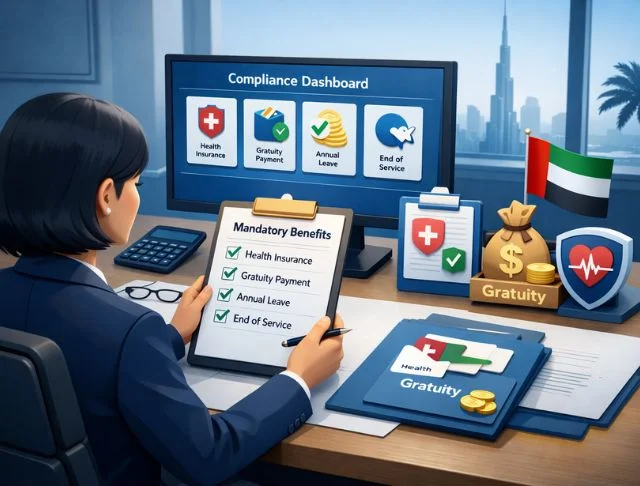
Employee benefits in the UAE consist of the financial, legal, and non-financial advantages that employers provide to employees in addition to their basic salary.
These benefits play a major role in attracting skilled professionals, improving employee satisfaction, and ensuring compliance with local labor laws.
For employers hiring in the UAE, understanding employee benefits is essential because the country has strict employment regulations. This applies to both local and foreign companies.
The UAE Labor Law imposes several mandatory benefits that every eligible employee must receive, including health insurance, annual leave, sick leave, maternity leave, public holidays, and end-of-service gratuity. However, employee benefits in the UAE fall into three main categories:
As a foreign employer, you should create a compliant and competitive benefits structure to ensure legal compliance and build a strong employer reputation in the local market.
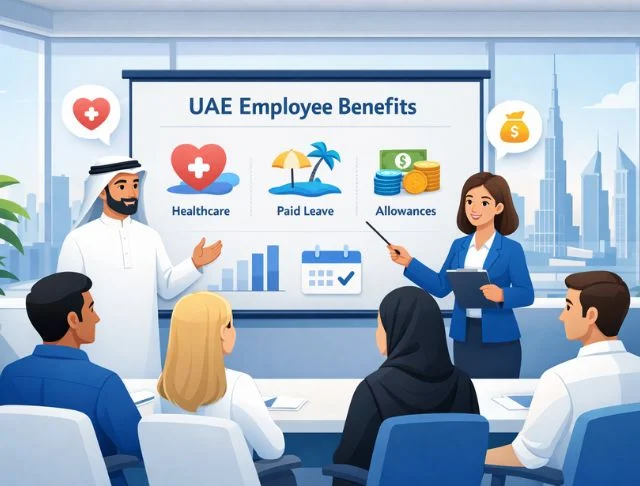
Since 1 January 2025, health insurance is mandatory for all private-sector employees across all seven Emirates extending the coverage obligation that previously applied only in Dubai and Abu Dhabi to the remaining five Emirates (Sharjah, Ajman, Umm Al Quwain, Ras Al Khaimah, and Fujairah).
Key employer obligations:
Dependent coverage rules vary by Emirate:
Emirate | Employer Obligation for Dependents |
Abu Dhabi | Employer must cover employee + spouse + up to 3 children under 18 |
Dubai | Employer covers employee only; employee is responsible for dependent registration |
Other Emirates | Dependent coverage is optional unless contractually agreed |
Employees with at least one year of continuous service receive gratuity upon termination: 21 days’ basic salary per year for the first five years. After that, they receive 30 days’ salary per year. The gratuity is capped at two years’ total basic salary.
It is calculated based on the last basic wage, excluding allowances such as housing, and prorated according to years of service.
Under Article 53 of Federal Decree-Law No. 33 of 2021, employers must pay the employee’s full final settlement within 14 calendar days from the date the contract ends not just the gratuity, but all outstanding entitlements including:
The 14-day window is calculated in calendar days (including weekends and public holidays), starting from the employee’s last working day or the effective termination date. Failure to settle within this period entitles the employee to file a complaint with MOHRE and pursue legal action for delayed payment.
Full-time employees receive 30 days of fully paid annual leave after completing one year of service. Employees who have served less than one year receive two days of leave per month.
Employees can carry over unused leave or receive compensation in cash at the end of the contract.
Employees are entitled to up to 90 days of sick leave per year: full pay for the first 15 days, half pay for the next 30 days, and unpaid leave thereafter. Employees must provide a medical certificate to qualify.
For gratuity calculations, periods of absence do not count toward the length of service.
Female employees receive a total of 60 days of maternity leave: 45 days with full pay and 15 days with half pay. Under private sector law, there is no minimum service requirement.
After returning to work, new mothers are entitled to one or two paid nursing breaks per working day (totalling no more than one hour), available for six months from the date of delivery. These breaks are fully paid and count as working time.
Additional extended leave entitlements (not mentioned in the blog — recommend adding):
Both parents (mother and father) in the private sector are entitled to 5 paid working days of parental leave, to be taken any time from the child’s birth until the child reaches 6 months of age. The leave can be taken consecutively or intermittently.
There is no minimum service requirement or post-probation condition for parental leave eligibility. Either parent may apply regardless of their seniority, contract type, or length of service.
Employees receive paid time off for all official UAE public holidays, typically 10 to 14 days annually, including Eid and National Day, regardless of their length of service.
Employers must sponsor the work visa, usually valid for two to three years, and the Emirates ID for all expatriate employees. This is part of the onboarding and residency requirements.
Under Article 13(12) of Federal Decree-Law No. 33 of 2021, employers must provide a one-way economy-class ticket to the employee’s home country (or agreed destination) when the employment ends and the employee intends to return home.
When the employer must pay:
When the employer is NOT obligated to pay:
Important: The annual air ticket (round-trip during employment) is a separate, entirely optional market practice that is not mandated by UAE labor law. It becomes legally binding only if explicitly stated in the employment contract.
Employers in the UAE commonly provide a monthly housing allowance, typically 20–40% of the basic salary. They may also provide company accommodation to offset high rental costs in Dubai and Abu Dhabi.
This perk is tax-free and excluded from basic salary calculations for gratuity. For lower-wage workers, shared labor camps are standard.
Coverage for spouses and children, typically up to three dependents, is optional nationwide but mandatory for dependents in Abu Dhabi. That is why many employers extend employee health plans to support family visas.
These premiums range from AED 2,000 to AED 10,000 annually per dependent. Employers may cover the full cost or split the expense with employees to support family relocation.
Round-trip economy tickets to employees’ home countries, typically valued at AED 2,000–5,000, are a common market practice for expatriates. Employers usually provide them once per year alongside annual leave. However, this is not legally required during employment.
Some companies include dependents or offer cash equivalents. This benefit helps improve retention among workers from Asia and Europe.
These allowances cover international school fees, typically ranging from AED 30,000 to AED 80,000 per child annually, for up to two or three children. This helps expatriates who relocate with their families.
These benefits are usually negotiated in employment contracts and are common among multinational companies hiring senior-level employees.

Employers often sponsor residence visas for spouses, children under 25, and sometimes parents. Companies cover costs such as medical tests and visa processing fees.
Employees can sponsor residence visas for their dependents (spouse and children) if they earn a minimum of AED 4,000 per month, or AED 3,000 per month plus employer-provided accommodation. This threshold applies regardless of the employee’s job title or nationality.
One-time payments ranging from AED 5,000 to AED 50,000 or more cover flights, household goods shipping, temporary housing, and initial setup expenses such as furniture or utilities.
Senior roles may receive higher amounts. These benefits remain common, although many companies reduced them after the pandemic to employee-only support.
Optional group life insurance, typically one to two times the annual salary, and long-term disability benefits are offered in addition to health plans. Large companies such as Google or Emirates commonly provide these benefits.
These benefits protect employees against death or incapacity. Employers pay the premiums to enhance financial security for expatriates who may not have local support systems.
Other perks that foreign companies offer include gym memberships, annual health checkups, counseling through Employee Assistance Programs, and wellness stipends ranging from AED 1,000 to AED 5,000 per year.
After COVID-19, companies such as PwC placed greater emphasis on mental health apps and stress leave to address high-pressure work environments.
Monthly allowances ranging from AED 200 to AED 500 help cover internet, ergonomic equipment, and utility expenses for hybrid work setups.
This has become a standard practice in more than 60% of firms in Dubai, supporting work-life balance amid heavy traffic and extreme heat.
Options such as four-day workweeks, core working hours like 10 a.m. to 4 p.m., or two to three remote workdays per week are widespread in the creative and IT sectors to improve productivity.
Companies such as Microsoft UAE lead with “right to disconnect” policies.
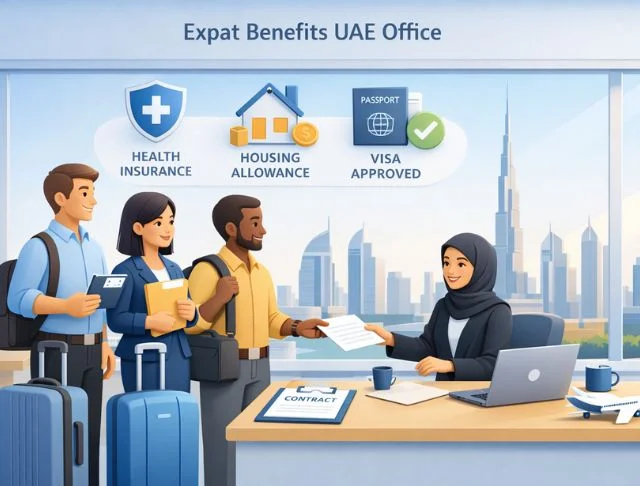
Mandatory expat-specific benefits in the UAE are limited to sponsorship and repatriation obligations under Federal Decree-Law No. 33 of 2021.
Employers must apply for and sponsor a two- or three-year residence visa tied to the employment contract through the Ministry of Human Resources and Emiratisation (MoHRE). This includes labor quota approval, medical fitness tests, and visa renewals for each contract term.
Employers cover the issuance, renewal, and associated fees, typically around AED 100–370, for the mandatory Emirates ID card. This card is required for banking, government services, and proof of residency.
The Emirates ID is biometric and linked to the sponsored visa. Employers handle the application process through ICP portals.
Employers must provide a one-way economy-class flight ticket to the employee’s home country upon contract termination. The value typically ranges from AED 1,500 to AED 4,000 depending on the destination and applies only at the natural end of service.
FMC Group has been providing Employer of Record services for more than 15 years. By using this service, companies can hire employees in the UAE without registering a local entity.
The company handles payroll, onboarding, time tracking, administrative tasks, and employee benefits. If employees are hired in countries other than the UAE, FMC Group also manages local tax compliance requirements.
Book a free consultation call to receive a customized plan for managing your employees’ benefits and compliance needs.
You are currently viewing a placeholder content from Calendly. To access the actual content, click the button below. Please note that doing so will share data with third-party providers.
More InformationYou are currently viewing a placeholder content from Calendly. To access the actual content, click the button below. Please note that doing so will share data with third-party providers.
More InformationYou need to load content from reCAPTCHA to submit the form. Please note that doing so will share data with third-party providers.
More InformationYou are currently viewing a placeholder content from Turnstile. To access the actual content, click the button below. Please note that doing so will share data with third-party providers.
More InformationYou are currently viewing a placeholder content from Vimeo. To access the actual content, click the button below. Please note that doing so will share data with third-party providers.
More InformationYou need to load content from reCAPTCHA to submit the form. Please note that doing so will share data with third-party providers.
More InformationYou are currently viewing a placeholder content from reCAPTCHA. To access the actual content, click the button below. Please note that doing so will share data with third-party providers.
More Information