
Hiring someone in Türkiye can be a lucrative way to scale the company. One reason is that companies optimize hiring costs. But deciding between employment and a contractor is confusing for foreign employers.
Working with an independent contractor seems simple and straightforward. But misclassifications can lead to heavy fines, stress, and waste of time.
The best solution is understanding key differences in this super useful guide. So, you do not need to face complex employment laws or misclassification issues.

Author

Co-author
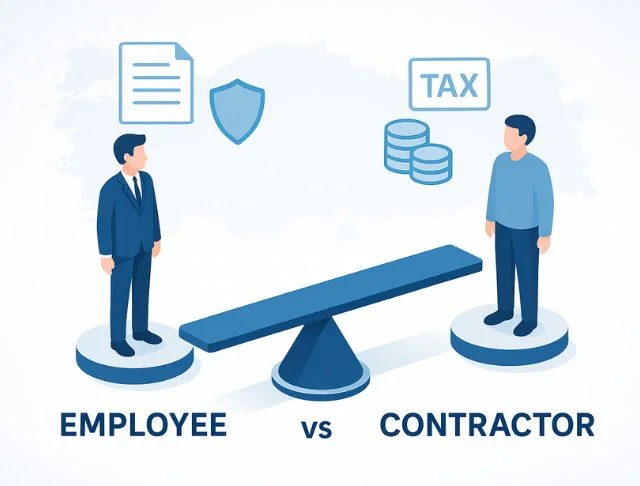
Hiring someone in Türkiye can be a lucrative way to scale the company. One reason is that companies optimize hiring costs. But deciding between employment and a contractor is confusing for foreign employers.
Working with an independent contractor seems simple and straightforward. But misclassifications can lead to heavy fines, stress, and waste of time.
The best solution is understanding key differences in this super useful guide. So, you do not need to face complex employment laws or misclassification issues.
Author
Co-author
Get in Touch with Us
Alp Atasoy
Sales and Business Development Consultant



Turkish Labor Act No. 4857 and Code of Obligations No. 6098 define employment. An employee is a person who performs work under the direction and supervision of an employer in exchange for wages.
The core defining characteristic is subordination. In simple words, it refers to how much control an employer has over a worker. If an employer explains about instructions, time and place of work, this is employment.
So, the employee works with the employer’s organizational structure. Companies expect to follow internal policies, reporting lines, and managerial instructions.
Another essential element that defines employment is wage relationships. The employee receives regular payment in return for personal performance of work. The employee has to work under supervision and can’t delegate the tasks to others.
There is no standalone statute that defines an “independent contractor” in Türkiye. Instead, contractors operate under service agreements. Turkish Code of Obligations No. 6098 governs the working terms.
The key characteristic that defines contract hiring is independence. Contractors work with their own terms. In this case, a contractor has control over the deliverables and quality of work. A contractor is not integrated into the company’s hierarchy.
Contractors bear their own economic risk. They manage tax filings, social security arrangements, and, where applicable, VAT obligations. A contractor does not have paid leave, overtime compensation, severance pay, or unemployment insurance.

The table shows you a clear difference when someone is considered an employee or contractor according to the Turkish government.
Aspect | Employee | Contractor |
Governing Law | Turkish Labour Act No. 4857 & Code of Obligations No. 6098 | Code of Obligations No. 6098 |
Control & Supervision | High – Employer decides how, when, and where work is done | Low – Worker controls how, when, and where work is done |
Integration into Company | Part of core operations; uses company tools and systems | Not integrated; works independently |
Economic Risk | Employer bears financial risk | Worker bears financial risk |
Payment | Fixed salary; regular wage payments | Paid per project or deliverable |
Social Security & Benefits | SGK registration, paid leave, overtime, severance, unemployment insurance | None |
Tax Obligations | Employer withholds income tax, stamp tax, and pays SGK contributions | Contractor self-files income tax; may register for VAT if applicable |
Termination Protection | Protected under labor law | Governed only by contract terms |
Contract Type | Employment agreement | Service contract / freelance agreement |
Typical Use Cases | Full-time roles, core operations, long-term positions | Short-term projects, specialized work, flexible roles |

You may be THINKING:
How does the Turkish government classify someone as an employee or contractor?
Legal officials don’t explain how they conduct worker classification, but courts decide each case. Labeling someone as a freelancer does not protect the company.
Real-world experience shows that courts usually consider four factors when auditing worker classification.
The court examines the worker’s role. If the role is specific and not tied to core company functions, such as sales or finance, it counts as a contract role. Courts also check the worker belongs to an internal team using company systems.
Courts also consider economic dependency. An employee relies on a single income and cannot take many jobs or manage other contractors. A contractor can work with many clients and earn from other sources.
Does the worker have core business rules, like business administration and hiring managers?
Is the worker part of the internal teams?
Does the worker use company email, tools, and systems for their work?
If the court answers “yes,” the court will classify the worker as an employee.
Exclusivity and continuity matter. Courts classify the worker as an employee based on long-term and open-ended engagement. Short-term, project-based, outcome-focused work fits contractor status.

Employee and contractor costs vary, making calculations difficult. The table below shows the extra costs of employment compared to contractors.
Cost Component | Employee | Contractor |
Gross Salary | Example: $1,275/month | Example: $1,500/month |
Employer SGK Contributions | $286 (≈22.5% of gross salary) | — |
Employee Tax & SGK Deductions | $327 (income tax + social security) | — |
Other Statutory Benefits | Paid leave, severance, overtime, unemployment insurance included | None required |
Total Employer Cost | $1,570 | $1,500 |
Net to Worker | ~$950/month (after taxes & contributions) | $1,500/month (before taxes) |

| Factor | Hire an Employee | Hire a Contractor |
| Duration of Work | Long-term or ongoing | Short-term or project-based |
| Role Integration | Core business operations | Peripheral or specialized tasks |
| Control Needed | High – you control how, when, and where work is done | Low – contractor manages own process and schedule |
| Work Type | Recurring, full-time responsibilities | Specific deliverables or outcomes |
| Flexibility | Limited; structured schedule and processes | High; flexible timing and methods |
| Cost & Compliance | Higher upfront cost due to SGK, taxes, benefits | Lower upfront cost; contractor handles taxes and social security |
| Intellectual Property (IP) | Employer automatically owns IP created in scope of work | IP belongs to contractor unless assigned by contract |
| Risk of Misclassification | Low (already an employee) | High if contractor is effectively treated like an employee |
| Typical Use Cases | Software developers, finance managers, customer service reps | Marketing consultants, UX/UI designers, short-term auditors |
If a worker meets conditions from many columns, it risks misclassification. Choose the benefits you need and classify the worker.

Employers misclassify a worker as a contractor when they legally qualify as an employee. This results in financial, legal, and operational risks in Türkiye.
Turkish courts and regulatory authorities focus on the actual working relationship. If a worker is treated like an employee in practice but labeled a contractor, the company may face the following risks:

Why are companies intended to work with contractors when going to the global market?
Companies work with contractors to avoid complexity of local laws. Understanding, complying, and remaining compliant altogether create this complexity. The other reason could be registering the company and unexpected delays in hiring.
What if you can hire employees in Türkiye in 48 hours and do not need to register a company, and fully comply with laws?
Employers of Record are designed to achieve these outcomes, and FMC Group has helped employers like you access the best talent for over 15 years. Book a free 30-minute consultation call with us and get detailed guidance for your next hire.
No, in Türkiye, an employee cannot work for multiple companies at the same time, and there are strict rules governing overtime work. Contractors, however, can work for multiple clients.
No rule is set regarding audit worker classification in Türkiye. SGK (Türkiye Social Security Institution) and tax authorities can audit at any time. Audits can be triggered by complaints, routine inspections, or flagged irregularities.
No, Türkiye does not use the 1099 model like the U.S. Employers do not withhold taxes for contractors, and contractors self-file income tax and social security contributions.
Contractors own the intellectual properties created by them in Türkiye, but if the contract explicitly states the IP is owned by another party, that flows as written.
No, severance is not mandatory for all employees. If an employee has worked for at least one year and is not terminated for just cause, the employer is required to pay severance.
You are currently viewing a placeholder content from Calendly. To access the actual content, click the button below. Please note that doing so will share data with third-party providers.
More InformationYou are currently viewing a placeholder content from Calendly. To access the actual content, click the button below. Please note that doing so will share data with third-party providers.
More InformationYou need to load content from reCAPTCHA to submit the form. Please note that doing so will share data with third-party providers.
More InformationYou are currently viewing a placeholder content from Turnstile. To access the actual content, click the button below. Please note that doing so will share data with third-party providers.
More InformationYou are currently viewing a placeholder content from Vimeo. To access the actual content, click the button below. Please note that doing so will share data with third-party providers.
More InformationYou need to load content from reCAPTCHA to submit the form. Please note that doing so will share data with third-party providers.
More Information