
Remote work has transformed the global workforce over the past few years, evolving from a niche perk to a mainstream employment model.
Today, approximately 330 million people worldwide work remotely, either full-time or in hybrid arrangements, spanning industries, regions, and job roles.
This shift is driven by advances in technology, changing employee expectations, and the lasting effects of the pandemic.
Understanding the scale and distribution of remote work is essential for businesses, policymakers, and researchers seeking to navigate this new “work from anywhere” era.

Author

Co-author

Remote work has transformed the global workforce over the past few years, evolving from a niche perk to a mainstream employment model.
Today, approximately 330 million people worldwide work remotely, either full-time or in hybrid arrangements, spanning industries, regions, and job roles.
This shift is driven by advances in technology, changing employee expectations, and the lasting effects of the pandemic.
Understanding the scale and distribution of remote work is essential for businesses, policymakers, and researchers seeking to navigate this new “work from anywhere” era.
Author
Co-author
Get in Touch with Us

Mr. Stephan Dorn
Managing Partner


Combining regional studies yields very rough figures. For instance, 24.9% of U.S. age‑25+ workers teleworking (34m out of 136m) and 22% of EU’s 15–64 workforce.
If 10% of the global workforce (≈820m used in WEF) were fully remote-capable, that is 82 million. If partial/hybrid remote workers are included, the total affected by remote options could exceed 300–400 million worldwide.
Notable Survey: Gallup finds that among U.S. employees with remote-capable jobs, 26% are fully remote and 52% hybrid. This suggests large mixed remote workforces. Global surveys (like Stanford’s) confirm higher shares in NA/EU than Asia.

Regionally, growth was modest pre-2020 then spiked: U.S. WFH share jumped from 5.7% (2019) to 17.9% (2021). In Europe, WFH shares rose 8 points (2019→2023). Analysts project continued growth in remote-capable jobs (25% rise by 2030.
Pre-2020: Remote work was relatively rare globally. U.S. ACS: 5.7% of workers (9 million) primarily WFH in 2019. Surveys estimated 7–8% of the global workforce worked remotely before COVID. European countries ranged 3–10% pre-pandemic.
Post-2020: Remote work skyrocketed as a pandemic response. U.S. share rose to 17.9% (27.6m) by 2021 and remains high (25% in 2024). EU: from 14% (2019) to 22% (2023). Canada: from 7% (2016) to 20–30% (2022–23). Australia/NZ roughly doubled or tripled their WFH shares.
United States: Implied growth was enormous in 2020–21 (over 100% annualized). For example, 2019–2021 ACS data imply 79% annual growth in “primary WFH” share.
Canada: Major jump in 2020 (to 40% WFH), then declines to 20% by 2023. Rate of change decelerated after 2021.

United States: As above, 34.0 million (25+) teleworkers in Q1 2024 (24.9% of workers). U.S. remote-capable workforce distribution: 26% fully remote, 52% hybrid, 21% on-site. Census data: 17.9% worked primarily from home (2021). Growth: tripled 2019→2021.
Canada: November 2023: 20% of Canadian employees worked most hours from home. (This fell from 30% in early 2022.) Since 2016 (7%), WFH share has increased 13 points.
European Union: In 2023, 22% of EU workers (age 15–64) worked from home in the survey week (up 8 pts since 2019).
United Kingdom: ONS reports 13–14% fully remote and 28% hybrid (at least 1 day WFH) in late 2024. Recent analysis suggests 40% of UK jobs have some remote component (14% fully, 26% hybrid).
Australia: 6.7 million Australians (≈46% of employed) worked from home at least some of the time (July 2024–June 2025). Among Australian capital-city workers, 60–70% report some WFH.
New Zealand: 2023 census – 17.7% of workers “mostly” worked from home (up from 11.9% in 2018). Among major regions, 18–20% of workers were primarily at home.
Other APAC: Data are limited. Singapore reported 30% home-based work during parts of 2020, later falling. In Japan/South Korea, WFH remains under 15%. China has low official WFH share (often single digits) aside from occasional flex days.
Brazil/Argentina/Mexico: A WEF article notes >2.2 million remote workers from these three countries contributing to global firms in 2023, but country-wide WFH percentages are scarce. Surveys suggest 30–50% of Latin American companies offer hybrid/remote policies, but most workers still come to a workplace.
Regional Trends: A U.S.-based tech poll (2022) indicated 40% of LatAm employees worked remotely in 2023 (up from 30% in 2019). (No official Labor stats found.)
Middle East: High-tech sectors in UAE, Israel have higher WFH (20–30%), but the regional workforce is largely on-site (oil, public sector). Anecdotal surveys cite 10–15% remote in UAE/Israel pre-2025.
Africa: In South Africa, a February 2023 study found 19% WFH options. In much of Africa, remote-capable jobs are a small minority. Across MEA, remote work is far less prevalent than in Western countries.
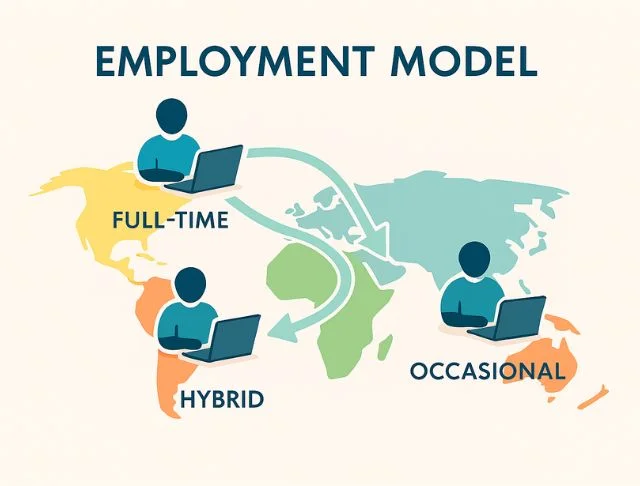
In the U.S., a substantial minority of workers are fully remote. For example, Gallup (2025) reports 26% of U.S. employees with remote-capable jobs work entirely from home. In hiring trends, the share of fully-remote job postings grew to roughly 13% by Q3 2024 (up from ~11% in 2023).
Hybrid arrangements are even more common. Gallup finds 52% of U.S. remote-capable workers have a hybrid schedule. Likewise, a 2025 Robert Half analysis shows about 24% of new U.S. job postings were hybrid roles (hiring partly remote). Overall, surveys indicate most employers now offer hybrid options (e.g. 88% of U.S. firms allow some hybrid work).
Freelancing has boomed, much of it remote. In the U.S. in 2023, 64 million people (≈38% of the workforce) performed freelance work. Globally, one estimate puts the independent contractor count at about 1.57 billion people (46.6% of global workforce). (Freelancers often work remotely, contributing trillions in economic output.)
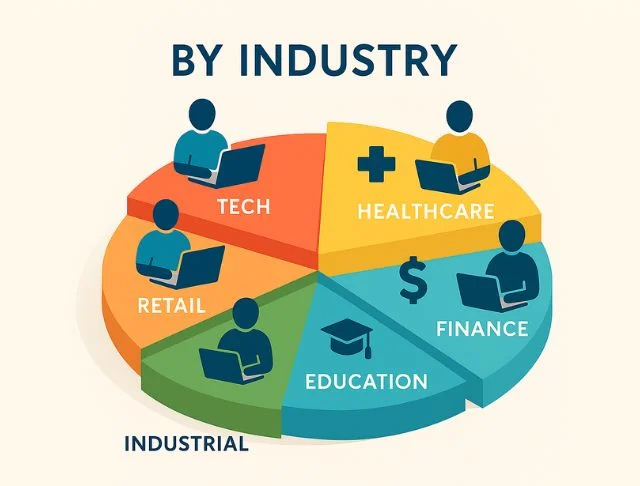
The tech sector leads remote adoption. Statista data (2024) indicate 67.8% of tech industry workers can work remotely. Official U.S. figures show the Information sector telework rate was 46.7% in Sept 2023. (For context, pre-pandemic tech-related fields averaged only 11–17% remote in 2019.)
Creative and media industries have high but lower remote rates. For example, in 2021 the “Arts, entertainment, and recreation” sector saw 17.4% of jobs remote (15.9% in 2022). Robert Half (Q3 2025) finds about 15% of Marketing/Creative job openings are fully remote. (Hybrid roles are more common.)
Many finance and professional services roles are remote. U.S. data show 52.8% of workers in Finance & Insurance teleworked in Sept 2023 (down from 44.7% in 2019). Professional/technical services reached 54.8% in 2023. Correspondingly, about 13% of new Finance/Accounting jobs are fully remote (Q3 2025).
Remote work is less common in support roles. In U.S. data, “Management, administrative, and waste services” (including call centers) had only 9.8% teleworking in Sept 2023. Robert Half reports only 8% of Customer Support/Administrative job postings are fully remote.
Remote work is rare in traditional education. In 2021, 23.1% of jobs in Educational Services were remote (falling to 17.8% in 2022). By Sept 2023 only 5.0% of education workers teleworked. (E-learning companies and some training roles have higher remote rates, but K–12 and higher-ed faculty mostly return to classrooms.)

Surveys suggest most small firms offer flexibility, but data vary. For instance, Robert Half finds 88% of U.S. companies of all sizes now offer hybrid options (implying even small firms allow some remote work). Specific breakdowns by company size are scarce, but hybrid work appears widespread.
Medium firms (100–999 employees) likewise embrace hybrid models. A U.S. hybrid-work survey shows about 27% of workers are hybrid and 11% fully remote, covering all company sizes. That suggests mid-size firms contribute to these shares, though exact split by company size isn’t public.
Large firms vary. Some big tech companies permit significant remote work, while others require offices. Generally, employers with thousands of employees still maintain in-person requirements; in a 2024 survey, 47% of fully in-office policies remained at enterprise level, with many requiring partial return. (Reliable figures by size are limited.)
A notable minority of firms operate as “remote-first” (100% distributed). Examples include GitLab, Automattic, and Basecamp, which maintain almost entirely remote workforces. By contrast, many traditional companies (especially outside tech) are “office-first.”

Younger workers have lower telework rates. U.S. CPS data (Oct 2025) show only 7.2% of those aged 16–24 teleworked, versus 25.0% of ages 25–54 and 23.7% of ages 55+. Census analysis also notes remote workers tend to be slightly older: median age 43.5 years vs 41.7 for all workers.
Women are slightly more likely to be remote than men. In the CPS (Oct 2025), 24.7% of working women teleworked versus 20.6% of working men. (Pre-COVID surveys found men and women had roughly similar access to telework, but current data indicate a modest female lead.)
Education is strongly correlated with remote work. In Q1 2024, 43.6% of workers with advanced degrees teleworked (up from 38.8% in 2023), compared to 38.4% of those with only a bachelor’s degree. Rates fall sharply for lower education: 18.3% with some college/associate, 8.5% with only a high school diploma, and just 3.5% with less than high school.
Higher-income households are far more likely to work from home. Census data (2020) found that 73.1% of households earning ≥$200,000 annually teleworked during the pandemic, versus only 12.7% of households under $25,000. This reflects that high-paying jobs (more likely remote) dominate WFH.

Several studies find little loss in productivity from remote work. A BLS analysis across industries reported that sectors with larger increases in remote work tended to see higher total-factor productivity growth (2019–21, 2019–22).
Surveys also suggest many teams maintain or even boost output when hybrid/remote. For example, one U.S. survey found 62% of managers said their hybrid/remote teams were more productive than in-office teams.
Remote work substantially cuts commute time. NBER research (2023) estimates the average remote worker saves about 72 minutes of commute per workday. This amounts to roughly 2 hours per week saved in 2021–22. Workers often reallocate 40% of that time to more paid work, potentially raising effective hours on job tasks.
Teleworkers contribute significantly to economic output. In the U.S., the freelance/independent sector alone (mostly remote) added about $1.27 trillion in earnings in 2023 (6% of U.S. GDP).
Similarly, studies attribute large productivity gains to WFH; one estimate suggests U.S. remote-capable jobs could add as much as $270 billion per year in work (5 million man-years) if fully utilized.
Businesses can cut costs via remote work. Global Workplace Analytics estimates that U.S. companies could save over $500 billion per year by expanded telework (over $11,000 per employee annually) through reduced real estate, utilities, and turnover.
A Stanford study similarly found about $2,000 per employee saved annually just on office space costs. Employees also save on commuting costs: one analysis notes $20 billion could be saved at gasoline pumps nationwide if many workers stayed home.
Sources: NBER, LS CFO Advisor, GlobalWorkplaceAnalytics
The rise of remote work is no longer a temporary trend, it has become a permanent feature of the global workforce.
With approximately 330 million people worldwide now working remotely, either full-time or hybrid, businesses must adapt to new ways of managing talent, maintaining productivity, and supporting employee well-being.
You are currently viewing a placeholder content from Calendly. To access the actual content, click the button below. Please note that doing so will share data with third-party providers.
More InformationYou are currently viewing a placeholder content from Calendly. To access the actual content, click the button below. Please note that doing so will share data with third-party providers.
More InformationYou need to load content from reCAPTCHA to submit the form. Please note that doing so will share data with third-party providers.
More InformationYou are currently viewing a placeholder content from Turnstile. To access the actual content, click the button below. Please note that doing so will share data with third-party providers.
More InformationYou are currently viewing a placeholder content from Vimeo. To access the actual content, click the button below. Please note that doing so will share data with third-party providers.
More InformationYou need to load content from reCAPTCHA to submit the form. Please note that doing so will share data with third-party providers.
More Information