
The return-to-office trend is shifting rapidly as companies balance productivity, employee preferences, and post-pandemic realities.
While hybrid work dominates, full-time office mandates are rising in certain sectors, particularly finance and large enterprises. Employees are navigating evolving expectations, commuting challenges, and new compliance measures.
This post dives into the latest 2026 statistics, showing how office attendance, enforcement, and workforce behavior vary across industries, regions, and company sizes, offering a quick snapshot of where corporate work-life is heading.

Author

Co-author

Get in Touch with Us

Leah Maglalang
Business Coordinator UAE


U.S. gender gap: 51% men vs 41% women support more in-office work.
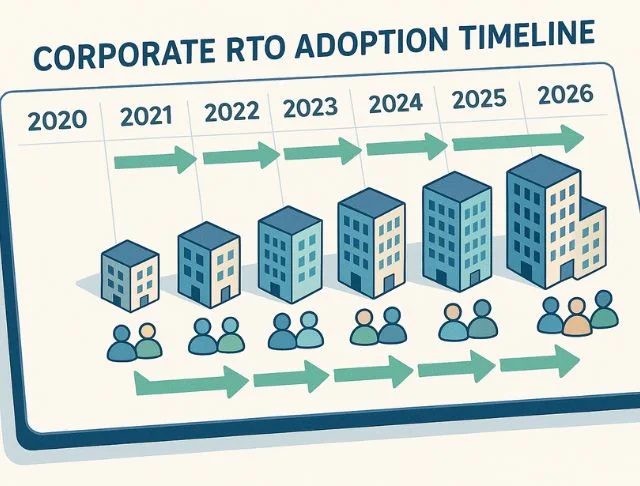
By the end of 2025, approximately 27% of companies will require fully in-person work, while 67% will operate under hybrid models and 6% will remain fully remote.
Among firms that resumed office operations, 31% mandated return-to-office (RTO) policies in 2021, increasing to 41% in 2022 and declining to 27% in 2023.
A late-2024 survey indicated that roughly 90% of companies intended to implement RTO policies by the end of 2024.
At that time, 51% already required employees to work some in-person days, 39% planned mandates by the end of 2024, 8% by 2025, and only 2% did not plan to implement RTO requirements.
Hybrid employees are slightly increasing their in-office presence. Gallup reports that hybrid workers now spend approximately 46% of the workweek on-site (around 2.3 days), up from 42% (approximately 2.1 days) in 2022.
In late 2025, the U.S. remote-capable workforce comprised approximately 52% hybrid employees, 21% fully on-site, and 27% fully remote.
U.S. office foot traffic is rebounding: July 2025 visits reached 78.2% of July 2019 levels, representing a 10.7% increase compared with July 2024. Major markets observed near-full recovery, with New York City at +1.3% relative to July 2019 and Miami at –0.1%.
Large employers increasingly announced stricter RTO mandates during 2024–2025.
Canadian banks (RBC, Scotiabank, BMO) and Starbucks North America support staff transitioned to four-day in-office schedules by late 2025.
Other firms, including Meta’s Instagram, Microsoft, and Paramount, announced three- to five-day in-office requirements for 2026.
Tracking and enforcement of RTO policies have intensified. Approximately 69% of employers now measure attendance, up from 45% the previous year, and 37–50% implement enforcement actions.
One survey found that 85% of employers communicated an RTO policy, and 69% tracked attendance, representing a 24-point year-over-year increase.
Where formal policies exist, compliance is high. JLL reports approximately 82% compliance when a full-time office schedule is mandated, increasing to 95% when only one to two days per week are required.
Resources: Founder Reports, HR Dive, Gallup, Placer.ai, 2727 Coworking, Archie App, CoStar, CFO.com, JLL, CBRE
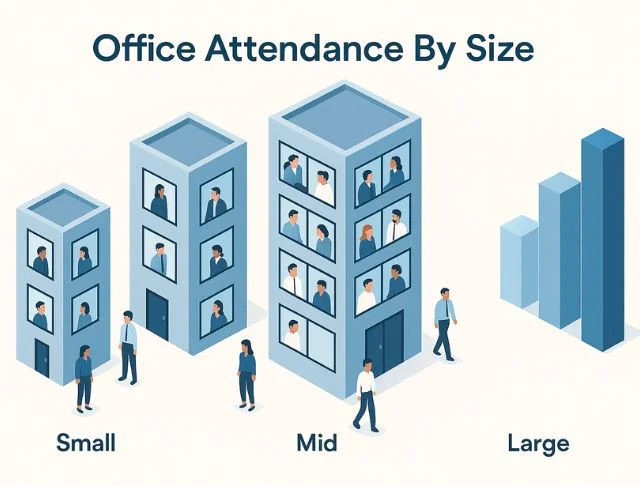
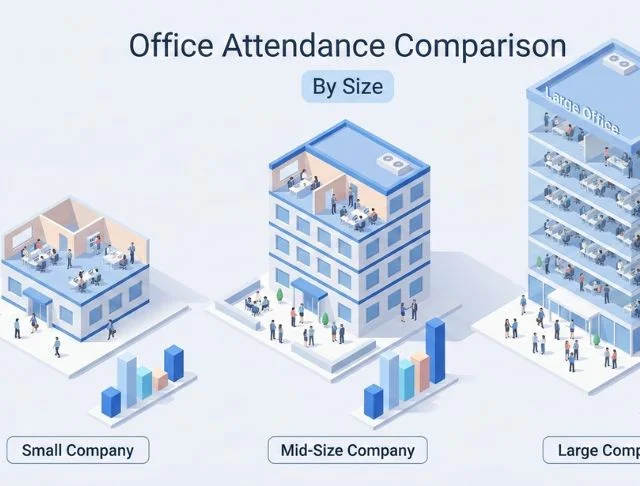
Large enterprises with 10,000 or more employees average approximately 2.5 days per week in the office. Only about 22% of these firms actively enforce their attendance policies.
Public data for mid-market firms is limited, as most surveys categorize companies broadly as “small” or “large.”
Small companies with fewer than 500 employees average approximately 3.4 days per week in the office and report higher compliance rates. Nearly half of these firms actively enforce RTO policies. One study found that 67% of companies with fewer than 500 staff remain fully remote.

The technology industry remains the most remote-oriented. In 2025, approximately 47% of tech-sector employees worked fully remotely, 45% operated under hybrid arrangements, and only 9% were fully on-site.
Financial firms, particularly in major markets, have led RTO mandates. By the second quarter of 2025, a majority of employees at Fortune 100 companies faced full-time in-office requirements, up from 5% in the second quarter of 2023.
In Canada, major banks including RBC, Scotiabank, and BMO implemented four-day in-office schedules. New York City’s finance sector contributed to office traffic reaching 101.3% of pre-COVID levels in mid-2025.
Several large manufacturing and industrial firms announced full-time RTO policies for 2026.
Novo Nordisk, in the pharmaceutical and manufacturing sector, mandated all office staff to return full-time by January 2026.
Within the life sciences, Novo Nordisk represents a notable example of full-time RTO.
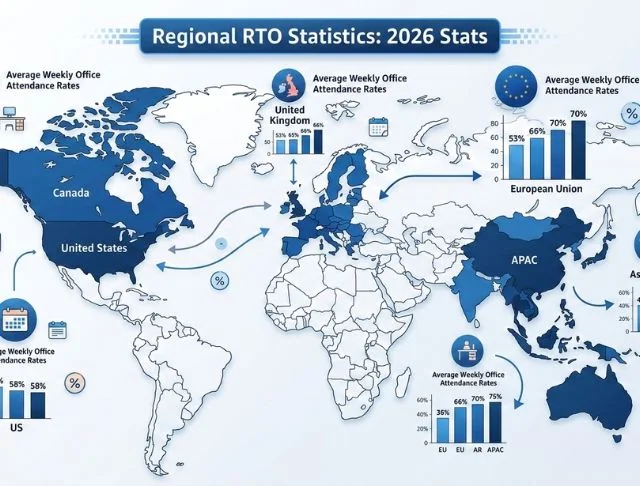
In the United States, late-2025 data indicate that approximately 52% of remote-capable workers operate under a hybrid model, 21% are fully on-site, and 27% work fully remotely.
Average employee-reported office days are about 2.9 per week, compared with employer expectations of 3.2 days.
Surveys show that 69% of U.S. firms track attendance, up from 45% in 2024, and 72% now meet their office-attendance targets, up from 61% the previous year.
Office vacancy reached roughly 19% in late 2025, reflecting continued underuse of corporate space.
In Great Britain, as of the first quarter of 2025, 28% of workers were on hybrid schedules, combining office and home work. This share has been rising steadily since early 2022, reflecting a decline in full-time commuting and an increase in hybrid and remote arrangements.
By mid-2025, 17.4% of Canadians worked primarily from home, down from 24% at the peak of the COVID-19 pandemic. The remaining 82.6% worked exclusively on-site.
An Indeed survey in 2025 found that only 34% of Canadian employees worked five days per week in the office, compared with 83% pre-pandemic, while approximately 66% now follow hybrid schedules, averaging three in-office days per week.
A majority of employees, around 80%, express a preference for some in-office time. Government and corporate mandates include a three-day in-office schedule for most employees (four for executives) and four-day requirements for large corporations such as Starbucks North America and Canadian banks.
Pan-European data are limited, but available reports indicate that about 85% of EU employees meet RTO requirements, notably higher than North America’s approximately 78%.
EU workers are less positive about RTO policies, with 64% expressing favorable views compared with 78% in North America. Hybrid work arrangements have grown across many EU countries, though a single compliance percentage is not available.
In Asia-Pacific, enforcement of RTO policies has intensified. Approximately 82% of employers report consequences for noncompliance, up 16 points from the previous year, and 50% tie attendance to performance reviews.
Around 42% of firms in the region plan to expand office space in the coming years, compared with 20% planning reductions, suggesting sustained expectations for in-office work.
Surveys indicate that about 71% of APAC workers view RTO policies positively.
Resources: Forbes Advisor UK, Benefits Canada, Office for National Statistics, Global Workplace Analytics, GoTo
Approximately one-third of employers indicate they may terminate or threaten employees who fail to comply with RTO mandates.
Around 34% of firms plan to use badge-swipe or occupancy tracking to monitor attendance, and 32% tie office attendance to performance reviews. In the Asia-Pacific region, roughly 50% of employers already use performance reviews for RTO compliance.
Stricter RTO mandates correlate with higher compliance. When a five-day office schedule is enforced, compliance rates are approximately 82%, increasing to 95% when only one to two days per week are required.
Strict RTO enforcement appears to increase voluntary turnover intent. Surveys show that 41% of U.S. workers would consider seeking a new job, and 14% would quit, if required to work five days per week in the office. Even executives are affected, with roughly one in three reporting they would consider leaving under a full-time RTO mandate.
Multiple studies link RTO mandates to higher attrition rates. Approximately 53% of remote-capable employees indicate they would seek new employment within a year if forced to return full-time to the office.
A separate survey found that 28% of employers reported firing workers for noncompliance with RTO policies, serving as a proxy for potential job loss risk. Long-term attrition statistics remain unavailable.
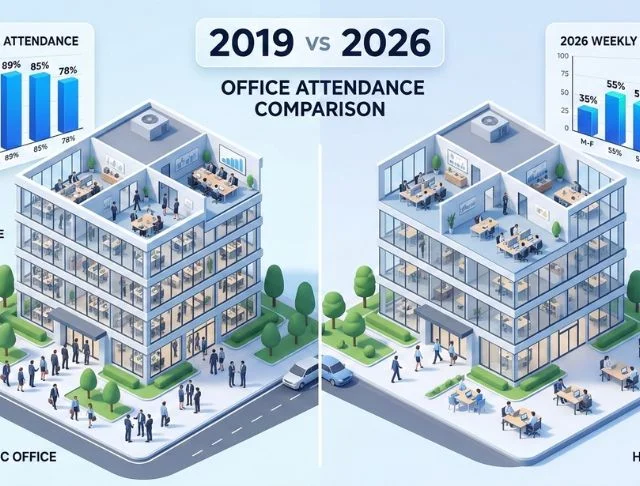
U.S. office occupancy has not fully recovered. In July 2025, visits reached approximately 78% of July 2019 levels. By city, New York City and Miami returned to near or above pre-COVID volumes (NYC +1.3%, Miami –0.1%), while cities such as Atlanta and Dallas remained up to 20% below 2019 levels.
In Canada, only 34% of employees now work five days per week in the office, compared with 83% pre-2019, reflecting a significant shift toward hybrid work.
U.S. office vacancy reached record levels of approximately 19% in late 2025, roughly double the pre-pandemic rate of 11%.
This indicates lower utilization of corporate real estate following RTO implementation, with many major firms consolidating space through a “flight to quality” strategy.
Analysis indicates that employers can save approximately $11,000 per year per employee working remotely half-time due to reduced office costs.
Conversely, employees face higher commuting and meal expenses, with 95% reporting increased costs when required to spend more days in the office.
High office vacancy, around 19%, indicates that even with RTO adoption, many workspaces remain under-utilized. CBRE notes that firms are “upgrading” office space rather than returning to previous utilization rates. Approximately 40% of employers plan no change in space, while 42% plan expansion.
Generational differences exist in RTO attitudes. About 49% of Baby Boomers and 48% of Millennials favor more in-office work, compared with 45% of Gen X and 40% of Gen Z. No direct attendance-rate breakdowns by age are available.
U.S. surveys show a gender gap in RTO attitudes, with 51% of men versus 41% of women supporting increased in-office work. In Canada, women report significantly higher burdens from RTO, including childcare, commute, and expenses.
Working parents tend to follow hybrid schedules more often. In Great Britain, 35% of parents worked hybrid compared with 24% of non-parents in early 2025. Surveys indicate that parents and caregivers highly value workplace flexibility.
Commute considerations remain a major factor affecting office attendance. About 45% of U.S. workers cite commuting time or distance as the biggest drawback of RTO.
While quantitative correlations between commute length and attendance are not reported, surveys consistently highlight commuting as a key barrier to increased in-office days.

Concrete forecasts for RTO compliance are limited. Analysts predict that the hybrid and remote share of the workforce, which was approximately 35–40% in 2022, will remain stable through 2024 and then increase modestly. This trend suggests that overall RTO compliance rates may slightly decline as workplace flexibility continues to grow.
Employers are continuing to adapt their RTO policies. In the Asia-Pacific region, 42% of firms plan to expand office space, compared with only 20% planning reductions, indicating expectations to maintain or increase attendance requirements. Specific enforcement trends through 2028 have not been quantified.
Analysts generally anticipate that hybrid models will persist across sectors, with technology and professional services remaining the most flexible. Manufacturing and finance sectors are expected to maintain stronger in-office work requirements. For example, Canadian data indicate that approximately 63% of employees expect to be in the office three to four days per week by 2026.
In 2026, the office isn’t disappearing, but it’s evolving. Hybrid work remains popular, yet stricter RTO policies are reshaping attendance patterns, enforcement, and employee sentiment.
Compliance rates are high when rules are clear, but commuting, parental responsibilities, and flexibility continue to influence choices.
Companies and employees alike are adjusting to this “new normal,” balancing in-office requirements with productivity and engagement.
You are currently viewing a placeholder content from Calendly. To access the actual content, click the button below. Please note that doing so will share data with third-party providers.
More InformationYou are currently viewing a placeholder content from Calendly. To access the actual content, click the button below. Please note that doing so will share data with third-party providers.
More InformationYou need to load content from reCAPTCHA to submit the form. Please note that doing so will share data with third-party providers.
More InformationYou are currently viewing a placeholder content from Turnstile. To access the actual content, click the button below. Please note that doing so will share data with third-party providers.
More InformationYou are currently viewing a placeholder content from Vimeo. To access the actual content, click the button below. Please note that doing so will share data with third-party providers.
More InformationYou need to load content from reCAPTCHA to submit the form. Please note that doing so will share data with third-party providers.
More Information