
The key difference between an employer of record (EOR) and an Agent of Record (AOR) lies in ownership, representation, and administrative burden.
An EOR acts like an external HR department that uses its own identity and employs workers for third parties, while an AOR only helps with administrative tasks. AOR is highly useful when you have many employees but a small internal HR team.
Both EOR and AOR are useful and boost company performance, but in different scenarios. To understand the key differences between the two, we need to know what they are, what each service covers, and when to use them.
This approach not only elaborates on the differences but also helps in choosing the right type of service for your needs.

Author

Co-author
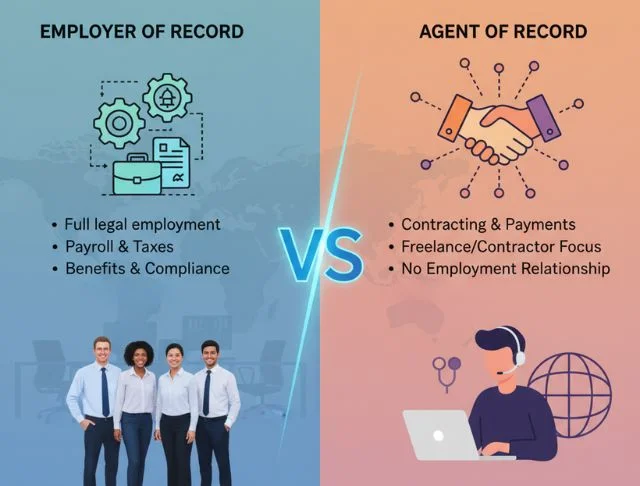
The key difference between an employer of record (EOR) and an Agent of Record (AOR) lies in ownership, representation, and administrative burden.
An EOR acts like an external HR department that uses its own identity and employs workers for third parties, while an AOR only helps with administrative tasks. AOR is highly useful when you have many employees but a small internal HR team.
Both EOR and AOR are useful and boost company performance, but in different scenarios. To understand the key differences between the two, we need to know what they are, what each service covers, and when to use them.
This approach not only elaborates on the differences but also helps in choosing the right type of service for your needs.
Author
Co-author
Get in Touch with Us

Leah Maglalang
Business Coordinator UAE

An EOR is a third-party organization that employs workers on your behalf but uses its own local resources.
You do not need to register a local company or handle payroll, insurance, or contracts, because an EOR service covers these. You get employees and assign day-to-day work responsibilities.
There are seven responsibilities that an EOR assumes when you partner with it. Simply put, you get a full HR department with two extra benefits: it is an external company and operates under its own identity.
Main Responsibility | Task 1 | Task 2 | Task 3 | Task 4 |
Payroll & Taxes | Salary processing | Tax withholding | Statutory filings | Local contributions |
Employment Contracts & Documentation | Draft employment contracts | Review compliance clauses | Issue offer letters | Maintain employee records |
Local Laws Compliance | Track labor laws | Follow country regulations | Ensure statutory benefits | Manage termination rules |
Administrative Rules | Maintain HR paperwork | Submit government filings | Keep employee records | Enforce company policies |
Employee Onboarding & Offboarding | Onboard new employees | Collect documents | Exit procedures | Final settlements |
Workers’ Compensation & Insurance | Provide mandatory insurance | Ensure workplace coverage | Handle claims | Manage liability protection |
HR & Employment Support | Employee queries | Leave management | Benefits support | Policy guidance |
Risk & Liability Management | Monitor compliance risks | Prevent misclassification | Manage legal exposure | Protect employer liability |
Working with an EOR is super easy if it is experienced, reputable, and transparent. As most people do not know much about this service, their lack of awareness can make them feel overwhelmed by the partnering process. Let’s see how simple it is to partner with an EOR:
The hiring company understands the EOR, including its pricing structure and competitive advantages. It signs a contract, providing complete details about the employee it wants, including the required country and salary range.
The employer of record service provider analyzes the market and the target country. They create a detailed plan and evaluate their resources. They either have registered their own local entity or partnered with local companies.
The EOR uses its resources to reach out to talented employees through local networks, job boards, and walk-in interviews, and after screening, it hires them. The EOR signs contracts with employees, becomes their legal employer, and also connects them with the hiring company.
After hiring, the responsibilities of an EOR do not end. The EOR manages payroll, taxes, administrative tasks, and all other responsibilities mentioned in the above table.
A U.S. software company that has recently received Series B funding wants to expand its team globally. Their software helps manage payroll, timesheets, invoices, and other administrative tasks. They need a team of writers, SEO specialists, and advertising specialists who are familiar with these tools and have experience in SaaS or multiple niches.
They contact an EOR and communicate their requirements to the provider. Within one week, the EOR provides a team, and the work begins. If they have to hire the team themselves, the process can take several months.
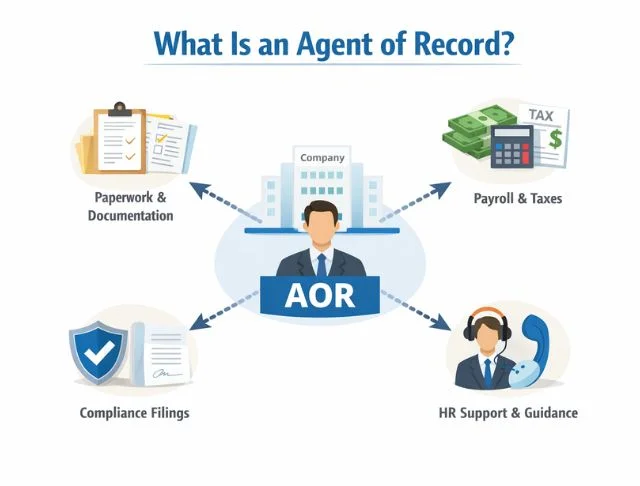
An Agent of Record is a person or company that performs work for your company as a contractor, not as an employee. Their core responsibilities are to complete the administrative tasks that you assign to them.
They function like a helper who takes over some of your tasks and completes them with your permission and resources. That’s it.
An Agent of Record can help coordinate a wide range of tasks in your company, but only administrative tasks. Their tasks can be divided into two types: internal support, such as handling paperwork, and coordination with external authorities.
An Agent of Record helps in paperwork and documentation required between an employer and employee. These include, but are not limited to, contracts, employee forms, and document filings.
Handling salary records is not an easy task, and even a small inaccuracy can lead to legal penalties. So, an agent of record validates the payroll, tracks taxes, and verifies the salaries.
Each employee role has its own benefits provided by the company. AORs also help manage these benefits and provide support for enrollment, vendor coordination, and policy management.
There are multiple documents that must be filled out and submitted to different departments. AORs reduce the burden by helping with government submissions, regulatory reporting, and legal compliance.
HR personnel have to manage employee queries about work, policies, and leave. When the number of employees is high and the HR department is small, an AOR comes into play.
When an Agent of Record enters into insurance coordination, they help with policy liaison, claims support, and track renewals.
The role of an AOR is like a helper and coordinator. They use your company, identity, and resources to complete assigned tasks and do not make independent decisions. They act only under your instructions. Here is how they work:
An AOR acts on your behalf. This means they do not have their own local entity or legal structure to complete your tasks and rely on your company when helping you. They execute tasks, follow instructions, and represent your company.
They are experts in government filings, local regulations, and official communications. This expertise ensures the process is completed with minimal errors.
Once you partner with an AOR, they first complete your assigned internal tasks, then coordinate with authorities, and then support HR processes. This support includes document collections, onboarding, and offboarding.
AORs do not make decisions and do not create their own rules or instructions when executing client tasks. They adhere to compliance requirements and follow administrative instructions.
Although AORs have multiple tasks, their core responsibility is maintaining legal oversight. They monitor risks, review policies, and perform regular oversight.
You have a company with twenty employees in different countries, and you also have an on-site team. Although you have seven members in an administrative department, there is still a lot of work to be done.
In this situation, you partner with an AOR, and they start completing your pending administrative tasks. So, it is simple.
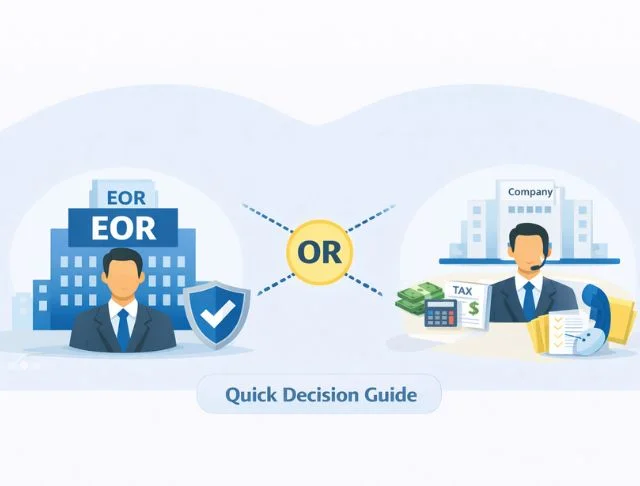
Selecting a service depends heavily on the needs of a company.
Does that mean you must have a long list of needs to find the right service?
Not really. Below is the quick decision guide that can help you choose the right one.
If you want to… | Choose this |
Hire employees in a country where you have no entity | EOR |
Legally employ workers without setting up a company | EOR |
Outsource payroll, taxes, and labor law compliance | EOR |
Transfer employment and compliance risk | EOR |
Replace internal HR completely | EOR |
Hire quickly across borders | EOR |
Test a new market before long-term expansion | EOR |
Keep full employer ownership | AOR |
Use your existing legal entity | AOR |
Get help with HR paperwork and administration | AOR |
Execute HR tasks under your company name | AOR |
Maintain control over hiring and HR decisions | AOR |
Reduce operational workload, not legal responsibility | AOR |
| EOR | AOR |
| Legal employer | Authorized agent |
| Hires employees | Supports hiring |
| Owns payroll | Coordinates payroll |
| Handles compliance | Advises compliance |
| No entity needed | Entity required |
| Assumes liability | No liability |
| Full HR | Admin support |
| Global hiring | Local support |
| Risk transfer | Risk retained |
Employer of Record (EOR) | Agent of Record (AOR) |
Pros | Pros |
No entity needed | Keeps employer control |
Fast global hiring | Lower cost |
Full compliance handled | Flexible support |
Payroll & taxes covered | Uses existing entity |
Legal risk transferred | Admin workload reduced |
Cons | Cons |
Higher cost | Entity required |
Less legal control | No risk transfer |
Dependency on the provider | Limited authority |
Not ideal long-term | Still employer liable |
Cost Factor | EOR | AOR |
Pricing model | Per employee | Service retainer |
Typical range | Higher cost | Lower cost |
Entity setup | Not required | Required |
Payroll ownership | Included | Not included |
Compliance liability | Included | Not included |
HR coverage | Full scope | Limited scope |
Legal risk cost | Transferred | Retained |
Best cost fit | Short-term expansion | Ongoing operations |
⬜ | Decision Factor | EOR | AOR |
⬜ | No local legal entity | ✔️ | |
⬜ | Need a legal employer | ✔️ | |
⬜ | Want compliance risk transferred | ✔️ | |
⬜ | Need full payroll & tax handling | ✔️ | |
⬜ | Hiring internationally | ✔️ | |
⬜ | Have a local entity | ✔️ | |
⬜ | Want to remain a legal employer | ✔️ | |
⬜ | Need admin support only | ✔️ | |
⬜ | Want lower cost | ✔️ | |
⬜ | Need execution under the company name | ✔️ |
There is a chance you may need different types of services in your hiring process, such as contracting, common law employment, traditional hiring, PEO, staff agency, or umbrella company.
You can read full, in-depth articles to make the right decision, or schedule a free thirty-minute consultation call, and we’ll help you pick the right one.
You are currently viewing a placeholder content from Calendly. To access the actual content, click the button below. Please note that doing so will share data with third-party providers.
More InformationYou are currently viewing a placeholder content from Calendly. To access the actual content, click the button below. Please note that doing so will share data with third-party providers.
More InformationYou need to load content from reCAPTCHA to submit the form. Please note that doing so will share data with third-party providers.
More InformationYou are currently viewing a placeholder content from Turnstile. To access the actual content, click the button below. Please note that doing so will share data with third-party providers.
More InformationYou are currently viewing a placeholder content from Vimeo. To access the actual content, click the button below. Please note that doing so will share data with third-party providers.
More InformationYou need to load content from reCAPTCHA to submit the form. Please note that doing so will share data with third-party providers.
More Information