
Are you looking to hire employees globally and deciding which option will be better: an EOR or a contractor?
This post aims to solve your confusion and help you make the right decision.
So, whether you want to hire employees in any country or in a specific niche, I hope you make an informed decision after reading this.
Let’s move ahead to a thoughtful decision:

Author

Co-author
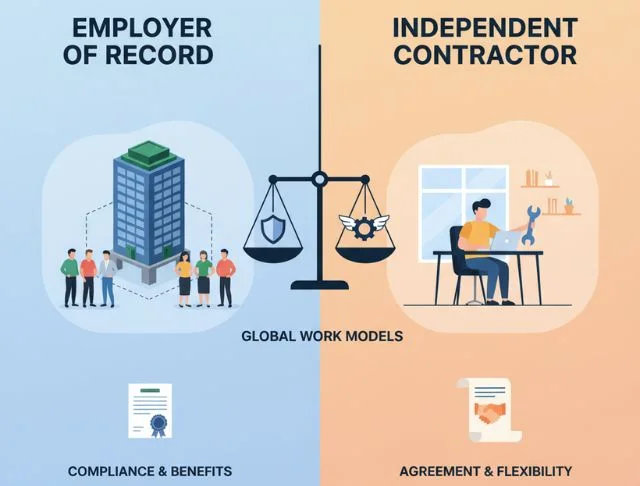
Are you looking to hire employees globally and deciding which option will be better: an EOR or a contractor?
This post aims to solve your confusion and help you make the right decision.
So, whether you want to hire employees in any country or in a specific niche, I hope you make an informed decision after reading this.
Let’s move ahead to a thoughtful decision:
Author
Co-author
Get in Touch with Us

Leah Maglalang
Business Coordinator UAE

An EOR is an organization or company located anywhere in the world that offers its services. This company hires employees using local, country-specific resources, such as local partners or its own registered entity, on your behalf.
Beyond that, here are other services that an EOR offers:
An EOR is a go-to solution for fast global hiring without setting up a local entity and dealing with the hurdles an employer faces during offshore hiring. These hurdles include:
It may seem obvious that an EOR handles two things: payroll and taxes. However, there is much more involved. EOR service providers calculate gross salary, income taxes, and social security contributions.
They run local payroll in the employee’s country and withhold required taxes. Not only that, an EOR submits payroll taxes to the local government, pays employees on time in their local currency, and issues payslips that comply with local laws.
Does an EOR only draft contracts and document the process?
No, not really. It does more than that. It ensures that the contract includes the following items:
Employer of Record services also maintain and handle employee records and contract amendments, such as raises and role changes.
This is one of the biggest benefits of hiring through an EOR. Every country has a long list of labor laws, written in legal terms and language, and they continuously change.
Either you need to learn and comply with them, or you can let an EOR take care of labor laws, minimum wage rules, working hour limits, leave laws, and termination regulations.
When you hire an employee, you take on full legal responsibility. But when you hire through an EOR, it acts as the legal employer that registers employees with tax authorities, social security systems, and labor departments. It also files required reports, manages statutory deadlines, and government correspondence.
Onboarding includes employee registration, tax IDs, and social security enrollment. Offboarding consists of notice period, final payroll, severance, and exit documentation.
When you hire by registering your local entity, you have to fulfill the following requirements; otherwise, if you hire through an EOR, they take the burden on their shoulders.
An EOR supports:
So far, we have covered thirty-seven employment responsibilities required when hiring as a common law employer, but when hiring through an EOR, it manages over forty-two employer obligations, adding five more as follows:
Different service providers operate differently. Some services are easy to get started with, while others have complex processes. Some include hidden risks like extra charges, while others give you full control of easy joining and free exit.
All these factors depend not on the services themselves but on the service provider. The process of hiring through a good EOR like FMC Group looks like this:
Step#1. You select the employee
Step#2. The EOR legally hires the employee
Step#3. Onboarding and employment setup
Step#4. Payroll, Taxes & Compliance Managed by the EOR
Step#5. You manage day-to-day work
Step#6. EOR also handles termination & offboarding (if required)
A martech company is growing fast due to its unique software and unmatched customer support. They decreased their churn rate and CAC while improving LTV.
Now they want to expand their team by hiring employees from multiple countries, like the UAE, the Philippines, etc. Instead of registering local entities in each country, they partner with an EOR.
That martech company manger day to day work operations, and the rest of all other operations are managed by the employer of record.

A contractor is a worker who provides services to a company under a service agreement. This worker is legally responsible for their own taxes, compliance, and benefits.
A contractor works very differently from an employee. People often think that paying via invoices means they are working with a contractor, but scope of work, dependency, control, and integration into the business determine whether a worker is a contractor.
A contractor creates an independent service agreement with a company that is mostly self-managed, and legal involvement is very minimal. In the case of a dispute, contractors rely on commercial or civil law remedies, not employment law. This agreement outlines the details of the service, including how it will be performed, delivered, and continued.
The company only sends agreed-upon payments to the contractor. Contractors must file their own taxes and create invoices to receive payment.
While employees receive benefits such as annual leave, paid leave, sick leave, minimum wage protection, insurance, and more, contractors do not. However, both parties can agree on benefits that are mutually beneficial.
A contractor may be engaged for a project-based scope, where the contract ends once specific work is completed, or for a time-based period such as a month, quarter, or year.
Working with a contractor is a lot easier than hiring an employee. This is why companies work with contractors when they need short-term support, want to test capabilities, or explore a local market. Here is how to get started with a contractor:
Step #1: Scope of Work Defined
Step #2: Service Agreement Signed
Step #3: Contractor Sets Work Method
Step #4: Work Delivered or Milestones Completed
Step #5: Invoice Issued by Contractor
Step #6: Client Processes Payment
Step #7: Contract Renewal or Termination
Consider a company located in Germany. They want to scale content production. Because they have no country preference, they post jobs on a global remote job board and receive applicants from Pakistan, India, the Philippines, and other countries.
After interviewing, they like the work of a Pakistani writer. They now have three options to work with the candidate. Either they register a company in Pakistan and hire him, partner with an EOR, or directly work with him as a contractor.
The first option is time-consuming and requires significant effort, while the second option can be costly at the start, so they choose to sign a contract and begin work.

Both are good options, and which option is more beneficial depends on the employer or company’s needs and goals. Here’s how the decision typically breaks down:
Partnering with an EOR is highly beneficial in the following situations:
Working with a service provider as a contractor is useful in the following situations:
| Aspect | Employer of Record | Contractor |
| Legal status | Legal employer | Independent business |
| Worker type | Employee | Self-employed |
| Payroll | Managed payroll | Invoice payment |
| Tax handling | Employer withheld | Self-paid taxes |
| Compliance | Fully compliant | Limited compliance |
| Control level | High control | Limited control |
| Termination | Law regulated | Contract based |
Category | Employer of Record | Contractor |
Setup speed | Slower setup | Fast setup |
Flexibility | Lower flexibility | High flexibility |
Legal risk | Low risk | Higher risk |
Worker loyalty | High loyalty | Low loyalty |
Scalability | Stable scaling | Rapid scaling |
Admin burden | Outsourced admin | Minimal admin |
Cost Factor | Employer of Record | Contractor |
Upfront cost | Higher cost | Lower cost |
Ongoing fees | Monthly fees | Per project |
Benefits cost | Included benefits | No benefits |
Tax burden | Employer paid | Contractor paid |
Compliance cost | Included | Potential penalties |
Long-term cost | Predictable cost | Variable cost |

Is this a short-term project or a long-term role?
Will you need to comply with local employment laws?
Will you manage hours, processes, and tools directly?
Are legal protections and compliance important?
Can you afford full employment costs, or is a project-based arrangement sufficient?
Misclassification, tax penalties, or employment disputes can be costly.
Things like onboarding, offboarding, benefits management, and statutory filings may be required.
FMC Group has been helping companies scale globally for over twenty-five years. They have hired many employees on behalf of clients and have also supported contractor engagements.
Benefit from their experience by scheduling a thirty-minute free consultation call to discuss which option works best for you.
OR
Read further to understand the key differences between an EOR and a common law employer.
No, there are significant differences between the two. Read the full guide about a common law employer and an EOR.
Yes, a contractor may work full-time for one company or multiple companies, and the key point is that they are not bound by employment law restrictions, which is why governments do not provide contractors with the same protections as employees.
Misclassifying a contractor as an employee can expose a business to serious legal, financial, and reputational risks. This includes fines, back taxes, lawsuits, and loss of compliance credibility.
Yes, in most cases, partnering with an Employer of Record is more expensive than hiring a contractor, but the cost often pays off through faster, compliant, and long-term hiring.
You are currently viewing a placeholder content from Calendly. To access the actual content, click the button below. Please note that doing so will share data with third-party providers.
More InformationYou are currently viewing a placeholder content from Calendly. To access the actual content, click the button below. Please note that doing so will share data with third-party providers.
More InformationYou need to load content from reCAPTCHA to submit the form. Please note that doing so will share data with third-party providers.
More InformationYou are currently viewing a placeholder content from Turnstile. To access the actual content, click the button below. Please note that doing so will share data with third-party providers.
More InformationYou are currently viewing a placeholder content from Vimeo. To access the actual content, click the button below. Please note that doing so will share data with third-party providers.
More InformationYou need to load content from reCAPTCHA to submit the form. Please note that doing so will share data with third-party providers.
More Information