
Remote work has grown faster than anyone expected. Today, the most reliable estimate suggests there are roughly 73 million remote-capable jobs worldwide, mostly in tech, finance, and other digital sectors.
This number shows how work is no longer tied to an office and sets the stage for a major shift in the global workforce.
Let’s dive into the numbers and see how remote jobs are distributed across regions, industries, and roles.

Author

Co-author

Remote work has grown faster than anyone expected. Today, the most reliable estimate suggests there are roughly 73 million remote-capable jobs worldwide, mostly in tech, finance, and other digital sectors.
This number shows how work is no longer tied to an office and sets the stage for a major shift in the global workforce.
Let’s dive into the numbers and see how remote jobs are distributed across regions, industries, and roles.
Author
Co-author
Get in Touch with Us

Mr. Stephan Dorn
Managing Partner


Global remote workforce 2030 projected: 1 B
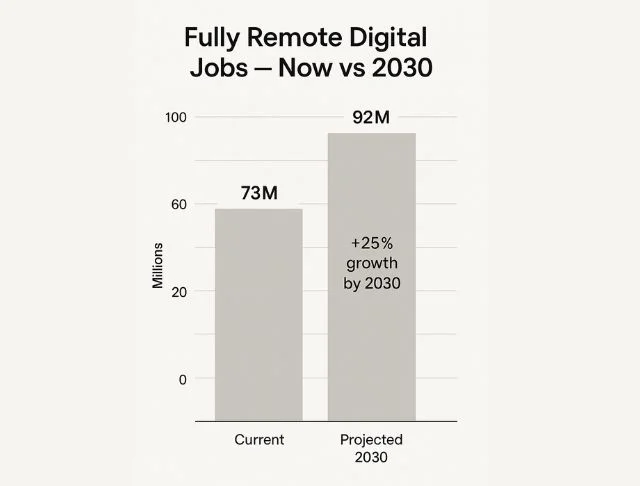
The way we work has changed fast. Millions of roles now let people log in from anywhere, shifting the global job market. Let’s break down the numbers to see the scope of remote work today.
Right now, about 73 million digital jobs can be done fully remotely. Experts project this could grow to 92 million by 2030, a 25% jump. These roles cover software, finance, and other digital fields.
Here’s a quick snapshot:
Metric | Jobs (millions) |
Current | 73 |
Projected 2030 | 92 |
Growth | 25% |
Globally, around 25% of workers have some form of remote work. This is up from roughly 5% before 2020 in many countries. The US alone had 35.5 million teleworkers in early 2024.
Not all remote jobs are the same. Only about 8% of workers are fully remote. Hybrid work, where employees split time between office and home, accounts for roughly 26% globally.
These numbers show a clear trend: more people will work from home at least part of the time. It’s no longer a perk, it’s becoming the norm.
Sources: WFHResearch, BLS, DemandSage

Remote work exploded in the past few years. Millions moved online quickly, then patterns stabilized. Let’s look at how remote jobs grew globally and in the US.
Remote work was tiny before 2020. In the US only 5% of paid hours were at home. During the pandemic, remote jobs jumped sharply. By 2020–21 telework hit around 50% of US work hours. After offices reopened, remote work fell but stayed above pre-pandemic levels.
Year | Remote Jobs (M) | Share % |
2019 | 10 | 5 |
2020 | 35 | 25 |
2021 | 45 | 33 |
2022 | 50 | 27 |
2023 | 55 | 22 |
2024 | 57 | 23 |
2025* | 60 | 24 |
2026* | 63 | 25 |
2027* | 67 | 26 |
2028* | 70 | 27 |
2029* | 82 | 28 |
2030* | 92 | 30 |
*Projected
Before 2020, remote work was rare worldwide. Only 3–5% of workers in Europe and Asia worked from home. COVID changed that. Countries like Canada saw WFH rise from 7% in 2016 to 40% in April 2020. Even after offices reopened, remote work stayed higher than before.
Period | Remote % |
Pre-2020 | 5 |
Peak 2020–21 | 33 |
Post-2022 | 23 |
The biggest surge came in 2020–21. In the US remote workdays reached 33% in 2021. Job postings peaked in early 2022 at 27% remote. After that, numbers dropped but stabilized above pre-pandemic levels.
Remote work may not hit pandemic highs again, but millions now work from home or in hybrid setups every week.
Sources: SpokesMan, EconomicGraph, ONS, IronHack
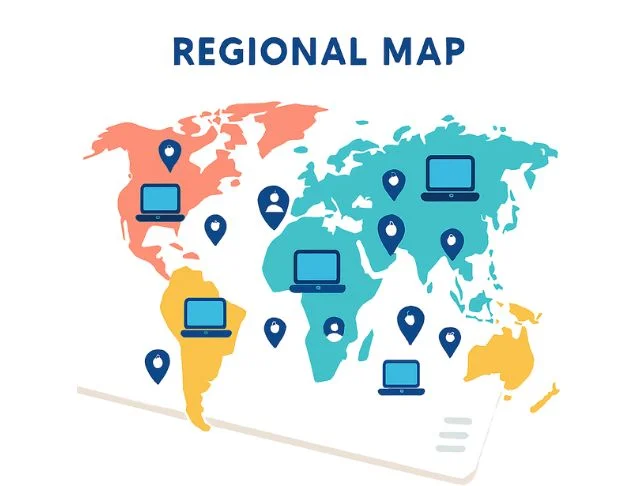
Remote work varies sharply across the globe. North America and Europe lead, Asia-Pacific is growing, and Latin America with Middle East & Africa lag behind. Let’s break down the numbers by region.
Region | Remote Jobs (M) |
North America | 40 |
Europe | 45 |
Asia-Pacific | 66 |
Latin America | 10 |
Middle East & Africa | 3 |
Global Total | 164 |
The US dominates remote work in North America. Around 35.5 M Americans teleworked in Q1 2024. About 22 M work fully remotely according to Upwork. Canada has 4 M remote workers, down from 40% during the pandemic. Mexico and other countries show lower adoption.
Europe has embraced hybrid work. The EU shows 22% teleworking in 2023. Northern countries lead: Netherlands 52%, Sweden 45%, Finland 42%. Germany sits at 23%, and Italy/Spain remain below 15%. The UK has ~28% hybrid arrangements.
Country | Remote % |
Netherlands | 52 |
Sweden | 45 |
Finland | 42 |
Germany | 23 |
UK | 28 |
Italy/Spain | 15 |
Asia-Pacific shows mixed adoption. India has 12.7% fully remote and 28.2% hybrid workers. Japan stayed under 10%, South Korea ~25%, and China largely onsite. Australia averages ~1.4 WFH days per week.
Country | Remote % |
India | 13 |
Japan | 10 |
S.Korea | 25 |
China | 5 |
Australia/NZ | 15 |
Remote work is modest in Latin America. Most countries average under 1 day per week at home. Chile hits 1 day, Mexico 0.8 days. Brazil and Argentina saw some growth during COVID but remain low overall.
Remote work remains rare. UAE shows 1% fully remote preference. Most other countries in the region have <10% adoption. South Africa averages 0.9 WFH days per week.
These numbers highlight a clear gap. North America and Europe set the pace, while Asia-Pacific, Latin America, and Africa catch up slowly.

Remote work shows wide differences from country to country. Let’s zoom in on the leading markets and see how many people work remotely today.
The US leads in both hybrid and fully remote work. About 35.5 M Americans teleworked in early 2024. Around 12% are fully remote, and nearly 30% work in hybrid setups. Upwork projects 22 M Americans will stay fully remote long-term.
Metric | Count/Share |
Teleworkers | 35.5 M |
Fully Remote | 12% |
Hybrid | 29% |
In the UK, hybrid work is now standard. Roughly 28% of employees split office and home work. Full-time remote sits lower at 12%. Pre-2020, remote work was almost zero.
Canada’s remote numbers fell after the pandemic peak. About 20% of workers mostly work from home today, roughly 4 M people. At the height of COVID, 40% WFH was common.
India shows strong growth in hybrid work. About 12.7% of office employees are fully remote and 28.2% hybrid. That totals roughly 66 M fully remote workers in a 520 M workforce.
Germany had a pandemic spike of 27% remote work but settled around 23% teleworking occasionally by 2023. The tech sector remains more flexible than average.
Even with declines after pandemic peaks, all these countries maintain remote work far above pre-2020 levels. Hybrid setups are now a key part of the modern workplace.
Remote work isn’t evenly spread across jobs. Tech and digital roles dominate, while education, marketing, and customer support are growing steadily. Let’s look at the distribution and role breakdowns.
Technology leads the pack with the highest share of remote jobs. Finance, admin, and operations follow. Marketing, customer support, and education show smaller but growing remote adoption.
Industry | Remote Jobs (M) |
Technology & Software | 11 |
Finance, Accounting & Fintech | 4.2 |
Professional/Admin | 6.2 |
Marketing & Media | 0.26 |
Customer Support & BPO | 0.3* |
Education & Online Learning | 0.2* |
*Estimates based on growth trends and market reports
Tech roles dominate because work is digital-first. Finance and admin jobs also moved online but at lower rates. Marketing and customer support show potential for expansion as companies adopt hybrid and fully remote models.
Remote opportunities differ by role even within industries. Technical and engineering roles have the largest remote share. Sales, creative, and management roles are increasingly remote, though adoption varies by company size.
Role | Remote Share |
Engineering/Technical | High |
Sales & Business Dev | Medium |
Creative & Design | Medium |
Operations/Admin | Medium |
Leadership & Management | Low-Med |
Technical roles remain the easiest to take remote. Sales and creative roles follow, often hybrid. Leadership and management need some office presence, but flexibility is growing.
Sources: PRNewswire, Census, Neat, VirtualVocations
Remote work is no longer a niche. It draws large applicant pools, often faster than on-site roles, and retention favors flexible models. Let’s explore demand, competition, and forecasts.
Remote job postings remain substantial but are a minority of listings. Virtual Vocations reported ~247,000 fully remote openings in 2024, up 16% from 2023. LinkedIn shows ~11% of US postings remote, while Indeed reports ~7.8%.
Remote roles attract far more applicants than on-site. LinkedIn data show 11% of postings generated 50% of applications. TalentAlly finds remote roles get 3–4× more candidates per role.
Remote jobs remain highly competitive. Many workers value flexibility over pay, with 61% willing to take a pay cut to stay remote.

Short-term forecasts see remote work stabilizing, mostly hybrid. 35–40% of US workers will log in from home at least part-time post-pandemic. Long-term, estimates suggest ~42% fully remote and 75% hybrid globally by 2030, totaling roughly 1 B remote workers.
Remote work will continue but varies by company approach:
Even with fluctuations, remote work is now a permanent feature of the modern job market. Companies ignoring flexibility risk losing talent.
Sources: HiringLab, FlexJobs, SecondTalent
Remote work has moved from a pandemic experiment to a permanent part of the global job market.
Today, tens of millions of workers log in from home or split time between office and remote setups, with tech, finance, and digital sectors leading the shift.
Looking ahead, remote-capable jobs are set to grow steadily. By 2030, estimates suggest nearly a billion workers worldwide could have some form of remote work.
The global workforce has changed, and remote work is here to stay.
You are currently viewing a placeholder content from Calendly. To access the actual content, click the button below. Please note that doing so will share data with third-party providers.
More InformationYou are currently viewing a placeholder content from Calendly. To access the actual content, click the button below. Please note that doing so will share data with third-party providers.
More InformationYou need to load content from reCAPTCHA to submit the form. Please note that doing so will share data with third-party providers.
More InformationYou are currently viewing a placeholder content from Turnstile. To access the actual content, click the button below. Please note that doing so will share data with third-party providers.
More InformationYou are currently viewing a placeholder content from Vimeo. To access the actual content, click the button below. Please note that doing so will share data with third-party providers.
More InformationYou need to load content from reCAPTCHA to submit the form. Please note that doing so will share data with third-party providers.
More Information