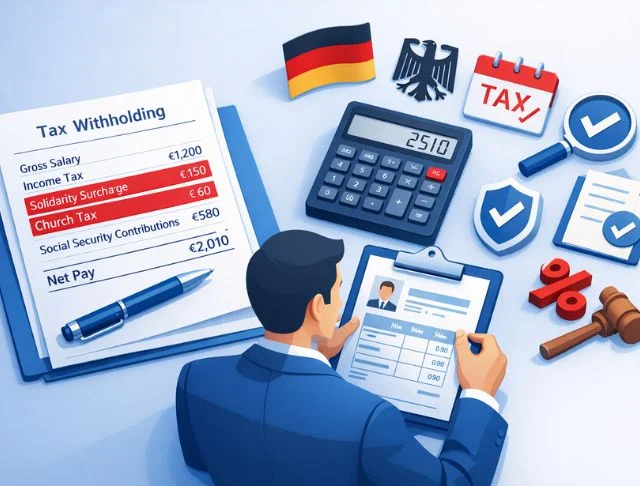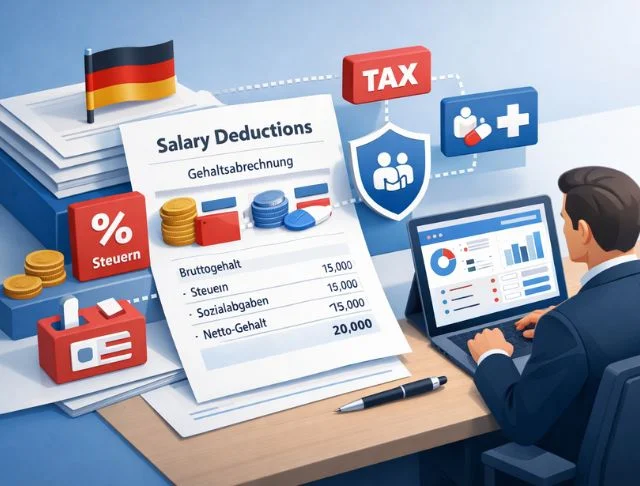
In Germany, employees pay different kinds of taxes and contributions for their well-being and protection. These deductions are not just a few payments but a long list that overwhelms employers. They not only miss payments but also face penalties due to non-compliance issues.
In this post, we’ll specifically cover all the deductions that employers make from employees’ salaries. An important nuance here is that employees also have to pay some of these deductions themselves. This article is all about employee payments that employers deduct and their contributions.
Author
In Germany, employees pay different kinds of taxes and contributions for their well-being and protection. These deductions are not just a few payments but a long list that overwhelms employers. They not only miss payments but also face penalties due to non-compliance issues.
In this post, we’ll specifically cover all the deductions that employers make from employees’ salaries. An important nuance here is that employees also have to pay some of these deductions themselves. This article is all about employee payments that employers deduct and their contributions.
Author
Wage tax is the main deduction from salary. It is not a fixed percentage for everyone because it changes based on income and tax class. Employers must withhold it from each monthly payroll.
The solidarity surcharge is 5.5% of the wage tax amount, not 5.5% of the gross salary. Many workers do not pay it, but higher earners may still owe it.
Church tax is usually 8% of the wage tax in Bavaria and Baden-Württemberg and 9% in most other states. Employers only withhold it when the worker is registered as a church taxpayer.
Statutory health insurance consists of a general contribution rate of 14.6% plus an additional contribution rate set by the health insurance fund. The average additional contribution rate in 2026 is 2.9%, resulting in an average total contribution rate of 17.5%. The actual rate may vary depending on the employee’s health insurance provider.
Pension insurance is 18.6% of gross pay, split 50/50. Employers withhold 9.3% from the worker’s salary and pay 9.3% themselves.
Unemployment insurance is 2.6% of gross pay, also split equally. Employers withhold 1.3% from the salary and pay 1.3% on top.
Long-term care insurance contributions depend on the employee’s number of children. The standard rate is adjusted through surcharges and discounts. Childless employees aged 23 and older generally pay an additional employee-only surcharge.
Employers usually withhold 1.8% from the salary. However, some workers may pay more based on their child status, and Saxony has a different contribution split.
The employer pays half of the statutory health insurance contribution. This consists of 7.3% from the general contribution rate plus half of the applicable additional contribution rate charged by the employee’s health insurance fund.
The employer pays 9.3% of the gross salary for pension insurance. This is the employer’s half of the total 18.6% rate.
The employer pays 1.3% of the gross salary for unemployment insurance. The employee pays the other half.
The employer usually pays 1.8% of the gross salary for long-term care insurance. In Saxony, the employer share is lower at 1.3%.
Accident insurance contributions are paid entirely by the employer and are determined by the responsible Berufsgenossenschaft based on the company’s industry classification and claims history.
Employers also pay a small insolvency levy (a payment that protects workers if a company becomes insolvent and cannot pay wages). In 2026, this is 0.15% and is paid only by the employer.
U1 and U2 are employer-only contributions, and the rates vary by health insurance provider. U1 reimburses employers for part of the continued salary payments during employee sickness. U2 reimburses employers for maternity-related costs. Contribution rates vary depending on the health insurance provider.
If an employer offers an occupational pension plan, part of the salary may go into it. This is usually based on the contract or company plan, so the amount can change from one employee to another.
Some employers offer private or extra health plans. If the worker joins, the employer may deduct an amount from the salary based on the plan.
Union fees are only deducted if the worker asks for it or gives permission. Employers should not withhold these fees without a legal or written basis.
Some companies let workers donate to charity through payroll. These deductions are optional and depend on company policy and employee consent.
Some companies allow workers to exchange part of their salary for certain benefits, such as pension contributions or transportation benefits. These arrangements depend on company policy and employee agreement.
If a court or authority orders a garnishment (when an employer must take money from a worker’s salary because of a legal order), the employer must deduct the amount from the salary. These deductions are not optional and must follow the order exactly.
Employers must report wage tax, solidarity surcharge, and church tax to the local tax office electronically. Wage tax filing frequency depends on the amount of wage tax paid in the previous calendar year. Employers may be required to file monthly, quarterly, or annually, regardless of whether they are domestic or foreign employers.
Employers must also report social security contributions for health, pension, unemployment, and long-term care insurance. They do this electronically through the payroll system or the social insurance reporting process.
Employers must send payroll-related data to the employee’s health insurance fund. This is useful for tracking health and care insurance contributions and matching them with payroll records.
At the end of the year, employers must issue an annual wage tax certificate for each worker. They must send it to the tax authorities by the last day of February of the following year.
ELStAM is Germany’s electronic system for payroll tax data. Employers use it to get tax class and allowance data for employees, and updates now happen electronically instead of on paper.
So far, you have learned that managing salary deductions in Germany can be overwhelming for foreign employers. From wage tax and social security contributions to health insurance, pension payments, and payroll reporting, German payroll compliance takes extra effort and time. Even small calculation or filing errors can result in penalties, employee disputes, or compliance risks.
That’s why many international companies choose to outsource payroll and employment administration through a single service: an Employer of Record. They partner with experienced local providers like FMC Group. As a trusted Employer of Record (EOR), FMC Group helps businesses hire and manage employees in Germany without the complexity of setting up a local entity.
FMC Group handles critical payroll responsibilities. These include salary deductions, tax withholding, social security registrations, payslip management, and government reporting. Their local HR and compliance experts make sure that all payroll processes align with German labor laws and tax regulations.
By outsourcing payroll and EOR services to FMC Group, employers can reduce administrative burdens, minimize compliance risks, and focus on business growth instead of payroll operations. This is especially valuable for companies that are scaling their teams in Germany for the first time and want to manage remote internal teams.
With local expertise and end-to-end support, FMC Group simplifies German employment compliance for global employers.
You are currently viewing a placeholder content from Calendly. To access the actual content, click the button below. Please note that doing so will share data with third-party providers.
More InformationYou are currently viewing a placeholder content from Calendly. To access the actual content, click the button below. Please note that doing so will share data with third-party providers.
More InformationYou need to load content from reCAPTCHA to submit the form. Please note that doing so will share data with third-party providers.
More InformationYou are currently viewing a placeholder content from Turnstile. To access the actual content, click the button below. Please note that doing so will share data with third-party providers.
More InformationYou are currently viewing a placeholder content from Vimeo. To access the actual content, click the button below. Please note that doing so will share data with third-party providers.
More InformationYou need to load content from reCAPTCHA to submit the form. Please note that doing so will share data with third-party providers.
More Information