
Expanding into the UAE with an Employer of Record is considered a smart way to hire quickly while avoiding the time and cost of establishing a local company.
However, as your workforce grows, you may reconsider creating your own UAE entity. Switching too early or too late can affect your company’s costs, compliance, and operational flexibility.
This guide explains when to transition from an EOR to a local entity in the UAE. In addition, you’ll learn about the signs to watch for, the transfer process, and how to ensure a smooth, compliant transition for your employees.

Author

Co-author
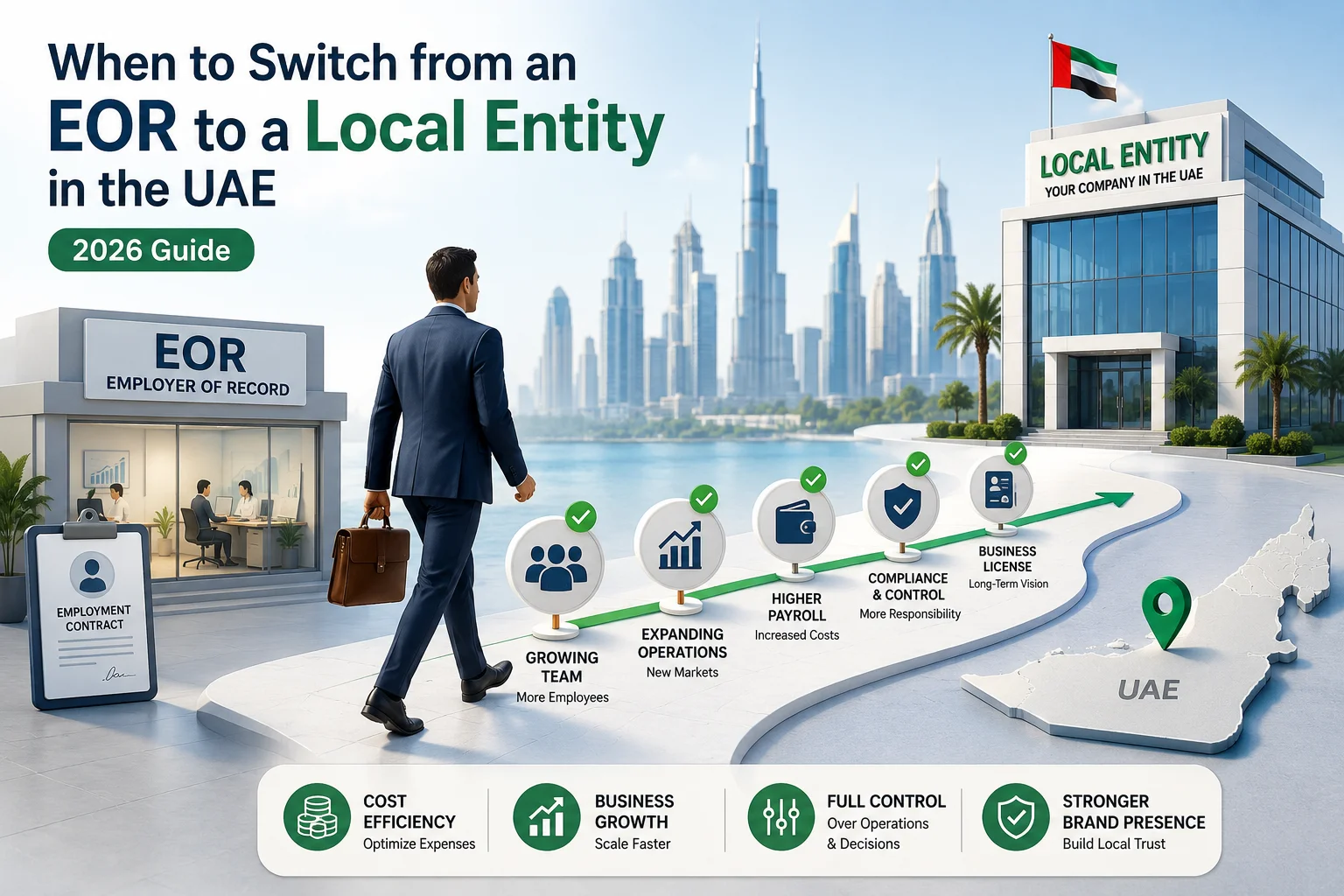
Expanding into the UAE with an Employer of Record is considered a smart way to hire quickly while avoiding the time and cost of establishing a local company.
However, as your workforce grows, you may reconsider creating your own UAE entity. Switching too early or too late can affect your company’s costs, compliance, and operational flexibility.
This guide explains when to transition from an EOR to a local entity in the UAE. In addition, you’ll learn about the signs to watch for, the transfer process, and how to ensure a smooth, compliant transition for your employees.
Author
Co-author
Get in Touch with Us

Leah Maglalang
Business Coordinator UAE

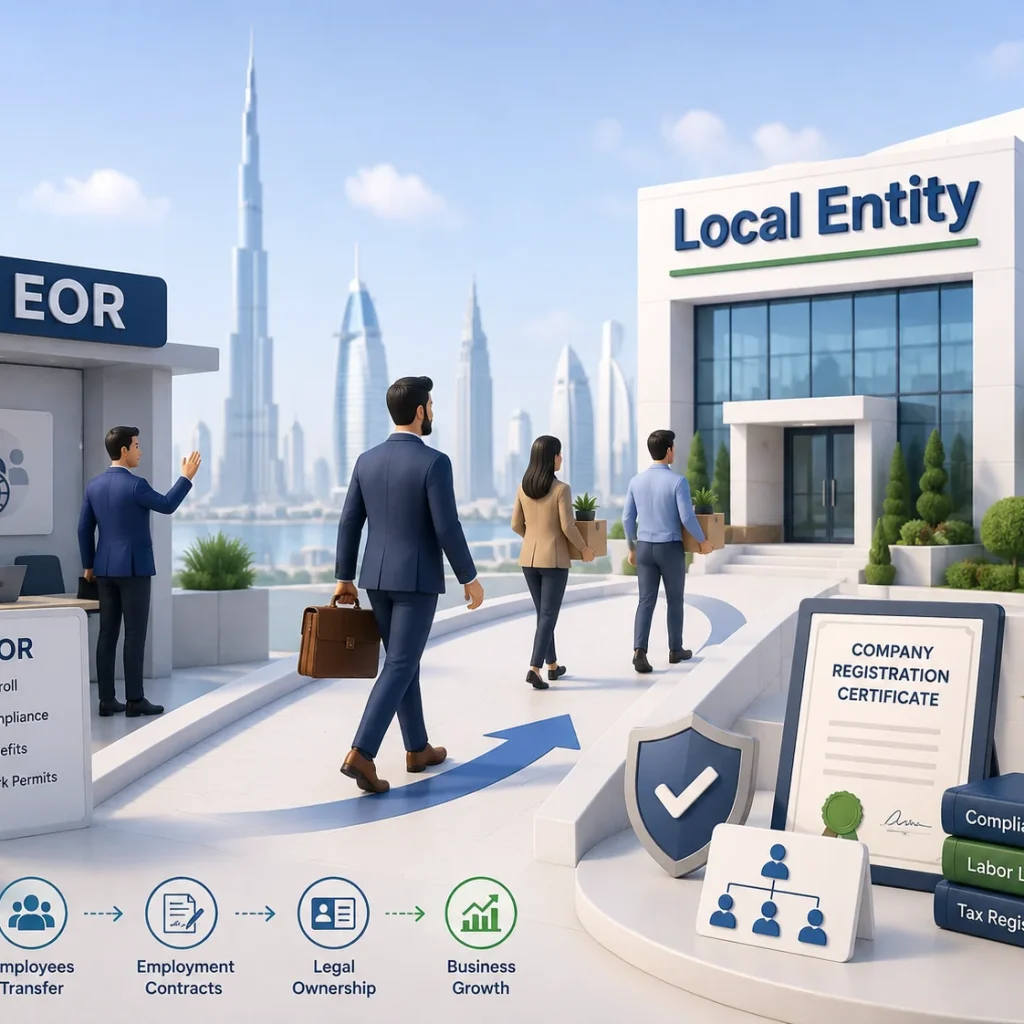
Switching from an EOR to a local UAE entity means your company replaces the EOR as the employee’s legal employer. After the transition is complete, your company becomes directly responsible for complying with UAE employment laws, including managing payroll, employee benefits, administrative tasks, and record-keeping.
That’s why this transition is more than just changing the employment contract. Employees receive new employment agreements under your UAE entity, while payroll, work permits, residence visas (where applicable), health insurance, and other employment records are also transferred.
In simple terms, rather than creating a new workforce, this process moves an existing team from an outsourced employment model to direct employment.


Remember that there is no fixed employee threshold for switching from an Employer of Record to your own UAE entity. Instead, you should evaluate whether your business has reached a stage where direct employment offers greater operational, commercial, or financial advantages.
If you’re hiring consistently instead of filling temporary roles, your business is on track for long-term growth. A stable and predictable workforce justifies investing in your own entity. You should build your own internal HR processes and scale your team.
An EOR helps you expand your team by handling employer obligations. However, if you need to issue invoices, sign commercial agreements, receive customer payments, or conduct local sales under your company’s name, you need to establish your own entity.
Opening an office, warehouse, showroom, manufacturing facility, or regional headquarters signals that you are building your business for the long term in the UAE market. These operations require a locally registered entity.
As your UAE business operations grow, you may need local bank accounts to manage different types of commercial payments. Banks generally require you to have your own entity to open and operate corporate accounts in the UAE.
You may have already heard that having your own local entity gives you more control over employment policies. But what does that really mean?
More control means more flexibility, the flexibility to design compensation structures, bonus schemes, equity or phantom-equity incentive plans, approval workflows, performance policies, and company handbooks. (Note: true equity-based ESOPs are not available to standard mainland LLCs under UAE Companies Law; companies wanting enforceable stock options typically structure them through a DIFC or ADGM entity.)
An EOR is the most cost-effective solution during market entry because it eliminates incorporation and ongoing administrative responsibilities. As your workforce grows, recurring EOR fees per employee may become higher than the cost of establishing and maintaining your own entity. At this stage, creating your own legal entity may become the more economical option.
Some investors, government tenders, procurement processes, and large enterprises prefer or require a locally established UAE entity. Having one can strengthen your commercial credibility and unlock new business opportunities.
The UAE may become your regional hub for serving customers, managing teams, or expanding into neighboring GCC markets. At this stage, if your focus is long-term growth, operational control, and regional expansion, establishing a local entity becomes the logical next step.
Establishing a UAE entity isn’t always the right move.
An Employer of Record remains the better option when speed, flexibility, and a low administrative burden are priorities, especially when entering a new market.
Business Situation | Is an EOR the Better Choice? | Why |
Testing the UAE market | ✅ Yes | Lower risk, no incorporation |
Hiring one or a few employees | ✅ Yes | Fast and cost-effective |
Temporary expansion | ✅ Yes | Easy to scale up or down |
Project-based hiring | ✅ Yes | No long-term entity commitment |
Expanding into multiple countries | ✅ Yes | Faster multi-country hiring |
Uncertain future hiring plans | ✅ Yes | Maximum operational flexibility |
Opening a permanent UAE office or regional headquarters | ❌ No | Local entity required |
Selling directly in the UAE | ❌ No | Commercial license needed |
Building a large, stable workforce | ❌ No | Greater control and scalability |
Meeting investor or enterprise requirements | ❌ No | Stronger commercial credibility |
The table below compares an EOR and a local UAE entity, focusing on the factors that matter most to foreign employers. The right choice between an EOR and a local entity depends on your expansion goals, operational needs, and long-term business strategy.
Feature | Employer of Record (EOR) | Local UAE Entity |
Legal employer | EOR | Your UAE company |
Company formation | Not required | Required |
Employee visas | Managed by EOR | Managed by your company |
Payroll | Processed by EOR | Processed by your company |
WPS compliance | Managed by EOR | Your responsibility |
HR administration | Mostly handled by EOR | Fully managed in-house |
Commercial activities | Not permitted | Fully permitted (with the appropriate license) |
Setup time | Days to weeks | Weeks to months |
Upfront costs | Lower | Higher |
Ongoing costs | Service fees | Entity maintenance, payroll, accounting, audits, and compliance |
Operational flexibility | High | Moderate |
Compliance responsibility | Primarily with the EOR | Primarily with your company |
Corporate bank account | Not available in your company’s name | Available |
Physical office | Usually not required | May be required depending on your license and jurisdiction |
Best suited for | Market entry, testing, and small teams | Long-term operations and business expansion |

I’m providing a decision framework to help you make the right choice. Answer the questions below to determine whether establishing a local UAE entity aligns with your long-term business objectives.
Rule of thumb: If you answer “Yes” to most of these questions, it may be time to establish a UAE entity. If you answer “No” to most of them, an Employer of Record is still the more practical and cost-effective option.

You must have a solid plan for a successful transition. This helps you avoid payroll interruptions, visa issues, and compliance gaps. The exact process may vary depending on whether you’re establishing a Mainland or Free Zone company. The following steps provide a roadmap of what the transition process looks like.
Incorporate your business in the appropriate Mainland or Free Zone jurisdiction. The jurisdiction you choose depends on your operational needs.
Secure the licenses you need to legally conduct your intended commercial activities.
Set up a UAE business bank account to manage payroll, operating expenses, and business transactions.
Register with MOHRE (for Mainland companies, where applicable) and any other relevant authorities. This is essential before employing staff.
Implement a payroll system that meets Wage Protection System (WPS) requirements. This applies to mainland companies and most MOHRE-registered free zone establishments; some free zones (such as DIFC and ADGM) operate their own separate wage protection frameworks, so confirm the applicable system with your free zone authority.
Coordinate with the EOR and the relevant authorities to transfer employees to your new legal entity while maintaining compliance.
Provide employees with new employment contracts under your UAE entity that comply with local employment regulations.
Move employee salaries, health insurance, leave balances, and other employment records to your new HR and payroll systems.
Explain what is changing, what will remain the same, and any actions employees need to take during the transition.
Finalize payroll reconciliation, employee transfers, required documentation, and any outstanding obligations before ending the EOR arrangement.

You need to meet the following requirements to comply with UAE laws and avoid disruptions during the employee transfer process.

In a company’s expansion journey, transitioning from an EOR to your own UAE entity is often the next step. FMC Group provides Employer of Record (EOR) services in the UAE. If you decide to establish your own entity or pursue other business objectives, FMC Group can assist with:
You are currently viewing a placeholder content from Calendly. To access the actual content, click the button below. Please note that doing so will share data with third-party providers.
More InformationYou are currently viewing a placeholder content from Calendly. To access the actual content, click the button below. Please note that doing so will share data with third-party providers.
More InformationYou need to load content from reCAPTCHA to submit the form. Please note that doing so will share data with third-party providers.
More InformationYou are currently viewing a placeholder content from Turnstile. To access the actual content, click the button below. Please note that doing so will share data with third-party providers.
More InformationYou are currently viewing a placeholder content from Vimeo. To access the actual content, click the button below. Please note that doing so will share data with third-party providers.
More InformationYou need to load content from reCAPTCHA to submit the form. Please note that doing so will share data with third-party providers.
More InformationYou are currently viewing a placeholder content from Elfsight. To access the actual content, click the button below. Please note that doing so will share data with third-party providers.
More InformationYou are currently viewing a placeholder content from reCAPTCHA. To access the actual content, click the button below. Please note that doing so will share data with third-party providers.
More Information